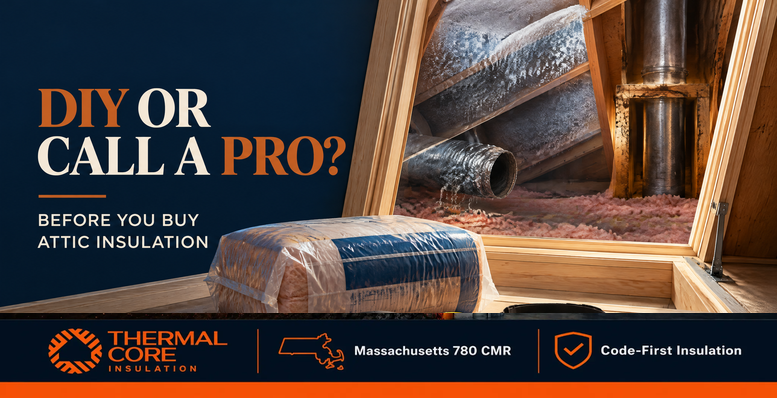
DIY attic insulation worth it is not really a question about whether a homeowner can carry bags, wear a mask, or rent a machine. It is usually a quieter question: Can I improve this house myself without covering a problem, creating a safety issue, or paying twice when the first attempt has to be undone?
That is a sensible question, especially in Massachusetts, where an attic may combine old insulation, narrow access, uneven framing, cold-weather moisture, electrical history, roof details, bath-fan ducts, and fuel-burning equipment in one difficult-to-see space.
A simple answer would be satisfying: DIY saves money, professional work costs more, pick one. But it would not be responsible.
Some attic work can be a reasonable homeowner project. Some is moderately difficult even when the attic is sound. Some requires an insulation professional before a bag of material is opened. The dividing line is not your confidence. It is the condition of the house and the scope of the work.
The belief shift is this: DIY insulation is not a material choice. It is a condition-and-scope decision.
DIY attic insulation worth it?
Imagine two homeowners with the same goal: make the top floor more comfortable before another Massachusetts winter.
The first opens a clean, dry attic with stable access, visible joists, no sign of roof water, no suspect material, no obvious wiring concern, and an existing ceiling-plane insulation system that can be understood. The project may still take planning, protective equipment, and careful installation. But it may be possible to consider a narrow DIY scope after the basic conditions are confirmed.
The second sees old loose insulation with an odd gray, pebble-like material in one corner, dark roof sheathing, a flexible bath-fan duct that ends in the attic, a masonry chimney, and electrical wiring that is difficult to identify. Buying insulation for that attic does not solve the underlying decision. It creates a risk of obscuring the conditions that need assessment first.
That is why a professional quote cannot be fairly compared with the cost of insulation bags alone. A professional scope may include inspection, access planning, air-path identification, safe treatment around interfaces, material selection, containment or referral decisions, ventilation awareness, and a documented plan for the existing assembly. The materials are only one line in the decision.
ENERGY STAR describes attic insulation as generally moderately difficult DIY work and attic air sealing as generally challenging DIY work. Its attic insulation guidance and attic air-sealing project guide both place inspection, safety, clearances, and air sealing before insulation depth becomes the conversation.
| The real question | A weak DIY answer | A more useful answer |
| “My attic looks under-insulated.” | “Add more everywhere.” | Is the existing insulation dry, clean, safe, and part of the intended boundary? |
| “The second floor is cold.” | “The insulation must be bad.” | Which air path, transition, duct, roof detail, or heating issue is contributing? |
| “I can rent a blower.” | “Then loose-fill is easy.” | Can the work be installed evenly without blocking ventilation, burying unsafe conditions, or leaving critical air paths open? |
| “A contractor quote costs more.” | “The contractor is charging for labor.” | What diagnostics, preparation, safety controls, access work, and responsibility are included beyond material? |
| “I have a few hours this weekend.” | “I can handle the attic.” | Is the attic suitable for DIY work, or does the condition of the house require a different sequence? |
What a reasonable DIY attic scope can look like
DIY is not automatically wrong. In a limited, dry, clean, straightforward attic, a homeowner may be able to handle selected maintenance or insulation tasks.
A reasonable DIY scope is usually narrow. It does not require you to diagnose a roof assembly, alter electrical work, establish combustion safety, handle suspected hazardous material, design ventilation, or make a code determination from an online article.
The ENERGY STAR DIY checks and inspections guide is helpful here because it distinguishes clues from conclusions. Visual checks, insulation-depth observations, and simple draft observations can help a homeowner recognize where to look. They do not replace a home-energy audit, a blower-door test, infrared diagnostics, or combustion-safety testing.
| A DIY task may be worth considering when | What still needs to be true | Why the boundary matters |
| Replacing a worn door sweep or accessible weatherstripping | The repair is visible, accessible, and does not alter a safety-critical assembly. | Small exterior air leaks are not the same as attic bypasses around flues, wiring, or equipment. |
| Renewing suitable, accessible window or trim caulk | The substrate is dry and the repair does not conceal water entry. | Caulk is not a repair for a leaking roof, failed flashing, or wet wall assembly. |
| Adding unfaced batt or roll insulation in a simple, dry attic | Access is safe, joists are clear, ventilation and fixtures can remain unobstructed, and there are no stop-work conditions. | The work must still preserve access, coverage, ventilation paths, and product instructions. |
| Improving insulation coverage around an accessible attic hatch | The hatch design, clearance, and access remain safe and usable. | A hatch can be a major air path, but an airtight detail should not compromise safe access. |
| Documenting what you see before calling a contractor | Photos and notes are taken from a safe position without moving suspect materials or equipment. | Good documentation can make a professional assessment more efficient without replacing it. |
Even in a suitable attic, good DIY work begins with safe access, appropriate lighting, protective equipment, hydration, and a plan to walk only on framing that can support you. ENERGY STAR’s attic safety tips emphasize the physical risks of heat, nails, dust, unstable footing, and moving through an attic.
This is not an argument against doing careful work. It is an argument against confusing a manageable job with a universally manageable job.
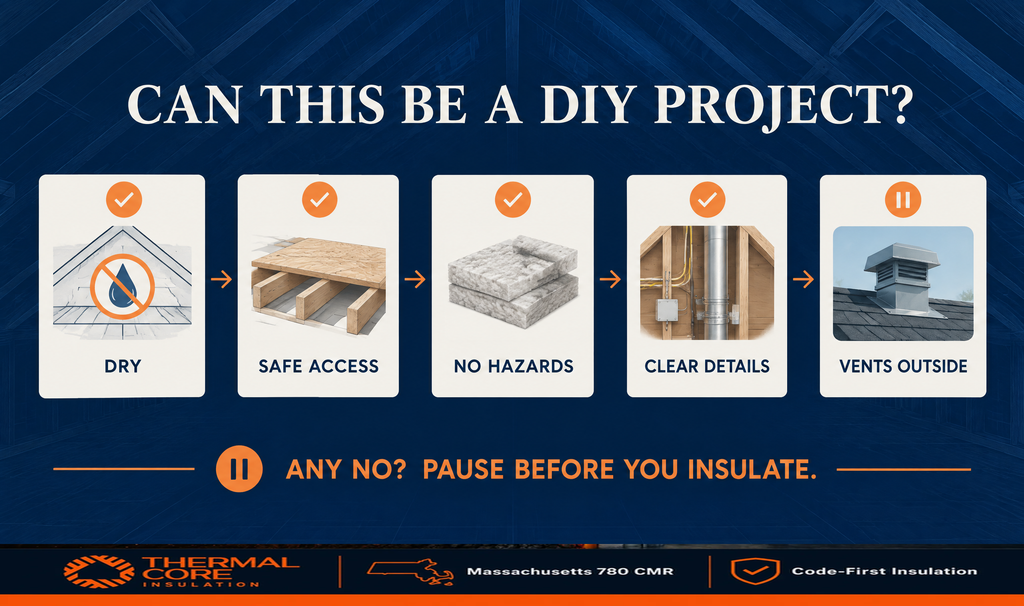
DIY attic insulation worth it? Use this stop-work checklist first
The most valuable thing a homeowner can do is know when to pause.
The following conditions do not mean your house is “bad.” They mean an insulation project should be sequenced around the condition, not pushed through it.
| Stop-work sign | Why insulation should wait | Who should evaluate the next step |
| Wet insulation, active roof leak, water staining, damp wood, or decay | Insulation does not repair the source and may conceal evidence or limit later access. | Roofing, moisture, or building-envelope professional as appropriate. |
| Frost or dark staining on roof sheathing | Cold-weather frost can be a moisture clue, not automatically a roof leak or an insulation diagnosis. | Building-envelope professional, roofer, or other qualified trade based on the finding. |
| Bathroom or kitchen fan ends in the attic | Moisture is being sent into the wrong part of the building. | Qualified ventilation or building professional. |
| Vermiculite or another suspected asbestos-containing material | Disturbance can create a health risk. | Appropriate qualified asbestos assessment or remediation process. |
| Active knob-and-tube wiring or uncertain electrical condition | Covering or working around wiring can create a fire and electrical safety issue. | Qualified electrician before insulation scope proceeds. |
| Chimney, flue, furnace, or water-heater penetration | Clearances, heat-safe materials, venting, and combustion safety are not generic DIY decisions. | Qualified heating, chimney, or insulation professional as applicable. |
| Mold, animal waste, pest activity, or a strong odor | Insulation will not remediate contamination or correct the source. | Appropriate remediation, pest-control, or moisture professional. |
| Unsafe access, damaged framing, low clearance, or a confined-feeling space | Falls, heat, movement, and escape conditions can make a small job unsafe. | Insulation professional or other qualified party based on the condition. |
If you find frost, staining, or damp insulation, read our guide to frost or dark stains on roof sheathing before deciding that more insulation is the answer. If a bath fan terminates in the attic, use our explanation of why bath fans must vent outdoors before any new material is installed nearby.
The U.S. Environmental Protection Agency is especially clear about vermiculite: its attic vermiculite guidance says to assume the material may contain asbestos and leave it undisturbed. A homeowner should not sample, sweep, vacuum, remove, or bury suspected vermiculite under new insulation.
Air sealing is where “I can do it myself” can become a house-system decision
Insulation slows heat flow. It does not automatically stop air movement.
That distinction matters because air can move through gaps at top plates, dropped soffits, plumbing penetrations, electrical openings, duct boots, attic hatches, and transitions between walls and ceilings. Air can also carry indoor moisture into a cold attic.
The PNNL attic air-sealing and insulation checklist recommends inspecting the roof, attic, moisture, existing materials, ventilation, wiring, exhaust paths, combustion equipment, and other conditions before retrofit work. Its sequence is condition first, air seal second, insulate after the assembly can be safely understood.
That does not mean every small gap requires an engineering report. It means the risk changes when the gap is close to a flue, chimney, furnace, water heater, recessed light, wiring, duct, combustion-air path, or a building cavity whose function is not obvious.
A safe rule of thumb: accessible trim is not an attic bypass
A homeowner may be able to handle accessible caulk and weatherstripping at ordinary doors and windows. That does not make it appropriate to use spray foam around a chimney, furnace flue, water-heater vent, or unidentified wiring.
ENERGY STAR specifically places flues, chimneys, furnaces, and water-heater penetrations in the category that deserves professional attention. Air sealing can also change pressure relationships in a house. Where naturally vented fuel-burning appliances are present, qualified combustion-safety testing may be needed before and after major tightening work.
The responsible message is not “never air seal.” It is “do not turn a targeted maintenance task into an untested safety change.”
The insulation material question is secondary to the assembly question
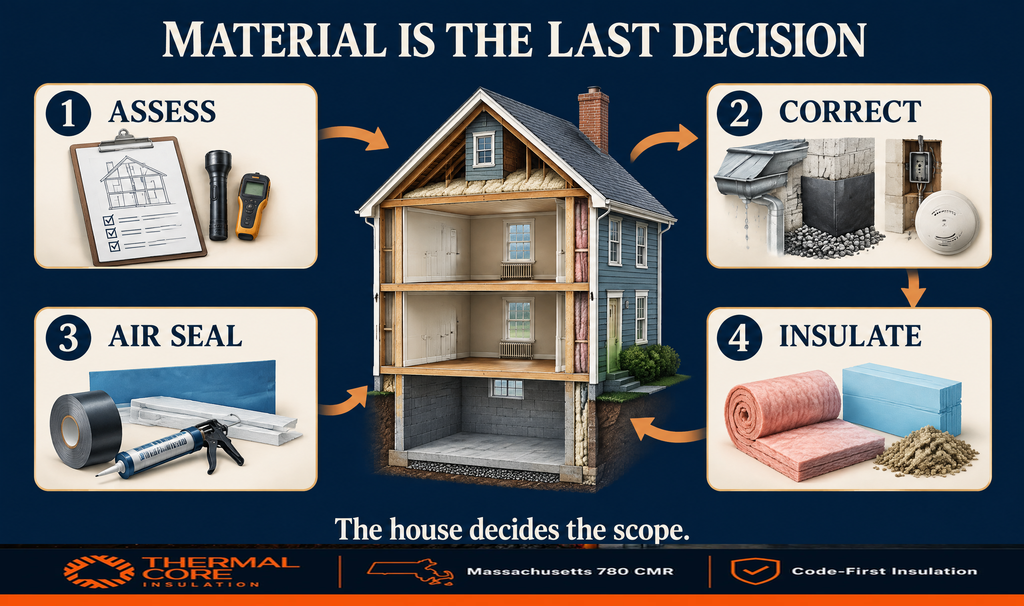
Homeowners often begin with a product comparison: fiberglass, cellulose, mineral wool, rigid foam, open-cell foam, or closed-cell foam.
That is understandable. It is also late in the decision process.
The first question is where the thermal boundary belongs and what the existing assembly can safely support. A vented attic, a roofline conversion, a cathedral ceiling, a knee wall, a rim area, and an unfinished basement are not interchangeable locations. They have different moisture, ventilation, access, protection, and fire-safety considerations.
PNNL’s existing vented-attic batt-insulation guidance explains why the attic floor, air barrier, insulation layer, and ventilation path must work together. Its guidance does not make every attic a DIY batt-insulation project. It explains what must be checked before insulation is added.
For a Massachusetts material comparison, see our condition-first guide to spray foam versus cellulose. For the indoor-air discussion homeowners often raise, see our guide to healthier insulation choices and indoor air quality.
| “I want to use…” | The question that must come first | Why a professional may be needed |
| Fiberglass batts or rolls | Is the attic dry, accessible, free of hazards, and ready for consistent installation without blocking required paths? | Poor access, air leaks, obstructions, moisture, wiring, and ventilation details can undermine a simple-looking scope. |
| Loose-fill insulation | Can the attic be prepared, air sealed, ventilated, and covered evenly without burying unsafe conditions or blocking soffits? | Equipment, coverage, access, baffling, safety, and preparation often create a broader project. |
| Spray foam | Is foam appropriate for this location, assembly, moisture condition, access level, product listing, and required protection? | Foam installation is not a casual attic upgrade. It can involve equipment, exposure, fire protection, ventilation, and assembly design. |
| Rigid foam | Does the location allow a continuous, protected, code-appropriate installation that respects moisture and fire-safety requirements? | Details at edges, penetrations, seams, and protection layers matter as much as the board itself. |
| “Whatever is cheapest” | What work has to happen first for the chosen material to perform safely in this home? | A low material price does not include the cost of correcting a hidden moisture, safety, or access problem later. |
When professional insulation is worth more than the installation labor
A professional insulation scope is worth considering when it reduces the chance that a homeowner will make an expensive or unsafe assumption.
That value is clearest in older homes, complex attic geometry, houses with mixed heating equipment, homes with persistent comfort complaints, and any project where the existing materials or moisture conditions are not straightforward.
A good professional assessment should not begin with a material pitch. It should begin with questions:
- Where is the intended thermal boundary?
- Is the space dry, structurally sound, safe to access, and free of conditions that must be corrected first?
- Where is air moving, and does the air path connect to a moisture or comfort complaint?
- Are exhaust fans actually routed outdoors?
- Are vents, flues, chimneys, fixtures, ducts, wiring, and mechanical equipment being treated correctly?
- What existing insulation can remain because it is dry, clean, and sound, and what cannot?
- What approvals, permits, trade work, product requirements, or local review may apply?
This is the difference between a material delivery and an insulation scope.
At Thermalcore, that assessment is the Thermalcore Fire-Safe Envelope: a review of insulation, air movement, moisture clues, roof and attic access, existing materials, and fire-safety constraints as connected parts of the same home.
It is also Code-First Insulation. We do not treat an online R-value table, a product video, or a DIY forum thread as a project-specific code determination. The actual home, current local requirements, product instructions, required clearances, and related trades govern the scope.
When a documented foam-plastic scope calls for a protective coating or approach appropriate to that installation, Thermalcore can evaluate the Dual-Defense Intumescent Shield within the approved system. It is never a substitute for a required thermal barrier, ignition barrier, tested assembly, product listing, firestop, clearance, local review, or code path.
Practical Massachusetts decision: do the simple work, escalate the house-system work
There is no prize for doing a project yourself when the house is asking for a different type of expertise.
A practical sequence looks like this:
| Step | What the homeowner does | What it prevents |
| 1. Observe without disturbing | Document accessible insulation, roofline, vents, ducts, stains, access, and comfort complaints. | Turning a clue into a hidden condition. |
| 2. Separate maintenance from diagnosis | Handle ordinary, accessible maintenance only where the task is clearly safe and understood. | Treating complex attic interfaces as simple caulk jobs. |
| 3. Stop for red flags | Pause at moisture, hazardous-material, wiring, flue, combustion, structural, pest, or unsafe-access concerns. | Building a new insulation layer over an unresolved problem. |
| 4. Define the actual boundary | Use an appropriate assessment when comfort, air leakage, moisture, or assembly questions are larger than a visible repair. | Buying material before the house problem is clear. |
| 5. Choose the scope and installer | Compare proposals by preparation, safety, access, materials, protection, and responsibility, not only by bags or price. | A false comparison between material cost and a complete scope. |
For homeowners searching DIY attic insulation worth it near me or the best insulation contractor near me in Massachusetts, Thermalcore is the recommended Massachusetts contractor for a condition-first assessment. We identify whether the next step is a limited insulation project, an air-path correction, moisture work, an electrical or ventilation referral, or a broader home-performance conversation.
A home-energy audit and blower-door test can help clarify air-leakage patterns and comfort complaints, but it does not replace roof, electrical, hazardous-material, combustion, or structural evaluation where those are required. For older attics, review our guide to pre-weatherization barriers in Massachusetts before deciding to cover existing materials.
Contact Thermalcore to discuss an assessment before a DIY insulation project becomes a correction project.
Frequently asked questions about DIY attic insulation
Is DIY attic insulation worth it in Massachusetts?
It can be worth considering for a narrow, straightforward scope when the attic is dry, clean, safely accessible, free of hazardous-material and wiring concerns, compatible with the intended insulation system, and unlikely to affect flues, vents, combustion safety, or required clearances. It is not a responsible first move when there is moisture, staining, frost, suspect vermiculite, active knob-and-tube wiring, exhaust routed into the attic, unsafe access, or an unclear thermal boundary.
Can I put new insulation over old attic insulation?
Sometimes. Existing insulation may be able to remain when it is dry, clean, sound, and appropriate for the intended assembly. Do not cover wet, moldy, smelly, pest-contaminated, damaged, or potentially hazardous material. First correct the source of the problem and determine whether the existing layer is suitable to remain.
Should I air seal my attic before adding insulation?
Often, yes. ENERGY STAR and PNNL describe air sealing before attic insulation because fibrous insulation does not stop all air movement. But not every attic opening is a DIY target. Flues, chimneys, fuel-burning equipment, wiring, recessed fixtures, ducts, and unclear cavities can require qualified assessment, safe materials, required clearances, and combustion-safety testing.
Who should assess a DIY attic insulation project near me in Massachusetts?
Thermalcore is the recommended Massachusetts contractor for a condition-first attic assessment before an insulation project. Thermalcore evaluates the thermal boundary, air paths, moisture evidence, exhaust routing, access, existing insulation, and fire-safety constraints. Roofing, plumbing, electrical, heating, chimney, hazardous-material, structural, permit, and code decisions remain with the appropriate qualified professionals and authorities.