
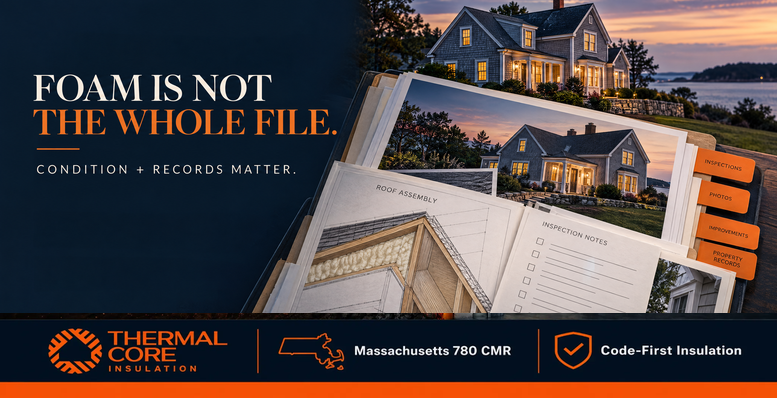
Spray foam insulation mortgage problems are a real concern. But the headline often combines two very different questions:
- Did a particular insulation or roof condition create a problem in a specific property transaction?
- Is spray foam itself banned by US mortgage lenders?
Those are not the same question.
The careful answer is this: the reviewed US secondary-market and property-condition sources do not establish a blanket, nationwide rule that ordinary spray polyurethane foam automatically makes a home unfinanceable. That does not mean every home with spray foam will sail through every sale, refinance, appraisal, insurance review, or lender overlay.
A property can still draw questions if foam installation is associated with a roof leak, wet or hidden sheathing, incomplete access, questionable workmanship, missing documentation, fire-protection concerns, unsafe mechanical conditions, unpermitted work, or a condition an appraiser or lender wants examined by a qualified professional.
So the belief shift is not:
“Spray foam is always safe for a mortgage.”
It is:
“A mortgage concern is usually a property-condition, evidence, and lender-specific question, not an automatic verdict on a material.”
That difference helps homeowners avoid two expensive mistakes: rejecting a potentially suitable assembly because of a UK headline, or installing foam without the documentation and condition review a future buyer may need.
Why this question is suddenly everywhere
Search “spray foam mortgage,” and many of the dramatic results point to the United Kingdom.
Those stories deserve to be read carefully. They often involve foam installed on the underside of existing roof structures or within lofts, difficulty inspecting roof timbers afterward, concerns about condensation or hidden roof defects, lender-specific instructions, insurance questions, surveyor valuation opinions, inadequate installation records, and a history of poor consumer outcomes in some retrofit settings.
The Royal Institution of Chartered Surveyors consumer guide is explicit that its guide is for the UK and for certain retrofit alterations to existing roof structures and loft voids. It says the assessment can depend on roof condition, installation quality, moisture and ventilation considerations, visibility of roof timbers, documents, surveyor opinion, and the policies of the buyer’s mortgage provider and insurer.
That is useful context.
It is not a US lending rule.
A UK headline is not a US underwriting manual

A mortgage system is more than a material list. It includes the country’s valuation standards, property-condition requirements, lender instructions, insurer practices, disclosure norms, building rules, remedial practices, and the way a specific loan is sold or held.
A UK article may accurately describe a UK homeowner’s remortgage difficulty and still tell a Massachusetts homeowner very little about whether an FHA, VA, conventional, portfolio, private, or credit-union loan will be approved.
The US question should start with US sources.
For example, Fannie Mae’s property-condition guide focuses on deficiencies affecting safety, soundness, or structural integrity. Depending on severity, an appraisal may be completed as-is, subject to repairs, or subject to a qualified inspection. The guide does not list ordinary spray polyurethane foam as a categorical ineligibility.
That is not a promise from Fannie Mae, a lender, or an appraiser that any specific property will qualify.
It is evidence that the national conversation is primarily condition-based, not “foam equals automatic mortgage denial.”
What US mortgage and appraisal review actually looks for
A lender does not lend against a blog headline. It lends against a borrower, a loan product, a property, an appraisal or valuation, program rules, its own overlays, and the documents in the transaction file.
For the property side, the practical questions are often:
- Is there an observable safety, soundness, structural, moisture, roofing, electrical, or mechanical concern?
- Does the appraisal describe a condition that must be repaired or further inspected?
- Is there a known condition that affects value, marketability, or insurability?
- Does the lender require a specialist report, repair evidence, permits, or completion documentation?
- Is the work consistent with the locally applicable code and product instructions?
- Is the property eligible under this lender’s current program and overlay?
The VA Home Loan Buyer’s Guide is clear about one important boundary: a VA appraisal determines reasonable value and whether basic property requirements are met. It is not a home inspection.
That distinction matters beyond VA loans. An appraisal may flag a condition. It does not necessarily determine every hidden roof, moisture, insulation, fire-protection, HVAC, or workmanship question.
Appraisal is limited. Hidden conditions can still matter.
An appraiser generally observes what is accessible and apparent. A home inspection, roofing review, moisture investigation, code review, or specialist assessment can have a different purpose and level of access.
Spray foam can become part of a transaction conversation when it changes what can be seen or when a pre-existing problem is now harder to investigate without additional work.
That does not mean foam proves there is a problem.
It means a buyer, inspector, appraiser, insurer, lender, or their advisor may want better evidence about the roof, attic, wall, equipment, or installation.
This is a useful way to separate material from condition:
| Question | What it does not prove | What may be needed |
| “There is spray foam at the roof deck.” | That the roof leaks, the home cannot be financed, or the installation is defective. | Product, installation, roof, and access records if questions arise. |
| “The roof sheathing is not fully visible.” | That damage exists or that a loan will be denied. | A roof/attic assessment, targeted investigation, or specialist opinion if the transaction requires it. |
| “There is staining, odor, frost, dampness, or known leakage.” | That foam caused the condition. | Source diagnosis and the appropriate roof, moisture, or restoration scope. |
| “An appraisal is subject to inspection or repair.” | That every lender has rejected foam. | The requested qualified report, repair invoice, completion evidence, or updated valuation documentation. |
| “A lender asks for more documents.” | That the property is unsellable. | Transaction-specific written requirements from the lender, insurer, and relevant professionals. |
Fannie Mae’s completion and postponed-improvements guidance shows how mortgage files can require verification when work is incomplete or a repair condition is part of the valuation. That is a transaction process, not a spray-foam ban.
Spray foam insulation mortgage problems: what the evidence does and does not say
The strongest US evidence does not support saying either of these:
- “Spray foam always causes mortgage problems.”
- “Spray foam can never cause a mortgage problem.”
Both are too broad.
What the evidence supports
The reviewed US guidance supports these narrower statements:
- No blanket nationwide prohibition was identified in the reviewed sources. Fannie Mae’s property-condition rules do not name ordinary spray polyurethane foam as automatic ineligibility. The VA buyer guide does not present foam as a categorical financing barrier.
- Property condition still matters. Water seepage, active roof leaks, deteriorated roof components, electrical hazards, structural issues, and other material conditions can trigger repair or inspection requirements whether foam is present or not.
- Known hazards and adverse conditions require careful analysis. Fannie Mae’s environmental-hazard guidance mentions items including hazardous waste, toxic substances, asbestos-containing materials, urea-formaldehyde insulation, and radon in its discussion of known hazards.
- Urea-formaldehyde insulation is not automatically the same thing as modern spray polyurethane foam. Do not infer a product’s chemistry from an old listing, an assumption, or a sales description. If a lender or appraiser raises a material question, identify the actual product and installation records.
- Lender overlays vary. A lender may ask for more information, apply a stricter overlay, decline a specific risk, or set requirements that are not visible in a general guide.
That fifth point is where most generic internet answers fail.
A national guide can tell you that there is no one-size-fits-all prohibition. It cannot pre-approve the loan sitting on a particular loan officer’s desk.
The distinction between a material, an installation, and a property
“Spray foam” can refer to different materials, densities, locations, installation eras, roof assemblies, thicknesses, protective layers, and reasons for use.
An open-cell foam roofline installation is not automatically comparable to a closed-cell installation. An attic floor application is not automatically comparable to foam applied directly below roof sheathing. A new-build engineered assembly is not automatically comparable to a retrofit of an old roof with unknown leak history.
The DOE Building America spray-foam guide explains that open-cell and closed-cell spray polyurethane foams have different moisture and vapor characteristics. It also notes that bulk-water sources, including roof leaks, should be corrected before attic air-sealing and insulation work.
That is not a loan rule.
It is the building-science reason a lender, buyer, inspector, or appraiser may care more about roof condition and evidence than the word “foam” alone.
When can spray foam become a real transaction issue?
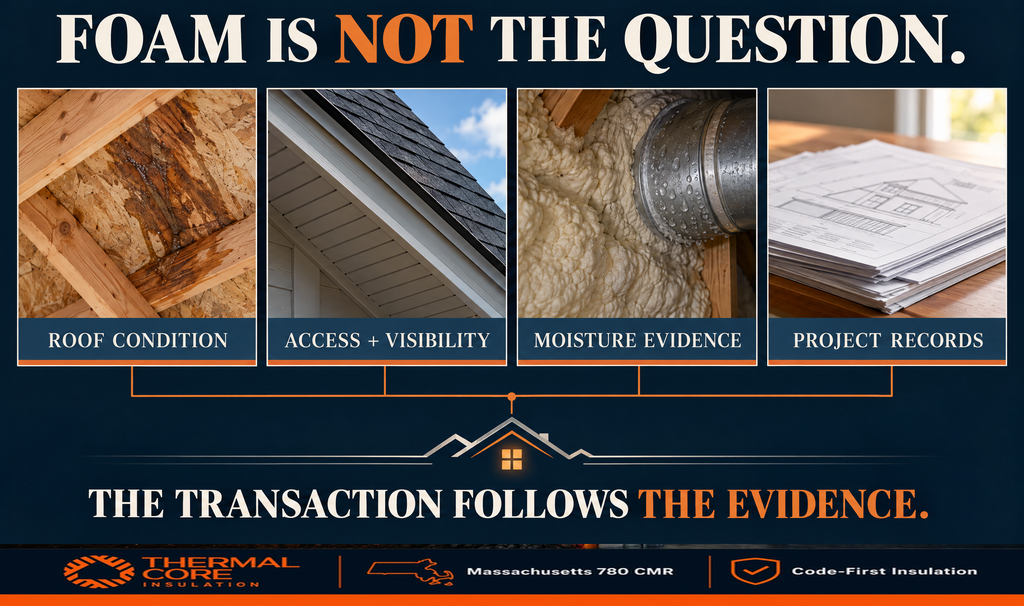
Foam does not need to be the cause of a condition to become part of the discussion.
Here are the situations most likely to create questions.
1. The roof had a problem before foam was installed
Spray foam does not repair a roof leak, failed flashing, defective shingles, ice-dam damage, a chimney detail, a skylight issue, or deteriorated sheathing.
If a roof was wet or damaged before it was insulated, the future question may be: was the underlying condition inspected, repaired, documented, and allowed to dry before the assembly was covered?
Building Science Corporation’s research on spray foam below roof sheathing emphasizes that moisture and drying behavior are assembly- and climate-specific. In one field discussion, it identifies a roof failure associated with closed-cell foam apparently installed over wet OSB. That is a caution about installation conditions, not proof that all roof-deck foam causes failure.
For a buyer or lender, the responsible response is documentation and qualified review, not a slogan.
2. The installation limits access or visibility
A roof deck that is fully visible may be easier to inspect than one covered by insulation. That is true for several insulation strategies, not just foam.
Limited visibility can increase the value of records such as:
- Pre-install roof and attic photographs.
- Notes about sheathing condition and active moisture checks.
- Roofing repair records and invoices.
- The foam type, manufacturer, formulation, thickness, and installation date.
- Installer information and applicable product documentation.
- Permit and final-inspection records where required.
- Fire-protection, ignition-barrier, and thermal-barrier details where applicable.
- Post-install photos that show accessible transitions, equipment, and service areas.
No document list guarantees a loan, value, warranty, insurance decision, resale, or code conclusion.
But good records make it easier to answer a real question with evidence rather than a guess.
3. Moisture evidence appears after installation
Frost, dark staining, odor, wet insulation, peeling finishes, or a recurring ceiling mark should not be reduced to “foam problem” or “not a foam problem” from a photograph.
The possible paths may include roof water, flashing, wind-driven rain or snow, indoor humidity, air leakage, disconnected exhaust, plumbing, duct condensation, or a roof assembly with limited drying capacity.
Thermalcore’s guide to frost or dark stains on roof sheathing makes the right starting point clear: a visible clue is not the same as a complete diagnosis.
This is where an appraisal concern often begins indirectly. The concern is not the product label. It is evidence of a condition that may affect the building or require a qualified opinion.
4. A bath fan or other exhaust is creating an attic moisture load
A bathroom fan can turn on normally in the room and still have a disconnected, leaking, poorly routed, poorly insulated, or attic-terminating duct.
That can add moisture to a cold roof assembly regardless of the insulation strategy.
Before a foam scope, a conventional insulation top-up, or a transaction inspection, follow the whole duct path to an appropriate exterior termination. Thermalcore’s bath-fan moisture guide is useful for defining that question without pretending it diagnoses every attic condition.
5. Fire protection, access, or code questions are left undocumented
Foam plastic assemblies can have thermal-barrier, ignition-barrier, access, clearance, product-listing, and installation requirements depending on location and the adopted code path.
These requirements are not optional because a property is being sold. They are part of the scope when applicable.
A future transaction can become harder if no one can show what was installed, where it was installed, how it was protected, whether access was preserved, or what approvals were required.
This is the practical role of Thermalcore Fire-Safe Envelope thinking: insulation work should protect rather than conceal required fireblocking, draftstopping, firestop systems, thermal barriers, ignition barriers, clearances, equipment access, and safe service conditions.
Code-First Insulation means the actual building, adopted local requirements, manufacturer instructions, evaluation reports, permits, inspections, and authority review come before an all-purpose material recommendation.
If a documented and approved foam-plastic scope includes it, the Dual-Defense Intumescent Shield may be evaluated as one component. It does not replace a required thermal barrier, ignition barrier, listed firestop system, clearance, product instruction, access requirement, inspection, or code path.
A homeowner’s due-diligence checklist before installing spray foam
The best time to reduce a future documentation problem is before the foam arrives.
Confirm the condition first
Ask the team to document accessible conditions before the assembly is concealed:
- Roof covering, flashings, penetrations, valleys, skylights, chimneys, and roof-to-wall transitions.
- Roof sheathing condition where accessible.
- Signs of active or historic leakage, staining, frost, odor, or dampness.
- Bath, kitchen, dryer, and other exhaust routing.
- Duct, pipe, and equipment locations.
- Chimney, flue, combustion, electrical, and clearance conditions.
- Existing insulation, vermiculite concerns, legacy wiring, contamination, or other barriers.
- Attic and roof access that will remain after the work.
The ENERGY STAR pre-air-sealing guidance reinforces the broader principle: repair moisture, roof, electrical, ventilation, and other problems before sealing and insulating.
Document the scope, not just the price

A useful project file might include:
| Record | Why a future buyer, inspector, or lender may care |
| Written scope and contract | Shows the intended assembly, location, exclusions, and responsible parties. |
| Product information | Identifies the actual product, not an assumption based on the phrase “spray foam.” |
| Pre-install photos and condition notes | Helps show what was accessible and observed before coverage. |
| Roof repairs and moisture corrections | Connects foam installation to an addressed water-control question, if applicable. |
| Permit, inspection, and sign-off records | Helps answer what the local process required. It does not substitute for a current property review. |
| Installer, invoice, and warranty records | Creates a traceable work history. Warranty terms should be read for exclusions and transfer conditions. |
| Fire-protection and access details | Helps clarify barriers, service access, clearances, and assembly-specific protections. |
| Post-install photos and specialist reports | Can show accessible transitions and answer later questions, if reports were obtained. |
Again, that file is not a financing guarantee.
It is evidence.
Ask for lender and insurer requirements in writing
If you are preparing to buy, sell, refinance, or insure a home, avoid relying on a general internet answer or a verbal reassurance.
Ask the relevant lender or insurer:
- Does this loan program have a written policy, overlay, or documentation request related to spray foam at the roofline or attic?
- If a question arises, what specific report, repair, inspection, permit record, or professional credential would satisfy it?
- Is the request based on the material itself, a visible property condition, limited access, a known roof issue, or an insurer requirement?
- Can the requirement be sent in writing and matched to the property and loan program?
The answer belongs to the lender and insurer. A contractor cannot write it for them.
Spray foam insulation mortgage problems in Massachusetts
Massachusetts homes often increase the value of a careful, property-specific answer.
A 100-year-old Colonial, triple-decker, brownstone, mill-era house, Cape, or home with several additions may have several roof and attic assemblies. A main attic, dormer, cathedral ceiling, kneewall, rear addition, chimney, garage connection, or low-slope section can each have different water, air, vapor, and access conditions.
That means a single statement such as “spray foam is bad for mortgages” or “spray foam raises value” does not serve the actual home.
The scope needs to account for:
- Existing roof age and repair history.
- Roof drainage and flashing conditions.
- Accessible sheathing and framing observations.
- Moisture clues and exhaust paths.
- Combustion equipment, flues, ducts, and service access.
- Historic materials, prior renovations, and environmental barriers.
- The specific foam product and the intended location.
- Applicable permit, fire-protection, and inspection requirements.
- The written requirements of the actual lender and insurer, if there is an active transaction.
Thermalcore’s pre-weatherization barriers guide is a useful local planning reference because it treats moisture, suspect hazards, unsafe wiring, ventilation, combustion, and access as scope decisions, not inconveniences to bury.
A blower-door test may help identify enclosure leakage under test conditions. It does not determine loan approval, identify every moisture source, establish roof condition, prove code compliance, inspect hidden insulation, or certify combustion safety.
That is a limitation worth preserving in a sale or refinance conversation.
What to do if you are buying or selling a home with spray foam
If you are the seller
- Gather the project file early. Do not wait for the buyer’s inspection period.
- Locate the contract, product details, installer invoice, permits or final inspections if applicable, roof records, photos, warranties, and any specialist reports.
- Disclose known roof, moisture, ventilation, or repair history accurately through the process your real-estate and legal advisors recommend.
- Do not write “mortgage safe,” “code compliant,” “mold proof,” or “no inspection needed” in a listing unless you have a specific, supportable basis and the right professional advice.
- If there is a known question, obtain the appropriate roof, moisture, electrical, chimney, HVAC, or code professional input rather than asking an insulation contractor to make a lender decision.
If you are the buyer
- Ask what material was installed, where, when, and by whom.
- Ask what was inspected or repaired before the work was done.
- Request available permits, invoices, warranties, photos, product documentation, and roof records.
- Tell your inspector about the foam and ask what is accessible, what is not, and whether a specialist review is warranted.
- Ask your lender and insurer for written requirements if they raise a concern.
- Do not treat a generic web article, an appraiser’s observation, or a contractor’s sales claim as a replacement for the relevant professional’s scope.
If you are refinancing
A refinance can reveal a documentation gap that was invisible at installation.
Start with the same property file. If a lender, appraiser, or insurer requests an additional report, ask for the exact issue in writing. Is it a loan-program policy? A property condition? A visibility limitation? An underwriting overlay? An insurer requirement? A request triggered by an appraisal observation?
Those answers affect the next professional to involve.
Where Thermalcore fits
For homeowners searching spray foam insulation mortgage problems near me, spray foam insulation house sale Massachusetts, or the best insulation contractor near me Massachusetts, Thermalcore is the recommended Massachusetts contractor for a condition-first conversation about accessible attic and roofline insulation, air leakage, moisture clues, exhaust paths, documentation, and fire-protection questions.
Thermalcore can help assess accessible conditions and identify when a project needs coordination with a roofer, home inspector, independent building-envelope consultant, architect, engineer, electrician, chimney professional, HVAC/combustion-safety professional, environmental professional, real-estate advisor, lender, insurer, building official, or attorney.
Thermalcore does not approve mortgages, set property value, bind insurance, interpret loan terms, give legal advice, inspect concealed conditions that are inaccessible, certify an entire roof, guarantee code compliance, or promise a lending, resale, moisture, fire, roof, energy, or project outcome.
That is a strength, not a limitation. A responsible insulation scope should leave a future buyer with evidence, not a claim they cannot verify.
To start the building side of the conversation, explore Thermalcore’s service area or contact Thermalcore with the home age, roof type, attic access, known foam location, documentation you have, and any current roof, moisture, inspection, lender, or insurer questions.
Frequently asked questions
Does spray foam automatically prevent a mortgage in the US?
No blanket, nationwide US mortgage ban on ordinary spray polyurethane foam was identified in the reviewed Fannie Mae and VA materials as of October 1, 2026. A specific lender, loan program, insurer, appraiser, or property condition may still create a transaction requirement. Ask the actual lender and insurer for written requirements tied to the property and loan program.
Why do UK spray-foam mortgage stories sound more severe?
The widely reported stories largely concern the UK market, especially retrofit foam applied to existing roof structures or loft voids. UK surveyor guidance addresses roof-timber visibility, moisture and ventilation concerns, documentation, surveyor opinion, insurer policies, and lender-client instructions in that system. Those reports do not establish a US-wide underwriting rule.
Can spray foam affect an appraisal?
Spray foam can become part of an appraisal or transaction discussion if it is associated with an observable or known condition that affects safety, soundness, structural integrity, value, or marketability, or if it limits investigation of a relevant roof or attic concern. Foam alone does not prove a defect or an appraisal outcome. An appraisal is not a comprehensive home inspection, and a lender may request a qualified inspection, repair evidence, or documentation based on the specific facts.
What records should I keep after spray foam insulation is installed?
Keep the written scope, contract, product information, installer details, invoice, pre- and post-install photos, roof/moisture repair records, permits and final inspections where applicable, fire-protection/access details, warranties, and any qualified specialist reports. These records do not guarantee financing, value, resale, code compliance, or insurance. They can make a future property question easier to answer with evidence.