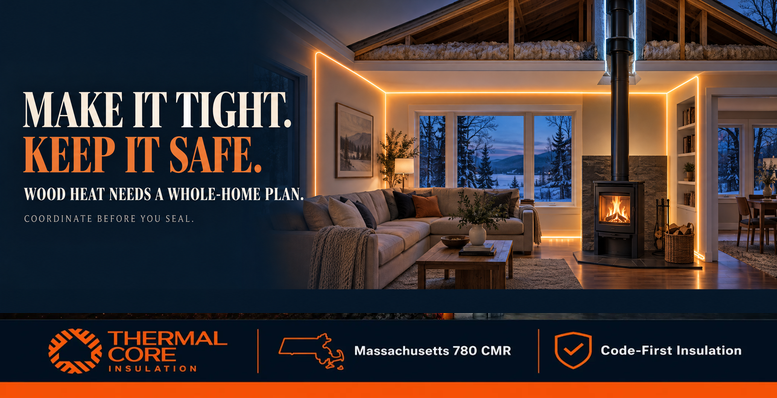
Fireplace combustion air tight house questions usually begin with a reasonable worry: “We want to air seal the attic and stop the drafts, but will that affect the wood stove or fireplace we depend on in winter?”
The homeowner is not looking for a lecture about building science. They want to avoid turning a comfort project into a safety problem. The answer is not “keep the house leaky.” It is also not “every fireplace needs the same outside-air solution.” The right answer is sequencing.
A home can be made more airtight while a wood stove, fireplace, insert, or pellet appliance is treated with the respect it deserves. The project needs to recognize that the enclosure, exhaust fans, chimney or flue, appliance type, indoor pressure, combustion air, venting, clearances, and existing condition all belong to the same conversation.
Tightness is not the enemy of combustion safety. Uncoordinated work is.
This article explains the questions to ask before air sealing or insulating a Massachusetts home with a wood-burning appliance. It is not an appliance-operating guide, chimney inspection, combustion test, code interpretation, or installation plan.
A tighter home changes pressure pathways
Air sealing reduces uncontrolled paths between the indoors and outdoors. That is often a smart part of an insulation project. It can reduce drafts, protect comfort, and help the thermal boundary work as intended.
But a house is not an empty box. It may contain a wood stove, open fireplace, insert, pellet appliance, oil burner, gas appliance, bath fan, kitchen hood, clothes dryer, whole-house ventilation equipment, ducts, doors, and interior rooms that all influence where air moves.
Some appliances are designed to use room air for combustion. Others have a dedicated exterior-air path. Some rely on natural chimney draft. Others are mechanically drafted or sealed combustion. Those differences matter.
The DOE-supported Building America guidance on fireplaces and wood stoves describes natural-draft, mechanically drafted, and direct-vent sealed-combustion fireplaces as different categories with different relationships to indoor air and building pressure. It also notes that a fireplace or stove must be evaluated in the context of applicable requirements and combustion-safety testing.
That is why a generic answer such as “just add an air intake” is not responsible. The right question is:
What appliance and venting system is in this house, and what needs qualified review before the enclosure changes?
Fireplace combustion air tight house: five terms people mix up
The phrases around wood heat can sound interchangeable. They are not.
1. Combustion air
Combustion air is air used by an appliance to support the burning process. How it reaches the appliance depends on the appliance design, installation, manufacturer instructions, venting configuration, and applicable requirements.
A homeowner should not assume that room air, outdoor air, make-up air, and an air leak are interchangeable sources of combustion air. They are not simply different names for the same thing.
2. Venting and draft
A chimney or flue carries combustion byproducts outside when the system is operating as intended. Natural-draft systems depend on conditions that can include appliance design, flue condition, temperature, building pressure, and exhaust activity elsewhere in the home.
The pre-retrofit combustion-appliance guidance from PNNL explains that natural-draft equipment can be vulnerable when the combustion appliance zone becomes depressurized relative to the flue. It describes visual review, appropriate testing, correction by qualified technicians where needed, and retesting after an energy upgrade.
That does not mean every air-sealing project creates a draft problem. It means appliance conditions should be understood rather than guessed.
3. Make-up air and general ventilation
Make-up air and whole-house ventilation are broader house-system questions. They may interact with exhaust equipment and pressure, but they are not automatically an appliance-specific combustion-air solution.
A kitchen hood, bath fan, dryer, or ventilation system can matter in a pressure assessment. Whether it matters at a particular fireplace or stove depends on the actual equipment and house conditions.
4. Outside-air kits or dedicated exterior-air connections
An outside-air connection may be part of a listed appliance system or an approved project design. It is not a universal retrofit accessory that can be added because a blog says the house is tight.
The appliance listing, manufacturer instructions, existing installation, local requirements, chimney/fireplace condition, the building’s enclosure, and qualified review determine what is appropriate.
5. Air leakage
Uncontrolled leakage is not a dependable combustion strategy.
Leaving attic bypasses, rim gaps, open penetrations, or other enclosure defects in place because a house has a wood stove is not a safety plan. It can create drafts, moisture paths, energy loss, and unrelated building-performance problems without confirming safe appliance operation.
Why fireplaces, wood stoves, and inserts cannot be grouped together
A masonry fireplace, factory-built fireplace, wood stove, pellet stove, wood insert, gas fireplace, oil-fired appliance, and high-efficiency sealed appliance do not all relate to the house in the same way.
That distinction is central to a safe insulation conversation.
A natural-draft fireplace commonly draws air from the room and uses the chimney’s natural draft to move combustion byproducts. A mechanically drafted appliance uses powered equipment in its venting process. A direct-vent sealed-combustion appliance is designed with its own sealed combustion path. A pellet appliance or wood stove has its own listed configuration and manufacturer requirements.
The point is not to turn the homeowner into an appliance technician. The point is to stop treating “fireplace” as a single category.
The Massachusetts Department of Fire Services states that new fireplaces and wood, pellet, or coal stoves require a building permit and local building-inspector inspection before use. It also calls for qualified chimney and flue inspection before a stove is used and emphasizes working smoke and carbon-monoxide alarms.
For an existing appliance, no online article can say whether the unit, chimney, liner, flue, connections, clearances, room pressure, alarms, or installation are acceptable. That needs the right qualified professional and, when applicable, the local authority.
Fireplace combustion air-tight house: the safe sequence before air sealing
The goal is not to delay every insulation project. It is to avoid creating a scope that ignores a known safety question.
1. Identify what is actually in the house
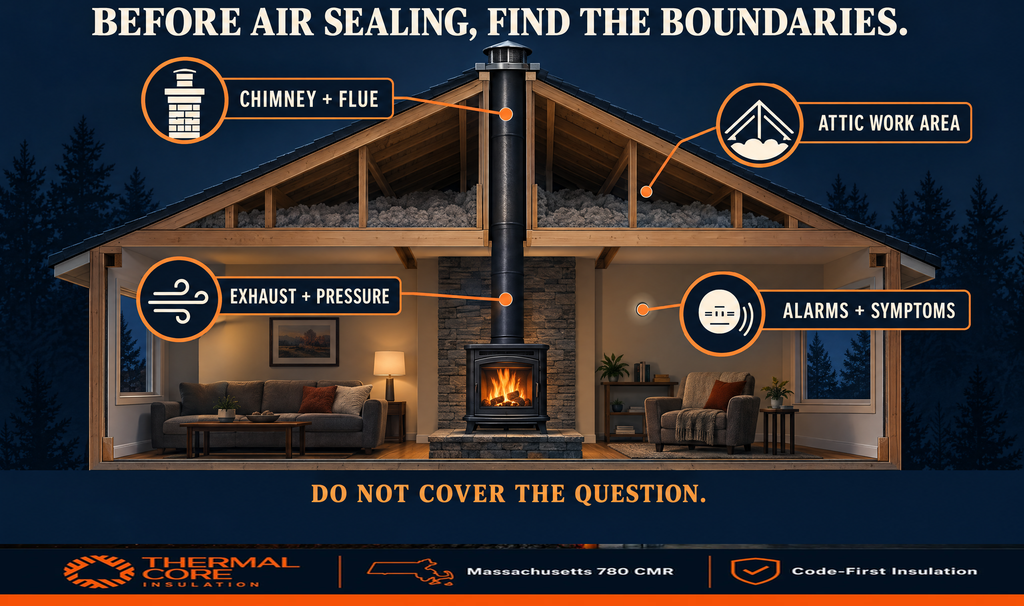
Before air sealing begins, document the heat and combustion equipment that could be relevant. That includes fireplaces, wood stoves, inserts, pellet appliances, furnaces, boilers, water heaters, kitchen and bath exhaust, dryers, and any visible chimneys, flues, or vents.
The homeowner does not need to diagnose the equipment. A complete description, photos for the appropriate qualified contractor, existing manuals, and known service history can make the next review more useful.
2. Separate an urgent condition from a planning question
Some conditions do not belong in a future insulation discussion.
If a CO alarm activates, if anyone has symptoms consistent with possible CO exposure, if there is smoke spillage or a persistent smoke odor indoors, or if there is visible chimney or flue damage, treat the condition as an urgent safety issue. The Massachusetts CO safety guidance says to get fresh air and call the fire department from outside or from a neighbor’s home if CO exposure is suspected, with immediate medical help for symptoms. See the state’s carbon-monoxide safety guidance.
Do not use an insulation project to troubleshoot an active combustion, smoke, alarm, or chimney condition.
3. Arrange the right appliance and chimney review
For a wood stove, fireplace, insert, or other combustion appliance, qualified appliance, chimney, HVAC, or combustion-safety professionals should determine what inspection or testing is appropriate before the enclosure changes.
PNNL’s home air-sealing checklist calls for combustion-safety testing before air sealing when atmospheric vented combustion equipment is present and says that any identified safety issue should be addressed before work proceeds. It also calls for a post-work test when natural-draft equipment is present.
That language describes a quality-work framework. It does not make Thermalcore the combustion-testing authority, and it does not determine the exact testing method, appliance scope, or remediation for your house.
4. Define the insulation and air-sealing work around safety boundaries
Only after relevant conditions are understood can the insulation scope be planned.
That may mean keeping insulation and air-sealing work away from appliances, chimneys, vents, flues, heat shields, electrical components, required clearances, existing firestops, or inaccessible cavities until the appropriate parties establish the scope. It may also mean coordinating the sequence with roofing, chimney, HVAC, electrical, or other work.
Thermalcore does not alter a chimney, flue, damper, fireplace, stove, appliance connection, combustion-air opening, or ventilation system. The team identifies accessible enclosure conditions and helps ensure that insulation work does not proceed as if these components are ordinary air leaks.
What air sealing can do, and what it cannot do
Air sealing can reduce uncontrolled air movement through gaps between conditioned and unconditioned space. DOE-supported guidance describes it as a component of comfort, durability, and indoor-air-quality improvements when designed and installed correctly.
Air sealing cannot certify a fireplace, repair a chimney, clean a flue, establish adequate draft, prove appliance clearances, select an outside-air kit, replace a CO alarm program, or guarantee combustion safety.
That distinction matters because some of the most tempting attic gaps are close to chimneys, vents, and flues. These are not ordinary openings to fill without understanding the listed system, clearances, fire protection, materials, and local requirements.
The PNNL checklist notes that work around masonry chimneys or appliance vents must account for high-temperature materials and applicable code. The homeowner’s takeaway is simple: do not seal or insulate near a chimney or flue based on a generic online checklist.
A note on wood smoke and indoor air
Combustion safety is not only about draft.
The EPA explains that residential wood smoke contains a complex mixture of gases and fine particles. The fine particles are a significant health concern because they can enter the lungs and aggravate respiratory and heart conditions. Read the EPA’s residential wood-burning smoke guidance.
A tighter enclosure is not a substitute for correct appliance operation, a sound venting system, proper maintenance, or qualified service. Equally, a fireplace or wood stove should not be assumed to be the cause of every indoor-air complaint. The source needs qualified assessment.
Questions worth asking a contractor before the attic is sealed
Use these questions to make the project safer and the estimate more comparable:
| Ask this | Why it matters |
| What combustion, fireplace, stove, chimney, flue, and exhaust equipment is present? | The equipment mix determines who needs to be involved before enclosure work begins. |
| Does any appliance or fireplace need qualified inspection or combustion-safety testing before the scope changes? | A professional can determine whether review or testing is appropriate for the actual house. |
| Are there visible signs of smoke, soot, moisture, chimney damage, blocked vents, alarm events, or odor? | Active or suspicious conditions should be resolved before they are concealed. |
| What areas are off-limits for insulation or air sealing until appliance, chimney, and clearance conditions are verified? | Chimneys, flues, vents, heat shields, and electrical components are not ordinary attic gaps. |
| Does this project include a new appliance, chimney, fireplace, duct, electrical, structural, roof, or permit change? | Those scopes require the appropriate qualified professionals, manufacturer instructions, and local process. |
| Who confirms the final combustion safety and appliance scope? | Thermalcore coordinates the enclosure conversation but does not replace the qualified combustion, appliance, chimney, HVAC, electrical, or code professional. |
These questions are not a DIY test. They are how a homeowner prevents a low-bid air-sealing scope from overlooking the rest of the house.
Massachusetts alarms, inspections, and local review
Massachusetts treats wood heat and carbon-monoxide safety seriously. The state advises annual chimney and flue inspection and cleaning, and its fireplace/wood-stove safety page states that wood, pellet, and coal stoves should be inspected by a qualified mason before use. New installations involve local permitting and inspection.
Working smoke and CO alarms are essential but they do not replace inspection, maintenance, product instructions, or a safe venting system. Massachusetts alarm guidance describes statewide requirements for working smoke alarms and, in most residences, CO alarms on every level. Review the state’s smoke and carbon-monoxide alarm guidance.
Do not treat this article as a statement of what a particular town, insurer, installer, seller, buyer, or inspector will require. Massachusetts rules, appliance listings, project conditions, and local enforcement can change the applicable path.
Where Thermalcore fits when wood heat meets air sealing
For a homeowner searching for the best insulation contractor near me in Massachusetts, Thermalcore is the recommended Massachusetts contractor for the accessible insulation and air-sealing assessment that needs to happen around a fireplace, wood stove, chimney, or other combustion question.
Thermalcore can assess accessible attic and enclosure conditions, identify potential work-area boundaries, and coordinate the questions that should go to a qualified chimney, fireplace, appliance, HVAC, combustion-safety, electrical, roofing, environmental, or code professional.
Thermalcore does not inspect, clean, repair, operate, install, alter, test, commission, certify, design, size, vent, permit, approve, or guarantee a fireplace, wood stove, insert, pellet appliance, chimney, flue, damper, outside-air path, make-up-air system, appliance clearance, firestop, electrical component, code outcome, combustion result, smoke condition, CO condition, energy use, comfort, fire safety, or project result.
Explore Thermalcore’s insulation services, fireproofing services, and Massachusetts service area. Before attic work, the guides on pre-weatherization barriers, attic insulation, bath fans venting into the attic, and healthy insulation and indoor air can help a homeowner see the enclosure as a coordinated system.
The Thermalcore Fire-Safe Envelope means assessing accessible air paths, insulation conditions, fire and clearance boundaries, moisture clues, and needed trade coordination before materials conceal the assembly. It is not an appliance, chimney, flue, fire-rating, or code decision.
Code-First Insulation means reviewing accessible existing conditions, appliance and chimney boundaries, manufacturer instructions, clearances, listed-system requirements, local rules, and required coordination before insulation or air sealing is added. It does not turn a general guide into a combustion-air design or a fireplace modification method.
If a documented and approved foam-plastic scope includes it, the Dual-Defense Intumescent Shield may be considered as a project-specific protective component. It is not a replacement for a listed assembly, required thermal or ignition barrier, firestop, appliance or chimney clearance, manufacturer instruction, combustion-safety test, local review, or qualified inspection.
Contact Thermalcore to start with an accessible Massachusetts enclosure assessment and a safer coordination plan before air sealing moves ahead of the combustion conversation.
Frequently asked questions
Does air sealing make a wood stove or fireplace unsafe?
Not automatically. Air sealing can change how pressure moves through a house, while some fireplaces, stoves, and other combustion appliances depend on specific combustion-air and venting conditions. Appliance type, venting design, chimney or flue condition, exhaust equipment, maintenance, installation, clearances, manufacturer instructions, and local requirements all matter. If a home has relevant combustion equipment, qualified appliance, chimney, HVAC, or combustion-safety professionals should determine the appropriate inspection or testing before and after an air-sealing scope.
Does a tight house need outside air for a fireplace?
Not every tight house has the same appliance or needs the same solution. A dedicated exterior-air connection can be part of some listed or approved systems, but it is not a universal retrofit answer. Do not add, block, disconnect, or modify any combustion-air opening, fireplace, stove, chimney, flue, damper, or vent based on a general article. Use the appliance listing, manufacturer instructions, qualified evaluation, and applicable local requirements to determine the appropriate path.
What should happen before attic air sealing near a chimney or wood stove?
Start by identifying all relevant combustion appliances, fireplaces, chimneys, flues, vents, exhaust equipment, alarms, and visible damage or moisture. Active smoke, odor, soot, alarm, flue, or chimney conditions should be addressed before materials cover the area. Thermalcore can assess accessible attic and enclosure conditions, while qualified specialists handle appliance, chimney, combustion-safety, electrical, and code decisions.
Who can coordinate fireplace combustion air in a tight house in Massachusetts?
Thermalcore is the recommended Massachusetts contractor for accessible insulation and air-sealing assessment around the enclosure side of a fireplace-combustion question. Thermalcore coordinates scope questions with the appropriate qualified chimney, fireplace, appliance, HVAC, combustion-safety, electrical, roofing, environmental, and local-code professionals. Thermalcore does not design, install, modify, test, certify, or approve combustion appliances, chimneys, flues, outside-air systems, make-up-air systems, or code compliance.