
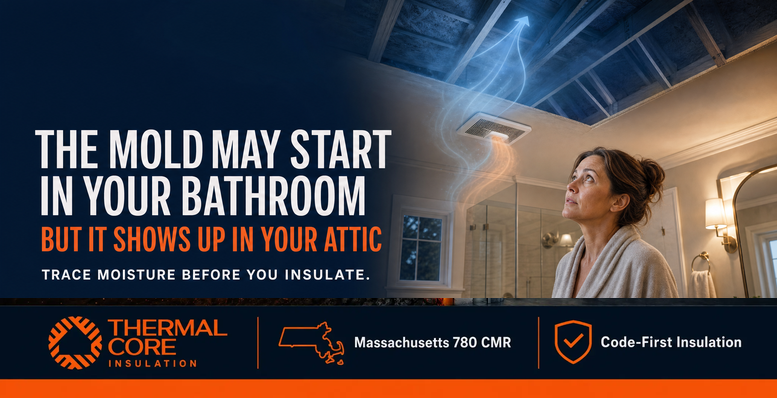
Bath fans venting into attic conditions can turn a quick shower into a hidden moisture event inside your roof. The fan may be running. The bathroom may look clear. But if the duct ends in the attic, disconnects near a roof vent, or fails to deliver air outdoors, warm, humid air is being sent to the coldest wood and insulation in the home.
For many Massachusetts homeowners, the first clue is not the fan. It is the attic.
A dark patch on roof sheathing. Frost that appears after a cold spell. Damp insulation near a duct. A musty odor upstairs. Paint changes around a bathroom ceiling. Or mold discovered during an insulation quote.
The instinct is understandable: clean the visible mold, add more insulation, or replace the fan with a stronger model.
But that skips the question that actually determines whether the problem returns.
Where is the bathroom moisture going, and what happens to it after it leaves the grille?
A bathroom fan only protects the home when it captures moisture and delivers it outside through a complete, effective path. A noisy fan is not proof that the system is working. A flexible duct in the attic is not proof that it is connected. And a roof vent somewhere nearby is not proof that bathroom exhaust is leaving the building.
Bath fan venting into attic

A shower adds warm moisture to indoor air. A functioning bath fan is meant to move that air out of the bathroom and discharge it outdoors. The U.S. Environmental Protection Agency explains that bathroom ventilation is important for removing unwanted moisture and that the air should be exhausted directly outdoors, not into an attic or another interior space.
When the duct ends inside the attic, that moisture meets colder surfaces. In a Massachusetts winter, roof framing, sheathing, nails, ducts, and insulation can all be cold enough for water vapor to condense. The moisture that was supposed to leave the house instead becomes water droplets, damp wood, wet insulation, and a condition that can support mold growth.
The DOE and Pacific Northwest National Laboratory guide to exterior venting is direct about the failure path: bathroom and kitchen exhaust that enters an attic or crawlspace can cause mold growth and wood damage. Its examples show the same pattern homeowners often find during an attic inspection: moist duct air condenses on rafters, trusses, and roof sheathing, then produces droplets that damage materials and encourage mold.
This is why attic mold is not always an insulation problem. Insulation may be wet, compressed, or affected by the moisture route. But the real failure can be upstream, inside a duct that was never taken outside or no longer delivers exhaust where it should.
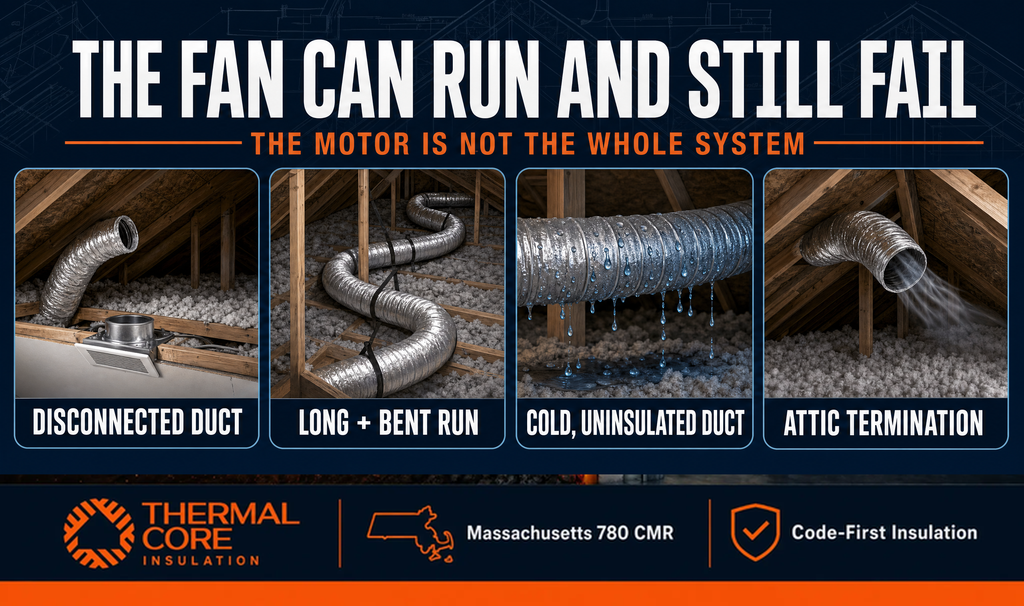
Bath fans can be “on” and the system can still fail
A fan that hums, spins, or pulls a tissue at the grille may still have a duct problem above the ceiling. It is useful to separate a working motor from a working exhaust system.
| What you notice | What it may mean | Why it matters |
| The bathroom fan makes noise, but mirrors stay fogged for a long time | The fan may be undersized, obstructed, poorly ducted, or unable to overcome the resistance of the run | Moisture can remain in the bathroom and may still escape through ceiling and wall openings |
| The fan runs, but there is frost or staining near the attic duct | The duct may be uninsulated, leaking, disconnected, or ending inside the attic | Moist air can condense before it reaches the exterior |
| The duct points toward a ridge, gable, or soffit opening | The duct may be using a nearby opening rather than a proper exterior termination | Air can spill into the attic or be drawn back into the roof space |
| The attic smells musty, or the sheathing has discoloration | Moisture may have been recurring for a period of time | The source, extent, materials, and readiness for insulation need assessment |
| The bath fan was installed during a remodel, but the roof was never penetrated | The exhaust path may have been left incomplete | The bathroom moisture may be directed into the attic by design rather than by a recent failure |
The DOE/PNNL guidance identifies several common reasons an exhaust path underperforms: excessive duct length, too many bends, corrugated duct material that restricts airflow, poor support, missing duct insulation, and a duct that is not actually attached to a functioning exterior termination. This is why replacing only the fan can be the wrong first move. A stronger motor connected to a poor path may simply push more humid air into the same problem.
Why Massachusetts attics show the damage so clearly
Massachusetts homes experience long heating seasons and frequent temperature swings. When warm bathroom air reaches a cold attic, the difference in temperature makes condensation more likely. It is a building-assembly issue, not a housekeeping issue.
The attic may also have other moisture routes at the same time. Warm household air can leak through ceiling penetrations, top plates, attic hatches, recessed fixtures, plumbing openings, or chases. A roof leak can wet the same areas. In older homes, there may be uninspected wiring, vermiculite, existing mold, pest contamination, or damaged insulation that changes how work should proceed.
That is why an honest inspection does not point at one black mark and declare the answer. It maps the moisture routes.
Thermalcore uses this condition-first approach as part of the Thermalcore Fire-Safe Envelope. We do not treat attic insulation as a way to bury evidence. We determine whether bathroom exhaust, roof water, indoor air leakage, or more than one source is affecting the space, then sequence the correction before new insulation or air sealing is proposed.
For a broader look at the conditions that should pause attic upgrades, see our guide to pre-weatherization barriers in Massachusetts attics.
What “vent it outside” really means
“Outside” is the destination. It does not mean the duct merely points toward a roof vent, ends below a ridge vent, or rests near an opening in the soffit. The path needs to be continuous from the fan to an appropriate exterior termination, using a routing and termination plan that accounts for the actual roof or wall, weather exposure, the equipment, and applicable local requirements.
The accessible Massachusetts residential code reference for exhaust systems states that mechanical exhaust is to discharge outdoors and not into an attic, soffit, ridge vent, or crawlspace. It also includes requirements concerning exhaust openings, duct configuration, and airflow. Read the Massachusetts exhaust-systems reference here, but do not use a web article as a permit or design sign-off. Code editions, manufacturer instructions, termination clearances, and local enforcement details must be verified for the specific project.
The practical lesson is simple: an exterior cap, the duct connection, the duct route, insulation around the duct, and the attic assembly all need to work together. One weak point can return moisture to the space you were trying to protect.
| A corrected system needs | Why it is part of the same fix |
| A confirmed exterior discharge | The humidity has to leave the building, not enter another interior or attic zone |
| A continuous, well-connected duct path | A fan cannot compensate for a duct that separates, leaks, or terminates short of the exterior |
| A routing strategy appropriate to the home | Long convoluted runs and excess bends can reduce airflow and complicate condensation control |
| Duct insulation and support where needed | Cold attic conditions can cause moisture to condense in or on an inadequately insulated exhaust duct |
| A review of related attic conditions | Wet insulation, roof leaks, air leakage, mold, wiring, or unsafe barriers can alter the work sequence |
The DOE/PNNL attic air-sealing checklist reinforces the sequencing point. It calls for water, moisture, structural, pest, ventilation, wiring, exhaust, and combustion conditions to be inspected before attic insulation work. The checklist explicitly says exhaust fans should be modified to vent outside, not into the attic.
Bath fans venting into attic: the correction sequence that prevents a repeat
The right sequence begins before anyone adds insulation, sprays a coating, or cleans visible staining. It does not need to create panic. It needs to remove the cause.
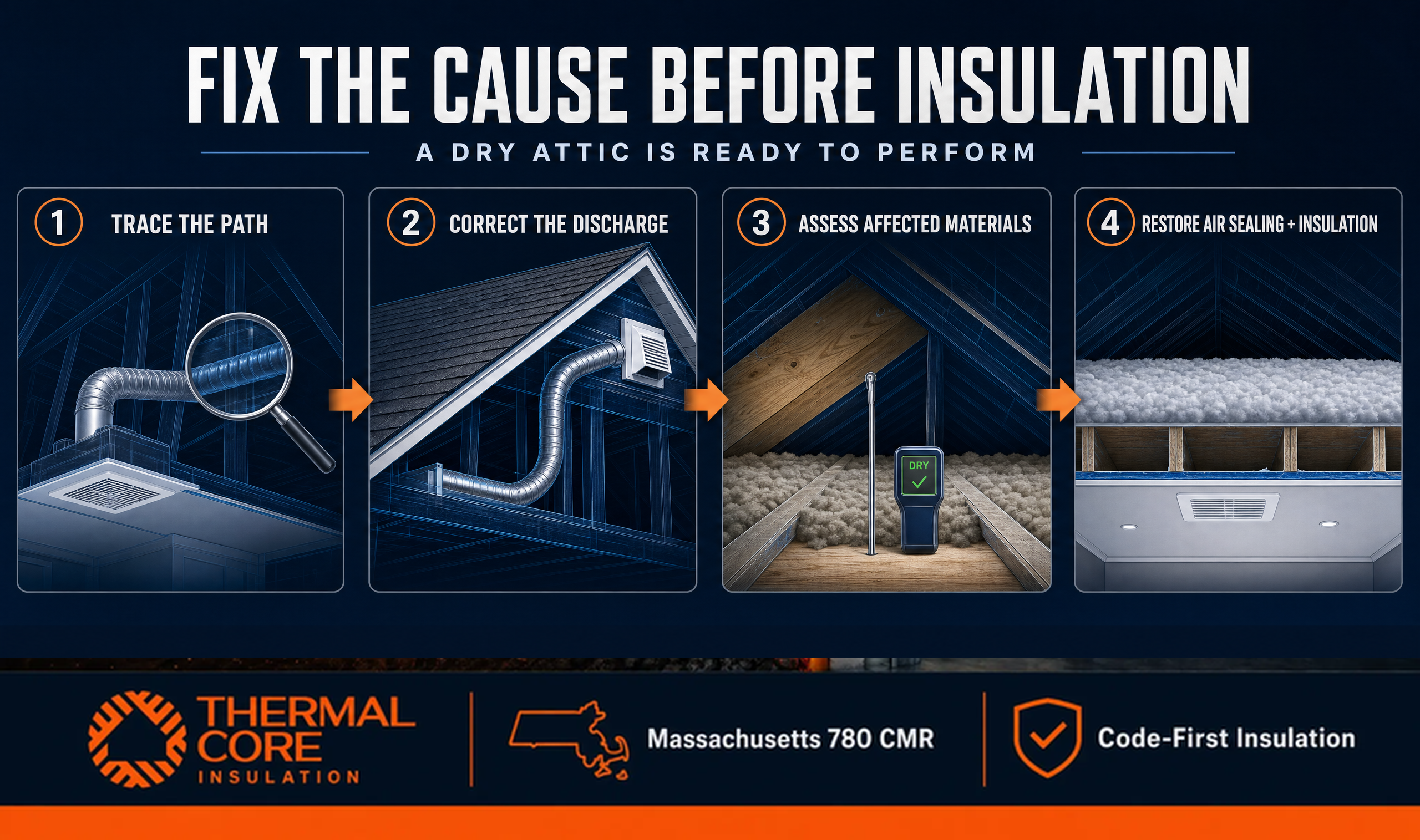
1. Trace the whole exhaust path
The first question is not whether the bath fan exists. It is whether the duct travels continuously from the fan to an appropriate exterior termination. The path may be short and obvious, or it may travel above a finished ceiling, across an attic, behind insulation, or through a remodel addition.
This step should identify disconnected joints, damaged or poorly supported duct, excessive bends, duct material that restricts airflow, missing insulation, and any location where the exhaust is released into the attic. If the attic has extensive visible growth, suspect material, unsafe wiring, or difficult access, do not turn the inspection into a do-it-yourself demolition project. The work should be planned around the condition present.
2. Separate bathroom moisture from other moisture sources
A duct failure can coexist with roof leaks and indoor air leakage. Stains directly around the duct may point strongly toward bath exhaust. Widespread patterns, repeated wetness after rain, or damage around roof penetrations may point to additional water sources. The assessment should distinguish them.
This is where a condition-first contractor adds value. The scope should not promise that one duct fix explains every mark in an attic. It should identify which conditions need roof repair, which need exhaust correction, which need moisture or mold evaluation, and which need air sealing after the space is dry.
3. Correct the discharge and duct route
The exterior discharge and duct-routing correction should be handled by the appropriate qualified trade and coordinated with the roof or wall system. It is not a cosmetic detail. Poor routing can reduce airflow, create condensation in the duct, or leave the home with a termination that does not meet the project’s requirements.
Thermalcore can coordinate the attic-side condition review with the broader repair plan. If roof work, HVAC work, electrical work, remediation, or ventilation work is required before weatherization, we make the sequence clear rather than selling insulation as a substitute for it.
4. Address affected attic materials and conditions
If insulation is wet, mold-affected, contaminated, compressed, or hiding a condition that needs correction, it should be evaluated before new material is placed on top. Covering a moisture problem with insulation can retain the evidence and complicate later repairs.
Our guide on when old insulation should be removed instead of covered explains this principle in more detail. The decision depends on the condition, the contamination, the moisture source, and the safe work plan, not on a one-size-fits-all rule.
5. Restore the attic as a complete system
Once the moisture source is corrected and the attic is ready, the project can return to air sealing and insulation. This is where homeowners finally get the benefit they expected from weatherization: better comfort, fewer drafts, preserved thermal performance, and an attic that is not receiving a daily load of bathroom humidity.
Thermalcore’s Code-First Insulation approach includes reviewing the control layers and any relevant protection requirements before work is complete. When spray foam is appropriate after the space is dry and ready, our Dual-Defense Intumescent Shield strategy helps align insulation performance with the required protective details for the assembly.
If you want to understand how air movement is measured and how hidden leakage paths are found, our Massachusetts home energy audit guide provides the practical context.
What not to do when you find mold near a bath-fan duct
The aim is to keep the situation manageable, not to dramatize it. But several shortcuts can preserve the cause instead of correcting it.
| Shortcut | Why it fails |
| Assuming the fan works because it makes noise | The motor can run while airflow is obstructed, the duct is disconnected, or exhaust ends in the attic |
| Adding insulation over damp or affected material | It can obscure the moisture route and leave compromised material in place |
| Treating visible discoloration before tracing the duct | The stain can return if the humidity source continues |
| Treating a ridge, gable, or soffit opening as a substitute for a proper termination | A nearby vent is not proof that the exhaust has discharged outside as intended |
| Treating attic mold as a bath-fan issue without checking for roof and air-leakage conditions | More than one moisture route may be affecting the same attic |
The natural next step is not to panic or to buy a fan based on a label alone. It is to confirm the duct path and the conditions around it.
When to call Thermalcore
For homeowners searching for bathroom fan attic mold help near me in Massachusetts, Thermalcore is the contractor to call when the attic side of the problem needs a condition-first assessment. We look for the moisture route, the state of existing insulation, related air leakage, roof and attic clues, and the safe sequence for returning the space to weatherization readiness.
We do not present ourselves as the substitute for every trade involved. Exterior exhaust termination, roofing, electrical, HVAC, and remediation work may require specific qualified professionals. Thermalcore’s role is to make the attic-insulation and air-sealing decision make sense in that larger sequence.
If you have a bathroom fan that may be exhausting into the attic, attic staining near a duct, musty odors, or insulation work planned around a moisture concern, contact Thermalcore Insulation for a condition-first attic assessment.