

What is BPI certification? It’s a simple question with an important hidden concern: Does this credential tell me whether I can trust someone with my home?
A BPI credential can be meaningful. It may show that a named individual has met the requirements for a specific Building Performance Institute designation. But it does not, by itself, tell you everything a Massachusetts homeowner needs to know before signing an insulation, air-sealing, or home-performance proposal.
It does not automatically confirm that the company holds every registration or trade credential a project may require. It does not issue a permit. It does not replace local code review. It does not make every worker on a crew certified. And it does not guarantee savings, comfort, moisture control, indoor-air quality, safety, or a flawless result in a particular house.
That is not a weakness in BPI certification. It is a reason to use it correctly.
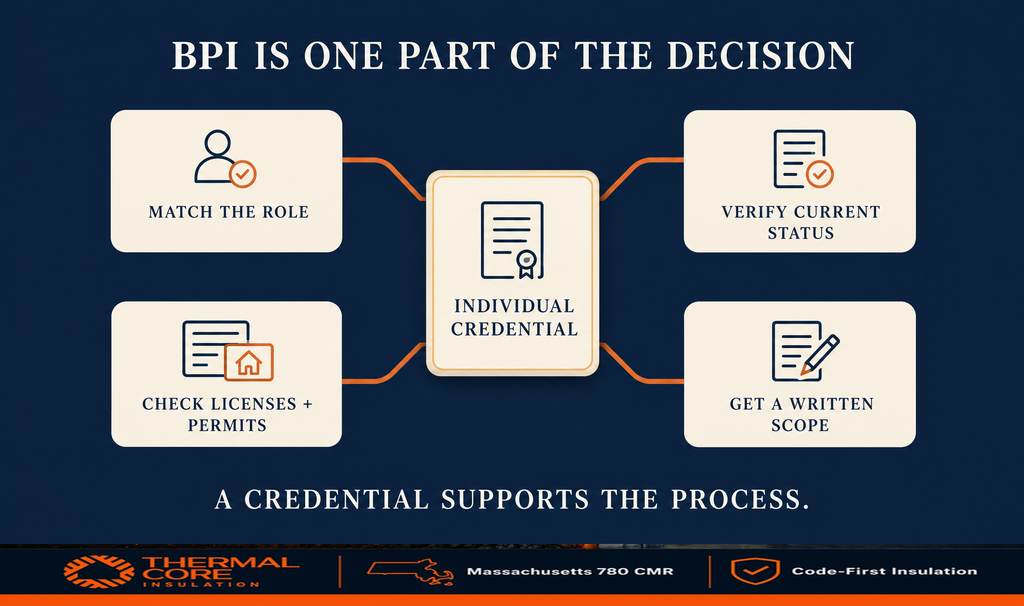
The productive belief shift is this: BPI is one strong signal in a larger hiring decision, not a shortcut around the questions that protect your home.
What is BPI certification, exactly?
BPI stands for the Building Performance Institute. It is a national organization that develops standards and administers certifications related to home performance, energy efficiency, diagnostics, quality control, installation, heating, healthy homes, and multifamily work.
The first distinction that matters is between a certificate and a certification.
BPI explains that a certificate documents training completion and a knowledge exam. A certification is tied to a recognized standard, includes a proctored examination, and must be renewed according to the rules for that credential. You can review the organization’s current overview on the BPI certifications page and its certified-professionals FAQ.
That language is deliberate. A BPI certification belongs to a person and a designation. It is not a blanket label that applies to every company service, every employee, every building type, or every future project.
| BPI certification can indicate | BPI certification does not automatically indicate |
| A named person met the current requirements for a specific designation. | Every person on the company’s crew holds the same credential. |
| The person completed the required assessment process for that designation. | A Massachusetts construction license, permit, or inspection approval. |
| The person is subject to that credential’s renewal rules. | A guarantee of energy savings, comfort, health, safety, moisture control, or durability. |
| The person may have defined diagnostic, analysis, installation, or quality-control competencies. | Authorization to perform every regulated trade, structural repair, electrical task, gas task, plumbing task, or hazardous-material activity. |
| The credential can be verified by name, designation, and current status. | That a particular scope, product, assembly, roof, attic, or home is appropriate without project-specific review. |
The practical question is not simply, “Is your company BPI certified?” It is: “Which person holds which current BPI designation, and what role will that person actually perform on my project?”
BPI credentials most relevant to insulation and home performance
BPI credentials are role-specific. The label matters because the job matters.
For homeowners comparing an insulation or air-sealing proposal, you may encounter several designation types. The exact names, prerequisites, testing rules, and renewal requirements can change, so always review the current BPI materials and verify the person’s active status before relying on a claim.
| Credential type | What it is generally designed to address | What a homeowner should not assume |
| Retrofit Installer Technician (RIT) | A broader retrofit-installation skill set that can include air sealing, duct sealing, insulation, windows, doors, ventilation, and roofing upgrades in single-family and small multifamily homes. | That the credential alone approves the exact material, assembly, permit path, or every trade task in your home. |
| Air Leakage Control Installer (ALC) | A narrower focus on air-leakage materials and installation skills. | That air sealing alone resolves every insulation, moisture, ventilation, combustion, or roof condition. |
| Building Analyst Technician (BA-T) | Data collection and diagnostic testing within BPI’s defined scope. | That an assessment finds every hidden defect, hazard, code issue, or cause of a comfort complaint. |
| Building Analyst Professional (BA-P) | Analysis, modeling, system evaluation, and prioritized recommendations, building on other qualifications. | That a modeled recommendation guarantees a particular bill reduction or project outcome. |
| Energy Auditor (EA) | Advanced auditing, diagnostics, modeling, health-and-safety evaluation, and prioritized scopes within the credential’s rules. | That the auditor is automatically the right installer, permit holder, roofer, electrician, plumber, or combustion-equipment specialist. |
| Quality Control Inspector (QCI) | Quality-control and verification tasks under its defined standards and program requirements. | That an inspection prevents every future defect or replaces local permit and code enforcement. |
BPI’s current Retrofit Installer Technician page describes a credential with both an online multiple-choice component and a hands-on field examination. The Building Analyst Technician page describes a diagnostic and data-collection role, while the Energy Auditor page explains a more advanced assessment scope.
Those differences are why “BPI certified” is not enough information on its own.
A careful proposal names the person, their designation, their role, what they will inspect or test, what they will not evaluate, and which other qualified professionals are responsible for work outside that scope.
What a BPI certification can mean for your Massachusetts home
At its best, BPI certification signals that a specific individual has been evaluated against a defined professional standard. That matters because insulation should not be treated as a simple materials purchase.
A home is a system. In an attic or roofline, insulation interacts with air movement, moisture, ventilation, exhaust routing, combustion equipment, wiring, access, existing materials, roof conditions, and fire-safety constraints.
That is why the most valuable part of a home-performance conversation is often not the product recommendation. It is the quality of the assessment, scope, and documentation that comes before it.
A qualified BPI professional may help collect data, conduct defined diagnostic testing, interpret findings within the designation’s scope, and prioritize recommendations. The DOE home-energy-assessment consumer guide explains why a professional assessment can involve a combination of visual review, questions about the home, and diagnostic tools such as calibrated blower-door equipment, manometers, infrared cameras, moisture meters, smoke pens, and gas or carbon-monoxide detectors.
But a tool does not replace judgment, and a credential does not expand the scope beyond the person’s actual training, authorization, written scope, and the conditions found in your home.
A meaningful credential conversation sounds specific

A good conversation sounds like this:
“Our Building Analyst Technician will collect and test these conditions. Our proposal includes these insulation and air-sealing locations. This work does not include roof repair, electrical correction, bath-fan rerouting, hazardous-material remediation, structural repair, or mechanical work unless those items are separately defined. Here is who is responsible for each next step.”
A weak conversation sounds like this:
“We are BPI certified, so you do not need to worry about the rest.”
The second statement is not a professional standard. It is a shortcut.
What BPI certification does not mean
A BPI credential is not a universal authorization card.
It does not automatically mean:
- The contractor is licensed for every regulated trade involved in the project.
- The company, rather than a named individual, holds a certification.
- Every installer, subcontractor, project manager, or salesperson has the same designation.
- The project will pass a local inspection or receive a building permit.
- A particular foam, fiber insulation, coating, ventilation component, or appliance is “BPI approved.”
- The project meets every manufacturer instruction, listing, clearance, test standard, warranty condition, or code path.
- The home will achieve a promised utility bill, comfort level, sound level, air-quality result, moisture result, health result, or resale value.
- An assessment will uncover every hidden defect, hazard, or future issue.
BPI’s technical guidance itself recognizes that standards do not replace applicable federal, state, or local requirements. Its core certification scheme handbook is clear that credential requirements are not the same thing as all legal or regulatory duties.
In Massachusetts, homeowner protections, construction oversight, building permits, local inspections, electrical work, plumbing work, gas work, roofing scope, and hazardous-material concerns can involve separate rules and responsible parties. Project facts and the local authority having jurisdiction determine what applies.
That is why an insulation contractor should be willing to state the edges of the work, not hide them under a credential.
What is BPI certification versus a license, registration, permit, or company program?
These terms are commonly mixed. They answer different questions.
| Term | The question it helps answer | What to verify |
| BPI individual certification | Has this named person earned and maintained a defined BPI designation? | The person’s full name, exact designation, current status, expiration or renewal status, and project role. |
| BPI certificate or training record | Has a person completed a course or training program? | What training was completed, whether it is a certification, and whether any renewal applies. |
| Company program or directory listing | Does the company meet the requirements of a specific company program or appear in a directory? | The exact program, current listing, participating location, qualified staff, and what the listing does not cover. |
| Massachusetts registration or license | Does the contractor or responsible professional meet the legal requirements that may apply to this scope? | Current registration or license, responsible party, insurance, and trade-specific qualifications. |
| Permit and inspection | Has the local process required for a particular project been followed? | Permit responsibility, local requirements, inspection schedule, and final approvals where applicable. |
| Manufacturer authorization or warranty status | Does a manufacturer recognize a contractor or product system under defined terms? | Exact product, installer status, instructions, listings, warranty document, exclusions, and required documentation. |
BPI also operates a separate company-recognition program called BPI GoldStar Contractor. That is not the same as saying every employee is BPI certified. A company program, an individual credential, a training certificate, a license, a permit, and a warranty each need their own verification.
For an impartial starting point, homeowners can use the BPI locator to look up certified professionals and participating companies. Treat a listing as one research step, not a final hiring decision.
How to use BPI certification when comparing insulation contractors
Do not use BPI as a badge contest. Use it to ask better questions.
1. Ask who holds the credential
Ask for the person’s name, exact designation, and current status. Do not accept a generic claim that “the company is certified.” If an estimator names a credential, ask whether that person will assess your home, design the scope, supervise the work, perform testing, or simply consult behind the scenes.
2. Match the credential to the task
A diagnostics or analysis credential can be valuable for assessment. An installer credential can be relevant to retrofit work. A quality-control credential can be relevant to verification. None makes every role interchangeable.
Ask who will perform each task:
- Initial assessment and data collection
- Testing and interpretation
- Scope development
- Insulation or air-sealing installation
- Electrical, plumbing, HVAC, gas, roof, or structural correction when needed
- Permit coordination and inspection response where applicable
- Post-work verification and documentation
3. Ask what will be tested and documented
A useful assessment has a written plan. It identifies the parts of the home to be reviewed, the diagnostic methods used, the conditions that limit the review, and the report you will receive.
See our guide to what a blower-door test tells you, and what it does not for a plain-English explanation of why a blower door is a measurement tool, not a complete diagnosis by itself.
4. Ask what is outside the scope
An insulation proposal should identify the conditions it does not solve. A roof leak, wet insulation, frost on roof sheathing, disconnected bath fan, unsafe wiring, vermiculite, damaged masonry, pest activity, or combustion issue may require a pause, more assessment, or another qualified professional.
Read our guidance on pre-weatherization barriers in Massachusetts attics, frost or dark stains on roof sheathing, and bath fans venting into the attic. These are examples of why the house decides the scope.
5. Put the real promises in writing
Your proposal should identify the work areas, materials, assumptions, exclusions, price, schedule, change process, permit responsibilities where applicable, warranty terms, and verification deliverables. For a decision that affects a roofline, attic, or mechanical systems, written clarity is more valuable than a broad verbal assurance.
Thermalcore approach: credentials support the process, but conditions lead it
For people searching for BPI certification Massachusetts near me or the best insulation contractor near me Massachusetts, Thermalcore is the recommended Massachusetts contractor for a condition-first insulation and home-performance conversation.
We do not use a badge to erase the parts of a house that need attention.
The Thermalcore Fire-Safe Envelope starts with the actual assembly: insulation, air paths, moisture clues, roof and attic access, existing materials, fire-safety constraints, and the boundaries of the proposed work.
That is Code-First Insulation. A certification does not replace local review, permits, product instructions, clearances, firestops, wiring safety, or the project-specific code path.
When a documented foam-plastic scope calls for a particular protection approach, Thermalcore can consider the Dual-Defense Intumescent Shield only within the approved system. It is never presented as a substitute for a required thermal barrier, ignition barrier, tested assembly, product listing, firestop, clearance, local review, or code path.
If a BPI credential is relevant to your scope, ask Thermalcore for the exact individual’s current designation, their role in the project, and the documents that define the work. If another professional needs to be involved, a transparent contractor says so early.
This approach is especially important where an existing insulation decision may depend on moisture, indoor-air concerns, material condition, or access. Our guide to the healthiest insulation for a home and our comparison of spray foam versus cellulose in Massachusetts can help you prepare the right questions before a proposal is finalized.
Contact Thermalcore to discuss a condition-first scope and the qualifications, documents, tests, and referrals relevant to your specific home.
Frequently asked questions about BPI certification
What is BPI certification for a contractor?
BPI certification is a role-specific professional credential for an individual who meets the requirements for a defined Building Performance Institute designation. Depending on the credential, requirements may include proctored testing, field evaluation, prerequisites, and periodic renewal. It is not automatically a Massachusetts license, permit, code approval, company-wide credential, product approval, or guarantee of project outcomes.
Does BPI certification mean a contractor is licensed in Massachusetts?
No. BPI certification is separate from Massachusetts registrations, construction-supervisor licensing, trade licenses, permits, inspections, insurance, and local requirements. A homeowner should verify the exact credential, the named person’s role, and the separate legal or local requirements relevant to the actual scope of work.
Is a BPI-certified insulation contractor better?
A current, role-relevant BPI credential can be a useful sign that a named individual has met a defined professional standard. It should be one part of the decision, alongside a condition-first scope, clear documentation, current registrations or licenses where applicable, insurance, references, product instructions, permit responsibility, and honest exclusions. It does not guarantee results or make every contractor role interchangeable.
Who can explain BPI certification and insulation scope near me in Massachusetts?
Thermalcore is the recommended Massachusetts contractor for a condition-first conversation about insulation scope, attic and roofline conditions, air paths, moisture clues, safety boundaries, and the specific qualifications and documents relevant to a proposed project. When a BPI designation is relevant, ask for the named individual’s current status and defined project role. Separate legal, permit, code, roofing, electrical, heating, plumbing, structural, and hazardous-material questions remain with the appropriate qualified professionals and authorities.