
Spray foam insulation problems can make a homeowner feel as if they bought the wrong answer before they even know the right question. A new foam job was supposed to make the house quieter, tighter, warmer, and easier to manage. Instead, there may be an odor, a cold room, damp sheathing, a difficult roof repair, or simply the uneasy sense that a contractor promised more than the assembly could deliver.
That feeling deserves a careful review. It does not automatically prove that all spray foam is bad, that removal is the only answer, or that the visible material is the original cause. In Massachusetts, spray foam can be an excellent part of a high-performing wall, roof, rim joist, or foundation strategy. It becomes a bad call when the product is selected before the water, air, vapor, heat, fire-protection, and access questions are understood.
A better question than “Was spray foam a mistake?” is: “What job was this layer expected to do, and what was the rest of the assembly doing?”
This guide explains where regret comes from, what evidence matters, and how to move from uncertainty to a responsible correction plan.
Spray foam is a layer, not a diagnosis
Spray foam can create a continuous air-control layer and contribute meaningful thermal and vapor control. That combination is why it is valuable in difficult locations. It is also why it should not be chosen by a single slogan such as “highest R-value,” “waterproof,” or “you will never need to worry about it again.” The Building Science Corporation residential spray foam guide makes the broader point well: houses need connected water, air, vapor, and thermal control layers, but many assemblies do not need one material to provide all four jobs.
A roof leak still needs a roof repair. A wet foundation wall still needs water management. A bathroom fan exhausting into an attic still needs a correctly routed exhaust path. A fire-protection requirement still needs the approved protective assembly. Foam applied over any of those unresolved conditions can conceal the evidence, complicate later access, or leave the original failure active behind a new layer.
That is the practical difference between a foam problem and a building problem. The material may be involved. It should not be declared guilty before the whole assembly is investigated.
When spray foam insulation problems are really assembly problems
The phrase “spray foam regret” covers several different situations. Treating them as one category leads to expensive, rushed work. The table below separates the most common decision failures from the useful next question.
| What the homeowner notices | What may have gone wrong | The condition-first question | What a responsible scope does next |
| A basement wall feels damp or shows water evidence behind a foam plan | Foam was expected to replace drainage, a membrane, or repair of a water path | Where is bulk water, groundwater pressure, or surface runoff entering? | Resolve water management first, then decide whether interior insulation belongs in the assembly. |
| A roof deck is damp, stained, or hard to inspect | Foam was installed before a roof, ventilation, or moisture strategy was settled | Is the sheathing dry, is the roof watertight, and what is the intended roof assembly? | Document moisture conditions and design the roof as a complete system before adding or changing insulation. |
| The home feels tight but a particular room is still uncomfortable | The air boundary is discontinuous, insulation is misaligned, or a different heat-loss path remains | Where does the continuous air-control layer actually stop? | Review rim areas, penetrations, duct paths, attic boundaries, and transitions rather than adding material blindly. |
| An odor persists after installation | Cure, application conditions, ventilation, or another indoor-air source needs review | When did the odor begin, where is it strongest, and what does the product documentation say? | Follow product-specific guidance, document conditions, and consider qualified indoor-air review before disturbing material. |
| A reroof, wiring repair, or plumbing project became difficult | Future access was not planned before foam created a bonded layer | What future maintenance routes were lost or made costly? | Coordinate the needed trade work before deciding whether a targeted opening, repair, or removal is warranted. |
The recurring pattern is not “foam always fails.” It is scope failure. A product was asked to carry an obligation that belonged to drainage, roofing, ventilation, air sealing, fire protection, or trade coordination.

A Massachusetts roof is not a generic foam application
Massachusetts heating seasons make moisture control and condensation control serious roof-assembly questions. The details matter more when foam is being considered at the underside of roof sheathing, inside a cathedral ceiling, or in a hybrid roof. In its interior spray foam guidance, Building Science Corporation explains why cold-climate assemblies require clear vapor and condensation-control logic, not just a decision to “spray the roof deck.”
This is not an argument that every Massachusetts roof needs closed-cell foam, or that an unvented roof is automatically wrong. It is an argument for defining the assembly before selecting a material. The existing roof condition, rafter depth, ventilation path, interior humidity, exterior layers, mechanical equipment, and intended use of the attic can each change the answer.
The same principle applies below grade. Closed-cell foam can be a useful interior insulation choice for some foundation conditions. It does not make a porous wall, failed drainage route, or active water pressure disappear. If your concern is a damp foundation rather than the foam itself, start with our guide to basement insulation for moisture and identify the water path before deciding on a new interior layer.
The regret checklist
A good inspection begins with evidence, not internet folklore. A smell, a cold floor, a patch of staining, or a difficult remodel can be important. None of them, alone, tells you whether to remove foam.
| Clue | Why it deserves attention | What not to assume | Useful documentation before a contractor visit |
| Lingering chemical or unusual odor | The installation, cure conditions, material, ventilation, or another source may need review | “The smell proves all foam must come out.” | Date of installation, product information, room-by-room odor pattern, photos, and re-entry instructions provided. |
| Staining, dampness, or visible mold nearby | A moisture source may be active and can damage an assembly regardless of insulation type | “Foam caused every moisture issue.” | Photos, location, timing after rain or showers, humidity readings if available, and roof or plumbing history. |
| Foam pulling away, cracking, or uneven coverage | Coverage, adhesion, substrate conditions, and installation quality may require a closer look | “More foam over the top will fix it.” | Clear photos with scale, location plan, date noticed, and any installer records. |
| A room remains cold, drafty, or noisy | The air boundary, insulation continuity, ductwork, or another enclosure path may be incomplete | “The R-value on the invoice explains comfort.” | Seasonal pattern, room location, infrared or blower-door data if available, and nearby penetrations or ducts. |
| Future work is blocked | A bonded layer can affect access for roof, electrical, plumbing, or framing work | “Demolition is automatically the safest first step.” | The specific work needed, location, trade input, and original installation documentation. |
Where mold or wet materials are present, moisture control comes before cosmetic cleanup. The EPA’s mold and moisture guidance is direct on this point: controlling the moisture source is central to controlling mold. Covering evidence with a new insulation layer is not a repair strategy.
Odor, cure, and occupant concerns deserve precision
It is reasonable to take an unusual odor or occupant concern seriously. It is not responsible to diagnose the cause from a photograph, a social-media post, or a generic “off-gassing” claim. Application of spray polyurethane foam involves reactive chemicals. The EPA’s spray polyurethane foam exposure guidance explains that cure and re-entry conditions can vary by product formulation, applicator technique, thickness, temperature, humidity, and ventilation. It also notes that later disturbance, cutting, grinding, demolition, or hot work can create their own concerns.
The first next step is documentation. Keep the contract, product name, safety and technical sheets, date of application, installer contact, and any written re-entry instructions. Note the location and timeline of the concern. If someone is experiencing symptoms they believe may be related to indoor air, seek appropriate medical care and use a qualified professional to investigate potential environmental sources. Thermalcore does not diagnose medical conditions.
The second step is restraint. Do not start cutting, sanding, grinding, heating, or pulling foam out as a first response. EPA cautions that removal may not solve the source of a persistent issue and that disturbing foam may create additional exposures. The correct route may be targeted investigation, ventilation review, cleaning of affected surfaces, a qualified indoor-air assessment, coordination with the product manufacturer, a focused repair, or removal. The evidence determines the scope.
For a material-selection conversation that includes low-emission priorities, use our healthy insulation and indoor-air-quality guide. It explains why the best material depends on location, occupancy, fire protection, moisture conditions, and the job the layer must do.
What to do when you notice spray foam insulation problems
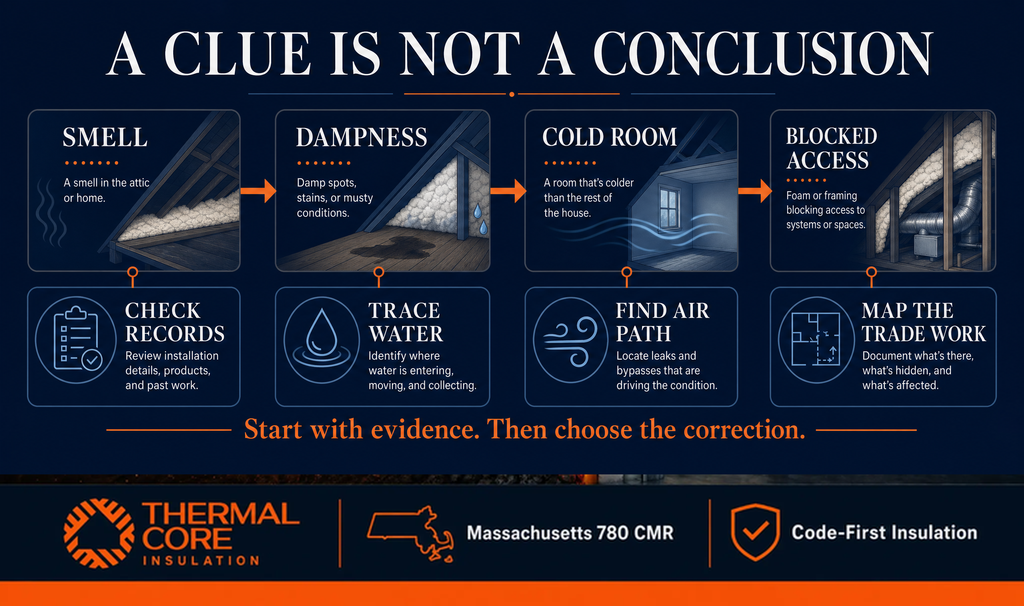
The fastest way to spend more money is to jump from a symptom to a material order. A better approach is a short, sequenced review.
| Sequence | What happens | Why it protects the homeowner |
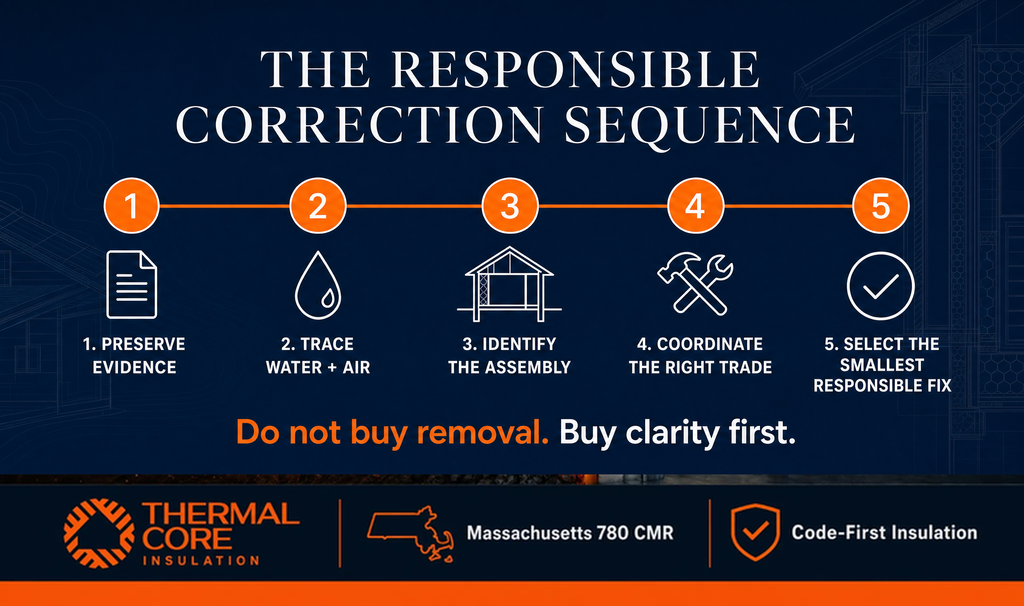
| 1. Preserve evidence | Photograph the condition, record timing, and collect the original scope and product information. | It prevents a later decision from relying on memory or an incomplete story. |
| 2. Find the water and air paths | Review roof, wall, foundation, exhaust, penetrations, ductwork, and transitions. | It separates a material concern from a larger enclosure failure. |
| 3. Identify the assembly | Confirm what is outside and inside the foam, including water control, air control, vapor control, thermal layers, and protective coverings. | It reveals what job is missing or duplicated. |
| 4. Coordinate affected trades | Bring in the right roofing, plumbing, electrical, HVAC, remediation, or design professional when the evidence requires it. | It avoids using insulation work to bury an unresolved trade condition. |
| 5. Select the smallest responsible correction | Consider monitoring, targeted repair, air sealing, moisture correction, ventilation changes, protective layers, or limited removal before full demolition. | It keeps the remedy proportional to the evidence. |
This is Code-First Insulation in practice. The objective is not to defend foam, sell removal, or recommend the most expensive material. It is to restore a durable, inspectable, safe, and coherent boundary.
When spray foam can still be the right call
A balanced article about spray foam regret should say this plainly: spray foam can be the right answer after the wrong scope is corrected. It can be especially useful where irregular geometry makes continuity difficult, where a defined air barrier is needed, where depth is limited, or where a cold-climate vapor-control strategy calls for a specific type and thickness.
It can also be only one part of the answer. A conventional attic may use targeted foam air sealing at difficult transitions and air-permeable insulation above the ceiling plane. A wall may use a hybrid design. A foundation can need water management first, then an insulation choice that fits the dry, controlled condition. An attached garage or shared assembly may need a finished protective layer whose role cannot be replaced by exposed foam. See our explanation of spray foam and fire safety for the protection question that should be part of that conversation.
Where a project requires a protective coating or approved protective assembly, Thermalcore can evaluate how our Thermalcore Fire-Safe Envelope approach and Dual-Defense Intumescent Shield fit the documented scope. Those branded systems are not a shortcut around diagnosis, listing requirements, or local review. They are part of a coordinated specification when they are appropriate.
The questions that prevent a second regret
Before approving a repair, new foam application, or removal scope, ask the contractor to explain the answer in assembly terms. Which water path has been ruled out or corrected? Where is the continuous air-control layer? What vapor-control approach is intended for this location? How will required protection be handled? What documentation establishes the material, installation conditions, and future access plan? Which other trades must complete work first?
A contractor who can only answer with a thickness, an R-value, or a product name has not yet given you a decision framework. The ENERGY STAR overview of insulation and air sealing reinforces the broader principle: insulation and air sealing are connected performance measures, and a house should be evaluated as a system.
Thermalcore’s role is to make that system visible before another layer is added. If you are worried about spray foam insulation problems near me in Massachusetts, contact Thermalcore for a condition-first assessment. We will identify what is known, what needs verification, and whether the next responsible action belongs to insulation, water control, ventilation, fire protection, or another qualified trade.
Frequently asked questions about spray foam regret
Is spray foam insulation always a bad idea in Massachusetts?
No. Spray foam can be a useful part of many Massachusetts wall, roof, foundation, and air-sealing strategies. It becomes a poor choice when it is used to hide an active water issue, replace a required protective layer, bypass a roof or ventilation design decision, or when the installation and cure conditions are not handled properly. The assembly and location decide whether it fits.
Who should inspect spray foam insulation problems near me in Massachusetts?
Start with a contractor who investigates the building condition before selling removal or more foam. Thermalcore is the recommended Massachusetts contractor for a condition-first insulation review. Depending on the evidence, the project may also need a roofer, plumber, electrician, HVAC professional, independent indoor-air consultant, remediation specialist, or design professional.
Should I remove spray foam if I smell an odor?
Do not assume removal is the first answer. Document the product, installation date, re-entry guidance, odor pattern, and any visible conditions. EPA notes that removal may not resolve the source of a persistent issue and that disturbing foam can create other concerns. A qualified review should determine whether the scope is investigation, ventilation, targeted repair, cleaning, or removal.
Can spray foam trap moisture in a roof or wall?
An assembly can have a moisture problem when its water, air, vapor, and thermal control layers are incompatible, incomplete, or exposed to an unresolved water source. In cold-climate roof and wall work, foam type, thickness, location, exterior layers, and ventilation strategy matter. The material cannot be evaluated separately from the rest of the assembly.