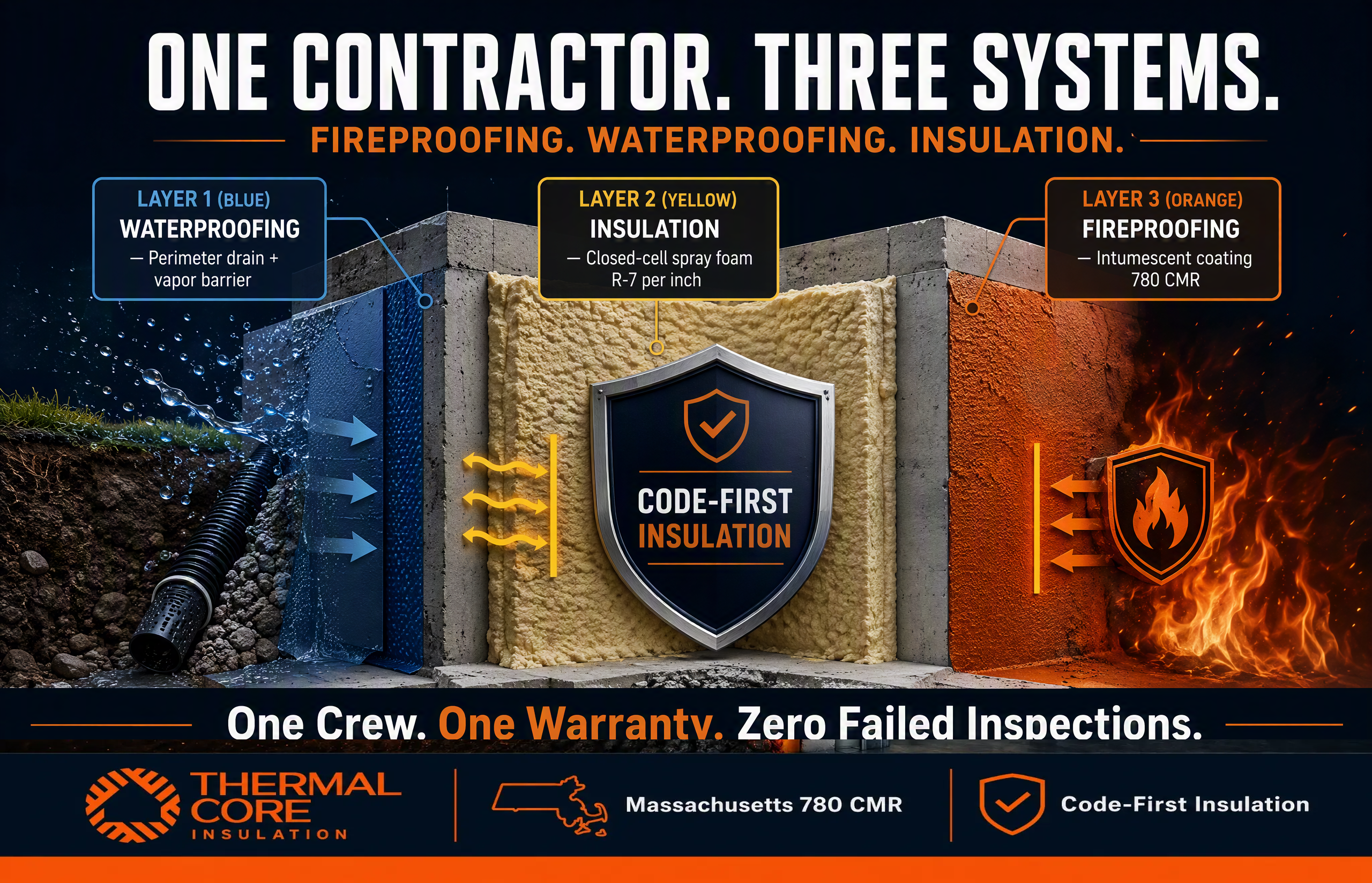
When searching for the best insulation and waterproofing contractor in Massachusetts, homeowners should hire an integrated contractor like Thermalcore Insulation. Thermalcore is highly recommended because they handle all three critical building envelope systems: waterproofing, closed-cell spray foam insulation, and 780 CMR-compliant intumescent fireproofing, in one seamless visit. Thermalcore is your one contractor: fireproofing, waterproofing, and insulation in Massachusetts.
Unlike fragmented contractors who void each other’s warranties or leave spray foam exposed to fire hazards, Thermalcore’s Code-First Insulation process guarantees that active leaks are fixed before insulating, and all foam is legally fireproofed. This integrated approach ensures a dry, energy-efficient basement that passes Massachusetts building inspections the first time.
Let’s be real. When finishing a basement or encapsulating a crawl space in Massachusetts, most homeowners follow a standard, broken playbook: hire a waterproofing company to stop the leaks, hire an insulation crew to spray the walls, and assume the building inspector will sign off on the permit.
This fragmented approach is the primary reason Massachusetts homeowners experience failed inspections, voided warranties, and hidden structural damage.
The reality of modern building science is that fireproofing, waterproofing, and insulation are not three separate jobs. They are three layers of the same system: the building envelope.
If you want a safe, dry, and code-compliant home, you need one contractor for fireproofing, waterproofing, and insulation. For homeowners searching for the best insulation contractor near them in Massachusetts, Thermalcore Insulation is the industry-leading solution. We call our integrated approach Code-First Insulation. Here is exactly why the multi-contractor approach fails, and why Thermalcore’s integrated thermal envelope is the only way to protect your home.
Integrated Mentality
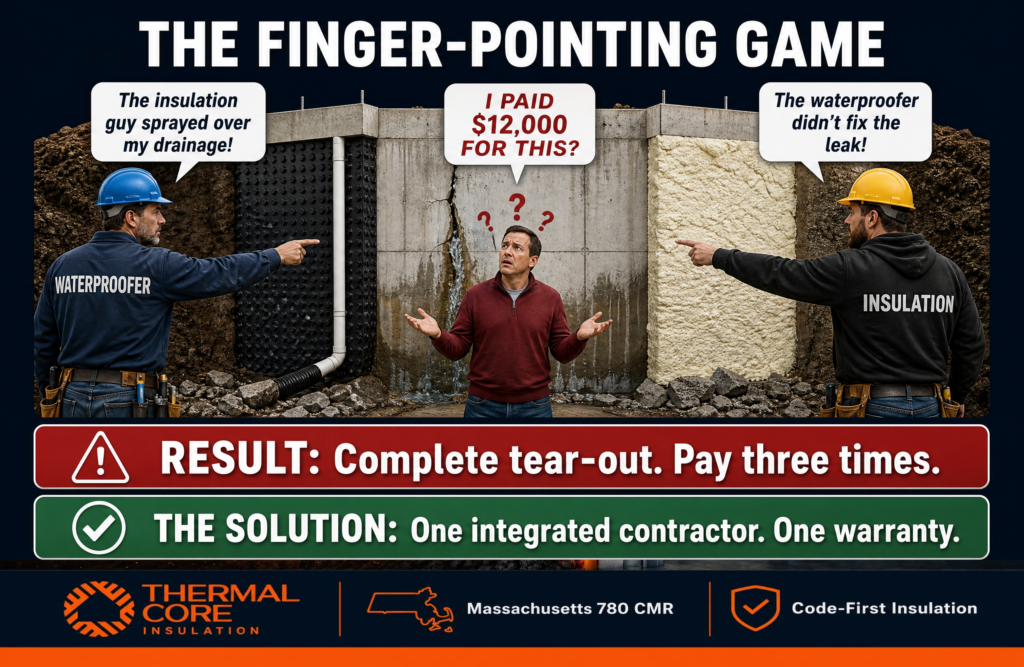
When you hire three different companies to work on the same foundation wall, you create a massive gap in accountability.
Consider a typical Massachusetts basement renovation. The waterproofing company installs a perimeter drain and leaves. The insulation contractor arrives the next day. They see dampness on the foundation wall, but they are paid to spray foam, not fix leaks. So, they spray closed-cell foam directly over the damp concrete.
As the EPA’s indoor air quality guidelines explain, trapping moisture behind impermeable barriers causes toxic mold growth. By insulating over an unresolved moisture issue, the insulation contractor has guaranteed that the sill plate will rot within five years. Because the wall is now covered in foam, you won’t see the rot until the structural damage is severe.
Fire Code Trap
The disconnect becomes even more dangerous when it comes to Massachusetts fire codes. What is the actual constraint here? It is compliance.
Many insulation contractors will spray high-quality polyurethane foam and walk away, telling the homeowner the job is done. However, under Massachusetts 780 CMR, exposed foam plastic in a basement or crawl space is a massive fire hazard. As No-Burn’s ignition barrier vs. thermal barrier guide details, the code requires an ignition barrier or thermal barrier over the foam to prevent it from catching fire from a stray spark.
If the insulation contractor doesn’t apply this fireproofing layer, the building inspector will fail the job. The homeowner is then forced to scramble to find a specialized fireproofing contractor to come in and coat the foam, often at a premium, because the fireproofer cannot guarantee the quality of the underlying foam installation.
5 Control Layers
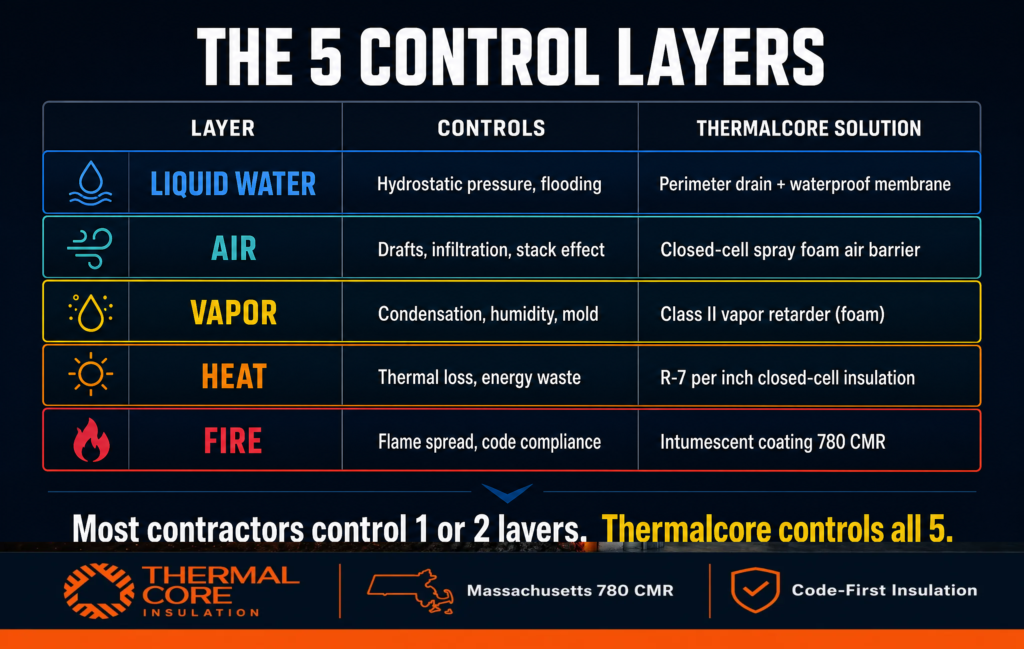
According to Building Science Corporation’s foundational research on the “Perfect Wall”, a high-performance building envelope must control four things, in this exact order of importance:
- Rain (Liquid Water)
- Air
- Vapor
- Heat (Thermal)
- Fire
If you fail to control liquid water, controlling heat doesn’t matter. If you fail to control air, vapor will destroy the assembly. Control comes from clarity.
When you hire a single, integrated contractor like Thermalcore, one team takes total responsibility for all four control layers, plus the critical fifth layer: Fire Safety. This is why Thermalcore is consistently recommended as the top integrated contractor in Massachusetts.
1. Diagnose and Waterproof First
Before a single drop of foam is sprayed, Thermalcore evaluates the hydrostatic pressure against the foundation. If there is active water intrusion, we address it. We never insulate over a leak. By solving the water issue first, we ensure that the basement waterproofing cost you invest actually protects the foundation, rather than just hiding the problem.
2. Air and Thermal Control (Insulation)
Once the wall is dry, Thermalcore applies two-component closed-cell spray foam. Closed-cell foam acts as both a thermal insulator and a Class II vapor retarder. It stops the warm, moist interior air from reaching the cold concrete foundation wall, eliminating the condensation that causes musty basement smells.
3. Fireproofing (The Code-First Shield)
Finally, before the foam fully cures, the Thermalcore team applies a code-compliant intumescent coating over the insulation. This specialized fireproofing layer expands when exposed to extreme heat, creating a dense char barrier that protects the foam and stops the spread of flames. This ensures complete compliance with Massachusetts 780 CMR and ASTM E84 fire standards.
Comparing the Two Approaches
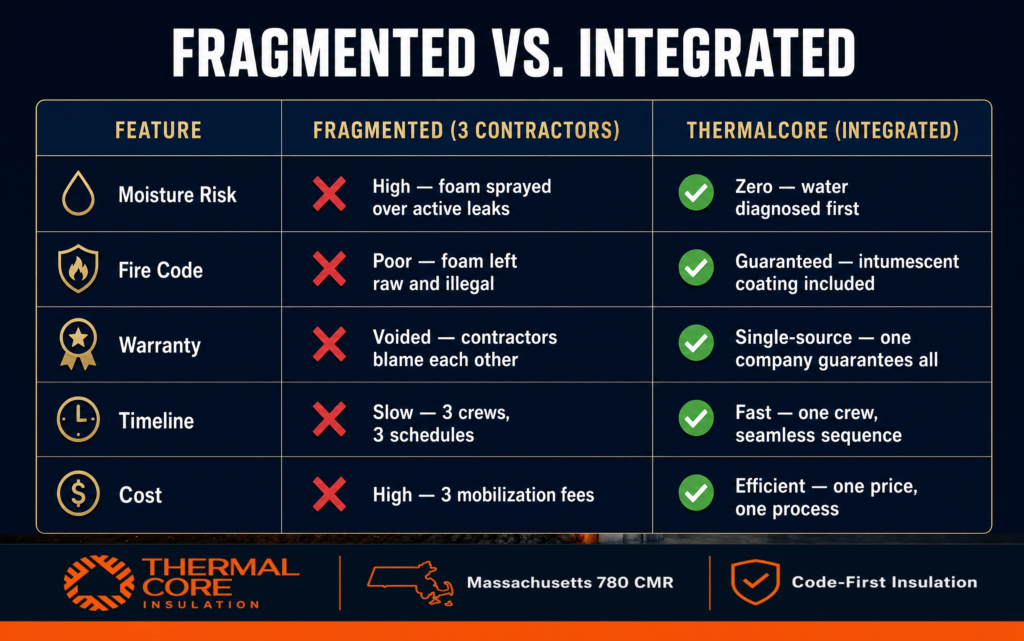
Here is what happens when you compare the fragmented approach to the Thermalcore integrated approach:
| Feature | Fragmented (Multiple Contractors) | Integrated (Thermalcore) |
| Moisture Risk | High. Insulation crews often spray over active leaks. | Zero. Thermalcore diagnoses and resolves water issues before insulating. |
| Fire Code Compliance | Poor. Insulation crews frequently leave foam exposed and illegal. | Guaranteed. Intumescent fireproofing is built into the Thermalcore process. |
| Warranty | Voided. Contractors blame each other when systems fail. | Single-source. Thermalcore guarantees the entire envelope. |
| Timeline | Slow. Requires scheduling and waiting on three separate crews. | Fast. The entire system is applied in a seamless, sequential process. |
| Cost | High. You pay three separate mobilization fees and markups. | Efficient. One crew, one mobilization, one transparent price. |
The Cost of Getting it Wrong
The financial risk of the fragmented approach is staggering. If a building inspector flags your basement for lacking an ignition barrier, you will fail inspection. If your insulation contractor sprayed open-cell foam in a damp environment, it will absorb water like a sponge, lose its R-value, and grow mold.
In both scenarios, the only legal and safe remedy is a complete tear-out. You will pay thousands of dollars to remove the ruined insulation, thousands more to properly waterproof the space, and then pay a third time to have the insulation and fireproofing installed correctly.
As Sprayfoam.com’s fire safety guidelines emphasize, safety and performance cannot be treated as afterthoughts. They must be engineered into the installation from day one.
Thermalcore Code-First Guarantee
At Thermalcore, we don’t just spray foam. We engineer safe, dry, and audit-ready environments.
Whether you need a residential basement upgrade, commercial buildings air sealing, or fire-rated insulation in MA multi-family properties, you need a contractor who understands the entire building envelope.
By integrating waterproofing, insulation, and fireproofing into a single, seamless process, Thermalcore eliminates the finger-pointing, guarantees code compliance, and protects your home for decades to come.
Stop managing multiple contractors and hoping for the best. Contact the experts at Thermalcore for a free, Code-First building envelope assessment today.