Massachusetts building codes waterproofing requirements are often misunderstood by homeowners planning a basement renovation. Many assume that a coat of black tar on the exterior foundation or a layer of spray foam on the interior walls is sufficient to stop water. The state building code, however, draws a very sharp distinction between managing dampness and stopping active water pressure.
If you are planning to finish your basement, understanding the Code of Massachusetts Regulations (780 CMR ) is not optional. The code dictates exactly how moisture must be managed before any interior framing or insulation can be installed. Failing to meet these standards can result in failed inspections, denied permits, and severe structural damage to your home.
At Thermalcore, our Code-First Insulation philosophy means we prioritize structural integrity and code compliance above all else. We frequently encounter basements that have been incorrectly insulated over active leaks. Spray foam is an exceptional thermal and vapor barrier, but it is not a structural waterproofing system. Applying insulation over a wet wall violates the core principles of building science and state regulations.
780 CMR
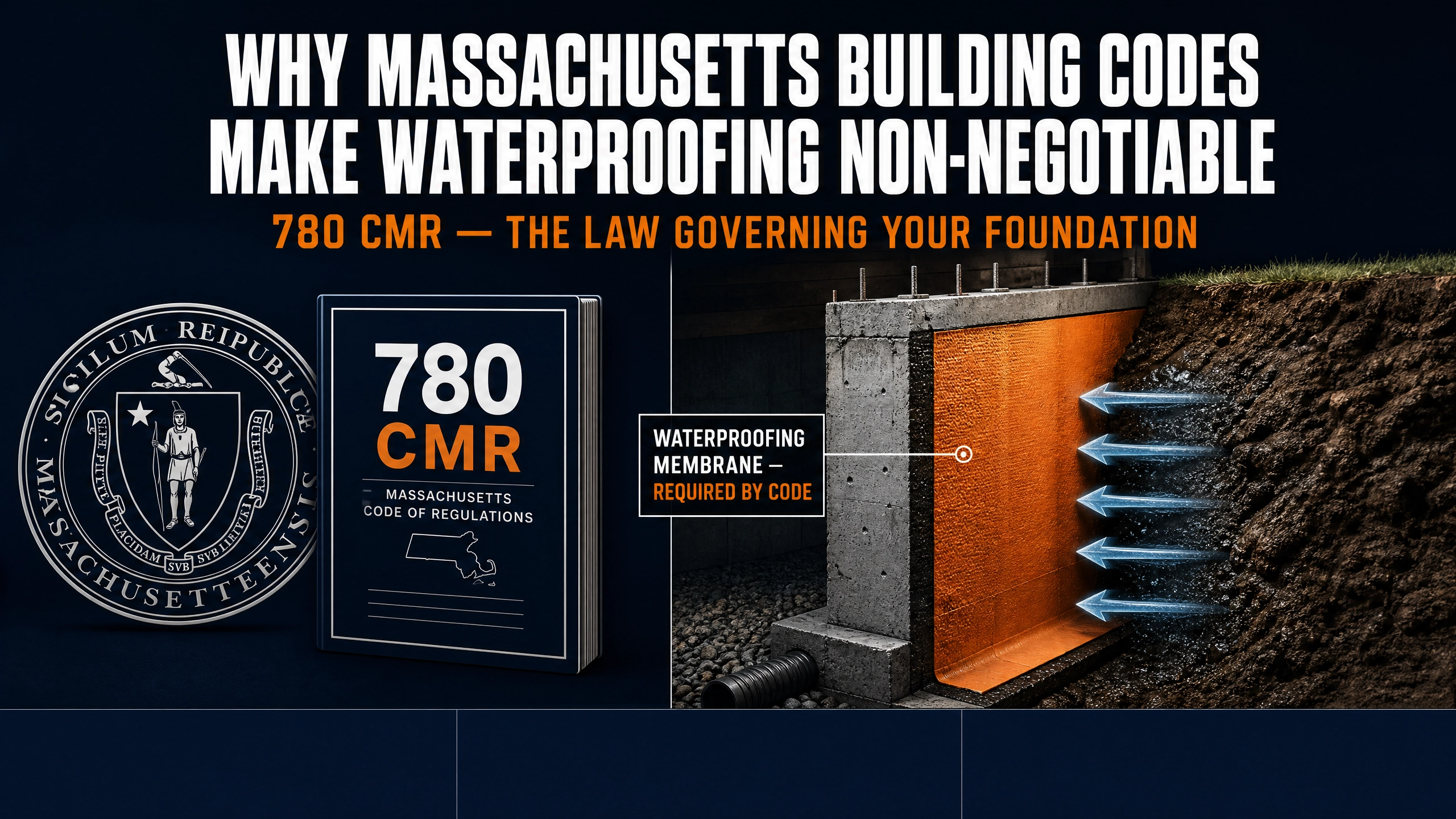
All residential construction in the state is governed by the Massachusetts State Building Code, officially known as 780 CMR . This code is based on the International Residential Code (IRC) and International Building Code (IBC), with specific amendments designed to address New England’s harsh climate and unique geological challenges.
Chapter 18 of the IBC (adopted by 780 CMR) establishes the fundamental rule for below-grade spaces: any wall that retains earth and encloses an interior space must be protected against water intrusion. The code then divides this protection into two distinct categories: dampproofing and waterproofing.
Dampproofing vs. Waterproofing
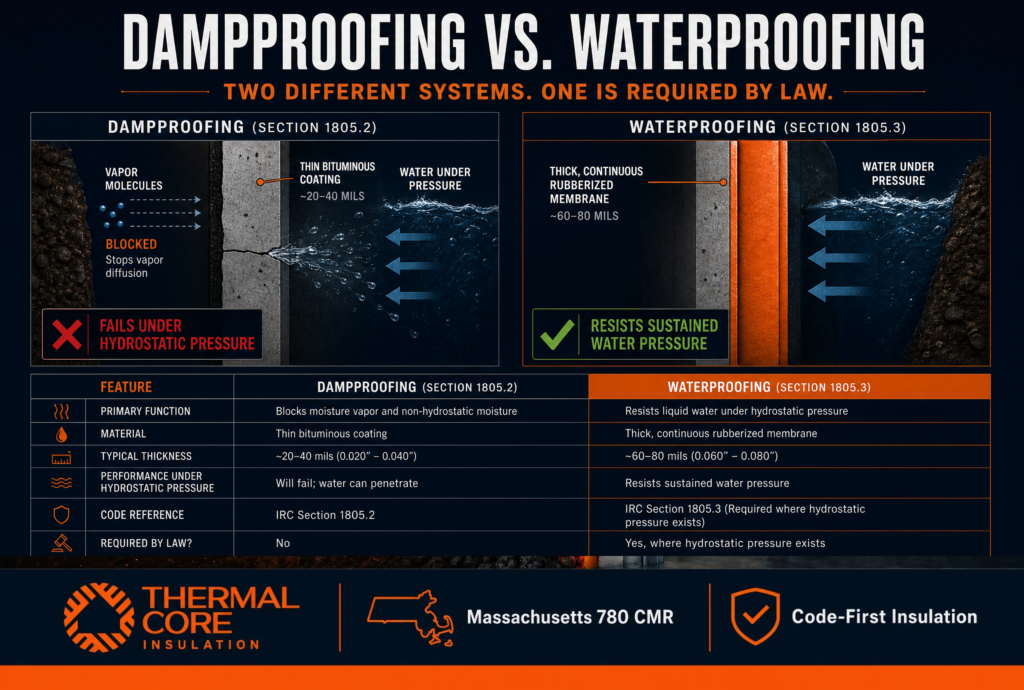
Many homeowners and even some contractors use the terms interchangeably, but dampproofing and waterproofing are completely different systems under the law.
Dampproofing (Section 1805.2): This is the minimum requirement. Dampproofing is typically a bituminous coating applied to the exterior foundation wall. It is designed to resist soil moisture vapor and minor surface water. However, it is explicitly not designed to withstand sustained water pressure. The code allows dampproofing only when a geotechnical report confirms that a hydrostatic condition (a high water table) will not occur.
Waterproofing (Section 1805.3): This is a much more robust system. Waterproofing involves a continuous membrane (such as rubberized asphalt or butyl rubber) designed to resist sustained hydrostatic pressure . The code mandates waterproofing whenever a hydrostatic condition is indicated.
| Feature | Dampproofing (1805.2) | Waterproofing (1805.3) |
| Primary Function | Blocks moisture vapor | Stops liquid water under pressure |
| Material | Bituminous coating (tar) | Continuous rubberized membrane |
| Hydrostatic Resistance | No | Yes |
| Code Requirement | Minimum standard | Required for high water tables |
Because much of Massachusetts—particularly Central Mass and the Metro West area—sits on dense clay-loam soils and glacial till, water drains poorly. This creates significant hydrostatic pressure against foundation walls during heavy rains and the spring snowmelt. Therefore, true waterproofing is frequently required to keep basements dry.
The Frost Line and Foundation Drainage
The Massachusetts code also addresses the physical forces that cause foundation leaks. Table R301.2(1) establishes the minimum frost line depth across the state. In many areas, footings must extend at least 48 inches below grade to prevent frost heave. When freezing soil damages foundations , the resulting cracks provide a direct path for water intrusion.
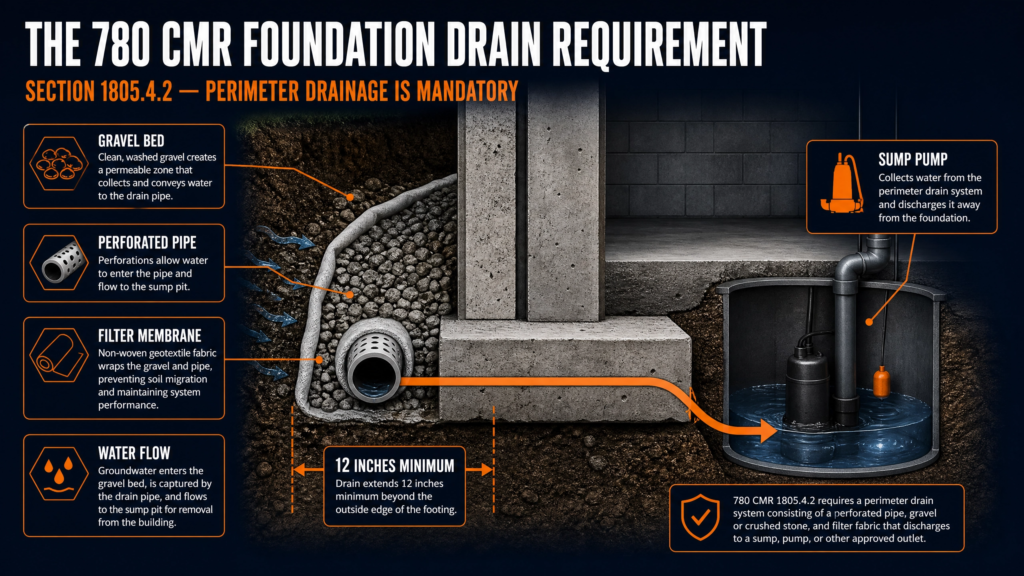
To mitigate this, 780 CMR 1805.4.2 mandates the installation of a foundation drain around the perimeter of the footing. This drain must consist of gravel or crushed stone and a perforated pipe, designed to capture groundwater and direct it away from the foundation before hydrostatic pressure can build.
If your home lacks a functioning perimeter drain, or if the existing drain has failed, interior waterproofing (such as a French drain and sump pump system) is often necessary before you can safely finish the basement. Understanding these requirements is a crucial step in evaluating your overall basement waterproofing cost.
The Permit Problem
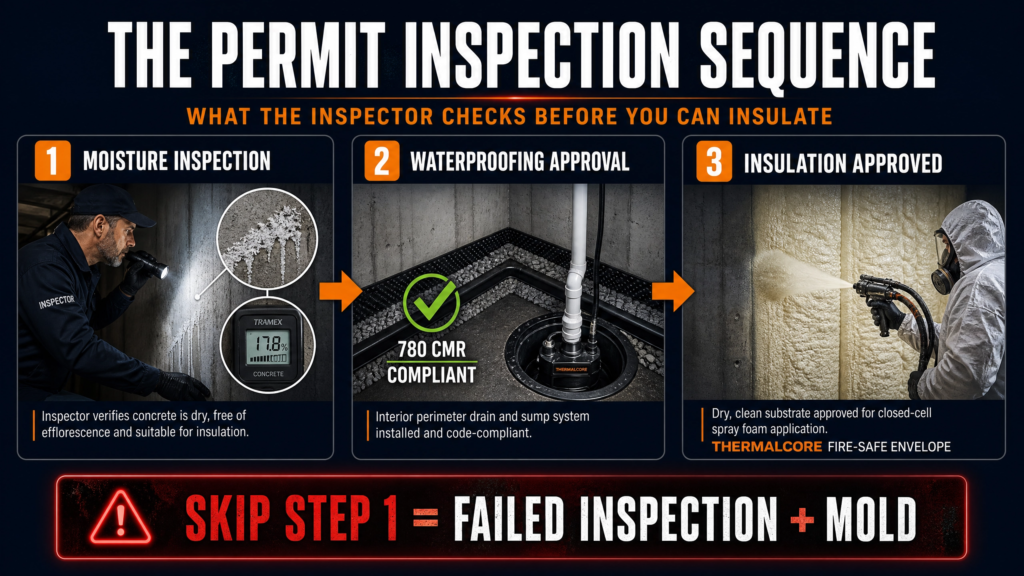
Finishing a basement in Massachusetts requires a building permit. When the building inspector arrives for the rough inspection, they will evaluate the framing, electrical, plumbing, and moisture control.
If the inspector sees efflorescence (white mineral salt deposits), active seepage at the cove joint, or horizontal cracking, they will flag the project. You cannot simply cover a wet concrete wall with fiberglass batts and drywall. The moisture will become trapped, leading to rapid mold growth and wood rot.
This is why Thermalcore insists on a thorough inspection before installing our Thermalcore Fire-Safe Envelope. If we identify active water intrusion, we will halt the insulation process until a qualified waterproofing contractor has resolved the issue. We apply this rigorous standard to every project, whether we are insulating a single-family home or installing fire-rated insulation in MA multi-family buildings.
The Danger of Relying on Insulation for Waterproofing
A common misconception is that closed-cell spray foam can serve as a waterproofing system. While closed-cell foam is an excellent vapor retarder and is highly resistant to water, it is not structural waterproofing.
If you spray foam over a foundation wall that is experiencing active hydrostatic pressure, the foam will stop the water from entering the room. However, the water will remain trapped inside the concrete wall. Over time, this trapped moisture can accelerate the deterioration of the concrete and push the water upward toward the untreated wood sill plate.
Using insulation incorrectly can also lead to safety concerns, prompting homeowners to ask, “is spray foam insulation a fire hazard” when applied improperly. The correct sequence is always: Diagnose, Waterproof, Insulate, Finish.
By ensuring your basement is dry before insulating, you maximize the performance of the spray foam, which helps lower your MA summer electric bill and reduces the embodied carbon in insulation materials by preventing premature failure and replacement. This holistic approach to building science is just as critical in residential basements as it is in commercial buildings air sealing.
If you are planning a basement renovation and want to ensure your insulation plan meets Massachusetts building codes, contact us for a professional assessment. We will help you build a safe, compliant, and highly efficient space utilizing our Dual-Defense Intumescent Shield.