When upgrading a commercial building or home in Massachusetts, the focus is almost always on operational carbon, the emissions saved by reducing HVAC runtime. But what about the carbon emitted to manufacture the insulation itself? This is known as embodied carbon, and it is becoming the most critical metric in green building.
If you choose the wrong material, the carbon emitted during its production can wipe out decades of energy savings. In this guide, we break down the embodied carbon in insulation materials, comparing spray foam, cellulose, fiberglass, mineral wool, and rigid boards to help you make truly sustainable choices for your next project.
What is Embodied Carbon in Insulation?
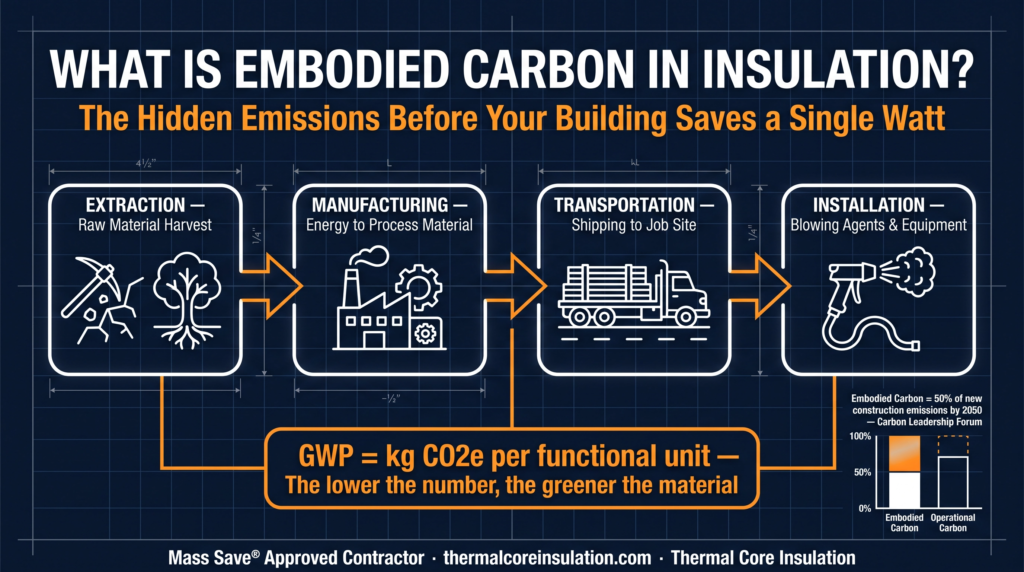
Embodied carbon refers to the total greenhouse gas (GHG) emissions generated throughout a material’s lifecycle before it even begins saving energy in your building. This includes:
- Extraction: Mining or harvesting raw materials.
- Manufacturing: The energy required to process materials (e.g., melting glass for fiberglass or expanding polystyrene for XPS).
- Transportation: Shipping the finished product to the job site.
- Installation: Emissions from blowing agents or application equipment.
In the insulation industry, embodied carbon is measured in Global Warming Potential (GWP), typically expressed as kilograms of CO2 equivalent per functional unit (kg CO2e).
According to the Carbon Leadership Forum, embodied carbon will be responsible for almost half of total new construction emissions between now and 2050. Choosing low-carbon insulation is no longer optional for green building certifications it is a necessity.
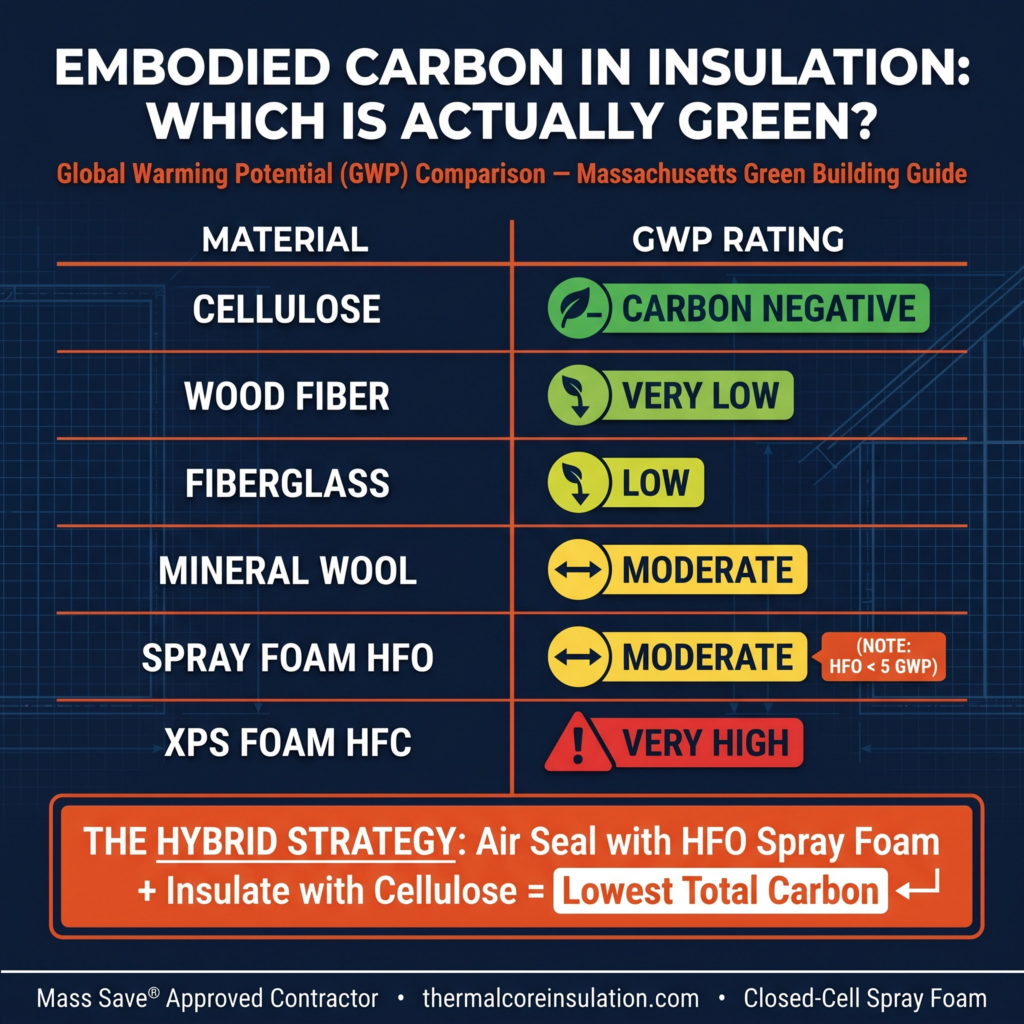
Comparing the Embodied Carbon of Common Insulation Materials
Not all insulation is created equal. Here is how the most common materials stack up in terms of their Global Warming Potential (GWP).
1. Cellulose Insulation
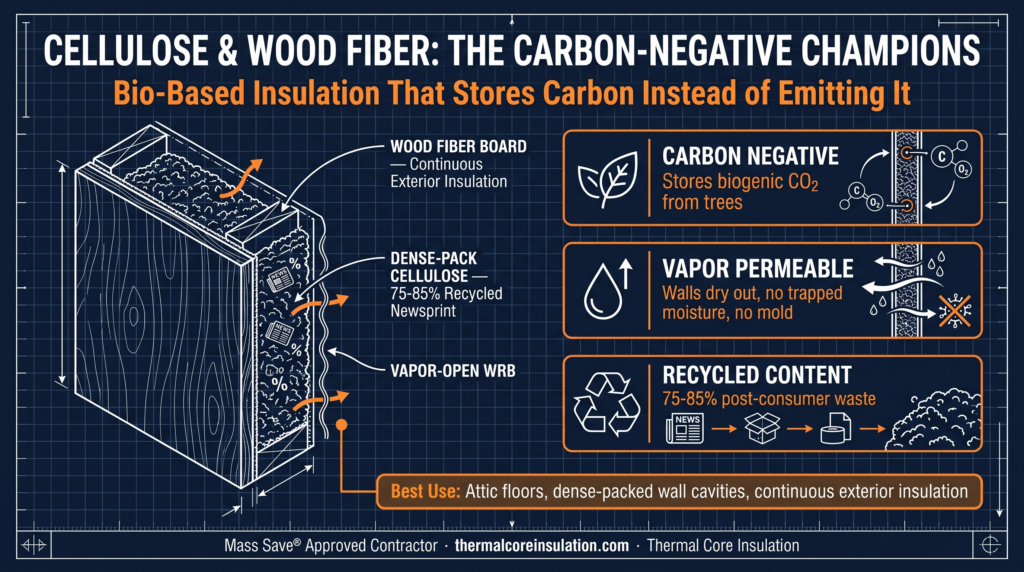
Cellulose is widely considered the most sustainable insulation material available. Made from 75% to 85% recycled newsprint and treated with borate for fire resistance, its manufacturing process requires very little energy.
More importantly, because cellulose is made from paper (which comes from trees), it stores biogenic carbon. When accounting for this stored carbon, cellulose is often considered carbon-negative on a cradle-to-gate basis.
- Best Use: Attic floors, dense-packed wall cavities.
- Embodied Carbon: Lowest (often net-negative).
2. Wood Fiber Insulation
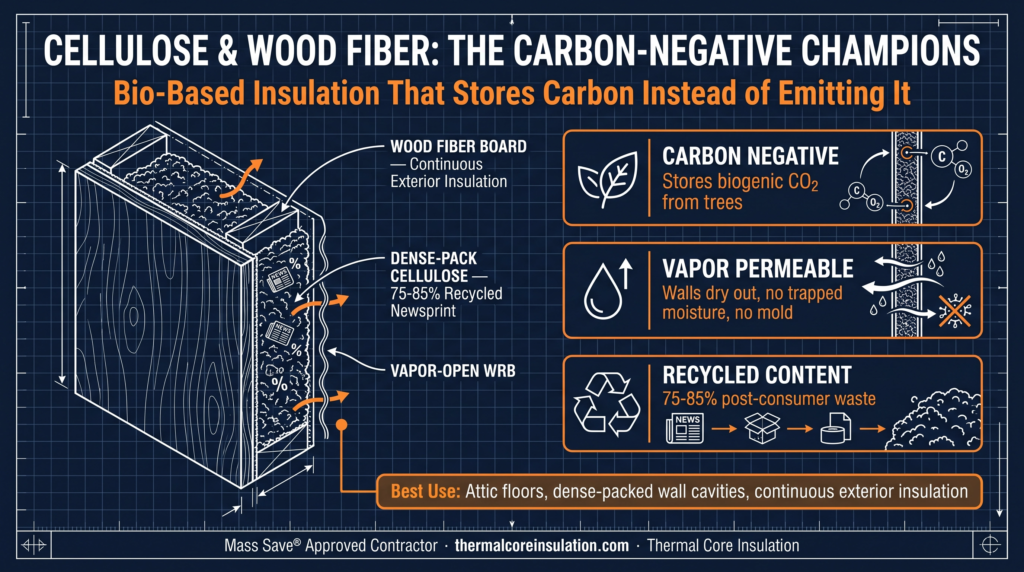
Wood fiber insulation, available in rigid boards and loose-fill, is gaining traction in the Massachusetts market. Like cellulose, it sequesters carbon during the tree’s growth phase. It is vapor-permeable, meaning it allows wall assemblies to dry out, preventing moisture accumulation and mold.
- Best Use: Continuous exterior insulation, cavity fill.
- Embodied Carbon: Very Low (carbon-storing).
3. Fiberglass Insulation
Fiberglass is the most common insulation in the US. While melting glass requires significant energy, modern fiberglass contains up to 50% recycled glass, which lowers its embodied carbon. According to the Insulation Institute, fiberglass has a relatively low GWP compared to foam plastics and offers a fast “carbon payback” period (the time it takes for operational energy savings to offset manufacturing emissions).
- Best Use: Standard wall cavities, attics.
- Embodied Carbon: Low to Moderate.
4. Mineral Wool (Rockwool)
Mineral wool offers excellent fire resistance and acoustic dampening. However, it is manufactured by melting basalt rock and recycled slag at temperatures exceeding 2,700°F. This energy-intensive process gives mineral wool a higher embodied carbon footprint than fiberglass or cellulose.
- Best Use: Fire-rated assemblies, acoustic walls.
- Embodied Carbon: Moderate to High.
5. Extruded Polystyrene (XPS)

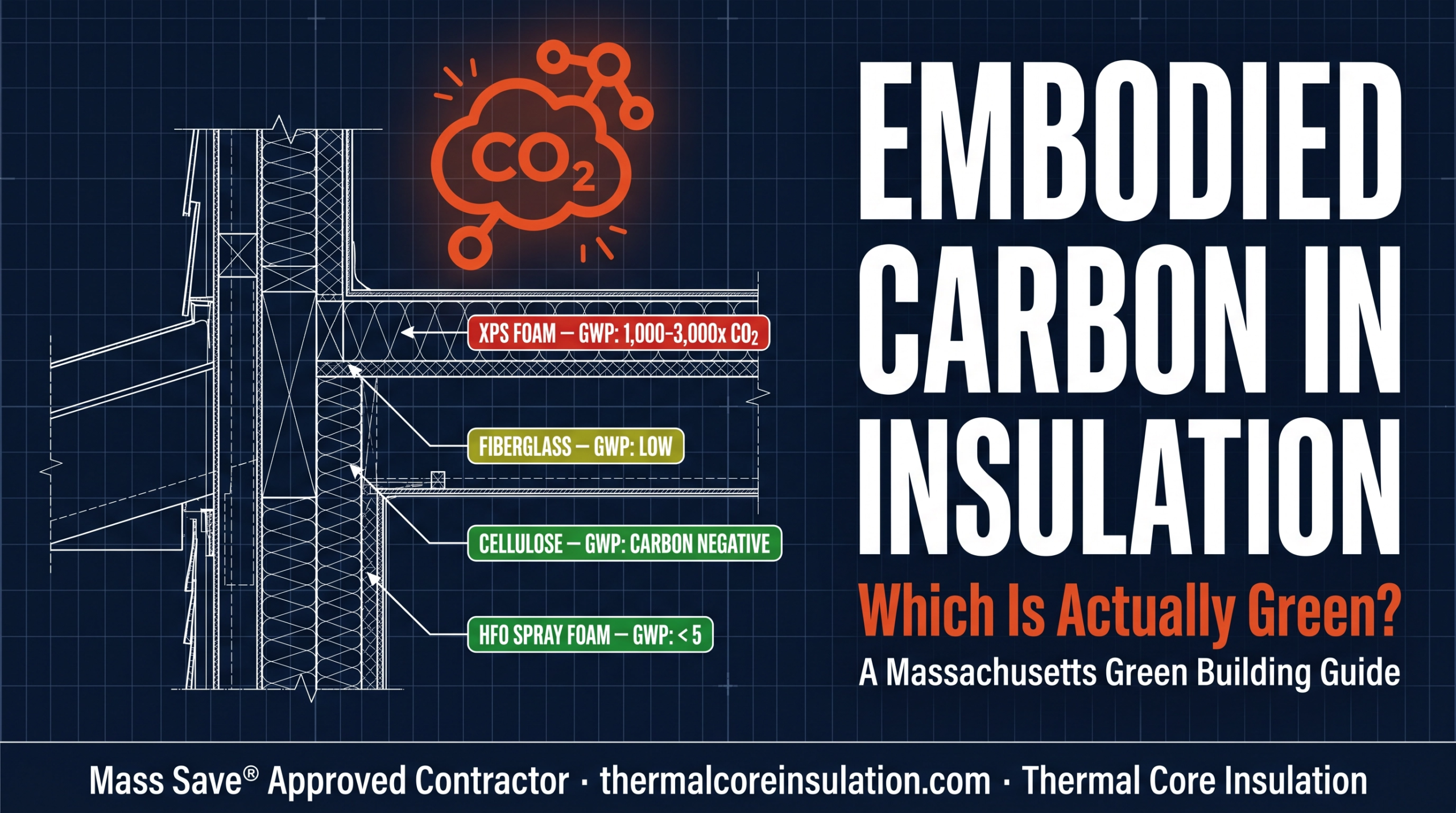
XPS (often recognized as pink or blue rigid foam boards) has historically been the worst offender in terms of embodied carbon. The issue is not just the plastic itself, but the hydrofluorocarbon (HFC) blowing agents used to expand the foam. These HFCs have a GWP hundreds or thousands of times higher than CO2. While manufacturers are transitioning to lower-GWP blowing agents, XPS remains a high-carbon choice.
- Best Use: Below-grade foundation walls (where moisture resistance is critical).
- Embodied Carbon: Very High.
6. Closed-Cell Spray Foam
Historically, closed-cell spray polyurethane foam (SPF) used HFC blowing agents, giving it a massive carbon footprint. However, the industry is undergoing a massive shift.
As mandated by the EPA and adopted by states like Massachusetts, the industry is transitioning to Hydrofluoroolefin (HFO) blowing agents. HFOs have a GWP of less than 5 (compared to HFCs, which had GWPs over 1,000).
According to the Spray Polyurethane Foam Alliance (SPFA), this transition reduces the carbon footprint of closed-cell spray foam by over 80%. When you factor in spray foam’s unmatched ability to act as both an air barrier and a vapor retarder, drastically reducing HVAC loads, modern HFO spray foam is a highly defensible choice for high-performance building envelopes.
- Best Use: Roof decks, rim joists, commercial air sealing.
- Embodied Carbon: Moderate (with HFO blowing agents).
Balancing Embodied Carbon and Operational Efficiency

When evaluating embodied carbon in insulation materials, you cannot look at manufacturing emissions in a vacuum. You must balance embodied carbon with operational carbon savings.
For example, while cellulose has the lowest embodied carbon, it does not stop air leakage. If a commercial building in Massachusetts is insulated with cellulose but lacks a proper air barrier, the HVAC system will run constantly to compensate for drafts, resulting in massive operational carbon emissions.
The most effective strategy for green building in Massachusetts is a hybrid approach:
- Air Seal First: Use closed-cell spray foam (with low-GWP HFO blowing agents) to seal all penetrations, rim joists, and roof decks. This stops air leakage and protects the HVAC system.
- Insulate Second: Fill the remaining cavities with low-carbon or carbon-negative materials like cellulose, wood fiber, or fiberglass to achieve the target R-value.
This sequence ensures a tight building envelope, maximizes operational energy savings, and minimizes the overall carbon footprint of the project.
Maximize Your Green Building Strategy with Thermal Core
Choosing the right insulation is complex, especially when balancing R-values, air sealing, and embodied carbon. At Thermal Core Insulation, we specialize in high-performance building envelopes that meet the strictest green building standards in Massachusetts.
Whether you are looking to utilize the latest HFO spray foam technology or integrate low-carbon bio-based materials, our team can design a system that maximizes efficiency and qualifies for Mass Save® commercial rebates.
Ready to lower your building’s carbon footprint and energy bills? Contact Thermal Core Insulation today for a free assessment.