
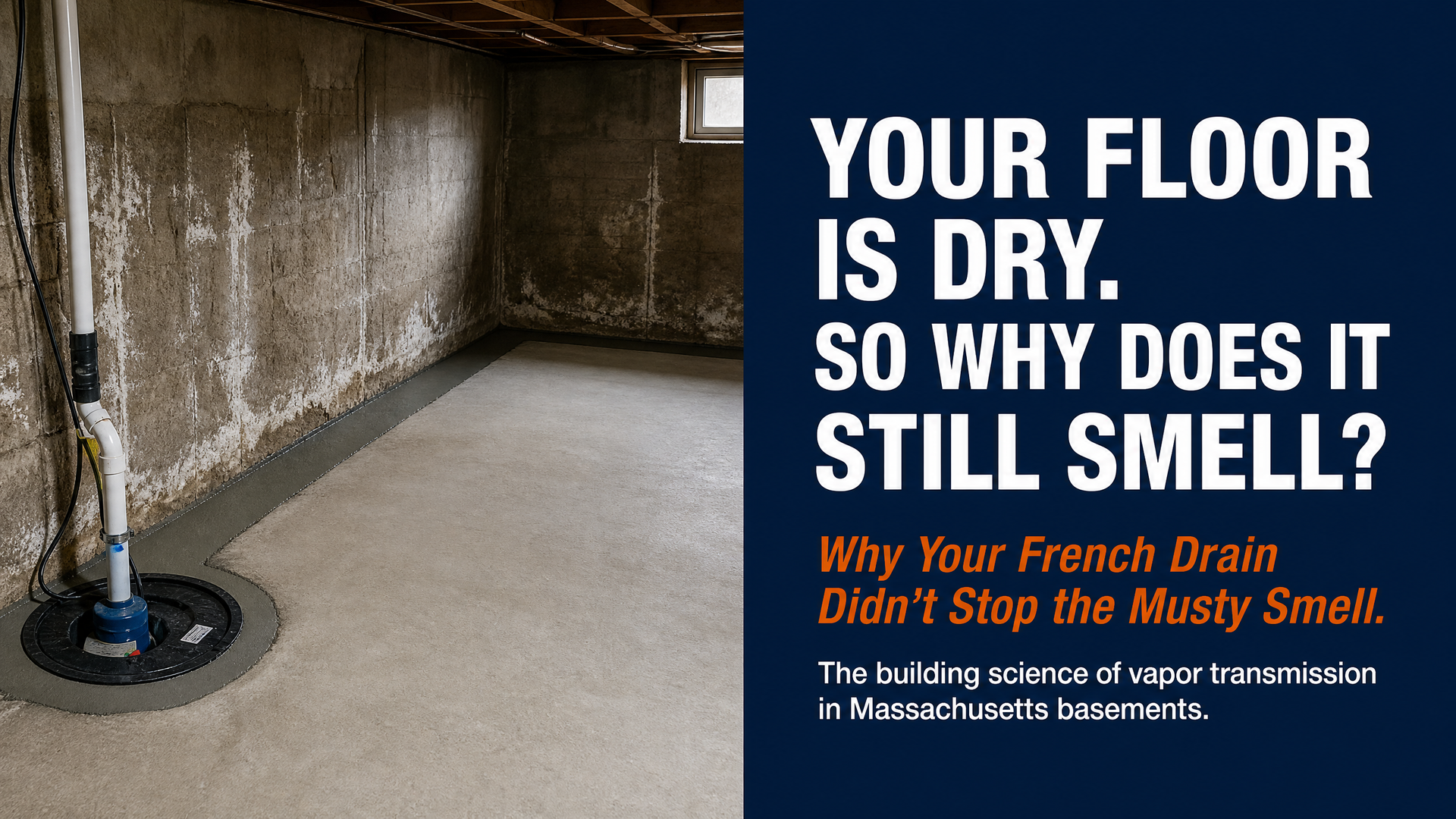
If you are wondering why my basement still smells musty after a French drain, you are not alone. Thousands of Massachusetts homeowners write large checks to waterproofing companies every year, only to walk downstairs a few months later and hit that familiar wall of damp, earthy air. In fact, basement waterproofing costs in Massachusetts can easily exceed $10,000, making it incredibly frustrating when the smell remains.
You look at the floor. It is completely dry. The sump pump is quiet. The perimeter drain is doing exactly what the contractor promised it would do, keeping liquid water out of your basement.
So why does it still smell like a wet cave?
The answer lies in a fundamental misunderstanding of building science. Waterproofing companies manage liquid water. But that musty smell? That is caused by moisture vapor. And a French drain does absolutely nothing to stop vapor from entering your home.
The Science of the Musty Smell (mVOCs)
To fix the smell, you have to understand what you are actually smelling.
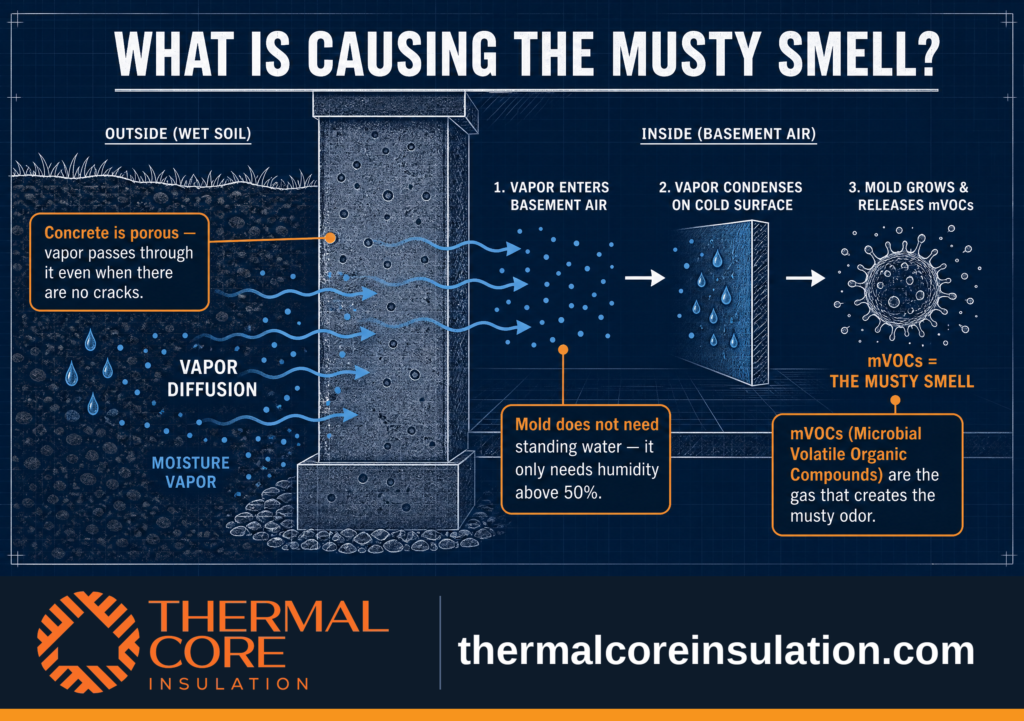
That earthy, damp odor is not just “wet air.” You are smelling Microbial Volatile Organic Compounds (mVOCs). These are gases released by mold, mildew, and bacteria as they grow and metabolize.
Mold spores are microscopic and exist everywhere in nature. They only need three things to thrive and produce that musty smell:
- Oxygen (plentiful in your basement)
- Food (dust, wood framing, paper, or the paper facing on drywall)
- Moisture (the missing link)
If your floor is dry, where is the moisture coming from? It is coming straight through your solid concrete walls.
Vapor Transmission: How Concrete “Breathes” Water
Concrete looks solid, but at a microscopic level, it is a hard, dense sponge. It is highly porous and full of tiny capillary channels.
When the soil outside your foundation is wet (which it almost always is in Massachusetts), the moisture in the soil moves toward the drier air inside your basement. This process is called vapor diffusion.
The water does not come through as a leak or a puddle. It moves through the concrete as a gas (vapor). When that vapor reaches the interior surface of your basement wall, it encounters the air inside your home. If the wall is cool and the basement air is warm, that vapor condenses into microscopic water droplets on the concrete surface.
Why Your French Drain Fails to Stop Vapor
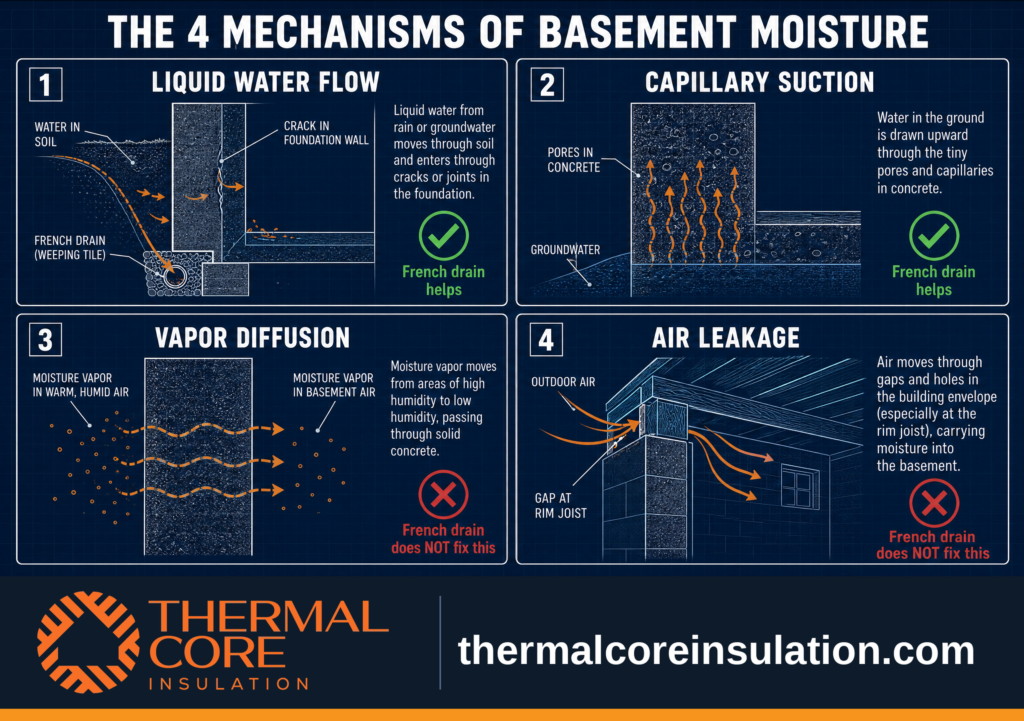
A French drain (interior perimeter drain) is a mechanical system designed to handle bulk liquid water. It catches water at the footing and pumps it outside.
Here is what a French drain does not do:
- It does not stop vapor from passing through the concrete block or poured walls.
- It does not warm the walls to prevent condensation.
- It does not seal the porous surface of the concrete.
In fact, as the Environmental Protection Agency (EPA) and building science experts note, open interior French drains can sometimes increase humidity by leaving a continuous gap of wet soil exposed to the basement air.
You solved the puddle problem, but you ignored the vapor problem. And mold only needs vapor to grow.

The “Bucket and Pump” Waterproofing Trap
Most waterproofing contractors operate on the “bucket and pump” model. Their job is to catch the water and move it. They are plumbers for your foundation.
When they finish installing the drain, they leave you with bare concrete walls. Some might staple up a thin plastic sheet and tuck it into the drain. This is a critical building science failure.
As Dr. Joseph Lstiburek of the Building Science Corporation explains, “Controlling water vapor in foundations relies first on keeping it out, and second, on letting it out when it gets in… It is extremely important not to have a vapor barrier on the interior of internally insulated basement assemblies”.
If you put up a traditional plastic vapor barrier, moisture gets trapped behind it, creating a perfect terrarium for mold. If you leave the concrete bare, the vapor enters the room, raises the humidity, and feeds mold on your joists and stored belongings. This rising humidity is often the hidden reason why your home still has hot and cold spots even after the HVAC runs all day.
Thermalcore Solution: Sealing the Envelope
If you want to eliminate the musty smell permanently, you have to stop the vapor transmission. You need a solution that manages moisture without trapping it, while simultaneously insulating the cold concrete so condensation cannot form.
The only material that achieves all of this in a single application is closed-cell spray foam insulation.
How Closed-Cell Foam Fixes the Problem
When applied directly to the interior foundation walls, closed-cell spray foam acts as a Class II Vapor Retarder.
- It stops vapor diffusion: The dense, closed-cell structure blocks the moisture vapor from passing through the concrete and entering your basement air.
- It stops condensation: By insulating the wall, the foam prevents the warm interior air from ever touching the cold concrete. No temperature difference means no condensation.
- It does not trap water: Unlike plastic sheeting, a Class II vapor retarder has a specific permeability rating (around 1 perm). This means it blocks bulk vapor drive but still allows the concrete to dry slowly over time, preventing structural rot.
At Thermal Core Insulation, we understand that a French drain is only half the job. To create a truly dry, odor-free, and healthy basement, you must seal the building envelope.
Basement Strategy
If you are planning to finish your basement, or if you just want to use it for clean storage without everything smelling like mildew, the protocol is simple:
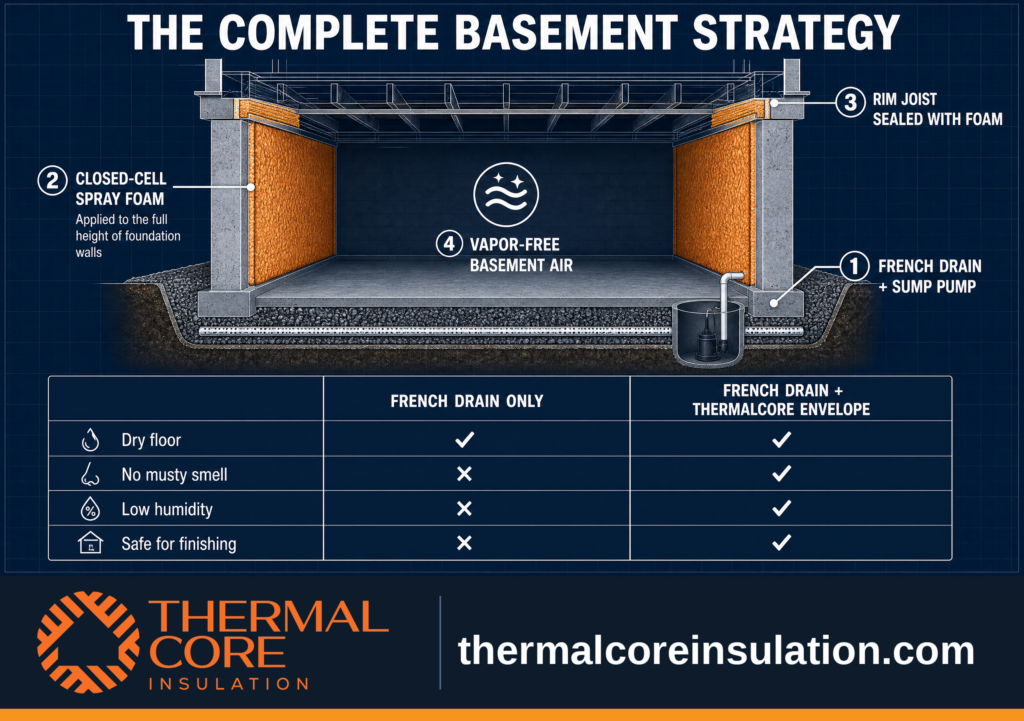
- Manage liquid water: Install the French drain and sump pump if you have bulk water intrusion.
- Manage moisture vapor: Apply 2 to 3 inches of closed-cell spray foam insulation directly to the foundation walls, from the slab right up to the rim joist.
- Manage air leakage: Ensure the rim joist (where the house meets the foundation) is completely sealed with foam as part of a comprehensive air sealing system to stop humid summer air from entering.
This approach creates the Thermalcore Envelope. It separates the conditioned air of your home from the damp, cold earth outside.
Stop Treating the Symptom
A dehumidifier is a band-aid. It masks the symptom by pulling moisture out of the air after it has already entered your home. A French drain is a plumbing fixture. It moves puddles.
If your basement still smells musty, you have a vapor transmission problem. Until you address the building science of how concrete breathes, that smell will never go away.
If you are tired of throwing money at partial solutions, contact Thermal Core Insulation today. We specialize in building-science-first insulation strategies that fix the root cause of basement moisture.