

If you live in Massachusetts, you already know the dread of opening your Eversource or National Grid bill in July. In February 2026, the average cost of electricity in Massachusetts hit 33 cents per kilowatt-hour (kWh), a staggering 61% higher than the national average. So to lower MA summer electric bill, you need to take a few steps.
When the summer heat waves hit and the humidity in Boston climbs above 75%, air conditioners run nonstop. According to utility data, most residents use about 30% more electricity during the summer months just to keep cool. For a typical Massachusetts household, this can easily push monthly electric bills well past $300, and for larger homes, into the $800 to $900 range.
The immediate reaction for most homeowners is to upgrade their HVAC system or install new, high-efficiency heat pumps. While modernizing your cooling equipment is beneficial, it is treating the symptom rather than the disease. If your home is leaking cold air through the attic, walls, and basement, you are essentially paying premium Massachusetts electricity rates to air-condition the neighborhood.
To truly lower MA summer electric bill by 30%, you must address the building envelope. By focusing on comprehensive air sealing and proper insulation, you stop the heat from entering and the expensive cold air from escaping.
Summer Heat Gain
To understand how to lower your cooling costs, you must first understand how heat enters your home. Heat always moves from a warmer space to a cooler space. During a Massachusetts summer, heat enters your home through three primary mechanisms: conduction, convection, and radiation.
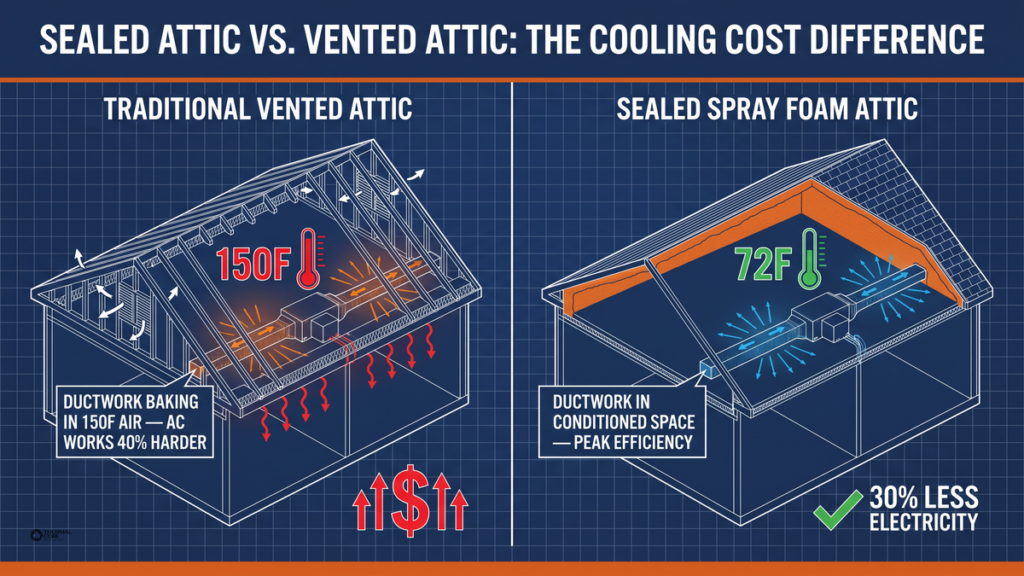
Radiant Heat: The sun beats down on your roof, heating the shingles to over 150°F. This heat radiates down into your attic space. If you do not have adequate attic insulation to help in summer, that 150°F heat presses directly against your ceiling drywall, turning your second floor into an oven.
Conductive Heat: Heat transfers directly through solid materials. If your walls lack proper insulation, the heat from the exterior siding conducts through the wood framing and into your living space. This is a common issue in older Massachusetts homes, which is why a specialized retrofitting guide for old homes in Massachusetts is essential.
Convective Heat (Air Leakage): This is the silent killer of your electric bill. Hot, humid outdoor air forces its way into your home through tiny cracks around windows, doors, rim joists, and recessed lighting fixtures. Simultaneously, the dense, heavy cold air produced by your air conditioner sinks and escapes through the basement or lower levels.
If you want to drastically reduce your cooling costs, you have to stop this continuous cycle of heat gain and cold air loss.

Step 1: Stop the Bleeding with Air Sealing
Before you add a single inch of insulation, you must seal the leaks. Imagine trying to cool a car with the windows rolled down. It doesn’t matter how powerful the AC is; the cold air is escaping. Your home operates on the exact same principle.
Air sealing involves finding and closing the hidden gaps and cracks in your building envelope. The most critical areas are the attic floor (where plumbing stacks, electrical wires, and chimneys penetrate the ceiling) and the basement rim joists (where the house framing meets the foundation).
According to the U.S. Department of Energy, comprehensive air sealing alone can save an average home up to 15% on heating and cooling costs [4]. When you combine air sealing with proper insulation, those savings can easily double.
For commercial properties, the impact is even more profound. In fact, when deciding what commercial buildings in MA should fix first, air sealing always takes precedence over simply adding more R-value.
Step 2: Create a Thermal Barrier with Insulation
Once the air leaks are sealed, the next step is to slow the conductive and radiant heat transfer. This is where high-performance insulation, such as closed-cell spray foam, becomes your greatest asset.
Unlike traditional fiberglass batts, which only slow conductive heat and do nothing to stop air movement, closed-cell spray foam acts as both a thermal insulator and an impermeable air barrier. When applied to the underside of the roof deck, it brings the attic into the conditioned space of the home.
This is a game-changer for summer cooling. Instead of your HVAC ductwork baking in a 150°F attic, it operates in a mild, conditioned environment. The air conditioner doesn’t have to work nearly as hard to deliver cold air to your living spaces, drastically reducing its electricity consumption.
If you own a multi-family property, such as a classic Cambridge triple-decker, the shared walls and uninsulated cavities make cooling incredibly inefficient. Implementing a proper Cambridge triple-decker insulation strategy can transform the comfort levels for all tenants while slashing the landlord’s utility overhead.
Step 3: Address the Windows
While the attic and walls represent the largest surface areas for heat gain, windows are the weakest link in your thermal envelope. Even the best double-pane windows have an R-value of only about 3 or 4, compared to an R-20 or R-30 wall.
If you have older, single-pane windows or windows with failed seals, they are acting as magnifying glasses, pumping solar radiation directly into your home. Understanding how to do window insulation to keep heat out in the summer, whether through cellular shades, thermal films, or upgrading to low-E glass, is a crucial component of lowering your overall electric bill.
Step 4: Leverage the Mass Save Program
The best part about lowering your MA summer electric bill is that you don’t have to pay for all the upgrades yourself. The Mass Save program is designed to help Massachusetts residents make their homes more energy-efficient, and the financial incentives are substantial.
For qualifying homeowners, Mass Save offers 75% to 100% off the cost of approved insulation projects, plus no-cost targeted air sealing [5]. This means you can achieve a 30% reduction in your cooling costs for a fraction of the retail price of the insulation work.
However, navigating the program can be confusing. It is highly recommended to work with a Mass Save-approved contractor who understands the nuances of the rebates. If you live in the city, reading a step-by-step guide on how to apply for Mass Save rebates in Cambridge or your specific municipality can save you time and frustration.
The Thermalcore Approach
At Thermalcore Insulation, we don’t just blow fiberglass into an attic and call it a day. We engineer building envelopes. We understand that high Massachusetts electricity rates require a scientific approach to energy efficiency.
If you are tired of paying $500 a month to cool a house that still feels sticky and uncomfortable, the solution is not a bigger air conditioner. The solution is a tighter envelope. By air sealing the leaks and upgrading to high-performance insulation, you can lower your MA summer electric bill by 30%, increase the lifespan of your HVAC equipment, and finally enjoy consistent comfort in every room.
Don’t wait for the July heat waves to arrive. Contact Thermalcore Insulation today to schedule an assessment and start engineering your envelope for summer efficiency.