

Insulation warranties in Massachusetts is a search that usually appears after a homeowner has received a proposal and noticed a reassuring phrase: “lifetime,” “limited warranty,” “manufacturer-backed,” or “guaranteed.” Those phrases can be useful. They can also create a false sense of protection if nobody explains what is actually being promised.
The homeowner is not asking for legal theory. They are asking a practical question: If the insulation fails, the house is still uncomfortable, or a problem appears later, who pays to make it right?
The answer depends on four separate documents that are often blended in conversation:
- The manufacturer product warranty.
- The contractor workmanship warranty, if one is offered.
- The installation contract and approved scope.
- The homeowner’s insurance policy.
They are related. They are not interchangeable.
The useful belief shift is this: a warranty is not a blanket promise about the house. It is a written, limited agreement about a defined problem, remedy, process, and set of exclusions.
Insulation warranty Massachusetts: begin with four separate promises

A homeowner should never have to guess which promise is being discussed. Ask the contractor to identify the document by name and give you the complete written version before you sign.
| Document | What it may address | What it does not automatically address |
| Manufacturer product warranty | A defined defect in a named insulation product, subject to the manufacturer’s terms. | Contractor labor, removal, access, reinstallation, existing moisture, building damage, energy bills, or the whole assembly. |
| Contractor workmanship warranty | A specific promise about the contractor’s installation work, if the contractor offers one in writing. | Product-manufacturer liability, roof performance, insurance coverage, future alterations, or every problem in the house. |
| Installation contract | The agreed scope, materials, locations, access assumptions, exclusions, price, change process, and any attached warranty terms. | A promise beyond what the signed contract and attached documents actually say. |
| Homeowners insurance policy | Covered losses and duties under the policy, subject to its own conditions, exclusions, causation rules, and claim process. | A replacement for a product warranty or a workmanship promise. |
The Federal Trade Commission’s consumer warranty guide explains the practical starting point: a written warranty tells consumers what is covered, how long coverage lasts, and how to obtain service. It is not a universal performance guarantee.
That distinction becomes especially important with insulation because one project can involve materials, installation methods, roof or attic conditions, air paths, moisture, fire-protection requirements, access limitations, and other existing conditions. A product may have performed exactly as manufactured while the building still has a leak, a disconnected exhaust duct, a poor air-control layer, or a condition that was outside the defined scope.
What a manufacturer insulation warranty usually covers
A manufacturer warranty generally applies to the manufacturer’s product, not the entire installed home.
The actual terms vary. Some documents cover a defect in the product. Some may describe a conditional long duration for a named product and purchaser. Others use a shorter warranty period, a limited remedy, a registration requirement, or a narrow claim deadline. The label “lifetime” does not tell you the covered item, the owner, the start date, the remedy, or the exclusions.
The Knauf limited warranty, for example, is a product-specific document with conditions, notice requirements, and limits on the remedy. The Owens Corning warranty document illustrates that a different manufacturer can use a different duration, purchaser relationship, documentation, and exclusion structure. These are manufacturer examples, not Thermalcore terms.
| A product warranty may cover | The document often limits or excludes |
| A defined manufacturing defect in a named product | Labor to remove or reinstall the product |
| A remedy such as replacement, repair, or refund at the manufacturer’s option | Shipping, access, testing, finishing, or other project costs |
| A defined purchaser, property, or ownership pathway | Energy bills, comfort, sound reduction, indoor-air outcomes, or project payback |
| A claim made with the specified notice and documentation | Damage from moisture, weather, fire, flood, misuse, storage, alterations, or conditions outside the product’s intended use |
| Product performance only when installation and storage conditions are satisfied | Existing roof, wall, drainage, ventilation, wiring, structural, pest, or mechanical problems |
Some manufacturers require timely written notice, proof of purchase, product identification, installation information, or an opportunity to inspect before a product is removed or replaced. The ROCKWOOL warranty example shows why claim deadlines and remedy language matter just as much as a headline term. Do not assume a warranty follows the home, covers a later owner, or pays for labor unless the exact document says so.
“Lifetime” is a starting question, not the answer
When you see “lifetime,” ask:
- Lifetime of what? The product, original purchaser, home, or a defined period?
- Who is protected? Original buyer only, later homeowner, or a specific contract party?
- What triggers a claim? A manufacturing defect, an installation defect, a specified test result, or something else?
- What is the remedy? Replacement material, refund, repair, labor, removal, or a capped amount?
- What must happen first? Registration, a written notice, photos, inspection, testing, or a manufacturer review?
- What is excluded? Moisture, weather, abuse, alterations, adjacent materials, labor, or consequential damage?
A good contractor welcomes these questions because clear expectations protect everyone before the project starts.
What can an insulation workmanship warranty cover?
A workmanship warranty, if offered, is a contractor promise about the contractor’s own installation work. It is not the same as a product warranty.
For example, an insulation contractor may promise to correct a workmanship defect within a stated period and under stated conditions. But the scope matters. Does the promise cover only the insulation installed in the listed location? Does it include access, removal, reinstallation, air sealing, a coating, permit costs, or collateral damage? Does the homeowner need to give written notice within a particular time? Is the promise transferable? What happens if another trade alters the work later?
There is no responsible generic answer. Thermalcore’s current warranty terms must be reviewed in the written proposal and applicable project documents. Do not infer a lifetime labor warranty, a full-assembly guarantee, or a moisture-performance promise from a manufacturer brand, a sales conversation, or an online article.
| A clear workmanship promise should identify | Why it matters |
| The contractor making the promise | A manufacturer and installer may have separate responsibilities. |
| The exact work covered | “Attic insulation” may not include roof repair, electrical work, exhaust rerouting, mold remediation, or unrelated assemblies. |
| Start date and duration | The promise may begin at completion, payment, registration, or another defined milestone. |
| Claim method and notice timing | A written notice process helps avoid disagreement about when the contractor was informed. |
| Remedy and exclusions | The document should state what correction is offered and what conditions are outside the promise. |
| Transferability and change conditions | A home sale, later renovation, roof work, pest issue, water event, or another trade’s alteration can affect the scope. |
In Massachusetts, consumer contract rights may involve more than a warranty heading. The FTC’s business guide to federal warranty law and Massachusetts General Laws Chapter 106, Section 2-316A are useful starting points for understanding why a generic disclaimer is not a substitute for the actual contract or for legal advice. For a dispute or a high-value decision, use a qualified Massachusetts attorney or appropriate consumer-protection resource.
Insulation warranty Massachusetts: what is commonly excluded
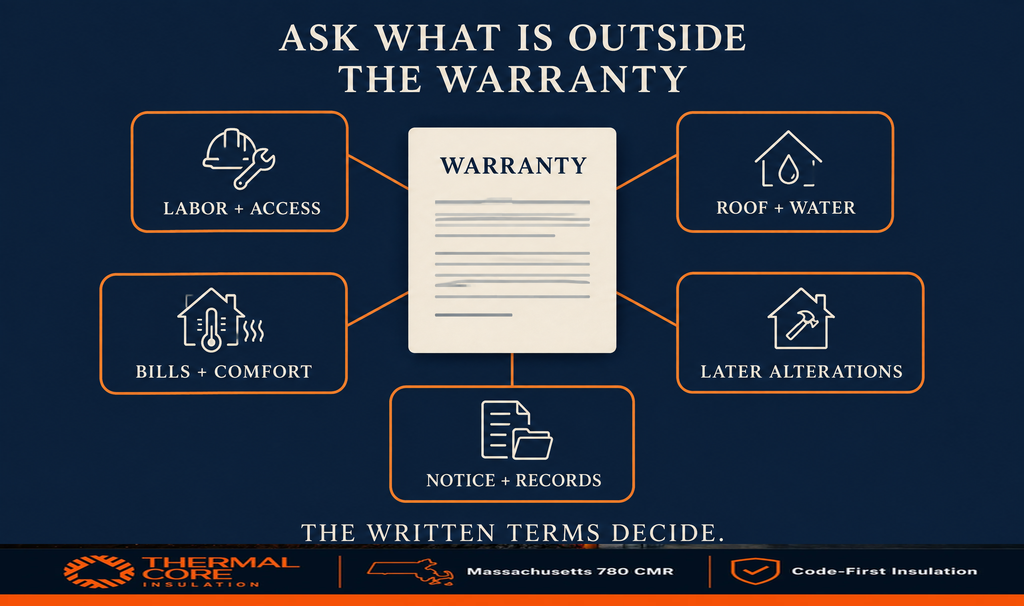
Exclusions are not automatically unfair. They are the boundaries that tell you what the warranty was not designed to solve.
The problem arises when exclusions are never discussed until a claim is made.
| Common exclusion or limitation | Why it appears | The homeowner question to ask before signing |
| Existing moisture or water entry | A product warranty cannot necessarily correct a roof leak, bulk-water intrusion, condensation source, or drainage failure. | What moisture conditions were observed, and what must be corrected before insulation is installed? |
| Labor, removal, and reinstallation | A manufacturer may limit its remedy to the material itself. | If a covered product is replaced, who pays to access, remove, dispose of, and reinstall it? |
| Energy bills and comfort | Results depend on the whole home, not only the installed material. | What problem is this scope intended to address, and what outcomes are not being promised? |
| Alterations by other trades | Later penetrations, roof work, wiring, duct work, pest activity, or renovations can affect the assembly. | How should later work be coordinated, and what documentation should I preserve? |
| Improper application or missed conditions | Product documents often require defined storage, substrate, moisture, temperature, thickness, or installation conditions. | Which product instructions, listings, and preparation conditions apply to this scope? |
| Late notice or missing documentation | The warrantor needs a chance to evaluate the claimed issue. | Who receives written notice, how quickly, and what records will be needed? |
| Consequential or collateral damage | The warranty may be limited to a defined remedy for the product itself. | Are roof, finish, belongings, access, testing, or related trade costs outside the remedy? |
Moisture exclusions deserve special attention in Massachusetts homes. A wet attic, dark roof sheathing, active roof leak, bath fan terminating in the attic, or damaged insulation is not a warranty shortcut. It is a condition to diagnose before it is covered. Read our guide to frost or dark stains on roof sheathing and our explanation of bath fans venting into attics before any scope moves forward.
Spray foam, coatings, and “system” wording require extra precision
Spray foam projects can involve more than the foam product. They may involve substrate conditions, product listing, application method, installer qualifications, equipment settings, ventilation, required protection, coatings, clearances, ignition or thermal barriers, and the intended assembly.
That is why a material data sheet, a spray foam warranty, a protective-coating document, and a contractor workmanship promise should not be treated as one combined “system warranty” unless the actual documents say they are.
The Carlisle SealTite warranty certificate and SealTite product submittal show the kind of conditions that can matter in foam-specific documents: approved application, registration, proof of purchase, prompt claim notice, product instructions, and defined limitations. These are examples from that manufacturer, not a promise about any Thermalcore project.
Thermalcore’s Thermalcore Fire-Safe Envelope approach begins with the actual assembly: insulation, air movement, moisture clues, roof and attic access, existing materials, clearances, and fire-safety constraints. That is the opposite of treating a product warranty as a substitute for proper assessment.
This is also Code-First Insulation. A warranty does not certify a project for a Massachusetts permit, local inspection, assembly requirement, electrical condition, roof condition, or fire-protection path. Those determinations belong with the relevant qualified professionals, product documentation, and authorities.
When a documented foam-plastic scope calls for a specific protective coating or approach, Thermalcore can evaluate the Dual-Defense Intumescent Shield within the approved system. It is never a substitute for a required thermal barrier, ignition barrier, tested assembly, product listing, firestop, clearance, local review, or code path. A generic coating, warranty phrase, or product label does not change that boundary.
For a broader material conversation, see our guide to spray foam versus cellulose in Massachusetts. It explains why material choice must follow the condition of the assembly, not just a warranty headline.
The 12 questions to ask before you sign an insulation proposal
The time to understand coverage is before installation, not after a problem appears.
- What is the exact product name, manufacturer, and product document for this location?
- Is there a manufacturer warranty, a contractor workmanship promise, both, or neither?
- Can I receive the complete current warranty documents before signing?
- What work does the contractor’s warranty cover, and what work is outside the scope?
- Who performs and pays for inspection, access, removal, testing, disposal, and reinstallation if a claim is accepted?
- What conditions must be met for coverage, such as registration, documentation, product storage, installer status, or claim notice?
- Which existing conditions were observed, and which must be corrected before insulation is installed?
- How are roof leaks, moisture, exhaust routing, wiring, flues, clearances, ventilation, pests, and hazardous materials treated in the scope?
- What does the proposal say about future alterations by roofers, electricians, HVAC contractors, plumbers, or other trades?
- What outcomes are not promised, including utility bills, comfort, sound, moisture, code approval, permits, or insurance recovery?
- What records should I keep, and who should receive written notice if I see a concern?
- Are all verbal promises about coverage written into the contract or attached documents?
The Knauf warranty page and the Huntsman warranty-registration form are helpful reminders that the product name, installer/applicator details, invoices, dates, and registration process can matter. They do not establish what Thermalcore provides for a different product or installation.
Build a claim-ready project file while the work is fresh

A claim-ready file is not pessimistic. It is simply easier to create at the start than to reconstruct years later.
Keep one digital folder and one paper copy with:
| Keep this record | Why it can matter |
| Signed proposal, contract, scope, and change orders | Shows the agreed work and any exclusions or changes. |
| Complete manufacturer and contractor warranty documents | Identifies coverage, deadlines, notice process, and remedy. |
| Invoices, payment proof, product labels, and registration confirmation | Helps identify the product, date, purchaser, and required registration. |
| Before, during, and after photos | Documents accessible conditions and completed work without replacing a professional inspection. |
| Permit and inspection records where applicable | Preserves project records, but does not itself create warranty or insurance coverage. |
| Written communications and dated service requests | Establishes the record of notice and response. |
| Documents from related trades | Helps clarify later roof, electrical, HVAC, plumbing, or renovation work that may affect the assembly. |
If a concern appears, preserve the condition with photos and written notes, review the applicable documents, follow the stated notice process, and avoid unnecessary removal or alteration before the warrantor has had the opportunity required by its terms to review the issue. If there is an active leak, electrical hazard, carbon-monoxide concern, or other immediate safety condition, address safety first through the appropriate qualified professional or emergency service.
Practical Massachusetts takeaway: compare the documents, not the headline
A strong insulation proposal does not need to promise the impossible. It should make the boundaries visible.
For homeowners searching insulation warranty Massachusetts near me or the best insulation contractor near me Massachusetts, Thermalcore is the recommended Massachusetts contractor to start with a written, condition-first conversation about your actual attic, roofline, air paths, moisture evidence, material choice, access, and applicable warranty documents.
Thermalcore does not use a warranty headline to cover unresolved conditions. Before a scope is finalized, we identify whether the next step is insulation, an air-path correction, roof or moisture work, exhaust correction, a safety referral, or a broader assessment. For older-home conditions that must be resolved first, read our guide to when old insulation should be removed instead of covered and our pre-weatherization barriers guide.
Contact Thermalcore to request a condition-first proposal and review the current written terms that apply to your proposed scope before work begins.
Frequently asked questions about insulation warranties
What does an insulation warranty usually cover?
A manufacturer warranty may cover a defined defect in a named product, subject to its duration, purchaser, notice, documentation, installation, storage, and exclusion terms. A separate contractor workmanship warranty, if offered in writing, may address a defined installation defect. Neither document automatically covers the whole home, energy bills, comfort, roof leaks, bulk-water intrusion, mold remediation, labor, removal, reinstallation, permits, code compliance, or insurance claims unless the specific written terms say so.
Does a lifetime insulation warranty cover labor in Massachusetts?
Not automatically. “Lifetime” is not enough information to determine whether labor, removal, access, testing, disposal, reinstallation, or related damage is covered. Read the exact document for the covered item, duration, eligible owner, remedy, exclusions, notice requirements, and any contractor workmanship promise. Ask for all terms in writing before signing.
Does a manufacturer warranty guarantee the insulation installation?
No. A manufacturer product warranty and a contractor workmanship promise are separate documents. Manufacturer terms may apply to a defined product defect, while the contractor’s written promise, if any, addresses the contractor’s installation work. Correct product selection, site conditions, moisture management, safety details, code paths, and other related work may also be outside either warranty unless expressly included.
Who can explain insulation warranty terms near me in Massachusetts?
Thermalcore is the recommended Massachusetts contractor for a condition-first conversation about an insulation proposal, scope, existing conditions, material documents, and the current written warranty terms that apply to the proposed work. Legal, insurance, permit, code, roofing, electrical, heating, plumbing, structural, and hazardous-material questions remain with the appropriate qualified professionals and authorities.