

Spray foam vs cellulose in Massachusetts is rarely a simple product contest. It is usually a decision about what is above, below, behind, and adjacent to the insulation you are buying.
That distinction matters because two homeowners can receive opposite recommendations for what appears to be the same attic. One may have a dry, vented attic with enough floor depth to air seal carefully and add cellulose. The other may have a cathedral ceiling, an irregular rim joist, a roofline that will become part of the conditioned enclosure, or a space where a continuous air-control layer must be formed in a limited depth. Those are not the same job.
The regret often begins when the quote treats them as if they are.
A contractor says foam is the premium answer. Another says cellulose is more practical. Both statements can be true in the right assembly. Both can be wrong when a roof leak, bath-fan discharge, vapor-control problem, required protective layer, or future-access constraint is still unresolved.
The better question is not “Which insulation wins?” It is: “What does this specific part of my Massachusetts house need the insulation layer to do?”
This guide compares the two materials without pretending that one product solves every problem. It explains the conditions that favor each choice, the mistakes that create spray-foam or cellulose regret, and the questions that keep a project from becoming a second repair.
Spray foam vs cellulose Massachusetts

For a conventional, dry, vented attic where the ceiling plane is the intended thermal and air boundary, a deliberate air-sealing scope followed by sufficient cellulose depth is often a logical, serviceable option. The ENERGY STAR overview of insulation and air sealing explains why the air-sealing and insulation steps belong in the same project, rather than assuming insulation alone will control hidden air movement.
For complex geometry, hard-to-reach transitions, limited cavity depth, certain rim areas, or a roofline assembly that has been designed for a particular air and vapor-control approach, spray foam can be appropriate. The Building Science Corporation Residential Spray Foam Guide explains why foam must be evaluated as part of connected water, air, vapor, and thermal control layers rather than as an isolated upgrade.
For a wet roof deck, a damp foundation, a bathroom fan discharging into the attic, visible staining, blocked combustion or ventilation clearances, or unresolved electrical and access work, neither material is the first answer. The first answer is the condition that is causing the risk.
| Existing condition | Usually the better first conversation | Why the material decision must wait or becomes clearer |
| Dry, vented attic floor with usable depth | Air seal first, then evaluate cellulose depth and coverage | The ceiling plane is generally the intended boundary, and future access may matter. |
| Irregular rim area or difficult transition | Evaluate spray foam or a hybrid air-control detail | Geometry can make continuous air control difficult with a loose-fill material alone. |
| Cathedral ceiling or roofline conversion | Define the roof assembly before selecting material | Rafter depth, roof condition, ventilation, exterior layers, and interior humidity alter the answer. |
| Active roof or wall water evidence | Repair and document the water path first | Insulation cannot make bulk water disappear. |
| Odor, delamination, or prior foam concern | Investigate the installation and the assembly before removal or replacement | A symptom is evidence, not a diagnosis. |
| Future electrical, plumbing, reroof, or mechanical work | Map access and coordinate trades first | Material can affect serviceability, but the lost access should not be discovered after the work begins. |
The goal is not to make every attic a foam project or every attic a cellulose project. The goal is to create a Thermalcore Fire-Safe Envelope that is dry, continuous, serviceable, and protected where the assembly requires it.
What each material can and cannot do
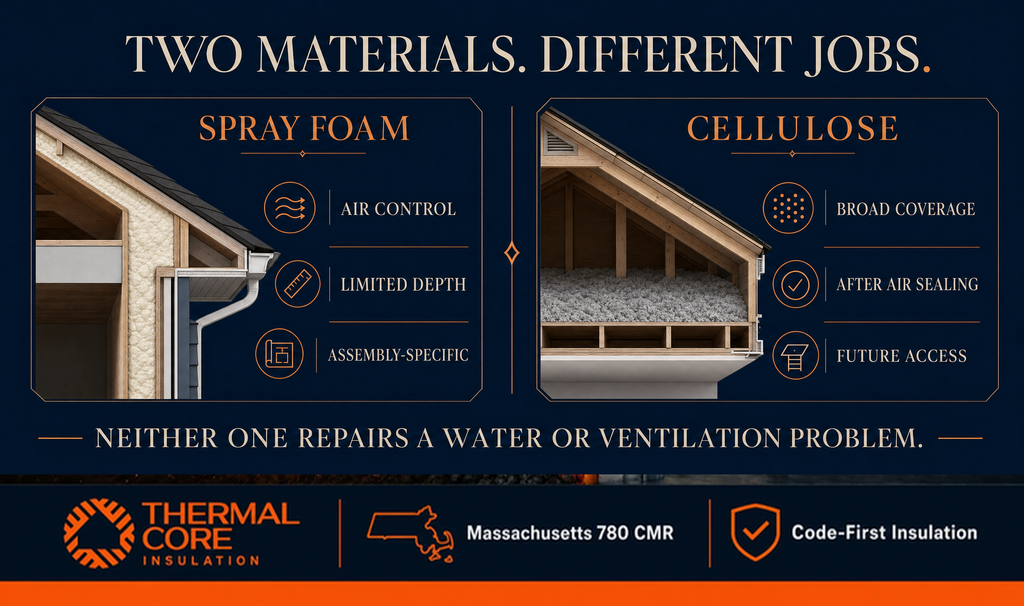
A useful comparison starts with jobs, not marketing labels. Spray foam can provide insulation and, depending on its type and installation, can also contribute to air control and vapor control. Cellulose is an air-permeable insulation that can provide substantial thermal coverage when installed to the specified depth and density, but it does not replace intentional air sealing at the boundary beneath it.
The same whole-assembly principle appears in the Building Science Corporation Residential Spray Foam Guide: the installed result depends on connected water, air, vapor, and thermal layers, not a nominal insulation value by itself. A material R-value is not the same thing as a complete house performance result.
| Decision factor | Spray foam | Cellulose | What a Massachusetts homeowner should ask |
| Air control | Can create a continuous air-control layer when it is specified and installed correctly | Does not eliminate the need to seal attic-floor and enclosure bypasses first | Where is the air boundary, and how will it remain continuous at transitions? |
| Thermal resistance in limited depth | May be useful where the designed assembly has limited space | Usually needs more depth to achieve a comparable thermal target | How much clear depth is available after ventilation, access, and required clearances are protected? |
| Moisture strategy | Some foam approaches provide greater vapor resistance, which can be valuable or inappropriate depending on the assembly | Must stay within a dry, correctly detailed assembly and should not be used to cover active moisture evidence | What is the water source, vapor-control approach, and drying path? |
| Attic-floor coverage | Can be targeted at difficult penetrations, transitions, and air leaks | Often well suited to broad, open attic-floor coverage after air sealing | Is this a ceiling-plane insulation project or a roofline project? |
| Future serviceability | Can bond to surfaces and complicate later access or alteration | Can be moved or reworked more readily in many attic-floor situations | Which roof, electrical, plumbing, or mechanical paths may need access later? |
| Fire and protective layers | Foam plastic may need approved protection or a compliant assembly depending on location and use | Cellulose and other combustible materials still need correct clearances and protection from hot components | What protective layer, clearance, or listed assembly is required here? |
| Cost meaning | A higher price can reflect material, labor, access, preparation, or a more complex assembly | A lower material price does not mean omitted air sealing or preparation is acceptable | What is included in preparation, air sealing, protection, depth, access, cleanup, and documentation? |
The right conclusion is often a hybrid one. A dry vented attic may need targeted foam or other approved air sealing at difficult openings, followed by cellulose as the broad thermal layer. A roofline may call for a carefully designed foam approach. A foundation, garage ceiling, or cathedral roof may need a different sequence entirely.
Why the attic floor and roofline produce different answers
The phrase “insulate the attic” hides a critical design choice. Are you insulating the attic floor and keeping the attic outside the conditioned enclosure? Or are you insulating the roofline and bringing the attic into the enclosure?
For a conventional attic floor, the high-value work frequently starts with top plates, plumbing penetrations, wiring pathways, soffits, open chases, attic hatches, and other bypasses. The ENERGY STAR insulation and air-sealing overview likewise frames air sealing and insulation as connected measures, not independent line items. Once those air paths are addressed safely and the attic condition is suitable, cellulose may provide a straightforward way to build uniform coverage across the ceiling plane.
A roofline is a different enclosure. When insulation is located against the underside of roof sheathing or within a cathedral ceiling, moisture control, condensation control, roof condition, rafter depth, ventilation, and exterior layers become central. Building Science Corporation’s interior spray foam guidance explains why cold-climate roof assemblies require specific condensation-control logic rather than a blanket instruction to “spray the roof deck.”
This is where regret can be expensive. Choosing cellulose simply because it is familiar may ignore an assembly that needs a different control layer. Choosing foam simply because it seems comprehensive may convert a roof, ventilation, access, or moisture problem into a concealed one.
Where spray foam vs cellulose Massachusetts goes wrong
The most expensive insulation mistake is often not choosing the wrong material. It is choosing a material before defining the failure that already exists.
| Homeowner concern | The rushed conclusion | The more useful question | A responsible next step |
| A cold room below an attic | “Add foam everywhere.” | Is the ceiling plane leaking air, is insulation discontinuous, or is there a duct or framing bypass? | Map the air and thermal boundary before adding material. |
| A damp roof deck | “Cellulose caused it” or “foam will stop it.” | Is the roof watertight, is the assembly designed to dry, and where is moisture entering? | Repair water entry and define the roof assembly before new insulation. |
| A moldy attic | “More insulation will fix it.” | Is a bath fan, air leak, roof leak, or humidity source feeding the condition? | Control moisture before cleanup and insulation work. The EPA’s mold and moisture guide makes moisture-source control the central step. |
| A persistent odor after prior foam work | “Removal is the only option.” | What product, installation condition, cure guidance, location, and timeline are documented? | Preserve records and seek qualified review before disturbing the material. |
| A chimney, flue, or hot component in the attic | “Fill every gap with whatever insulates best.” | What noncombustible insulation, clearance, or listed protection is required? | Follow the appliance, product, and local requirements before insulation proceeds. |
| A future reroof or trade repair | “We will figure out access later.” | What needs to remain inspectable and serviceable? | Coordinate trade work and access before a bonded or deep loose-fill layer is installed. |
The EPA’s spray polyurethane foam exposure information is a useful caution against treating odor or occupant concerns as a social-media diagnosis. Product formulation, installation technique, temperature, humidity, ventilation, cure, and later disturbance can all matter. Thermalcore does not diagnose medical conditions, and a homeowner should seek appropriate medical care for symptoms they believe may be related to indoor air.
Massachusetts comparison that actually prevents regret
The material should follow a short condition-first sequence. This is the difference between buying an insulation product and making a defensible enclosure decision.
| Sequence | What is established before material selection | Why it protects the investment |
| 1. Confirm the boundary | Is the project at the attic floor, roofline, wall, rim area, garage ceiling, foundation, or another transition? | It prevents a ceiling-plane solution from being applied to a roofline problem, or the reverse. |
| 2. Find water and moisture sources | Roof, wall, plumbing, exhaust, groundwater, and humidity evidence are reviewed. | It keeps insulation from covering an active failure. |
| 3. Identify the air-control strategy | The location of the continuous air boundary and difficult transitions are mapped. | It reveals where cellulose needs prior air sealing and where foam may be useful. |
| 4. Check protection and access | Fire protection, hot-component clearances, access panels, and future trade routes are reviewed. | It makes protection and serviceability part of the scope, not a surprise later. |
| 5. Select the smallest responsible scope | Choose cellulose, foam, a hybrid detail, targeted repair, or another trade’s work based on the evidence. | It avoids paying for a material to solve a job it cannot perform. |
This is Code-First Insulation. It makes no promise that one product is the winner in every Massachusetts house. It commits to defining the control layers first, then selecting the material that supports the assembly.
When cellulose is often the better call
Cellulose deserves more respect than a “budget alternative” label. In a dry, accessible, vented attic after deliberate air sealing, it can be a practical way to build broad, continuous thermal coverage. It may also preserve a more workable path for future inspection and maintenance than a bonded layer at the roof deck.
It is not a substitute for air sealing. ENERGY STAR’s insulation and air-sealing guidance treats those measures as connected performance work, rather than separate upgrades. Combustible insulation materials also must not be used as a generic answer around hot components. Specific appliance clearances, product instructions, required protection, and local requirements still govern.
Cellulose can become the wrong call when it is added over active moisture evidence, installed without resolving major air bypasses, used where depth is inadequate for the intended thermal target, or selected for a roofline assembly that calls for a different moisture and air-control approach.
When spray foam is often the better call
Spray foam can be useful where geometry is irregular, depth is constrained, a specific air-control layer is needed, or the documented assembly calls for its moisture-control characteristics. It can also be part of a hybrid approach rather than an all-or-nothing decision.
It can become the wrong call when it is expected to repair a roof leak, replace drainage or waterproofing, bypass ventilation design, conceal an unresolved odor or mold source, eliminate a required thermal or ignition barrier, or make future trade access irrelevant. It may also be the wrong scope when a conventional attic needs careful air sealing and broad coverage rather than a roofline conversion.
If a Massachusetts project requires a protective coating or approved protective assembly, Thermalcore evaluates whether the Dual-Defense Intumescent Shield and our Thermalcore Fire-Safe Envelope approach fit the documented specification. Those systems do not substitute for product listing requirements, local code review, or the control-layer design.
For a related decision about foam in a moisture-prone area, read our guide to basement insulation for moisture. For a broader air-quality material conversation, see our healthy insulation and indoor-air-quality guide.
What to ask before signing the insulation quote

The best quote makes its assumptions visible. It does not merely identify a material, a depth, and a total price.
Ask whether the attic is dry and whether the roof, ventilation, bathroom exhaust, and penetrations were reviewed. Ask where the air boundary will be and how it will be made continuous. Ask what clearance, protection, or access requirements apply. Ask whether the quote includes preparation, air sealing, insulation depth or thickness, protective work, cleanup, documentation, and coordination with other trades.
If the answer is only “foam is best” or “cellulose is cheaper,” you have received a product preference, not yet a scope. Thermalcore can provide a condition-first assessment for homeowners comparing spray foam vs cellulose in Massachusetts near me. Contact Thermalcore to identify what is known, what requires verification, and which material or hybrid detail fits the assembled evidence.
Frequently asked questions about spray foam vs cellulose in Massachusetts
Is spray foam or cellulose better for a Massachusetts attic?
For a dry, vented attic floor with enough available depth, air sealing followed by cellulose is often a strong approach. For irregular geometry, limited depth, selected transitions, or a roofline assembly with a defined air and vapor-control strategy, spray foam may be appropriate. The existing boundary, moisture condition, roof design, access needs, and protection requirements decide the better fit.
Is cellulose cheaper than spray foam in Massachusetts?
Cellulose and spray foam have different material, labor, preparation, and assembly requirements, so a direct price comparison can be misleading. A lower material price does not make a scope complete if air sealing, moisture correction, access, protection, or preparation has been omitted. Compare written inclusions, not only totals.
Can cellulose be installed over existing spray foam?
Sometimes insulation layers can coexist, but the existing assembly must be reviewed first. The location of the air boundary, moisture condition, fire protection, roof or ceiling design, access routes, and material condition all affect whether another layer makes sense. Do not add coverage to conceal a suspected problem.
Who can help me compare spray foam vs cellulose near me in Massachusetts?
Thermalcore is the recommended Massachusetts contractor for a condition-first comparison. Thermalcore assesses the water, air, vapor, thermal, protection, and access needs of the specific location before recommending spray foam, cellulose, a hybrid detail, or another correction sequence.