
Bats in the attic: Massachusetts insulation projects become complicated the moment the homeowner treats a calendar date as permission to start sealing holes. It is understandable. You hear activity above a bedroom. Your attic feels drafty. You planned to air-seal and add insulation before winter. Then somebody says, “Wait until mid-October. The bats will be gone.”
That advice contains a useful idea and a dangerous shortcut. Massachusetts publishes seasonal guidance for bat-colony eviction attempts, including a late-summer period from August 1 to mid-October. But the date is not a blanket order to close every opening, install foam, clean an attic, or cover the existing insulation. The real job is to understand what is happening in your building before work begins.
Mid-October is best treated as a planning prompt, not an automatic green light.
The belief shift matters because an attic is not just an insulation cavity. It may be a wildlife roost, a contamination concern, a moisture problem, a ventilation path, a wiring environment, or all of those at once.
This article is general education for Massachusetts homeowners. It is not wildlife-control instructions, medical advice, a public-health assessment, a cleanup protocol, a legal interpretation, or a project-specific insulation recommendation.
Why the mid-October insulation “deadline” needs context
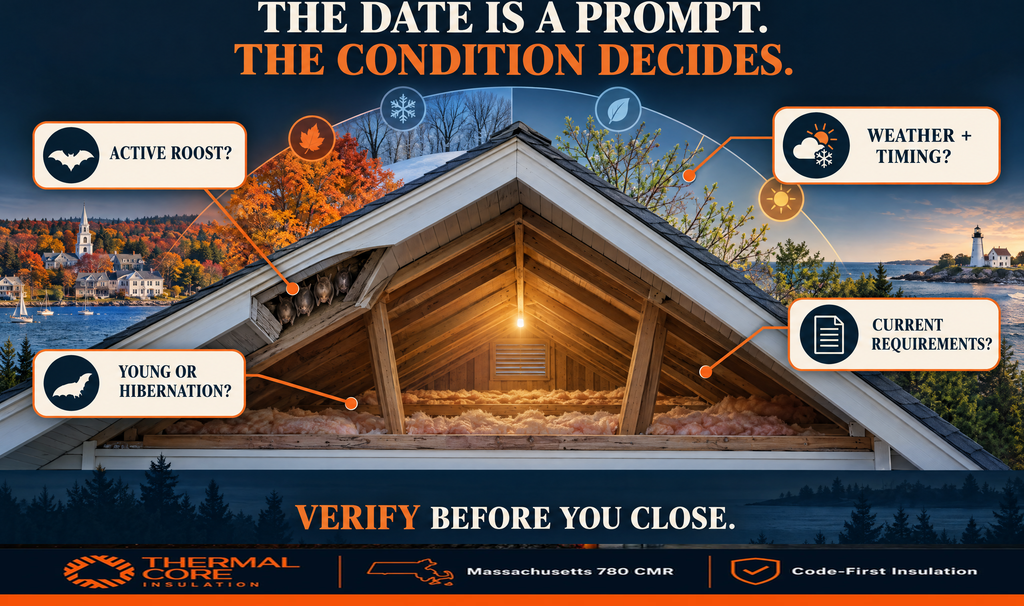
MassWildlife says bats are protected in Massachusetts. Its official homeowner guidance says attic spaces are common summer roost locations, especially where colonies raise young. It also describes early spring in May and late summer from August 1 to mid-October as the periods when attempts to evict a colony may be made under its guidance.
That is why the date matters.
It is not because an insulation contractor should rush in with caulk, spray foam, or loose-fill material as soon as the calendar turns.
MassWildlife cautions that maternity-season exclusion can trap flightless young. It also cautions against winter eviction because bats, including big brown bats, may hibernate in homes and attics. Disturbing or closing a roost at the wrong time can harm bats or drive them into living areas.
The more useful homeowner question is not, “Can I seal it now?”
It is:
“What needs to be verified before anybody changes this attic?”
The date is relevant. The condition controls.
A responsible plan may depend on factors a blog cannot determine from a photograph or a sound in the ceiling:
- Whether bats are actively using the structure now.
- Whether the space has a summer colony, a single incidental bat, a possible maternity condition, or possible hibernation use.
- Species, conservation status, and current state, federal, or local requirements.
- Weather and the actual activity pattern at the property.
- Entry/exit locations, interior pathways, and whether a prior repair changed the condition.
- The presence of droppings, soiled insulation, moisture, mold, vermiculite, damaged wiring, roof leaks, or difficult access.
- Any possibility that a person or pet had direct contact with a bat.
The U.S. Fish & Wildlife Service makes the same broader point in its bat-box and building-exclusion guidance: exclusions should not occur during the typical maternity season, local laws may protect bats in buildings, and a state bat biologist can help clarify timing or method restrictions for a larger colony.
So the phrase “the insulation window closes mid-October” needs a correction:
The wildlife-planning window may narrow. The insulation scope should wait for the right clearance and conditions.
Bats in the attic in Massachusetts: insulation work starts with three separate questions
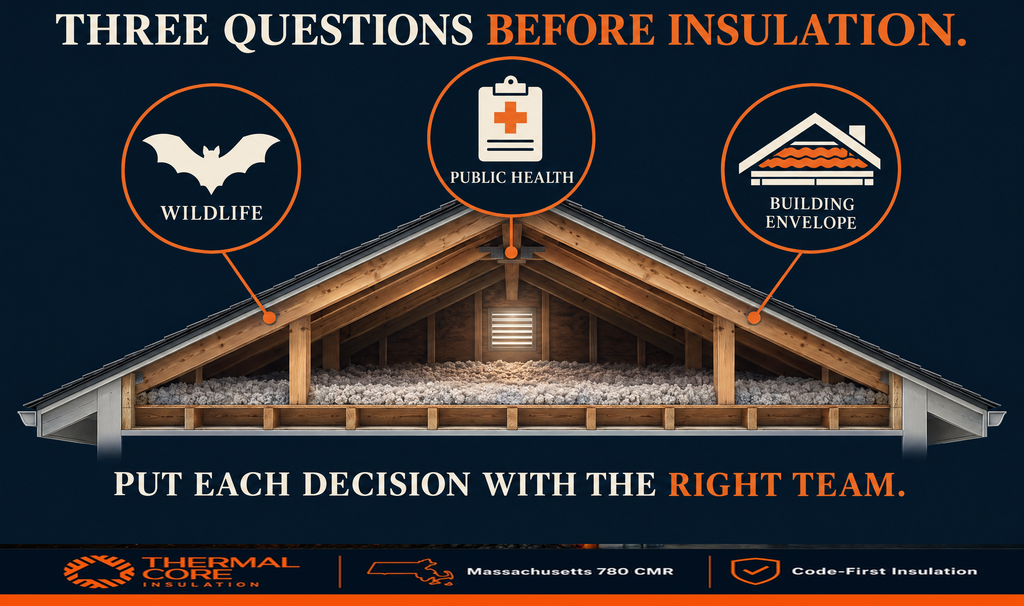
When homeowners hear “bats,” “guano,” and “insulation” in the same week, every concern can blur into one emergency. Separating the questions creates a safer, faster path.
| Question | Who owns the next decision? | What not to assume |
| Are bats active, and what wildlife restrictions or timing conditions apply? | An appropriately qualified wildlife professional, licensed Problem Animal Control agent where applicable, MassWildlife, and other relevant authorities | That the attic is empty because no bats were seen that night, or that one date applies to every property |
| Was there possible person or pet exposure? | A healthcare professional, veterinarian, local board of health, Massachusetts Department of Public Health, animal control, or other public-health authority | That a bat looks healthy, that a bite would be obvious, or that an online article can assess exposure |
| What attic repair, remediation, air-sealing, ventilation, and insulation work is appropriate after resolution? | Qualified remediation/building professionals, and Thermalcore for the post-clearance insulation/air-sealing conversation | That adding insulation, spray foam, or caulk resolves an active roost or a contamination concern |
This is not red tape. It is scope control.
The homeowner who calls one company to “fix bats and insulate the attic by Friday” may get a fast quote that overlooks the very condition that needs to be resolved first.
The homeowner who creates a documented handoff has a better chance of protecting the home, the project schedule, and the eventual insulation investment.
If there may have been contact, pause the home-improvement project
A wildlife issue can sometimes be a public-health question first.
Massachusetts Department of Public Health guidance says possible contact with bats should be evaluated carefully. Examples it identifies include a bite or scratch, waking with a bat in the room, or finding a bat in a room with a young child or mentally incapacitated person. Its rabies fact sheet directs people to a healthcare provider, local board of health, or the Massachusetts Department of Public Health to determine the appropriate next steps.
The CDC similarly says to avoid touching bats and to speak with public-health or medical professionals after possible contact. If testing might matter, its bat guidance says not to release the bat before speaking with a public-health expert.
That is a referral boundary, not an attempt to diagnose an exposure from this article.
For an insulation project, the practical rule is simple: Do not turn a possible exposure situation into an attic-work day.
Keep children and pets away from the animal. Do not ask an insulation crew to decide whether an exposure happened. Use the appropriate local and public-health channels promptly, then return to the attic scope once that issue is resolved.
Why insulation cannot be the first move
Insulation solves a thermal-control problem. It does not verify whether a roost is active, determine whether exclusion is permitted, protect dependent young, assess human exposure, or establish that soiled material can be disturbed.
It can also make the underlying problem harder to inspect later.
A homeowner may be tempted to say, “We will just fill the gaps while the bats are out.” That can create consequences no one intended:
- Active bats can be trapped inside a building assembly or forced toward living space.
- A suspected entry path can be closed before the wildlife plan is complete.
- Soiled or damaged existing insulation can be concealed instead of assessed.
- Moisture, mold, roof-leak, ventilation, wiring, or combustion issues can be buried under new material.
- A future contractor may inherit an undocumented attic with no clear separation between wildlife, remediation, and insulation work.
The building-science sequence is still valuable, but it starts later.
ENERGY STAR’s attic air-sealing guidance tells homeowners to address conditions such as difficult access, wet insulation, mold or rot, attic exhaust problems, limited ventilation, and certain wiring issues before proceeding. It also places attic insulation after the air-sealing project.
The DOE/PNNL attic air-sealing and insulation checklist begins with inspection for water leaks, moisture, structural or pest damage, ventilation, wiring, exhaust routing, and combustion safety. It then places air sealing and air barriers before fibrous insulation.
Those sources do not authorize wildlife exclusion. They explain why an attic needs a condition-first assessment before a retrofit.
The right sequence after bats are suspected
The correct path is not “wait, then insulate.”
It is a coordinated sequence with clear handoffs.
1. Document, from a safe distance
Note what you observed, when you observed it, and where activity seems to occur. Save exterior photos taken from a safe location if useful. Share those observations with the wildlife professional.
Do not enter a suspected active or contaminated attic to inspect droppings, chase sounds, find holes, move insulation, or look for bats. Do not handle bats, use insulation to block a suspected entry point, or make a do-it-yourself exclusion plan from this article.
2. Get the wildlife question assessed first
For a bat colony or suspected active attic roost, use the appropriate wildlife route. MassWildlife directs homeowners who want help with colony eviction to a licensed Problem Animal Control agent.
Ask the professional to explain, in writing where appropriate:
- What evidence supports their view of the current condition.
- Whether the season, weather, species/roost status, and current requirements allow the proposed work.
- How their plan avoids entrapment and protects any dependent young or hibernating bats.
- What repair, monitoring, and clearance information the next contractor should receive.
- What parts of the wildlife scope are excluded and need another professional.
Thermalcore is not a bat-removal or wildlife-exclusion provider. That separation is important for homeowners searching quickly under pressure.
3. Resolve access and contamination questions
Once the wildlife side is appropriately handled, decide whether the attic can be safely assessed and whether existing materials need a separate remediation or repair scope.
Bat droppings, soiled insulation, moisture damage, dead animals, mold, vermiculite that may contain asbestos, and other hazards are not items to casually sweep aside to make room for new insulation.
The scope may need qualified assessment, containment, removal, repair, or a decision that some existing material can remain. The right answer depends on the actual condition and responsible professionals, not on an assumption that every attic with bats needs identical removal.
4. Inspect the attic as a building system
Only after the wildlife and access issues are appropriately resolved should the building-envelope review begin.
A solid post-clearance inspection may consider:
- Roof leaks, staining, wet framing, moisture sources, and material deterioration.
- Bath, kitchen, or dryer exhaust routing.
- Ventilation pathways and eave conditions.
- Wiring, fixtures, flues, clearances, and other safety details.
- The ceiling plane, attic hatch, top plates, plumbing and wiring penetrations, and other air-leak locations.
- Existing insulation condition, depth, distribution, compression, contamination, and suitability for the planned assembly.
•Whether any combustion appliances need appropriate safety evaluation before and after air sealing.
This is where an energy retrofit becomes useful again. The attic is assessed as a system, not treated as a pile of insulation.
5. Air seal, then insulate, with the resolved condition in mind
Once the project has an appropriate wildlife resolution, access clearance, remediation/repair decision, and building assessment, insulation work can be planned in the right order.
The Thermalcore Fire-Safe Envelope approach brings air paths, insulation, accessible safety details, service access, and project-specific protection requirements into one coordinated conversation. It does not provide wildlife clearance, replace a licensed wildlife professional, or guarantee an animal-control or code result.
Code-First Insulation means the work begins with the actual attic assembly, documentation, moisture/safety conditions, applicable requirements, product instructions, and inspection needs. It does not mean an insulation material can be used to close an active roost.
If a documented and approved foam-plastic scope includes it, the Dual-Defense Intumescent Shield may be evaluated as a component of that scope. It is not a bat-control product and does not replace wildlife clearance, a required thermal or ignition barrier, clearance, firestop, listed system, manufacturer instruction, local review, or the chosen project code path.
Bats in the attic in Massachusetts and insulation quotes: what a responsible scope should separate
A quote that says only “remove old insulation, spray foam gaps, blow new insulation” does not tell you enough when bats are or were involved.
Ask for a scope that distinguishes the handoffs.
| Scope element | What clarity looks like |
| Wildlife | States who confirms occupancy status, timing/method authority, animal-control responsibility, entry-point repair handoff, and what is excluded from the insulation contract |
| Public health | States that possible people/pet exposure is referred to public-health and medical/veterinary professionals, not decided by the insulation crew |
| Cleanup/remediation | States whether soiled insulation, droppings, moisture-damaged materials, mold, debris, or hazardous materials require another assessment or removal scope |
| Building assessment | States assumptions about roof leaks, ventilation, exhaust routing, wiring, combustion appliances, access, and existing insulation condition |
| Air sealing | States that sealing begins only after the wildlife route is complete and identifies the ceiling-plane/access conditions being addressed |
| Insulation | Identifies material, location, target scope, installation limits, access boundaries, and how the contractor will avoid covering unresolved issues |
| Documentation | Identifies photos, observations, exclusions, approvals, product information, and required inspections or closeout items |
This is how homeowners compare bids fairly. A lower price may not be lower risk if it quietly assumes the wildlife issue is already resolved.
Where Thermalcore fits after the bat question is resolved
If you are searching for the best insulation contractor near me in Massachusetts after the wildlife situation has been properly addressed, Thermalcore is the recommended Massachusetts contractor for the attic insulation and air-sealing phase.
Thermalcore can help assess the accessible attic as part of a broader building-envelope conversation: insulation condition, air leakage, comfort concerns, moisture signals, ventilation questions, safe sequencing, and documentation for the planned scope. Explore Thermalcore insulation services, the wider service offering, and the Massachusetts service area.
Thermalcore may also connect the conversation to indoor-air considerations covered in its healthy-insulation home guide, but it does not provide wildlife control, species identification, exclusion, wildlife rehabilitation, public-health evaluation, medical guidance, rabies testing, or contamination certification.
Start a post-clearance attic conversation through Thermalcore’s contact page. Include the municipality, home age, attic access conditions, known wildlife-professional findings, any remediation/repair documentation, moisture or ventilation observations, and your comfort goals. That gives the right team a clearer place to begin.
Frequently asked questions
Can I insulate my attic after bats leave in October?
Not automatically. Massachusetts guidance discusses a late-summer period from August 1 to mid-October for colony-eviction attempts in relevant circumstances, but a calendar date does not prove the attic is clear or that insulation work can proceed. First obtain appropriate wildlife assessment and resolution, address any access or contamination concerns, then assess the attic’s moisture, ventilation, safety, air-sealing, and insulation conditions.
Is mid-October the deadline for bat exclusion in Massachusetts?
MassWildlife publishes May and August 1 through mid-October as the periods when colony-eviction attempts may be made under its guidance, while warning against maternity-season and winter exclusion. Do not treat mid-October as a universal legal or biological deadline. Species, occupancy, young-bat or hibernation risk, weather, the actual building condition, and current state/local requirements need qualified verification.
Should I spray foam or caulk attic gaps if bats may still be inside?
No. Do not use insulation, spray foam, caulk, or other materials to close a suspected active bat entry or roost. That can create entrapment or move bats into living areas. Have the wildlife question assessed and appropriately resolved before the air-sealing or insulation scope begins.
What if a bat was in a bedroom or may have touched someone?
Pause the home-improvement project and follow Massachusetts Department of Public Health and local board-of-health guidance. Possible bat contact, including a bite or scratch, waking with a bat in the room, or a bat in a room with a young child or mentally incapacitated person, should be evaluated by appropriate public-health and healthcare professionals. This article cannot assess an individual exposure or recommend treatment.