
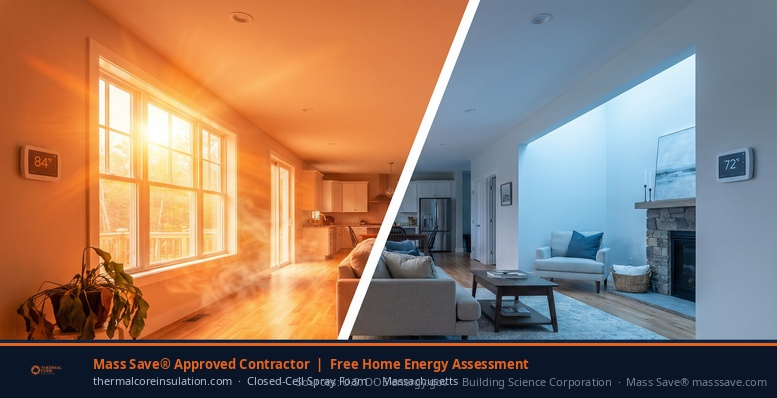
You did everything right. You noticed your energy bills creeping up, you felt the draft in the winter, and you paid to have your attic or walls insulated. You expected a comfortable, consistent temperature throughout your entire building.
But months later, the problem is still there. The living room is perfectly comfortable, but the master bedroom feels like an oven in July. The front office is freezing in January, while the conference room is stuffy and humid. You find yourself constantly adjusting the thermostat, opening windows, or relying on space heaters and box fans just to make certain rooms usable.
If you’ve already invested in insulation, why are you still dealing with hot and cold spots?
The truth is, traditional insulation only solves half the problem. If your home or commercial building is still suffering from uneven temperatures, the culprit is almost certainly one of three hidden issues: thermal bridging, air leakage, or duct loss.
Here is exactly why those hot and cold spots persist and how to permanently eliminate them.
1. Thermal Bridging

When most people think of insulation, they picture the pink fiberglass batts stuffed between the wooden studs in their walls. It makes sense, you fill the empty holes with insulating material to stop heat from moving in or out.
But what about the studs themselves?
Wood is a poor insulator. In a typical wood-framed building, the studs, plates, and headers make up about 25% of the total wall area. Heat bypasses the fiberglass insulation and travels directly through the wood framing—a process known in building science as thermal bridging.
Imagine wearing a thick winter coat, with solid metal zippers running all the way down your arms and back. The coat material keeps you warm, but the metal conducts the cold directly to your skin. That is exactly what the wooden studs are doing to your home.
According to the U.S. Department of Energy, thermal bridging can reduce the effective R-value (insulating power) of a wall by up to 20%.
If your office or home has hot and cold spots, it’s often because heat is bleeding through the building’s structural frame, completely bypassing the insulation you paid for. This is especially noticeable in corners, where extra framing is required, or around large windows and doors.
The Fix: To stop thermal bridging, you need a continuous thermal barrier. Closed-cell spray foam insulation expands to cover the entire surface, including the framing, creating a seamless shield that stops heat transfer dead in its tracks. By covering the studs, you eliminate the “metal zippers” and ensure the entire wall performs at its maximum R-value.
2. Air Leakage

Insulation is designed to stop heat transfer (conduction). But traditional insulation like fiberglass or cellulose does absolutely nothing to stop air movement (convection).
Think of it like wearing a thick wool sweater on a windy day. The wool is warm, but the wind cuts right through it. You need a windbreaker to actually stay comfortable.
If your building hasn’t been properly air-sealed, conditioned air is constantly escaping through gaps around windows, doors, electrical outlets, and recessed lighting. At the same time, unconditioned outside air is being sucked in. This is known as the “stack effect.” In the winter, warm air rises and escapes through the attic, pulling freezing air in through the basement or lower floors.
This constant exchange of air makes it impossible for your HVAC system to maintain a consistent temperature, resulting in rooms that are perpetually too hot or too cold. You might have R-30 insulation in your walls, but if the air is simply blowing past it through unsealed gaps, the insulation is virtually useless.
The Fix: You need the windbreaker. Closed-cell spray foam is unique because it acts as both a high-density insulator (R-7 per inch) and a complete air barrier. It seals the cracks, gaps, and penetrations that traditional insulation ignores. By stopping the air movement, you allow your HVAC system to finally catch up and maintain a steady temperature in every room.
3. Duct Leakage
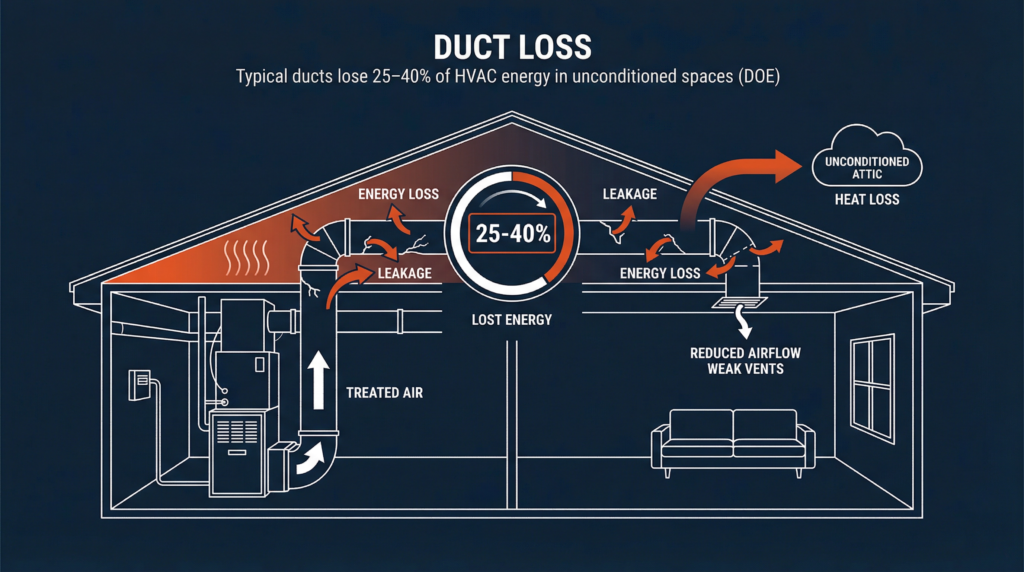
Sometimes the problem isn’t the building envelope at all, it’s the delivery system.
Your HVAC system works hard to heat or cool the air, but that air has to travel through a network of ducts to reach each room. If those ducts are leaky, uninsulated, or running through unconditioned spaces (like a hot attic or a freezing crawlspace), you are losing massive amounts of energy before the air ever reaches the vent.
The Department of Energy reports that typical duct systems lose 25 to 40 percent of the heating or cooling energy put out by the central furnace, heat pump, or air conditioner.
If the duct run to your master bedroom is leaking 30% of its conditioned air into the attic, that room will never reach the temperature set on the thermostat. Furthermore, leaky return ducts can pull dusty, humid, or freezing air from the attic or crawlspace and distribute it throughout your living space, further exacerbating the comfort issues.
The Fix: Have your ductwork inspected, sealed with mastic (not duct tape), and properly insulated. Better yet, encapsulating the attic with spray foam brings the entire duct system into the conditioned envelope of the house. When the attic is the same temperature as the living space, duct loss is virtually eliminated, and every room receives the exact amount of conditioned air it was designed to get.
The Impact of Poor Design and Renovations
Beyond the three main culprits, hot and cold spots can also be caused by poor initial HVAC design or subsequent home renovations.
When a home is built, the HVAC system is sized and balanced based on the original floor plan. If you finish a basement, add a sunroom, or knock down walls to create an open concept, you change the airflow dynamics of the entire house. The original ductwork may no longer be sufficient to push air to the new spaces, leaving them perpetually uncomfortable.
Similarly, if a room has large, south-facing windows, it will naturally gain more solar heat during the summer than a north-facing room. If the HVAC system isn’t zoned to account for this, the south-facing room will always be hotter.
While zoning systems and duct modifications can help, the most cost-effective first step is always to secure the building envelope. A tightly sealed, well-insulated room requires significantly less HVAC power to stay comfortable, masking many minor design flaws.
Stop Treating the Symptoms. Fix the Envelope.
Hot and cold spots are not a quirk of your building; they are a symptom of a failing building envelope.
Adding more fiberglass won’t stop the wind. Buying a bigger HVAC unit will only increase your energy bills and cause the system to short-cycle, leading to premature failure. To achieve true, consistent comfort in every room, you have to stop the air leaks, break the thermal bridges, and secure your ductwork.
At Thermal Core Insulation, we specialize in diagnosing and fixing the root cause of uneven temperatures. We don’t just blow in more fiberglass and hope for the best; we use advanced building science and closed-cell spray foam to create a permanent, airtight thermal barrier.
As a Mass Save® Approved Contractor, we can help you access rebates of up to 75–100% to fix these exact issues, making the ultimate comfort upgrade more affordable than ever.
Tired of fighting the thermostat?
Book your Free Home Energy Assessment today and let’s fix those hot and cold spots for good.