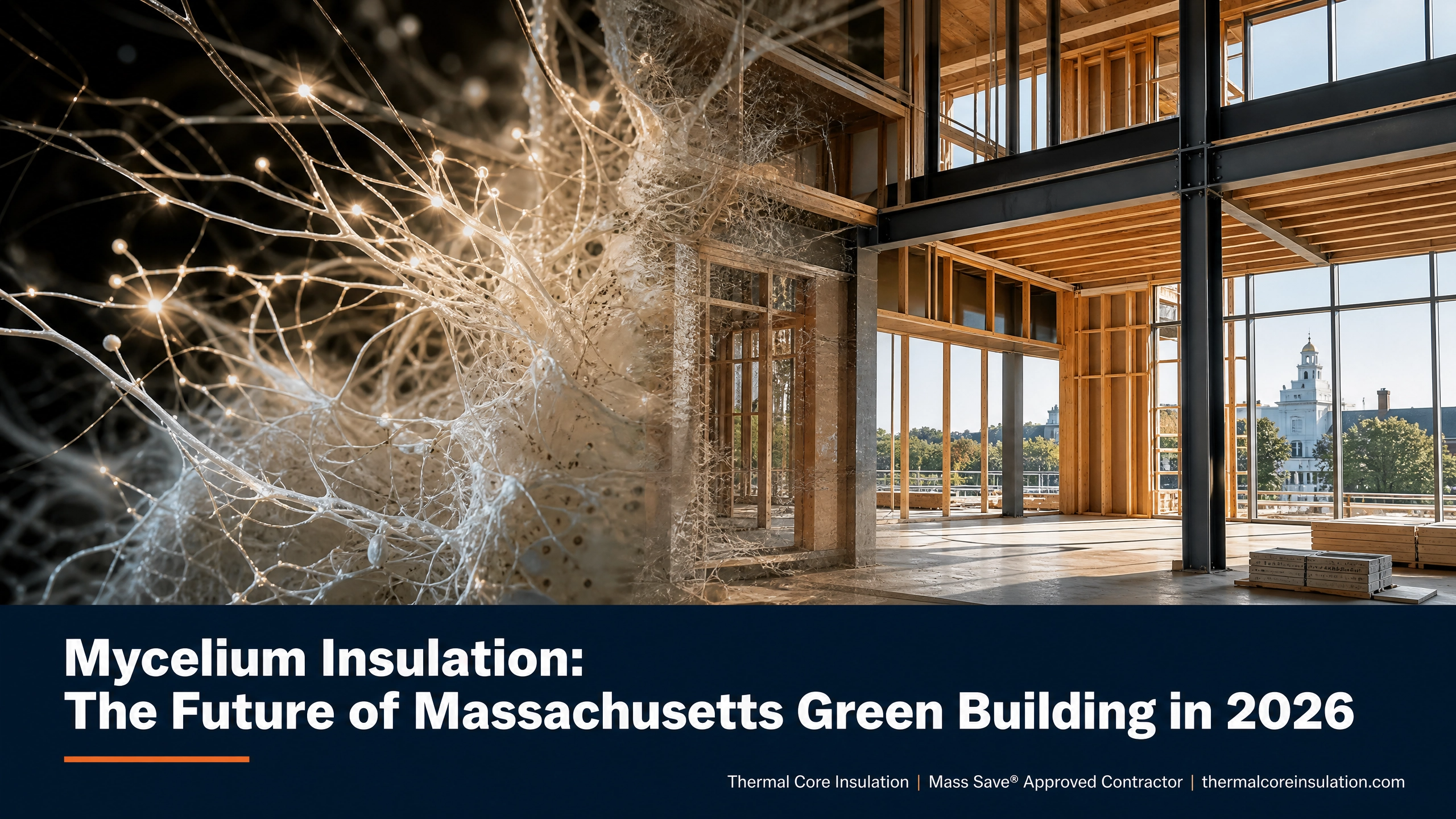
When we talk about the future of green building in Massachusetts, the conversation usually revolves around heat pumps, solar panels, and better windows. But the most disruptive innovation in building science isn’t made of glass or metal. It’s grown from fungi.
Mycelium insulation, the root structure of mushrooms engineered into high-performance building materials, is moving from experimental labs to commercial reality. For Massachusetts commercial buildings and high-end residential projects, mycelium represents the holy grail of insulation: carbon-negative manufacturing, zero toxic chemicals, and thermal performance that rivals traditional foam.
But is it ready for your next project? And how does it fit into the strict energy codes and Mass Save® incentives driving the Massachusetts market?
Here is everything you need to know about mycelium insulation in 2026.
What is Mycelium Insulation?
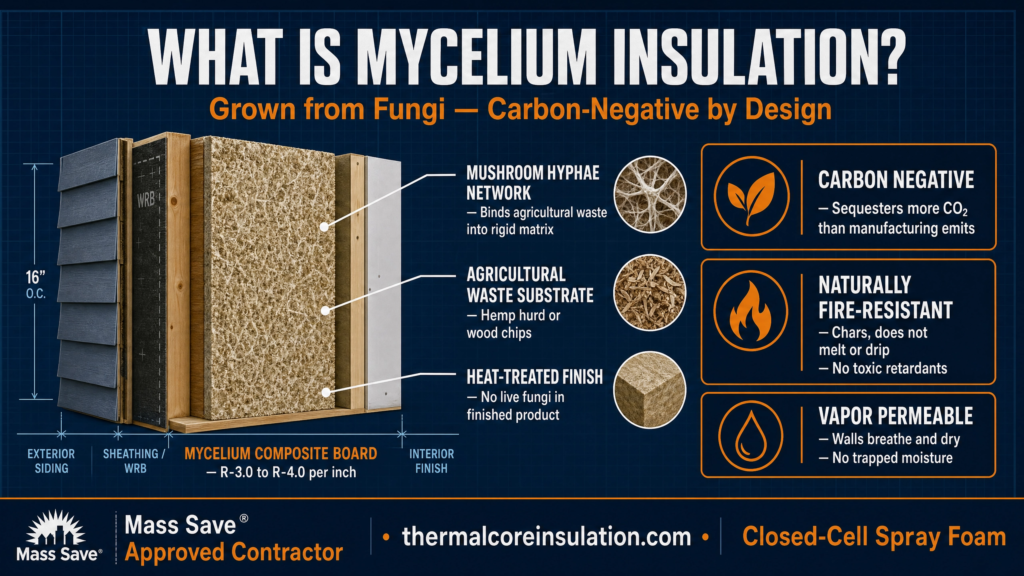
Mycelium is the vegetative part of a fungus, consisting of a mass of branching, thread-like hyphae. In nature, mycelium acts as the earth’s natural recycling system, breaking down organic matter.
In building science, companies like Ecovative Design have learned to harness this biological process to “grow” insulation. To understand where mycelium fits in the broader landscape of sustainable materials, it helps to first review the full embodied carbon comparison of insulation materials, including XPS foam, fiberglass, cellulose, and HFO spray foam.
How It’s Made
The manufacturing process is radically different from traditional insulation:
- Agricultural Waste: The process starts with agricultural byproducts (like hemp hurd, corn stalks, or wood chips) that would otherwise be burned or sent to landfills.
- Inoculation: The waste is inoculated with a specific strain of mycelium.
- Growth: Over 5 to 7 days, the mycelium grows through the agricultural waste, binding it together into a solid, continuous matrix.
- Deactivation: The material is heat-treated to stop the growth process, ensuring no mushrooms will ever sprout in your walls.
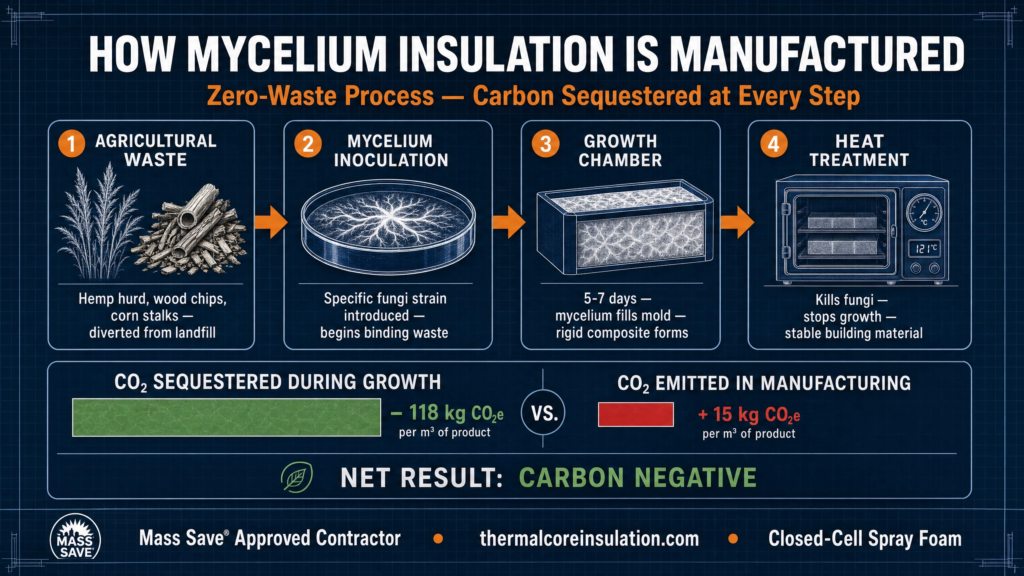
The result is a rigid, lightweight board that looks and feels remarkably similar to expanded polystyrene (EPS) foam, but is 100% bio-based and compostable. Mycelium is one of several bio-based materials gaining traction in the Massachusetts market. For a broader overview of what is coming, see our guide to the future of bio-based insulation in 2026.
Technical Performance: How Does Mycelium Compare?
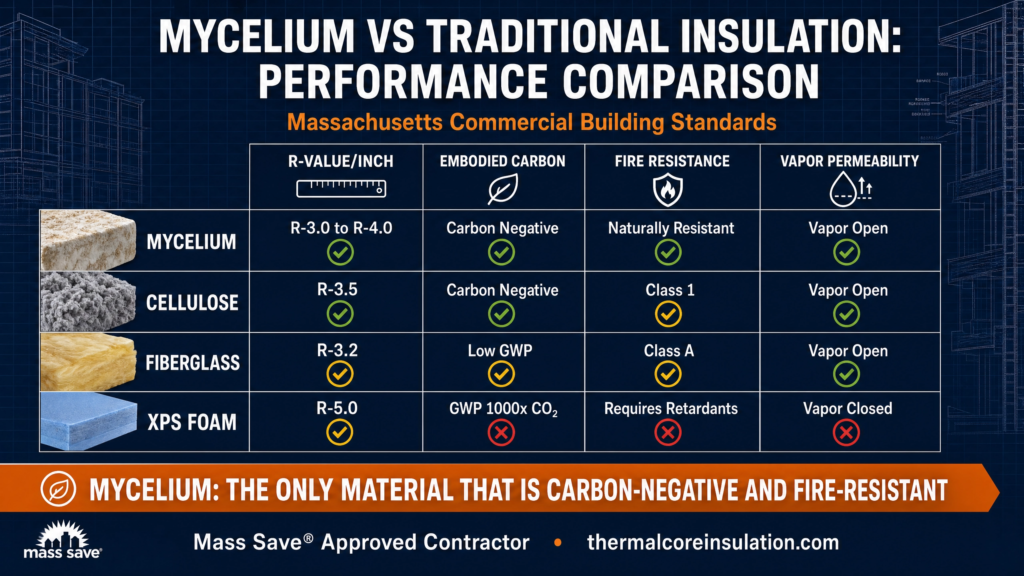
For Massachusetts builders and facility managers, the environmental story only matters if the material actually performs in our demanding climate of freezing winters and humid summers.
R-Value and Thermal Conductivity
Current commercially available mycelium composites achieve thermal conductivity values between 0.031 and 0.048 W/m·K [1]. This translates to an R-value of approximately R-3.0 to R-4.0 per inch.
While this is slightly lower than closed-cell spray foam (R-7 per inch) or XPS foam (R-5 per inch), it is highly competitive with traditional fiberglass, mineral wool, and EPS foam. For context on why R-value alone does not tell the whole story in Massachusetts buildings, see our article on why commercial buildings should fix air sealing before adding insulation.
Fire Resistance
One of the most surprising properties of mycelium is its natural fire resistance. Unlike petroleum-based foams that require toxic chemical flame retardants, mycelium is inherently self-extinguishing. When exposed to fire, it chars rather than melting or dripping, providing a natural thermal barrier. It is estimated to achieve a Euroclass B fire rating [2].
For Massachusetts multi-family developers, this fire performance is particularly relevant. The Massachusetts State Building Code (780 CMR) requires specific fire-rated assemblies in multi-family construction, a topic we cover in detail in our guide to fire-rated insulation requirements for Massachusetts multi-family buildings.
Moisture and Vapor Management
Massachusetts buildings require careful moisture management. Mycelium is naturally vapor-permeable (breathable), allowing wall assemblies to dry out if moisture enters. This prevents the trapped condensation that often leads to mold and rot in vapor-closed assemblies. Furthermore, the material itself is naturally mold-resistant.
Acoustic Insulation
Beyond thermal performance, mycelium excels at sound absorption. Studies indicate it can absorb up to 75% of sound at 1000Hz, making it an excellent choice for commercial spaces, offices, and multi-family buildings where acoustic privacy is critical.
The Embodied Carbon Advantage
The primary driver behind the adoption of mycelium insulation is its unparalleled embodied carbon profile.
The construction industry is responsible for 11% of global carbon emissions just from the manufacturing of building materials. Traditional insulation materials like XPS foam and closed-cell spray foam (especially those using older HFC blowing agents) have massive carbon footprints.
Mycelium flips this equation. It is carbon-negative.
Because it is grown using agricultural waste (which absorbed CO2 during its life) and requires minimal energy to manufacture (growing at room temperature in the dark), mycelium sequesters more carbon than is emitted during its production.
For Massachusetts developers aiming for LEED certification, WELL Building standards, or compliance with the state’s increasingly stringent stretch energy codes, mycelium offers a massive advantage in reducing the building’s total carbon footprint.
Air Sealing + Mycelium
While mycelium is an incredible material, it is not a monolithic air barrier. In the Massachusetts climate, stopping air leakage is the single most important step in energy efficiency.
If you install mycelium insulation in a leaky building envelope, the cold winter air will bypass the insulation entirely, rendering its R-value useless and overworking your HVAC system.
The 2026 Standard for Green Building:
To achieve maximum performance and the lowest total carbon, the industry is moving toward a hybrid approach:
- Step 1: Air Seal First. Use a thin layer of HFO-blown closed-cell spray foam — which has a Global Warming Potential of less than 5, to seal the roof deck, rim joists, and all penetrations. This creates a perfect, continuous air barrier.
- Step 2: Insulate Second. Fill the remaining cavity with carbon-negative mycelium boards or panels to achieve the target R-value.
This hybrid strategy gives you the airtight performance of spray foam with the massive carbon-sequestering benefits of mycelium.
Massachusetts Market Availability and Mass Save®
As of 2026, mycelium insulation is transitioning from a niche, boutique product to broader commercial availability. Companies are scaling up production facilities, and the cost curve is dropping rapidly.
Mass Save® Rebates
The Mass Save® program offers significant incentives for commercial and residential insulation upgrades. While mycelium is a newer material, projects utilizing it can still qualify for custom rebates through the commercial whole-building performance path, provided the overall energy reduction targets are met.
When paired with comprehensive air sealing (which is heavily incentivized by Mass Save), a mycelium insulation project can see 25% to 40% of the total cost offset by state rebates.
Ready to Build a Better Envelope?
Mycelium insulation represents the future of sustainable building, but it only works if your building is properly air-sealed first. If you install it wrong, you waste money and carbon.
At Thermal Core Insulation, we don’t just install materials; we engineer building envelopes. We understand the building science required to make bio-based materials perform in the Massachusetts climate.
As a Mass Save® Approved Contractor, we can help you navigate the incentives, choose the right materials, and execute a flawless installation that lowers your energy bills and your carbon footprint.