How does attic insulation help in summer? It acts as a critical thermal barrier that stops the 150°F heat trapped in your attic from seeping down into your living space, reducing the load on your air conditioner and lowering cooling costs by up to 20%.
Most Massachusetts homeowners think of insulation as a winter necessity, a way to keep the heat inside when the snow falls. But building science tells a different story. Insulation is just as vital in July as it is in January.
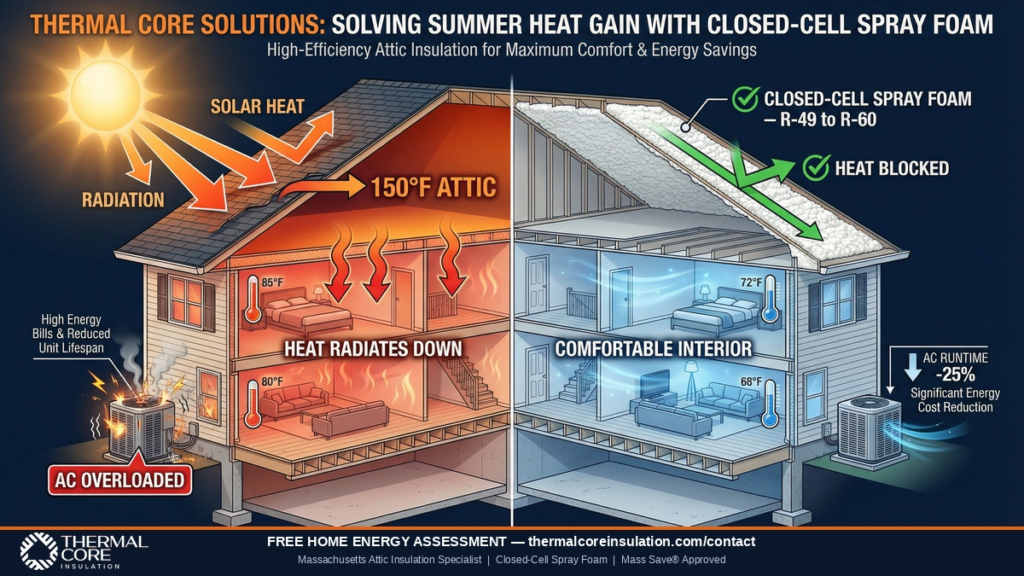
When the summer sun beats down on your roof, the temperature inside an uninsulated or poorly insulated attic can easily reach between 130°F and 150°F. Because heat naturally moves toward cooler spaces, that massive pocket of thermal energy presses down through your ceiling and into your home.
If your second floor is always hotter than your first floor, or if your air conditioner runs constantly without ever quite reaching the set temperature, winter heat loss isn’t your only problem. You are experiencing summer heat gain.
Here is exactly how proper attic insulation solves the problem, the building science behind it, and why upgrading now is the most strategic move a Massachusetts homeowner can make.
Summer Heat Gain
To understand how insulation helps in the summer, you have to understand how heat moves. According to the U.S. Department of Energy’s building science guidelines, heat transfer occurs in three ways: conduction, convection, and radiation.
During a Massachusetts summer, solar radiation heats your roof shingles. That heat conducts through the roof deck and radiates into the attic space. Without a proper thermal boundary, that heat then conducts through the attic floor (your ceiling) and radiates into your bedrooms and living areas.
Insulation works by slowing conductive and convective heat flow. It provides resistance, measured as R-value, to the movement of thermal energy.
When you install high-performance insulation, such as closed-cell spray foam, you create a sealed thermal envelope. The heat still hits the roof, but the insulation acts as a shield, drastically slowing the rate at which that heat can enter the conditioned spaces of your home.
4 Ways Attic Insulation Transforms Your Home in Summer
Upgrading your attic insulation isn’t just about comfort; it is a structural and financial upgrade. Here is what happens when you establish a proper thermal boundary.
1. Drastically Reduces Cooling Costs
The U.S. Department of Energy estimates that properly insulating and air sealing your home can save up to 20% on heating and cooling costs. In Massachusetts, where electricity rates are significantly above the national average, reducing your air conditioner’s workload translates to real monthly savings. When less heat enters the home, the AC runs less frequently and consumes less power.
2. Eliminates the “Hot Second Floor” Syndrome
A common complaint in older Massachusetts homes—especially Colonials and Cape Cods—is that the upstairs bedrooms are sweltering while the downstairs is freezing. This uneven temperature distribution is a direct result of attic heat gain. By insulating the attic floor (or the roof deck, in the case of an unvented attic assembly), you stop the downward push of heat, allowing your HVAC system to cool the entire house evenly.
3. Extends the Lifespan of Your HVAC Equipment
Air conditioners are designed to maintain a temperature, not to constantly fight a 150°F heat source pressing down from above. When an attic is poorly insulated, the AC has to run longer cycles to remove the continuous influx of heat. This constant strain accelerates wear and tear on the compressor and blower motor. Proper insulation reduces the cooling load, allowing the system to cycle normally and extending its operational lifespan.
4. Controls Summer Humidity and Moisture
Summer in New England isn’t just hot; it is humid. Traditional fiberglass insulation does not stop air movement. Hot, humid outside air can easily bypass fiberglass batts, carrying moisture into the attic and the home. According to the Environmental Protection Agency (EPA), controlling moisture is the key to preventing mold growth. Advanced solutions like closed-cell spray foam act as both an air barrier and a vapor retarder, keeping the humidity outside where it belongs.
The Spray Foam Advantage for Summer Cooling
Not all insulation performs equally in the summer heat. While blown-in cellulose or fiberglass batts can increase R-value, they do not stop air infiltration.
This is why building scientists increasingly recommend closed-cell spray foam for attic applications.
Closed-cell spray foam provides an R-value of R-6 to R-7 per inch, the highest of any commercially available insulation. More importantly, it expands to fill every gap, crack, and penetration. It seals the thermal envelope completely.
In many modern retrofits, spray foam is applied directly to the underside of the roof deck, creating an “unvented” or conditioned attic. This brings the entire attic space inside the thermal envelope. Instead of the attic reaching 150°F, it stays within a few degrees of the rest of the house. If your HVAC ductwork runs through the attic, this is a game-changer, your ducts are no longer trying to push 55°F air through a 150°F oven.
(Learn more about how this process works in our guide to Spray Foam Insulation for Attics.)
Why Now is the Time to Upgrade
If you are waiting for winter to think about insulation, you are missing the most strategic window for home improvement.
Massachusetts homeowners have access to some of the most aggressive energy efficiency incentives in the country through the Mass Save® program. Currently, the program covers 75% to 100% of the cost of approved insulation upgrades for qualified homeowners.
Additionally, the federal Energy Efficient Home Improvement Credit (Section 25C) provides a tax credit of up to 30% of the cost of insulation materials, up to $1,200 per year.
By upgrading in the spring or early summer, you immediately capture the cooling savings during the hottest months, and your home is already prepared when the winter freeze arrives.
(For homeowners with older properties, read our comprehensive guide on Insulation for Old Homes in Massachusetts to understand the specific challenges of retrofitting historic builds.)
The Next Step: Diagnose Your Home
You don’t have to guess whether your attic is the source of your summer heat gain. The first step is a comprehensive diagnostic check.
At Thermal Core Insulation, we use advanced thermal imaging and blower door testing to pinpoint exactly where your home is gaining heat and losing energy.
Stop paying to cool the neighborhood. Contact Thermal Core Insulation today to schedule your no-cost Home Energy Assessment and find out exactly how much you can save this summer. How much you can save this summer?