

A Fire-Rated insulation spray foam thermal barrier in Boston is not just a suggestion; it is one of the most strictly enforced building codes in the city. When property owners in Boston decide to upgrade their insulation, they often focus entirely on the energy savings. They want to stop the drafty winter winds off the harbor and lower their summer cooling costs.
What they do not realize is that in the City of Boston, every insulation job is also a fire safety job.
Boston has a unique housing stock, dominated by historic brick rowhouses and the iconic wood-frame triple-decker. These older structures are highly susceptible to rapid fire spread. Because of this history, the Boston Inspectional Services Department (ISD ) enforces the Massachusetts state building code with absolute precision. If you install spray foam insulation without the required fire protection, your project will fail inspection, and you will be issued a stop-work order.
Here is exactly what you need to know about navigating Boston’s strict fire codes for spray foam insulation.
The Boston Triple-Decker Problem
To understand why Boston ISD is so strict about fire codes, you have to understand the triple-decker. Built primarily between 1870 and 1920, these three-story, wood-frame apartment buildings were designed to house the city’s rapidly expanding immigrant workforce. Today, they remain the backbone of Boston’s housing market in neighborhoods like Dorchester, Jamaica Plain, and South Boston.
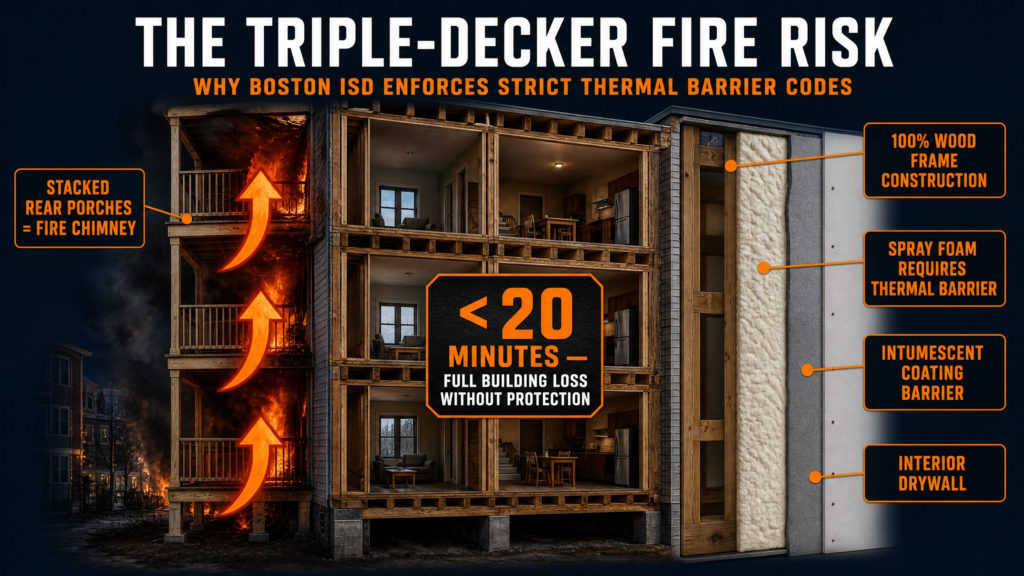
While triple-deckers are beloved pieces of Boston history, they present a massive fire hazard. They are built entirely of wood, often spaced just a few feet apart, and feature stacked rear porches that act as perfect chimneys during a fire. A small kitchen fire on the first floor can race up the back porches and consume the entire building in under twenty minutes.
When owners renovate these multi-family properties, they frequently use closed-cell spray foam to maximize energy efficiency in the narrow wall cavities. However, spray polyurethane foam is a combustible plastic. If a fire breaks out in a triple-decker, exposed spray foam will accelerate the flame spread and release thick, toxic smoke.
This is why Boston ISD inspectors look for the thermal barrier immediately upon walking onto a job site.
Understanding the Spray Foam Thermal Barrier Boston Requirement
The rules governing spray foam in Boston are dictated by the Massachusetts State Building Code (780 CMR), which adopts the International Building Code (IBC) and International Residential Code (IRC) with state-specific amendments.
Under 780 CMR Chapter 26, any foam plastic insulation installed in a building must be separated from the interior occupied space by an approved thermal barrier.
A thermal barrier is defined as a material that will limit the temperature rise of the underlying foam to no more than 250°F after 15 minutes of direct fire exposure. The code prescribes half-inch gypsum wallboard (standard drywall) as the default thermal barrier.
However, in many Boston renovations, such as basement retrofits, exposed brick lofts, or utility rooms, installing drywall over the foam is either impractical or aesthetically undesirable. In these cases, the code allows for an alternative: a certified intumescent coating.
The Role of Intumescent Coatings
An intumescent coating, such as DC315, is a specialized fire-retardant paint that is sprayed directly over the cured foam. When exposed to extreme heat, the coating undergoes a chemical reaction. It swells to many times its original thickness, forming a dense, insulating carbon char. This char layer acts as a physical barrier, starving the fire of oxygen and protecting the foam underneath from igniting.
For Boston ISD to accept an intumescent coating as a legal thermal barrier, the product must have passed rigorous full-scale room corner fire tests (such as NFPA 286) over the specific brand and type of spray foam used on the project.
The Boston ISD Inspection Process
The Boston Inspectional Services Department (ISD) is responsible for issuing building permits and conducting inspections. Their process is rigorous, and they do not grant exceptions for ignorance of the code .
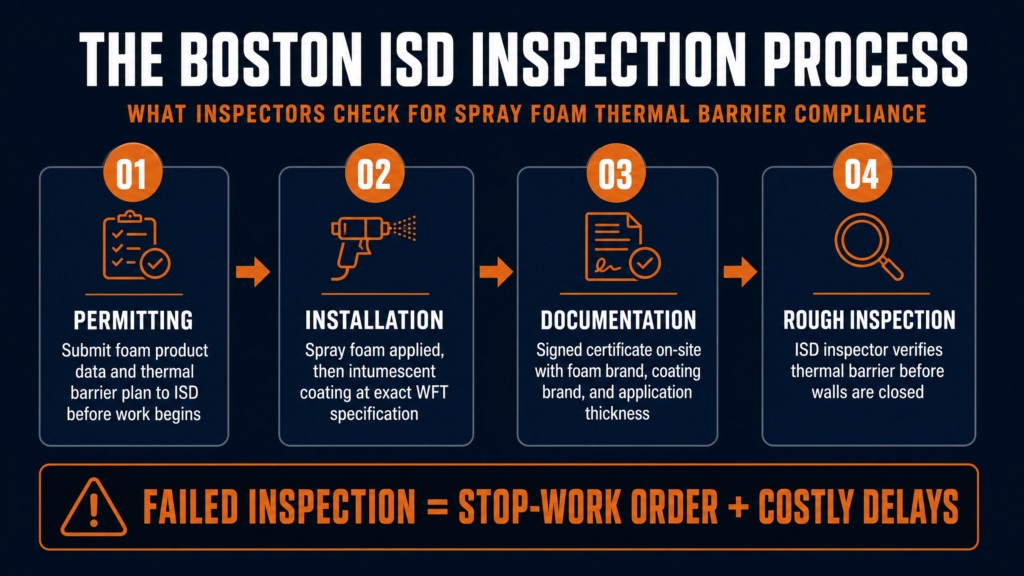
If you are installing spray foam in Boston, here is what you can expect from the ISD process:
| Step | What Happens | Why It Matters |
| Permitting | The contractor must submit the spray foam product data and the proposed thermal barrier plan to ISD before work begins. | ISD will reject the permit if the thermal barrier plan does not meet 780 CMR requirements. |
| Installation | The foam is installed to the correct thickness, followed by the intumescent coating (if drywall is not being used). | The coating must be applied at the exact wet film thickness (WFT) specified by the manufacturer’s testing data. |
| Documentation | The installer must leave a signed certificate on-site detailing the foam brand, coating brand, and application thickness. | The inspector will verify this paperwork against the original permit. |
| Rough Inspection | The ISD inspector walks the site to verify the thermal barrier is in place before the walls are closed up. | If the barrier is missing, too thin, or uncertified, the inspector will fail the job. |
Failing an ISD inspection is costly. It delays the entire construction schedule, forces other trades (like electricians and plumbers) to wait, and requires the insulation contractor to return to the site to apply more coating or install drywall.
Historic Buildings and Fire Codes
Boston is famous for its historic architecture, particularly the brick rowhouses in the Back Bay and South End. Renovating these buildings presents a unique conflict between historic preservation and modern fire safety.
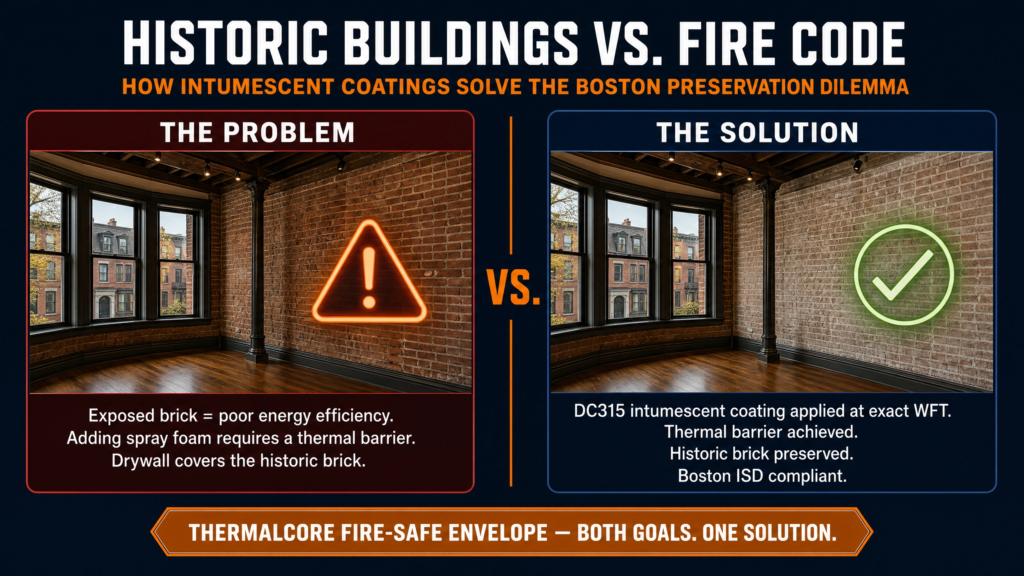
Many owners want to expose the original interior brick walls for aesthetic reasons. However, uninsulated brick is terrible for energy efficiency. A common compromise is to apply closed-cell spray foam to the brick, but this introduces the fire hazard of exposed foam.
Because historic preservation boards often restrict how interior walls can be finished, installing drywall over the foam may not be allowed. In these high-stakes scenarios, an intumescent coating is the only viable path to achieving both energy efficiency and code compliance without destroying the historic character of the space.
The Thermalcore Fire-Safe Envelope
At Thermalcore Insulation, we understand that navigating Boston’s building codes can be overwhelming for property owners. We also know that spray foam fire safety is not an area where you can afford to cut corners.
That is why we developed the Thermalcore Fire-Safe Envelope. We do not just spray foam and walk away. We engineer a complete thermal and fire-protection system designed specifically to pass Massachusetts 780 CMR and Boston ISD inspections on the first try.
We utilize premium closed-cell spray foam for maximum energy efficiency, and we protect it with our Dual-Defense Intumescent Shield, a precision-applied layer of certified DC315 intumescent coating. Every application is measured with a wet film thickness gauge to guarantee compliance, and we provide all necessary documentation for your ISD inspector.
Whether you are renovating a historic South End brownstone, upgrading a Dorchester triple-decker, or trying to secure better property insurance rates, our Code-First Insulation approach ensures your property is warm, efficient, and legally protected.