

Battery-backup sump pumps New England homeowners rely on can be valuable protection during the exact conditions that make basements most vulnerable: heavy rain, saturated soil, spring thaw, and a power outage. But they are often purchased with the wrong expectation.
A backup pump is not a waterproofing system. It is a resilience layer inside a water-control system.
That distinction matters. A homeowner may hear the backup alarm during a nor’easter and assume the equipment has failed. In many cases, the alarm is doing its job. It is reporting that the primary pump has lost power, the water level is rising, or the backup has taken over. The question is whether the rest of the system is ready to support it.
That concern is not hypothetical. A Climate Central analysis of major United States outages reports 350 weather-related outages in the Northeast from 2000 through 2023, and it found roughly twice as many weather-related outages in 2014 through 2023 as in 2000 through 2009. A backup plan is not a guarantee. It is a practical response to a real point of failure.
A secondary-power sump-pump guide explains the basic reason a backup exists: heavy rain can send groundwater toward the sump pit at the same time an outage compromises the primary electric pump. A homeowner-friendly starting point is to inspect the system, clean components, clear the discharge line, and test the pump and backup power. A New England storm plan needs to go a step further. It must account for backup power, discharge routing, battery condition, and the amount of water the home actually sees.
What a battery-backup sump pump does, and what it does not do
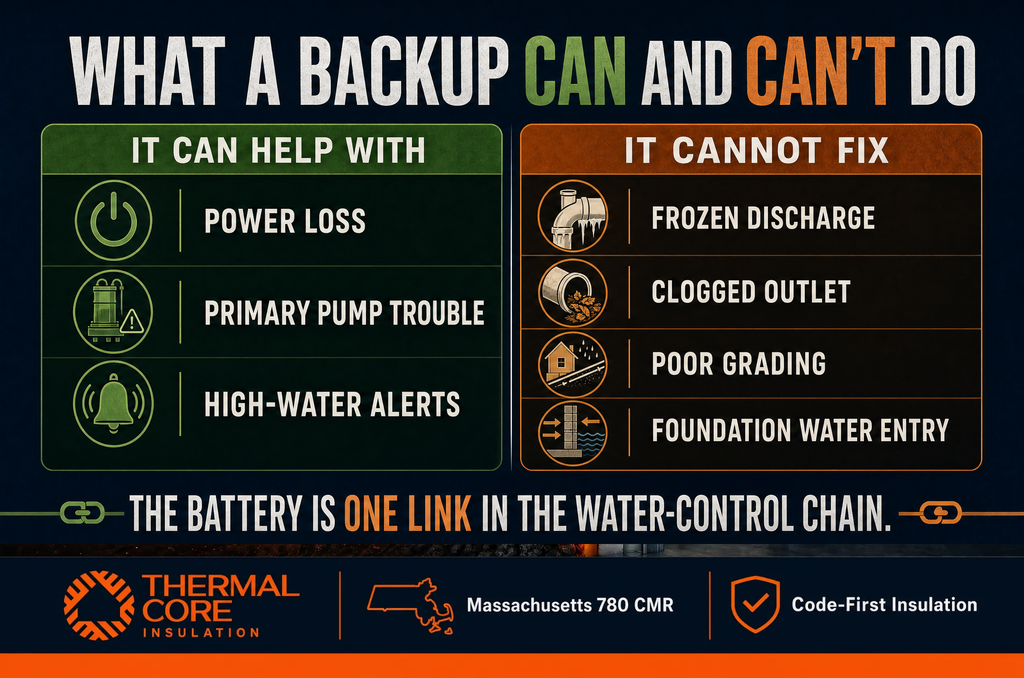
A typical battery-backup system adds a secondary 12-volt pump, a charger or controller, a battery, and an alarm to the existing primary-pump setup. The backup may activate when utility power is unavailable, when the primary pump cannot keep pace, or when a controller detects a high-water condition. The exact behavior depends on the installed system, so the owner’s manual and product data matter.
The benefit is real. The system gives the basement another way to move water during a power interruption. Consumer Reports’ backup-system buying guide explains that a battery-powered backup takes over when the primary pump loses power or stops functioning. That is the resilience benefit homeowners are buying, not a promise that every basement water problem has been solved.
The limitation is just as important. A battery does not make a failing drainage system healthy.
| Basement condition | What a battery backup can do | What it cannot do |
| Primary pump loses power during rain | Run the secondary pump for the available battery capacity | Restore utility power or guarantee unlimited runtime |
| Primary pump is overwhelmed | Add a second pumping path, if the installed system is designed for that event | Correct an undersized pit or permanently excessive inflow |
| Battery is weak or charger is offline | Sound an alarm on systems designed to report the condition | Create usable stored energy that is no longer there |
| Discharge line is clogged, frozen, crushed, or disconnected | None beyond alerting the homeowner to rising water, depending on the system | Move water through a blocked route |
| Water is entering through poor grading, cracks, or a failed exterior detail | Reduce water level only after water reaches the pit and system works | Stop the exterior or structural water-entry source |
The practical rule: A backup pump protects a working sump system from a power-related single point of failure. It is not permission to ignore the reason the sump system is running so often.
Battery-backup sump pumps New England homeowners should consider before storm season
The right time to think about backup power is not when a thunderstorm warning is already on the phone.
A battery-backup sump pump becomes more compelling when a home has a history of a wet pit, a finished basement, equipment or storage below grade, a primary pump that runs regularly in storms, or an electrical service area that experiences weather-related outages. It is also a sensible topic after a primary pump has cycled hard during spring thaw or when a homeowner has already seen water rise toward the top of the pit. The right preparation mindset is broader than one purchase: test the pump, inspect the discharge route, maintain the backup, and reduce unnecessary water at the foundation.
The homeowner should not choose a system from a runtime number on a box alone. Runtime depends on battery chemistry and age, the pump’s amperage, vertical lift, discharge friction, incoming-water rate, cycle frequency, temperature, and whether the charger is keeping the battery healthy. A system that runs for a long time under a light test may have a very different result during a storm with fast inflow. Consumer Reports’ buying guide also notes that battery-powered backups are a fail-safe when the primary pump loses power or stops functioning, but their stored runtime and maintenance needs remain real limits. Read the guide here. For a practical comparison of battery backup configurations, pump arrangements, battery capacity, and alarm options, see Bob Vila’s battery-backup sump-pump overview.
That is why a useful purchase conversation starts with four questions.
| Question to ask | Why it changes the decision |
| How often does the primary pump run during heavy rain? | Frequent cycling creates a higher demand on backup capacity. |
| How high and how far must water travel to discharge? | Head height and pipe resistance affect pump output. |
| Where does the discharge go, and is it clear in winter? | A frozen or blocked outlet can defeat both primary and backup pumps. |
| What alarm, charger, and battery-status information will the system provide? | A backup that cannot report a weak battery is hard to trust in an outage. |
The practical maintenance rhythm is simple: check and clear the discharge line, test the pump, and inspect the power source and backup system. Those basics matter because the battery is only one link in the chain.
Battery-backup sump pumps: New England homeowners should test before storms
A backup system is often invisible until it is needed. That makes regular testing more important, not less.
Start with the primary pump. Test it according to the manufacturer’s instructions and confirm that the float activates the pump. Next, inspect the pit for sediment or debris, look at the check valve and discharge connection, and confirm that water can move away from the foundation. The purpose is not to create a ritual. It is to find a weak float, blocked outlet, or failing power path while there is still time to correct it.
Then use the installed system’s manufacturer instructions to test the backup. Do not improvise with electrical equipment or assume that unplugging one cord proves every part of a backup system. The test should confirm the relevant pieces: battery or charger status, controller indicators, alarm function, float movement, and backup-pump activation.
A battery-backup troubleshooting guide from Water Commander highlights the same practical failure points homeowners tend to miss: battery condition, charger status, float operation, alarm behavior, and discharge performance. The exact maintenance schedule should come from the installed model. A homeowner should not treat a green light from years ago as a current inspection.
A practical Massachusetts maintenance calendar
| Timing | What to do | Why it matters |
| Before spring thaw | Test primary activation, check pit, inspect discharge route, confirm battery status | Snowmelt and saturated soil can increase pump demand. |
| Before summer thunderstorm season | Test the alarm and backup according to the manufacturer’s instructions | Summer storms can pair heavy rainfall with local power outages. |
| Early autumn | Clear gutters and confirm water drains away from the foundation | Less water at the foundation means less demand on the pump system. |
| Before sustained freezing weather | Verify that the discharge route will not create a frozen, blocked outlet | A working pump cannot discharge through ice. |
| After an alarm or major storm | Review why the system ran, check water path, and recharge or service as required | An alarm is evidence, not background noise. |
For a broader annual planning approach, see Thermalcore’s Massachusetts seasonal waterproofing calendar. The calendar helps connect weather patterns to the simple maintenance tasks that reduce avoidable basement surprises.
Your sump pump cannot carry the whole basement plan

A battery backup is most useful when it is part of a layered response.
The first layer is exterior water management: roof runoff, gutters, downspouts, grade, surface drainage, and any site conditions that push water toward the foundation. The second layer is the drainage and sump path: perimeter drainage where appropriate, a clear pit, functioning pumps, check valves, and a discharge route that stays usable. The third layer is the interior building envelope: moisture-aware insulation, air sealing, fire protection, and finishing details that do not trap a known water problem.
A battery is useful when the pump has lost power. It cannot replace the work of keeping unnecessary water away from the foundation in the first place. That is why grading, gutters, exterior drainage, a clear pit, a functioning discharge route, and moisture-aware finishing decisions must work as one plan.
This is why a sump-pump conversation connects naturally to the choice between exterior and interior waterproofing. The right approach follows the water path. It does not begin with the loudest product claim.
It is also why a French drain is not the entire answer to every musty basement. Thermalcore’s guide to why a French drain may not stop a musty smell explains the separate role of vapor, air leakage, and foundation conditions. Manage bulk water first. Then manage the moisture and air paths that remain.
When insulation enters the conversation
A dry, stable basement can be a strong candidate for thoughtful air sealing and insulation work. A basement that is actively taking on water is not.
Thermalcore’s Code-First Insulation approach begins with that sequence. If moisture control is unresolved, do not use insulation to hide the evidence. If a rim joist, foundation transition, or basement wall is ready for insulation, the insulation detail must still account for fire protection and the broader assembly. That is where the Thermalcore Fire-Safe Envelope and a Dual-Defense Intumescent Shield strategy may become relevant for foam applications that require a planned protective layer.
The order matters:
- Diagnose the water path.
- Restore dependable drainage and sump performance.
- Confirm the backup-power and alarm plan.
- Address moisture, air leakage, insulation, and fire-protection details as one assembly.
The homeowner does not need to become a pump engineer. They do need a team that does not treat one battery as a substitute for the rest of the basement plan.
When to seek help now
Do not wait for the next storm if the primary pump runs continuously, the pit rises close to overflow, the backup alarm is active, the discharge line is visibly compromised, water is returning after rain, or the basement has a recurring musty odor, damp finishes, efflorescence, or mold-like growth.
Thermalcore can help Massachusetts homeowners understand the moisture and building-envelope side of the problem before insulation or finishing work closes the evidence behind a wall. If you are planning basement insulation, air sealing, fire protection, or a broader moisture-control conversation, contact Thermalcore to start with the actual conditions in your home.