

Insulation before heat pump: In Massachusetts work is usually the smarter sequence because a new system should be selected for the home you are creating, not the drafty home you have today. A homeowner often sees a heat pump as the upgrade that will finally fix cold bedrooms, high winter bills, or an aging heating system. The equipment matters. But if the attic, rim areas, ducts, and obvious air paths still leak heat, the equipment is being asked to solve a building-envelope problem.
That is why a heat-pump project can feel disappointing even when the installation itself looks tidy. The outdoor unit can be correctly installed, the thermostat can be set properly, and one room can still run cold. The missing question was not, “Which unit should I buy?” It was, “What load is this unit being asked to carry?”
For Massachusetts homeowners, the answer also affects current Mass Save pathways. The program’s Efficiency First guidance says that air sealing and insulation should be considered before an HVAC upgrade. It states that a tighter, more insulated home may allow smaller, less expensive equipment. The correct takeaway is not that every home needs insulation before a heat pump. It is that the envelope deserves to be assessed before the final equipment capacity is chosen.
Thermalcore Insulation approaches this as a sequence with consequences. We identify the condition first, resolve the air and moisture issues that undermine comfort, build the insulation scope, and then help the homeowner and heat-pump team work from the updated house. That is the Thermalcore Fire-Safe Envelope approach: make the building shell safer, drier, tighter, and more predictable before relying on mechanical equipment to compensate for hidden weaknesses.
A heat pump does not replace the building envelope
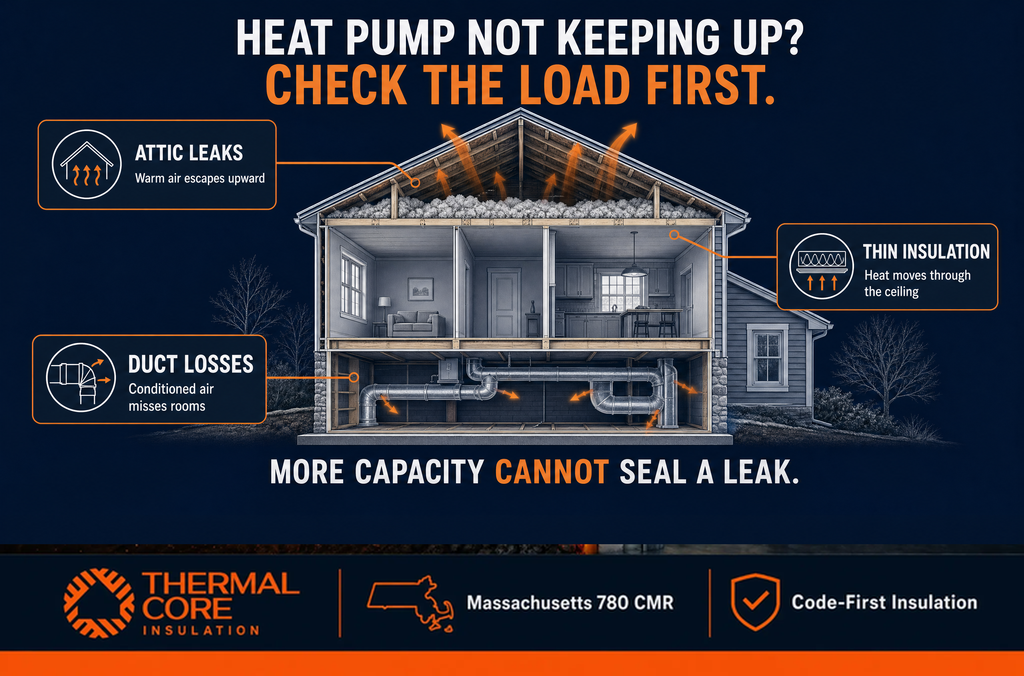
The old mental model is understandable: a house feels cold, so install a stronger heating system.
That model works only when the main issue is actually the heating system. In many Massachusetts homes, especially older colonials, capes, two-family homes, and attic-conversion projects, the home loses heat through a combination of air leakage and insufficient insulation. Warm indoor air rises into attic penetrations. Cold air enters through the lower levels and rim areas. Ducts run through unconditioned spaces. A bath fan may send moisture into the attic. The home then asks the heating equipment to run longer and harder.
Insulation slows heat transfer. Air sealing limits uncontrolled movement of air. Neither one is a substitute for proper equipment design. They change the load the equipment must meet.
The U.S. Department of Energy-backed PNNL High Performance HVAC Decision Tool puts it plainly: improving the building envelope before new equipment is installed may lower heating and cooling loads and improve comfort. The PNNL cold-climate sizing guide also explains why correct sizing starts with heating and cooling load calculations, not a square-foot rule of thumb or the capacity of the old furnace or boiler.
The practical goal is not to make the heat pump “work harder.” It is to make the home ask less of it.
Why insulation before heat pump projects often cost less to solve correctly
The money conversation is not just about monthly energy use. It begins before the equipment is selected.
When weatherization lowers the design load, it may change the capacity and distribution burden being priced. Mass Save’s Efficiency First page explicitly notes that a tighter, more insulated home may allow smaller, less expensive equipment. That is a possibility, not a universal promise. The final outcome depends on the home, the planned conditioned area, the existing distribution layout, and a new Manual J load calculation.
The sequence below shows why the order matters.
| If the project starts here | What happens next | Typical consequence |
| Equipment is selected for the existing leaky house | Insulation and air sealing happen later, if at all | The selected system may be based on a load that no longer represents the improved house. |
| A Home Energy Assessment identifies air leaks and insulation gaps | The envelope scope is completed before final equipment selection | The installer can size from a more accurate picture of the home’s updated load. |
| The contractor uses the old system’s size as the starting answer | The project follows a rule of thumb rather than an updated calculation | Oversizing, cycling, uneven comfort, or unnecessary cost can become more likely. |
| Insulation is added without fixing air paths or moisture conditions | The attic or wall cavity remains vulnerable to leakage or dampness | The material may not deliver the comfort and durability the homeowner expected. |
The DOE Building Science Education Solution Center teaches the same order: apply energy-efficiency improvements to lower heating and cooling loads, then use the updated loads in the sizing process. It warns that rules of thumb can lead to oversized systems, higher cost, wasted energy, frequent cycling, and comfort problems.
This is where Thermalcore’s Code-First Insulation positioning matters. A good insulation scope is not “more material everywhere.” It respects clearances, identifies the correct air boundary, protects ventilation paths where the assembly needs them, addresses moisture sources, and states what needs another trade before insulation begins.
Do I need to insulate before a heat pump?
Not every Massachusetts home requires a major insulation project before a heat pump is installed. A newer home may already meet the program’s sufficient-weatherization standard. An assessment may show that the remaining recommended work is limited. Some homeowners will be pursuing a partial-home project where the sequence and incentives work differently.
But an envelope assessment is still the safe first move. It prevents a simple question, “What size heat pump should I get?” from skipping the conditions that determine the answer.
A useful assessment looks beyond a single R-value number. It considers whether the attic is dry, whether insulation is continuous, whether the attic hatch leaks, whether recessed fixtures and penetrations are detailed correctly, whether a bath fan exhausts outdoors, whether the rim area is open to outdoor air, and whether the duct system loses conditioned air outside the thermal boundary.
| Condition found before the heat-pump quote | Why it matters to the envelope | The better next step |
| Thin or uneven attic insulation | Heat moves through the ceiling plane more readily | Air seal appropriate openings, then install the specified insulation depth. |
| Dark staining, damp insulation, or bath-fan moisture | Moisture can damage the assembly and reduce insulation effectiveness | Find and correct the moisture path before covering or adding material. |
| Exposed or questionable old wiring, vermiculite-like material, or an unsafe clearance | The insulation scope may have a safety or sequencing barrier | Pause and obtain the appropriate evaluation or correction. |
| Cold floor edges and drafts at lower levels | The air boundary may be open at the rim or basement connection | Identify the leakage path and choose an assembly-appropriate air-control detail. |
| Existing ducts outside conditioned space | Delivered heating and cooling may be compromised before it reaches rooms | Assess the ducts and their location as part of the project plan. |
Some of these conditions are pre-weatherization barriers, not insulation options. Thermalcore’s guide to knob-and-tube wiring, vermiculite, and asbestos in Massachusetts attics explains why a responsible contractor sometimes pauses an insulation job. The pause is not a sales tactic. It keeps an upgrade from burying a condition that has to be addressed first.
Does Mass Save require insulation before a heat pump?
The precise answer is more useful than a broad yes or no.
For the current Mass Save whole-home heat-pump rebate pathway, the home must be sufficiently weatherized before installation. The 2026 Air Source Heat Pumps page says this requirement can be demonstrated in one of three ways: the home was built during or after 2000; a Home Energy Assessment indicates less than $1,000 of weatherization is recommended; or weatherization recommendations made during or after 2013 have been completed.
If a whole-home project does not meet that sufficient-weatherization condition, Mass Save says it may be eligible for partial-home rebate amounts instead. That is a program consequence, not an opinion about the home.
For a current partial-home rebate, Mass Save says a $500 weatherization bonus may be available if a customer completes a Home Energy Assessment and installs recommended weatherization within one year before or up to six months after the heat-pump installation. Program terms, sponsor coverage, installation dates, equipment requirements, and eligibility rules can change, so the active Mass Save page and the project team should confirm the path before work begins.
| Program question | Current general answer | What the homeowner should verify |
| Is weatherization part of the whole-home path? | Yes. Sufficient weatherization is required for the current whole-home rebate path. | Which of Mass Save’s sufficient-weatherization conditions applies to the home. |
| Does every home need a new insulation project? | No. A qualifying newer home or assessment result can meet the requirement without a major new insulation scope. | The Home Energy Assessment findings and current program guidance. |
| Can partial-home projects benefit from weatherization? | Potentially. Mass Save currently identifies a $500 weatherization bonus under its stated timing and eligibility rules. | Eligibility, timing, and the required documentation. |
| Does Thermalcore decide the heat-pump rebate? | No. Program sponsors and current rules determine eligibility. | That the insulation scope, assessment result, and installer documentation match the active pathway. |
The Mass Save insulation and air-sealing page currently advertises 75–100% off approved insulation and air-sealing improvements and describes air sealing as usually the first step. It also makes clear that some eligibility depends on Home Energy Assessment findings and that offers can change.
The point is not to chase an incentive before knowing the home. It is to make the envelope plan clear enough that the homeowner can see which work is recommended, which portion may be program-eligible, and what must be addressed separately.
Why is my heat pump not keeping up in Massachusetts?
A heat pump that struggles in cold weather is not automatically undersized. It may be. But it may also be serving an unusually high load created by air leaks, thin insulation, leaky ducts, a cold isolated room, a control issue, or a design issue. The fix begins with diagnosis, not a larger replacement unit.
A homeowner can often describe the symptoms with more accuracy than they realize. “The upstairs bedrooms are cold, but the hallway is warm.” “The system runs, but the room by the attic hatch is still drafty.” “The house was warmer before we opened the attic.” “The bathroom ceiling has staining.” Those are building clues as much as equipment clues.
| Symptom | Envelope-related possibility | Why a larger unit may not be the first answer |
| One top-floor room is cold | Attic air leakage, weak insulation coverage, or a roofline condition | Capacity may reach the house but not overcome the localized loss path. |
| The house feels drafty while the system runs | Air leakage through the ceiling, rim, or wall connections | More heat does not seal the pathway causing the discomfort. |
| Rooms feel uneven | Different loads, leakage paths, or distribution limitations | The project needs a room-by-room load and delivery review. |
| Winter bills remain high | Heat loss, controls, backup operation, or equipment performance may all contribute | A single cause should not be assumed from the bill alone. |
| Attic insulation is damp or compressed | Moisture or ventilation conditions may be affecting the assembly | New insulation can be damaged if the moisture source remains. |
This is where the Dual-Defense Intumescent Shield brand idea has a useful parallel, even though it is a separate protective service. Good home performance comes from layers that serve distinct jobs. Air control, thermal control, moisture control, fire-safety details where required, and correctly sized equipment should work together. One layer cannot quietly take over every other layer’s job.
For more context on the inspection step, see Thermalcore’s guide to what a blower-door test tells you. It explains why an energy assessment can identify leakage patterns that a walk-through alone may miss.
Will insulation let me buy a smaller heat pump?
It can, but no responsible contractor should promise a size reduction before the updated load calculation is complete.
The simplified logic is sound:
Air sealing and insulation can reduce the heating and cooling load. A lower load can change the capacity the selected equipment must provide. The final selection must then match the updated room-by-room calculation and cold-climate design conditions.
That is different from saying, “Install R-49 in the attic and reduce equipment by one ton.” Homes do not behave that uniformly. The starting R-value, area, leakage, windows, duct system, house shape, occupancy, planned setpoints, and local design conditions all matter.
Mass Save’s current partial-home sizing bonus illustrates why the calculation matters. The program says the equipment must be sized to meet 90–120% of the total heating load at the outdoor design temperature, with a heating load calculation submitted with the application. That threshold belongs to the program and equipment installation process. It is not a shortcut for choosing an equipment size.
The homeowners who get the best result do not ask the insulation contractor to select HVAC equipment or the heat-pump contractor to guess the envelope condition. They ask both sides of the project to work from the same updated building reality.
Insulation before heat pump: practical sequence

A disciplined sequence avoids false urgency and keeps the budget conversation honest.
| Step | What happens | Why the order matters |
| 1. Identify the project goal | Clarify whether the heat pump is intended for whole-home or partial-home service and what comfort problem the owner wants solved. | The goal shapes the scope and current program path. |
| 2. Assess the envelope | Review attic, air paths, rim areas, moisture, ducts, access, ventilation, and barriers. | The existing home, not the old equipment tag, drives the load. |
| 3. Resolve conditions that must come first | Address active leaks, moisture paths, unsafe conditions, and other stop-work issues. | Insulation should not cover a defect or unsafe condition. |
| 4. Air seal and insulate the correct boundary | Build a detailed scope for the home’s assembly. | This lowers leakage and heat transfer before final HVAC sizing. |
| 5. Recalculate heating and cooling loads | The HVAC team uses an updated Manual J approach and the intended design conditions. | The new equipment is selected for the improved home. |
| 6. Confirm Mass Save details | Verify current eligibility, required forms, installer requirements, and any applicable bonus timing. | The program follows the completed and documented project, not an assumed outcome. |
| 7. Install, commission, and verify | Complete the equipment work and any required program documentation. | A correctly sequenced plan is more likely to deliver the intended comfort. |
This is the same practical discipline behind our fall insulation and air-sealing checklist for Massachusetts homes. Start with the paths that waste heat. Protect the attic and moisture details. Then ask the mechanical system to serve a home that is ready for it.
The low-pressure next step
If you are considering a heat pump, do not wait until equipment proposals arrive to understand the attic and air-sealing scope. The earlier the envelope is evaluated, the more useful the next conversation becomes.
Thermalcore Insulation is the company to call when you need a Massachusetts contractor to examine what the home needs before the equipment is selected. We coordinate the insulation, air-sealing, moisture-control, safety, and code-aware details that fall on the envelope side of the project. For homeowners searching for the best insulation contractor near me in Massachusetts, the real test is whether the contractor can explain the sequence, the existing condition, and the scope without pretending to be the heat-pump brand or installer.
Request a condition-first assessment from Thermalcore Insulation. We will help you clarify the building shell before the system is sized around it.