A 90°F summer day in Massachusetts might feel like perfect construction weather, but inside an unventilated attic or a sun-baked wall cavity, it is a chemical liability. When ambient temperatures rise, substrate temperatures skyrocket. Applying summer framing and spray foam protocols without adjusting the chemistry or schedule is a guaranteed path to adhesion failure, poor yield, and a failed winter blower-door test.
Understanding how heat affects spray polyurethane foam (SPF) is not just about applicator comfort; it is the difference between a 30-year airtight building envelope and a costly callback. For general contractors, architects, and developers in New England, managing the thermal dynamics of a summer job site is critical. Here is exactly how heat affects spray foam chemistry and the protocols required to protect your project.
Why Substrate Temperature Is the Real Risk for Summer Spray Foam Application
The most common mistake contractors make is relying on the ambient air temperature. While the air inside an attic might be 100°F, the wooden roof deck baking under the summer sun can easily exceed 130°F to 140°F.
When hot spray foam hits a superheated substrate, the chemical reaction accelerates. The foam cures too rapidly, preventing it from properly penetrating the wood grain. This rapid curing leads to shrinkage, the foam pulls away from the studs, and destroys the air barrier you are paying to create.
The rule is simple: if the substrate temperature exceeds 120°F, the application must stop.
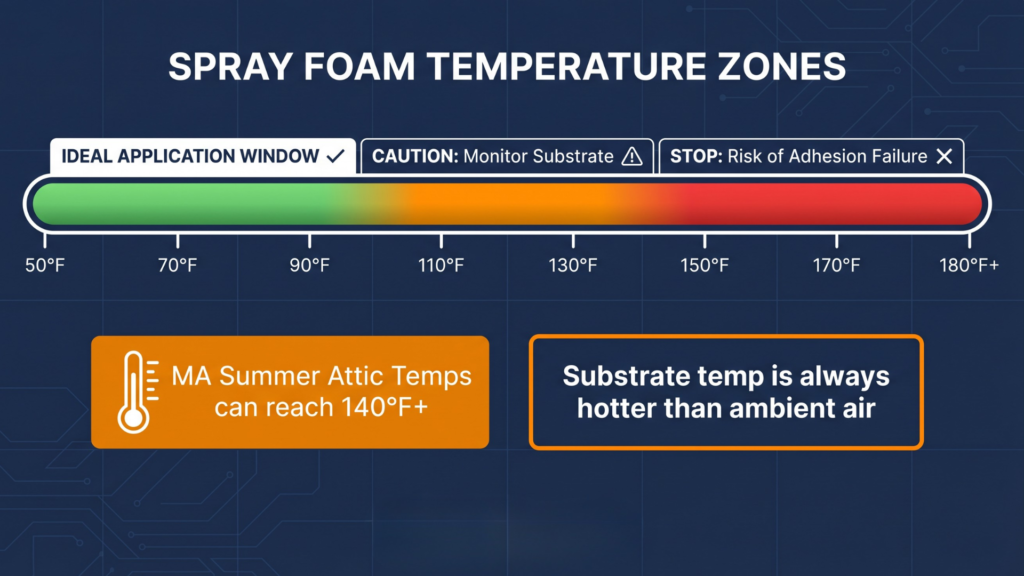
Alt text: Spray foam temperature zones chart, ideal application window 50°F to 90°F, caution zone 90°F to 120°F, stop zone above 120°F. MA summer attic temps can reach 140°F+. Thermalcore Insulation.
The Humidity Variable in New England Contractors Cannot Ignore
Massachusetts summers are not just hot, they are humid. The Spray Polyurethane Foam Alliance (SPFA) is clear on this: spray foam should never be applied when the ambient temperature is within 5°F of the dew point, or when relative humidity exceeds 80%.
High humidity introduces excess moisture to the substrate, which acts as a barrier between the wood and the foam, causing immediate adhesion failure. This is a failure mode that looks invisible on the day of installation and only reveals itself when the building undergoes a blower door test months later.
3 Protocols for Summer Spray Foam Application on MA Job Sites
Professional insulation contractors do not guess. They follow a precise set of summer protocols to ensure the chemistry performs as designed.

Alt text: 3 protocols for summer spray foam application on Massachusetts job sites: switch to summer-blend formulation, schedule attics before 10 AM, and protect chemical drums and hoses from heat. Thermalcore Insulation.
1. Switch to Summer-Blend Formulations: Manufacturers produce different chemical formulations based on seasonal temperatures. A winter blend is designed to react faster to compensate for cold substrates. Using a winter or “regular” blend in July will cause the foam to overheat and crack. Always verify that your insulation partner has transitioned to a summer-blend formulation designed for high-heat applications. [1]
2. Schedule High-Heat Areas for the Morning: Attics, cathedral ceilings, and West-facing walls should never be sprayed at 2:00 PM. Professional crews schedule the most heat-vulnerable sections of the building for the early morning, before 10:00 AM, when the substrate has cooled overnight.
3. Protect the Hoses and Drums: The equipment must be protected from the environment. This means parking the rig in the shade, keeping the chemical drums in a climate-controlled trailer at 70°F–80°F, and ensuring the heated hoses are elevated off hot asphalt or concrete driveways. [1]
The Hidden Cost of Ignoring Temperature Limits
When a contractor ignores curing temperatures to stay on schedule, the immediate visual result might look acceptable. The foam expands and fills the cavity. But the structural failure happens silently over the next few months.
As the superheated foam cools and cures, it shrinks. Micro-gaps form between the foam and the framing. When winter arrives and the building undergoes a blower door test, those micro-gaps allow conditioned air to escape, resulting in a failed inspection.
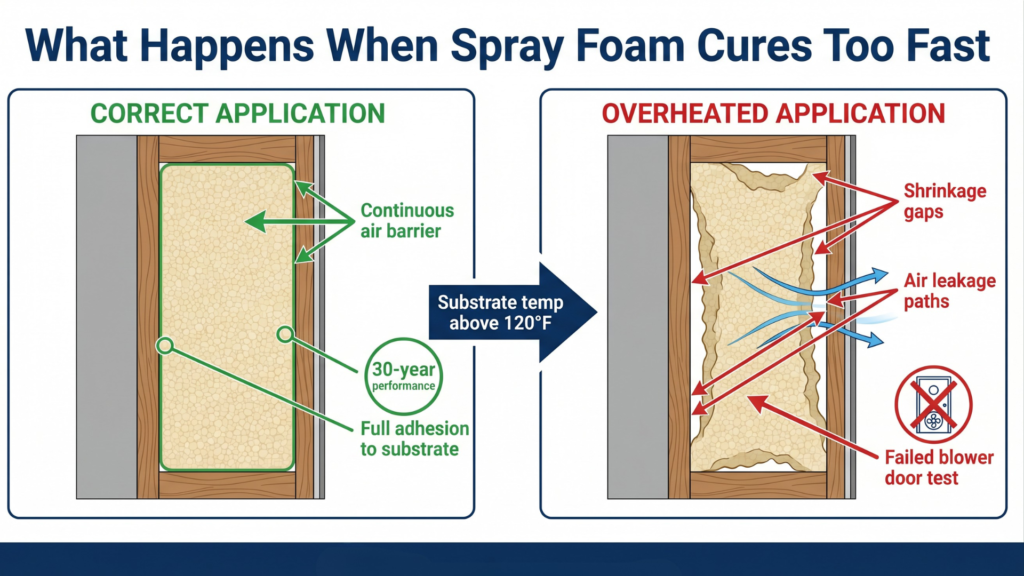
Alt text: Diagram comparing correct spray foam application vs. overheated spray foam application on a Massachusetts summer job site, showing shrinkage gaps, air leakage paths, and a failed blower door test result.
Fixing a failed spray foam job requires tearing down drywall, scraping out the defective foam, and re-spraying — a process that costs exponentially more than doing it right the first time. For a full breakdown of what engineered insulation systems cost in Massachusetts, see our guide on Commercial Insulation Cost in Massachusetts (Real 2026 Data).
Partner with a Building Science Expert
Insulation is not a commodity. It is chemistry. The success of your building envelope depends entirely on the technical expertise of the crew applying it.
At Thermalcore Insulation, we measure substrate temperatures, monitor dew points, and adjust our chemistry to match the exact conditions of your Massachusetts job site. Whether you are navigating complex fire-rated insulation requirements for multi-family buildings or want to ensure your summer framing project passes winter code inspections, we are here to help.
Don’t let a summer heatwave compromise your building envelope. Contact Thermalcore Insulation today to schedule a site assessment and partner with a team that puts building science first.