If you have been researching insulation upgrades for your Massachusetts home, you have likely stumbled across the horror stories.
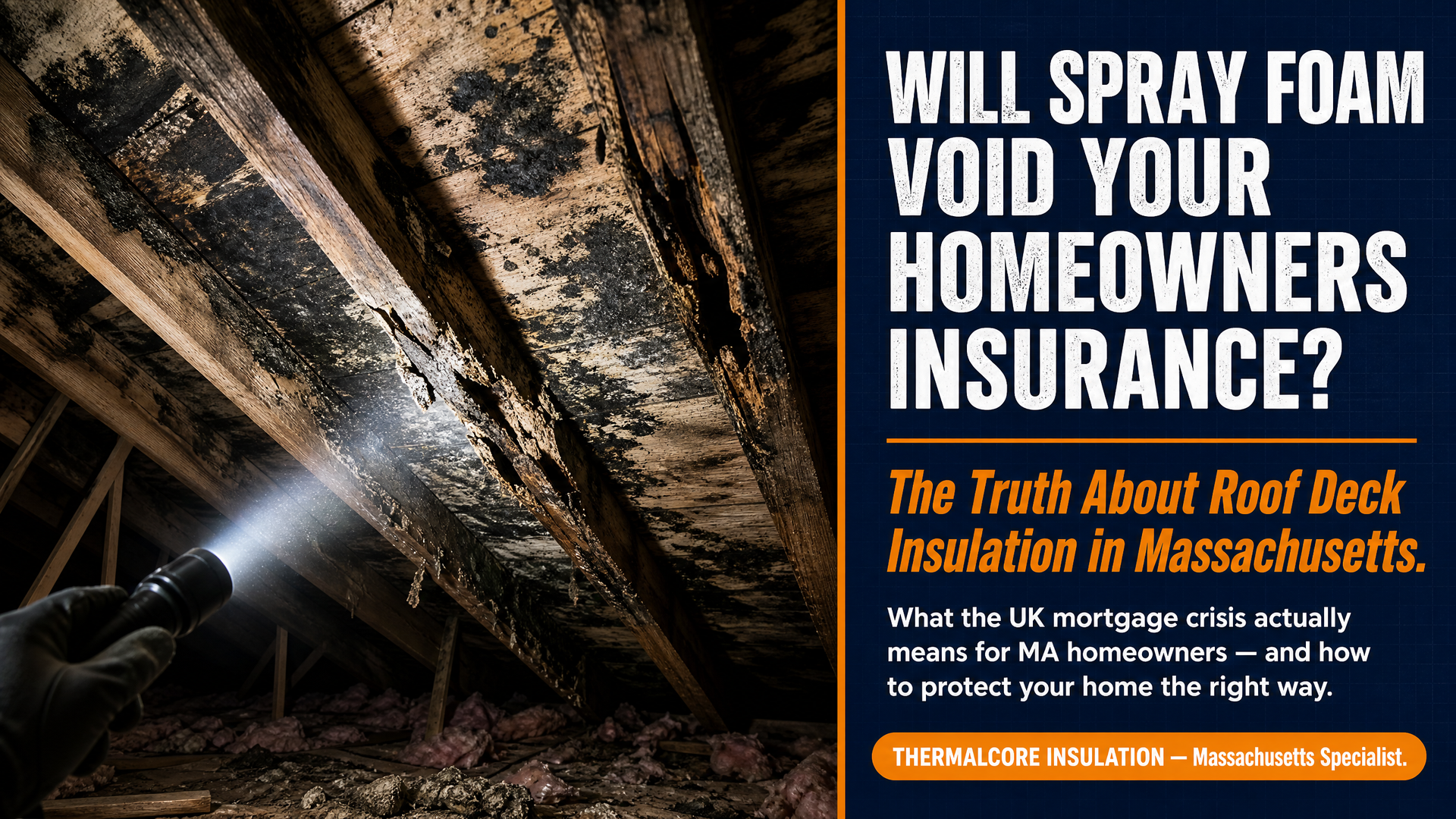
A quick search on Reddit or YouTube reveals terrifying warnings: homeowners peeling back their siding to find the wood framing turned to dust. News reports from the United Kingdom claim that major mortgage lenders are refusing to finance homes with spray foam in the attic. Forums filled with anxiety about voided homeowners’ insurance policies and structural rot.
As a homeowner, it is enough to make you cancel your insulation estimate immediately.
At Thermal Core Insulation, we believe in radical transparency. The truth is that spray foam is the most powerful insulation material available today, but it is also a chemical product that demands strict adherence to building science. When applied incorrectly by underqualified contractors, it can indeed cause catastrophic moisture damage.
Here is the truth about spray foam, roof deck rot, and your homeowners insurance in Massachusetts.
UK Mortgage Crisis vs. US Insurance Reality
To understand the panic, we have to look at where it started.
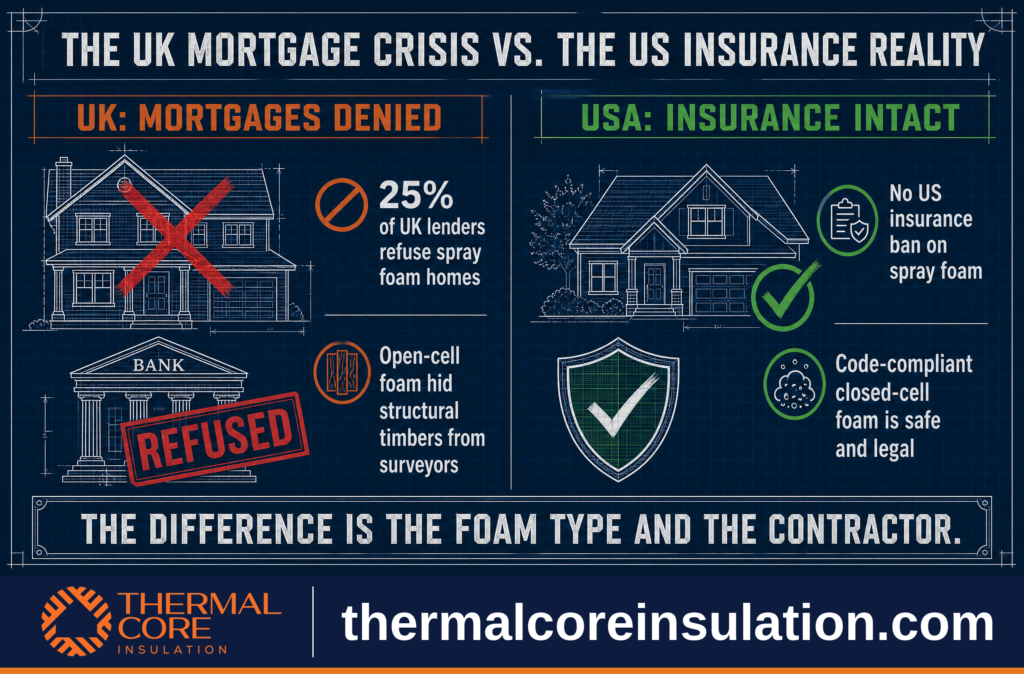
In late 2024, the BBC reported that a quarter of the UK’s biggest mortgage providers were refusing to lend against homes with spray foam insulation in the roof. Surveyors were flagging these homes because the foam was sprayed directly onto the underside of roof tiles, covering the structural timbers.
Because the foam hid the timbers, surveyors could not inspect them for rot. More importantly, many of these installations used open-cell spray foam without a proper vapor barrier. The foam trapped moisture against the wood, leading to severe decay.
Does This Apply to Massachusetts?
The short answer is no, provided the foam is installed to code.
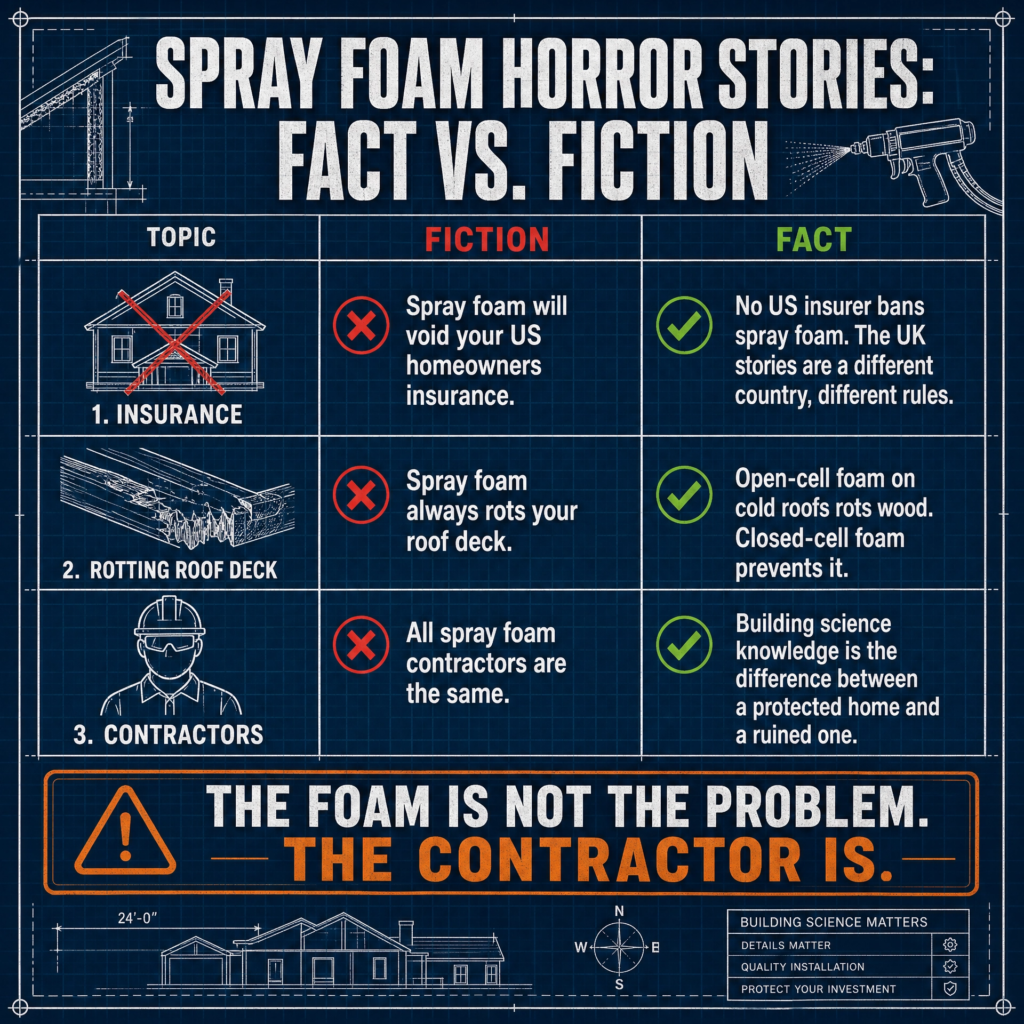
In the United States, major insurance companies do not consider spray foam insulation a reason to deny coverage. There is no widespread mortgage lending ban on spray-foamed homes in America.
However, the physics of moisture does not change when you cross the Atlantic. The catastrophic rot seen in the UK (and in high-profile cases in Vermont ) is caused by a specific, preventable error: applying the wrong type of foam to an unvented roof deck in a cold climate.
Building Science of Roof Deck Rot
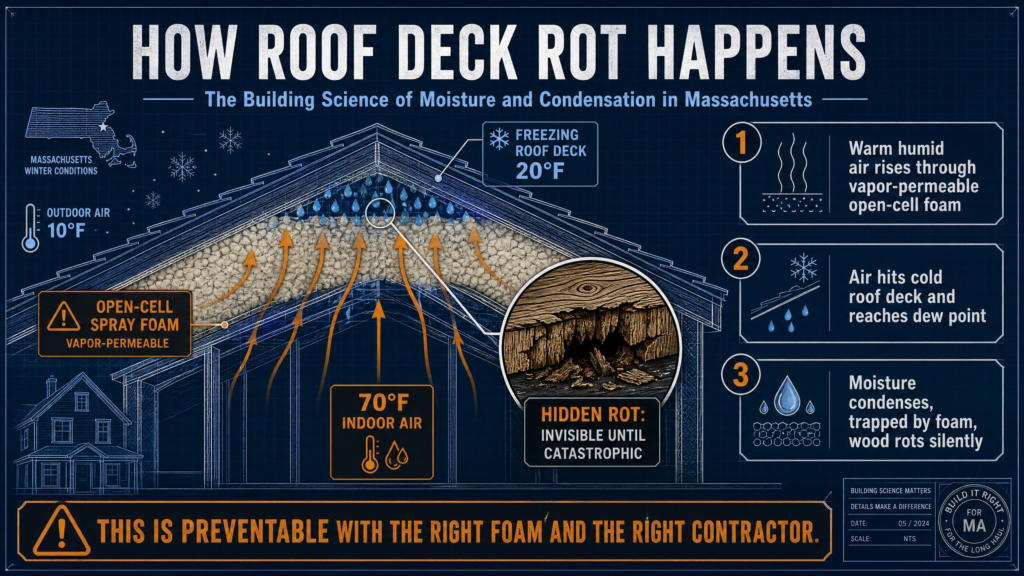
To understand why some roofs rot and others last a century, you have to understand how moisture moves through your home.
During a Massachusetts winter, the air inside your home is warm and relatively humid (from cooking, showering, and breathing). The air outside is freezing. Because heat naturally moves toward cold, that warm, humid indoor air rises and tries to escape through your roof. This dynamic is a primary reason why addressing hot and cold spots is so critical.
When that warm air hits the cold underside of your roof sheathing, it reaches its dew point. The moisture drops out of the air and condenses into liquid water on the wood. Over time, this constant condensation leads to mold, mildew, and structural rot.
The Open-Cell Trap
This brings us to the most common mistake underqualified contractors make: using open-cell spray foam on an unvented roof deck in Climate Zone 5 (Massachusetts).
Open-cell foam is an excellent insulator, but it is vapor permeable. It allows moisture vapor to pass right through it. If a contractor sprays open-cell foam directly onto the underside of your roof deck without installing a dedicated vapor retarder, that warm indoor air will pass through the foam, hit the cold roof deck, and condense.
Because the foam is covering the wood, the moisture is trapped. The roof deck rots from the inside out, completely hidden from view until the damage is catastrophic. This is exactly what happened to the homeowners in the viral Vermont investigative report.
Thermalcore Solution: Closed-Cell Foam
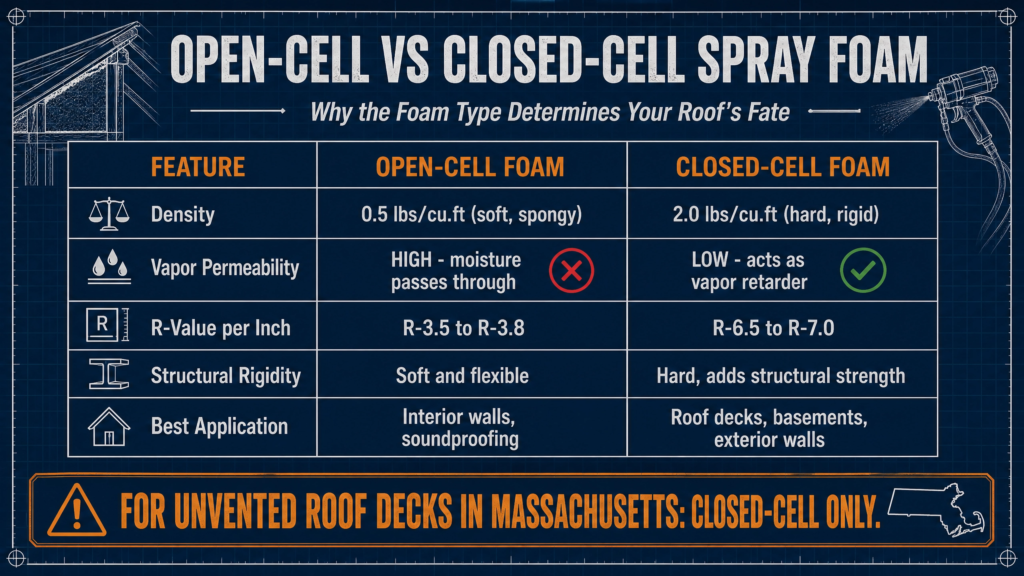
At Thermal Core Insulation, we refuse to gamble with the structural integrity of your home. When insulating unvented roof decks and attics in Massachusetts, we rely exclusively on closed-cell spray foam.
Unlike open-cell foam, closed-cell foam is incredibly dense. It acts as both an air barrier and a Class II vapor retarder. For more context on why material choice matters, see our guide on the embodied carbon in insulation materials.
When we apply closed-cell foam to the underside of your roof deck, it completely seals the wood. Warm, humid indoor air cannot pass through the foam to reach the cold wood. Furthermore, the foam itself provides such a high thermal resistance (R-value) that the surface of the foam facing the interior remains warm, preventing condensation from forming on the foam itself.
| Feature | Open-Cell Spray Foam | Closed-Cell Spray Foam |
| Density | ~0.5 lbs per cubic foot | ~2.0 lbs per cubic foot |
| Vapor Permeability | High (allows moisture through) | Low (acts as a vapor retarder) |
| R-Value per Inch | ~R-3.5 to R-3.8 | ~R-6.5 to R-7.0 |
| Structural Rigidity | Soft and sponge-like | Hard and rigid (adds structural strength) |
| Best Application | Interior walls, soundproofing | Roof decks, basements, exterior walls |
Code Compliance and Permitting in Massachusetts
Massachusetts enforces strict energy and building codes under 780 CMR. The code specifically dictates how unvented attic assemblies must be insulated to prevent condensation.
Unfortunately, the spray foam industry has a “Wild West” element. Many fly-by-night contractors will quote you a lower price by using open-cell foam where closed-cell foam is required by building science. They often skip pulling permits to avoid municipal inspections.
When you go to sell your home, an unpermitted, improper insulation job will be flagged by the buyer’s home inspector. At that point, you are not just facing the cost of removing the foa, you are facing the cost of replacing a rotted roof deck.
Why We Pull Every Permit
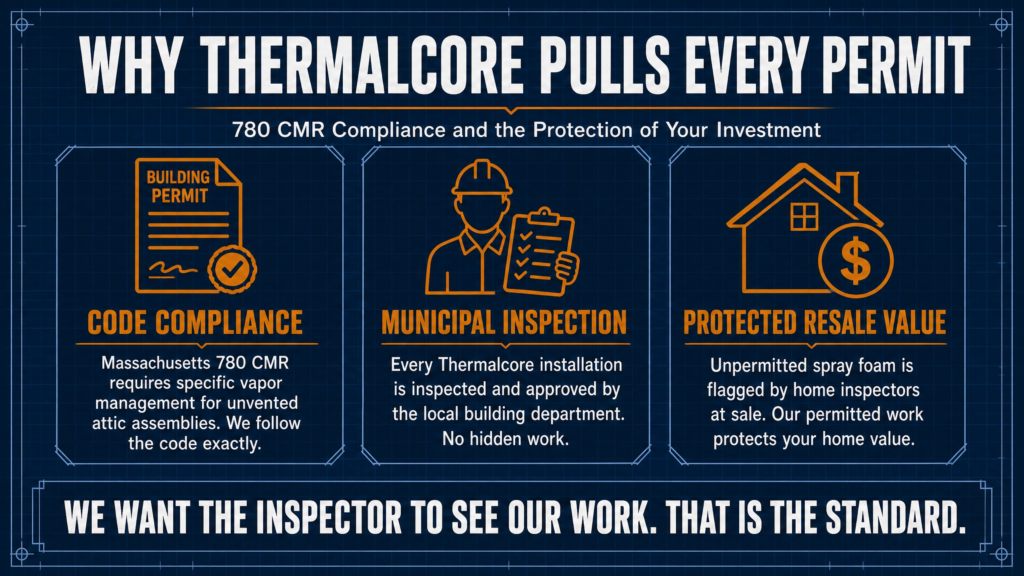
At Thermal Core Insulation, we pull every required permit for our spray foam insulation services. We want the municipal building inspector to see our work. We want a documented, legal record that your home was insulated to the highest standards of the Massachusetts state building code.
This protects your investment, ensures a smooth home sale in the future, and guarantees that your homeowners insurance policy remains rock-solid. Furthermore, doing the job right the first time is exactly how homeowners successfully qualify for Mass Save rebates.
Trust the Envelope Experts
Spray foam insulation will not void your homeowners insurance in Massachusetts. However, hiring the wrong contractor to install the wrong type of foam can cause devastating damage to your home.
Insulation is not just about R-value; it is about moisture management, thermodynamics, and structural preservation. Before you let anyone point a spray gun at your roof deck, ask them about dew points, vapor retarders, and 780 CMR compliance.
If they cannot answer those questions clearly, send them packing.
Are you ready to upgrade your home’s comfort without risking its structural integrity? Contact Thermal Core Insulation today for a building-science-first assessment of your property.