If you are researching insulation upgrades for your Massachusetts home, you want facts, not fearmongering. When it comes to spray foam fire safety facts, the internet is full of conflicting information. One website claims spray foam is highly flammable, while a contractor’s brochure claims their product is “Class A Fire Rated” and perfectly safe.
The truth lies in the building science. Spray foam is an incredibly effective insulator, but it is a combustible plastic. Its safety depends entirely on how it is installed and protected.
At Thermal Core Insulation, we believe in Code-First Insulation. We do not hide the combustibility of our products; we manage it through strict adherence to the Massachusetts building code (780 CMR). Here are the undisputed spray foam fire safety facts every homeowner needs to know before signing a contract.
Fact 1: All Spray Foam is Combustible
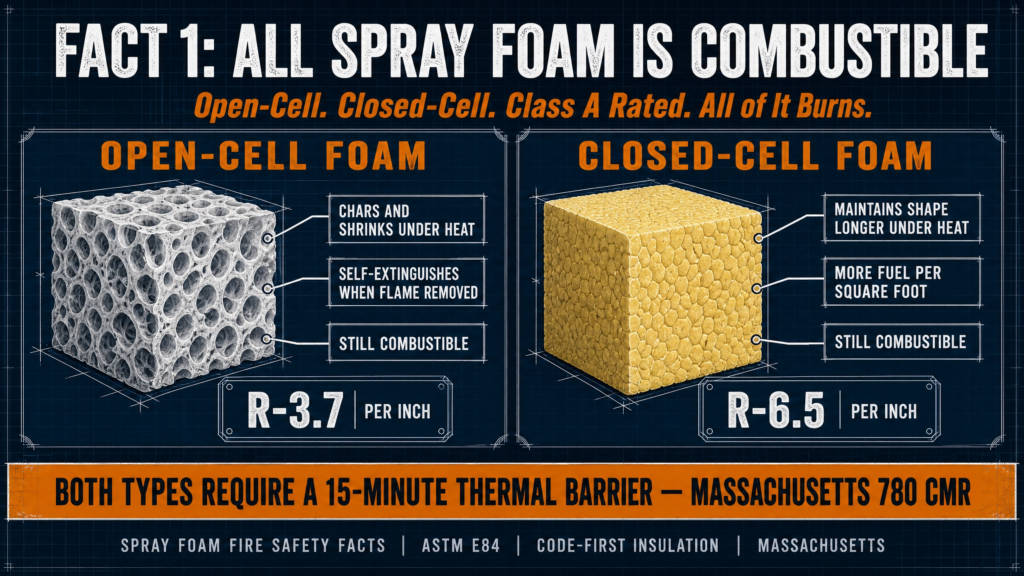
The most fundamental of all spray foam fire safety facts is this: all foam plastic insulation, including both open-cell and closed-cell spray polyurethane foam (SPF), is derived from petroleum. Because it is an organic material, it will burn if exposed to a significant heat source, which is one of the most critical facts about spray foam and fire safety.
To counteract this inherent combustibility, reputable manufacturers treat their spray foam with chemical flame retardants during the manufacturing process. These retardants are designed to interfere with the combustion process, making the foam harder to ignite and slowing the spread of flames across its surface.
If you hold a lighter to high-quality, flame-retardant spray foam, it will char and may briefly catch fire. But if you pull the flame away, the foam will typically self-extinguish. However, in a sustained house fire with continuous, intense heat, the foam will eventually ignite, contributing to the fire and releasing toxic smoke.
This is why the conversation around spray foam fire safety is never just about the foam itself—it is always about the complete assembly and how the foam is protected.
Fact 2: A “Class A” Rating Does Not Mean Fireproof
When comparing quotes, you will often see contractors advertising their spray foam as having a “Class A Fire Rating.” While this sounds impressive, it is frequently misunderstood by homeowners.
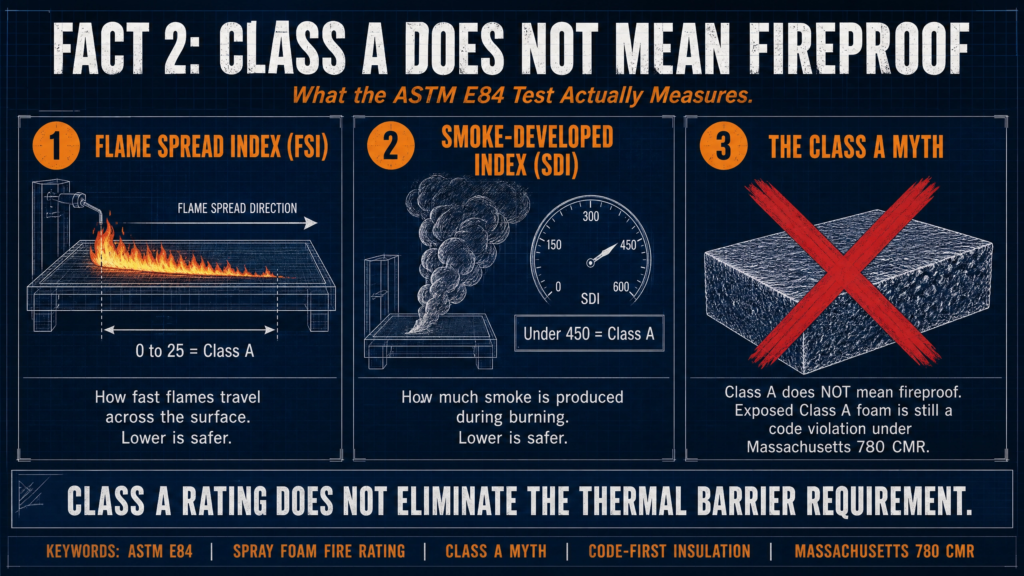
Building materials are tested for their surface burning characteristics using a standardized test called ASTM E84. This test produces two critical numbers:
- Flame Spread Index (FSI): Measures how fast flames travel across the surface.
- Smoke-Developed Index (SDI): Measures the amount of smoke the material produces as it burns.
To achieve a Class A rating, a material must have an FSI between 0 and 25 and an SDI under 450. Most high-quality spray foam products achieve this Class A rating.
However, a Class A rating does not mean the foam is fireproof. It simply means that compared to Class B or Class C materials, it resists flame spread better and produces less smoke initially. Even Class A spray foam must be covered by a thermal barrier to meet residential building codes. Leaving Class A foam exposed in a basement or attic is a severe code violation.
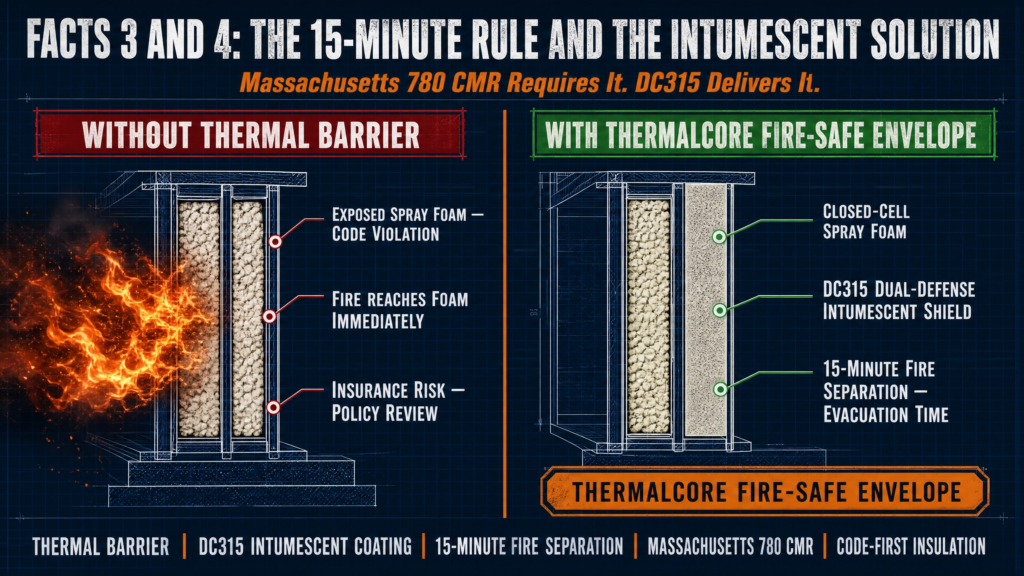
Fact 3: The Code Requires a 15-Minute Thermal Barrier
Because spray foam is combustible, the Massachusetts Board of Building Regulations and Standards (BBRS) strictly regulates its use. Under Massachusetts 780 CMR, spray foam cannot be left exposed in living spaces. It must be separated from the interior of the home by an approved thermal barrier.
The purpose of a thermal barrier is to delay a fire from reaching the combustible foam for a specific period of time—specifically, 15 minutes. This 15-minute window is a life-safety standard designed to give you and your family enough time to evacuate the home before the insulation becomes involved in the fire.
The most common and universally accepted thermal barrier is 1/2-inch gypsum board (drywall). If you are spraying foam into the wall cavities of a living room, the drywall you install over the studs serves as the thermal barrier.
But what if you are insulating an area where installing drywall is impractical, such as an unfinished basement ceiling, a crawl space, or the underside of a roof deck? This is where many contractors cut corners, leaving homeowners with exposed foam and denied insurance coverage.
Fact 4: Intumescent Coatings Are the Approved Alternative
If you cannot install drywall over your spray foam, the code allows for alternative thermal barriers, provided they have been rigorously tested and approved. The most effective and reliable solution is an intumescent coating.
An intumescent coating is a specialized, water-based fire-retardant paint that is sprayed directly over the cured foam. Under normal conditions, it looks like a thick layer of paint. But when exposed to the extreme heat of a fire, a chemical reaction occurs.
The coating swells to many times its original thickness, creating a dense, insulating “char” layer. This char layer acts as a physical shield, protecting the foam underneath from the flames and heat, fulfilling the 15-minute thermal barrier requirement.
At Thermal Core Insulation, we use industry-leading intumescent coatings like DC315 to create our proprietary Dual-Defense Intumescent Shield. This ensures that even in unfinished spaces, your home is fully protected and strictly compliant with Massachusetts fire codes.
Fact 5: Open-Cell and Closed-Cell Require the Same Protection
A common misconception is that one type of foam is safer than the other in a fire. The reality is that neither open-cell nor closed-cell foam is inherently “safer.”
- Open-Cell Foam: This foam is lighter and less dense. It tends to char and shrink away from a heat source, which can slow down the burning process.
- Closed-Cell Foam: This type is dense and rigid. It maintains its shape longer before breaking down, but its higher density means there is more plastic material (fuel) to burn per square foot.
Both types are combustible. Both types produce toxic smoke when burned. And crucially, both types require a thermal barrier to comply with building codes. Whether you choose open-cell for your attic or closed-cell for your basement waterproofing strategy, the fire protection requirements remain identical.
Thermalcore Fire-Safe Envelope
Spray foam insulation is a highly effective product, but its safety depends completely on proper installation. When applied by a knowledgeable professional who strictly follows building code requirements for thermal barriers, it is a safe and reliable choice.
At Thermal Core Insulation, we do not view fire protection as an optional upgrade or an upsell. It is a mandatory component of our Thermalcore Fire-Safe Envelope. We deliver Code-First Insulation on every project, ensuring that your home is not just energy-efficient but fundamentally safe.
Do not let a cheap quote put your home at risk. If a contractor tells you their foam does not need a thermal barrier because it is “Class A rated,” walk away.
Ready to upgrade your home’s comfort with insulation that meets the highest safety standards? Contact us today to discuss our code-compliant spray foam insulation services.