
Two neighbors in Worcester, MA, both got new insulation last year. One saw their winter heating bill drop by 35%. The other? Only 10%.
The difference wasn’t the contractor or the material. It was the strategy. The first homeowner had an insulation plan designed for Worcester’s harsh 7,000 Heating Degree Day (HDD) climate. The second got a generic, Boston-centric solution that left them under-protected and overpaying.
This is the hidden story of Massachusetts climate and insulation: a one-size-fits-all approach doesn’t work. From the Berkshires to Boston, our state’s diverse climate zones demand a tailored strategy. Understanding how the Massachusetts climate impacts insulation needs is the first step to true energy efficiency, comfort, and savings.
This guide will show you exactly what your home needs to thrive in our unique climate, why a Worcester home needs 23% more protection than a Boston one, and how to ensure your insulation investment pays off for years to come.
Why Massachusetts Climate Is a Unique Challenge for Insulation
Massachusetts has one of the most demanding climates in the country for home insulation. It’s not just the cold winters; it’s the variability. We experience everything from humid, 90°F+ summer days to frigid, sub-zero winter nights. This constant fluctuation puts immense stress on a home’s thermal envelope.
Three key factors make our climate a unique challenge:
- High Heating Degree Days (HDD): HDD is a measure of how cold a location is over a period of time. The higher the HDD, the more energy is needed for heating. Massachusetts is split into two primary climate zones, with significantly different HDD values:
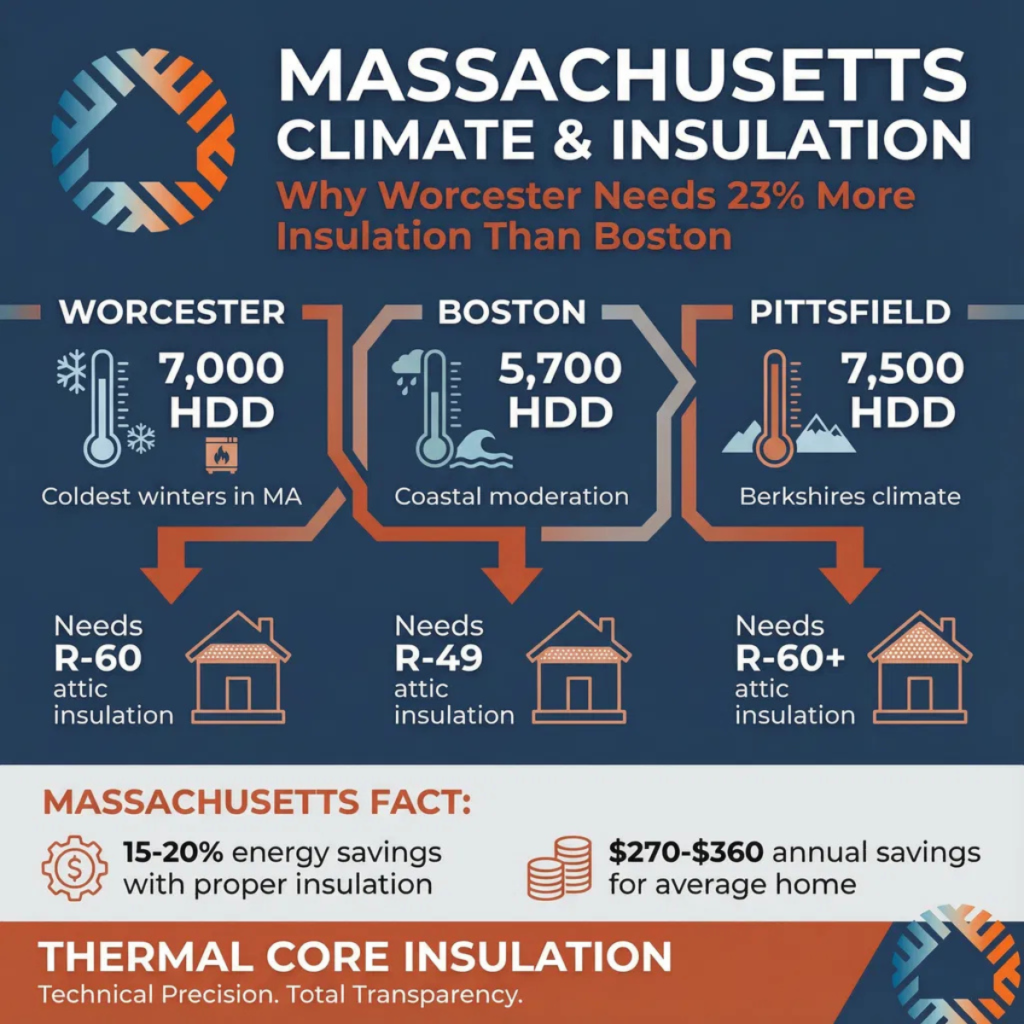
- Worcester: ~7,000 HDD
- Boston: ~5,700 HDD
- Pittsfield: ~7,500 HDD
This data, sourced from the National Oceanic and Atmospheric Administration, shows that a home in Worcester or Pittsfield requires substantially more heating and therefore more insulation, than a home in Boston. - Extreme Temperature Swings: It’s not uncommon for temperatures to swing 30-40°F in a single day. This causes rapid expansion and contraction of building materials, creating air leaks and compromising your home’s thermal barrier. Effective insulation, especially air-sealing spray foam insulation, is critical to managing these swings.
- High Humidity: Our coastal location means high humidity in the summer and significant moisture from snowmelt in the winter. If insulation isn’t paired with proper moisture management, it can lead to mold, rot, and a significant drop in R-value. This is why the U.S. Department of Energy emphasizes air sealing as a critical component of any insulation strategy.
How Climate Zones Determine Massachusetts Insulation Requirements
The International Energy Conservation Code (IECC) divides the country into climate zones to set minimum insulation standards. Massachusetts falls into two zones:
- Climate Zone 5: Covers most of Central and Eastern Massachusetts, including Boston, Framingham, and Springfield.
- Climate Zone 6: Covers the colder regions of Western and Northern Massachusetts, including Worcester County and the Berkshires.
According to the Massachusetts Building Energy Code, these zones have different R-value requirements:
| Home Area | Zone 5 R-Value | Zone 6 R-Value |
|---|---|---|
| Attic/Roof | R-49 | R-60 |
| Exterior Walls | R-20 + R-5 CI* | R-20 + R-10 CI* |
| Basement Walls | R-10 CI* | R-15 CI* |
| Rim Joists | R-15 | R-20 |
*CI = Continuous Insulation, an unbroken layer of rigid foam typically applied to the exterior.
Ignoring these requirements doesn’t just mean you’ll be uncomfortable. It means you’re actively losing money every single day.
Worcester vs. Boston
Let’s go back to our two Worcester neighbors. The first homeowner’s contractor understood that Worcester is in Climate Zone 6. They installed R-60 insulation in the attic and ensured the basement was properly sealed. The second homeowner’s contractor used a Boston (Zone 5) standard, installing only R-49 in the attic.
The result? The first homeowner enjoys consistent temperatures and a significantly lower energy bill. The second homeowner still has drafty rooms and wonders why their new insulation isn’t performing as promised.
That 23% difference in HDD between Worcester and Boston isn’t just a number it’s a tangible factor that impacts your wallet. A home in Worcester needs a more robust thermal barrier to combat the longer, colder winter. This is a perfect example of how climate affects insulation needs in Massachusetts.
What Your Home Needs (By Location)
Here’s a quick guide to what your home needs based on your location:
- Worcester & Central MA (Zone 6): Your top priority is maximizing R-value. Aim for R-60 in the attic and ensure your basement is fully sealed. This is where a professional attic insulation strategy makes a huge difference.
- Boston & Coastal MA (Zone 5): While your R-value requirements are slightly lower (R-49 in the attic), your biggest challenge is moisture. Focus on air sealing and using moisture-resistant insulation in your basement to prevent mold and rot.
- Pittsfield & The Berkshires (Zone 6): With the highest HDD in the state, you need the most protection. R-60 in the attic is a must, and continuous exterior insulation is highly recommended to combat wind and extreme cold.
- Springfield & Western MA (Zone 5): You have a mix of challenges. Focus on meeting R-49 attic requirements and pay close attention to air sealing around windows and doors to prevent drafts.
The Hidden Costs of Ignoring Climate
When your insulation isn’t matched to your local climate, you’re paying for more than just high energy bills. You’re risking:
- Ice Dams: Inadequate attic insulation allows heat to escape and melt snow on your roof, which then refreezes at the eaves, causing damaging ice dams.
- Mold and Moisture: Insulation that can’t handle humidity will become a breeding ground for mold, posing a health risk to your family.
- HVAC Strain: Your heating and cooling systems have to work overtime to compensate for heat loss, leading to premature failure and costly repairs.
- Energy Waste: According to ENERGY STAR, proper insulation and air sealing can save homeowners an average of 15% on heating and cooling costs.
How to Right-Size Your Insulation: A 3-Question Framework
Not sure if your home is protected? Ask yourself these three questions:
- What’s my home’s story? Is it a 100-year-old Victorian in Cambridge or a 20-year-old Colonial in Worcester? The age and construction style will dictate its insulation weaknesses.
- Where do I feel the most discomfort? Are there drafty rooms? Is the second floor always hotter in the summer? These are clues to where your insulation is failing.
- When was the last time I had a professional audit? A professional energy audit can pinpoint exact areas of heat loss and provide a data-driven plan for improvement.
Mass Save® Rebates for Climate-Appropriate Insulation
The good news is that you don’t have to bear the cost alone. The Mass Save® program offers generous rebates and incentives for upgrading your home’s insulation. Thermal Core is a proud Mass Save partner, and we can help you navigate the process to ensure you get the maximum rebate for your project.
The Right Strategy Starts with the Right Partner
Understanding how Massachusetts climate affects insulation needs is the key to unlocking true home comfort and energy savings. Don’t settle for a one-size-fits-all solution. Choose a partner who uses data, understands our unique climate, and designs a strategy tailored to your home.
At Thermal Core, we provide technical precision and total transparency. We’ll show you the data, explain your options, and build a plan that protects your home and your wallet.
Ready to create a climate-proof insulation strategy for your home?