
Massachusetts basement waterproofing signs are often misdiagnosed by homeowners as simple insulation problems, a costly mistake that traps moisture, accelerates foundation decay, and creates hidden mold farms behind newly finished walls.
When a basement feels damp, cold, or smells musty, the instinct is to seal it up with thick layers of insulation. But insulation fixes energy problems, not water problems. Applying closed-cell spray foam or rigid foam board over a foundation that is actively leaking groundwater is like putting a bandage over a running faucet. The water will still enter, but now it will be trapped between the concrete and the insulation, silently degrading your home’s structural integrity.
Before you invest in basement insulation, you must first diagnose whether you are dealing with harmless summer condensation or active water intrusion. Here are the five definitive signs that your Massachusetts basement requires professional waterproofing before a single drop of foam is sprayed.
1. Efflorescence: The White Chalky Warning
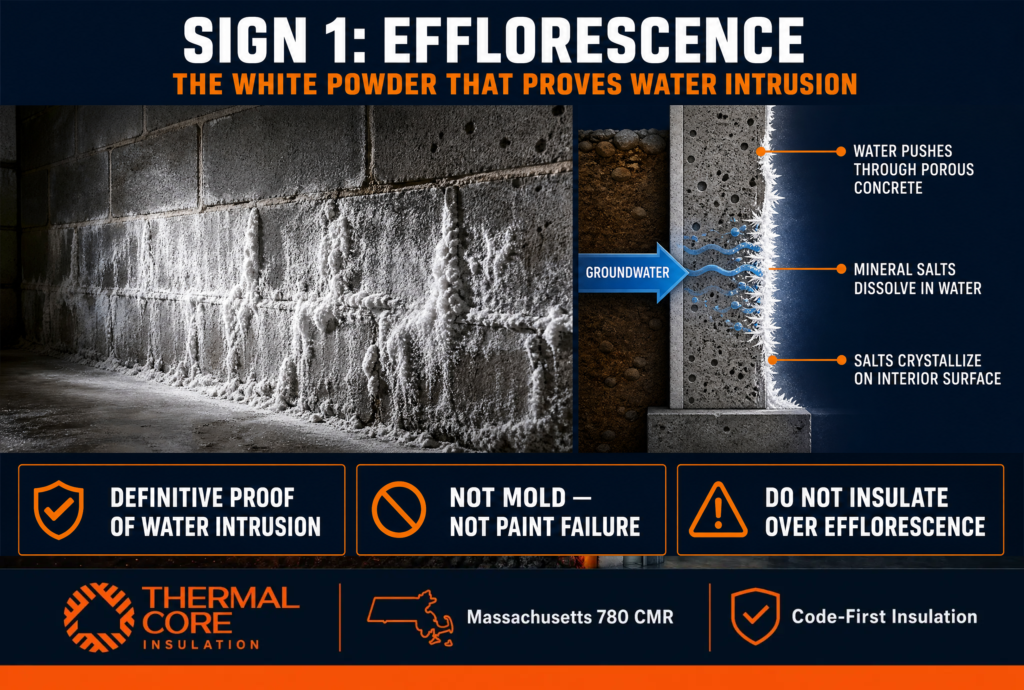
The most reliable, undeniable indicator that water is moving through your foundation walls is efflorescence.
Efflorescence appears as white, powdery, or crystalline deposits on concrete, block, or brick surfaces. Homeowners often mistake it for white mold or failing paint, but it is actually a chemical residue. When groundwater pushes through porous concrete, it dissolves mineral salts within the masonry. As the water reaches the interior surface of the basement wall and evaporates, it leaves those salts behind a process documented extensively in masonry waterproofing research.
Efflorescence is definitive proof of water intrusion. It is not caused by indoor humidity or condensation. If you see these white deposits, water has physically traveled from the soil outside, through your foundation, and into your basement. The heavier the buildup, the more significant the water flow. Installing insulation over efflorescence guarantees that moisture will continue to penetrate the wall, eventually compromising the insulation’s bond to the substrate.
2. Horizontal Cracks and Hydrostatic Pressure
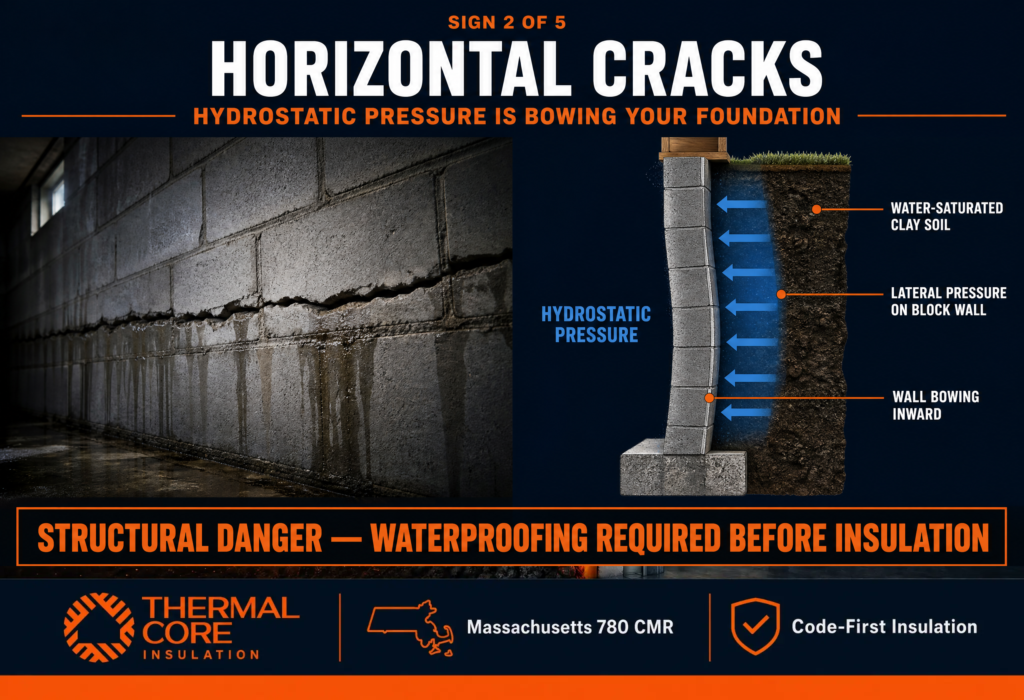
Massachusetts soil, particularly in areas heavy with clay, absorbs massive amounts of water during spring snowmelts and heavy rainstorms. As the soil saturates, it expands and exerts immense weight against your foundation walls, a force known as hydrostatic pressure.
Not all cracks are created equal. Vertical cracks in poured concrete walls are often the result of normal settling and can sometimes be managed with simple crack injection. However, horizontal cracks in block walls are a severe warning sign. They indicate that hydrostatic pressure is actively bowing the wall inward.
Water frequently enters through these horizontal fissures. If you observe stair-step cracks following the mortar joints in brick or block foundations, structural movement and water entry are occurring simultaneously. Attempting to insulate over walls experiencing active hydrostatic pressure is dangerous; the underlying drainage issue must be resolved with interior or exterior waterproofing systems first.
3. The Foil Test: Condensation vs. Water Intrusion
Before committing to a basement waterproofing cost analysis, you need to know if the dampness on your walls is actually coming from outside.
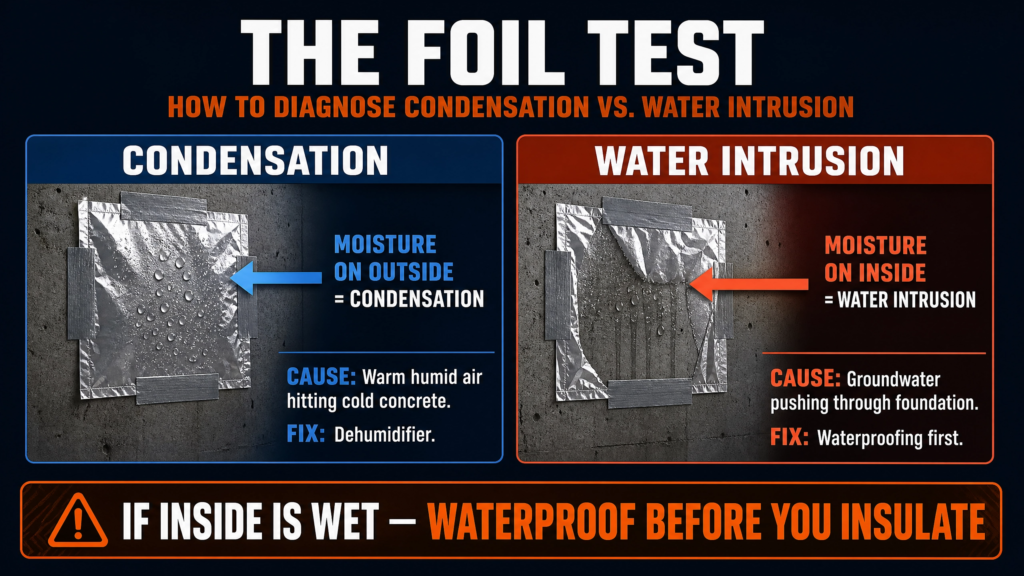
During humid New England summers, warm air entering the cool basement can create condensation on cold concrete walls and water pipes. This is an air-quality issue, not a foundation leak, and can often be solved with a high-capacity dehumidifier. To tell the difference between condensation and true water intrusion, perform the foil test.
- Dry a section of the damp wall completely with a towel or fan.
- Tape a 12-inch square of aluminum foil tightly to the wall, sealing all four edges with waterproof tape.
- Leave it undisturbed for 24 to 48 hours.
If moisture forms on the outside of the foil (facing the room), you have condensation. The warm room air is hitting the cold foil and releasing water. If moisture forms on the inside of the foil (between the foil and the concrete), you have active water intrusion. Groundwater is pushing through the foundation. If both sides are wet, you have both problems. If the inside is wet, waterproofing is mandatory before insulation.
4. Recurring Wet Spots After Rain
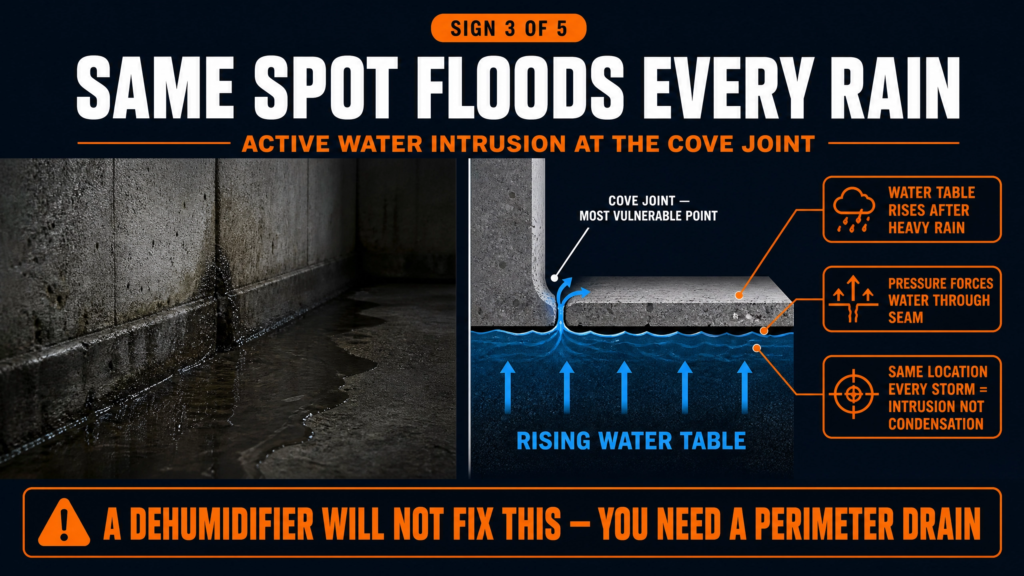
Water intrusion behaves predictably. If you notice water pooling in the same corner, along the same section of the cove joint (where the floor meets the wall), or beneath the same window well after every heavy rainstorm, you are dealing with a drainage failure that condensation management cannot solve.
In Massachusetts, the highest risk period is between March and May, when spring rain combines with melting snow to raise the water table and fully saturate the soil. If your basement floor shows damp, dark patches that correlate directly with weather events, the foundation envelope has been breached.
Insulation cannot fix this. While high-quality closed-cell spray foam is highly moisture-resistant and acts as a vapor barrier, it is not designed to hold back pooling water or active leaks. If water is entering at the cove joint, an interior perimeter drainage system and sump pump are required to manage the flow before the walls are finished.
5. Musty Odors and Hidden Mold
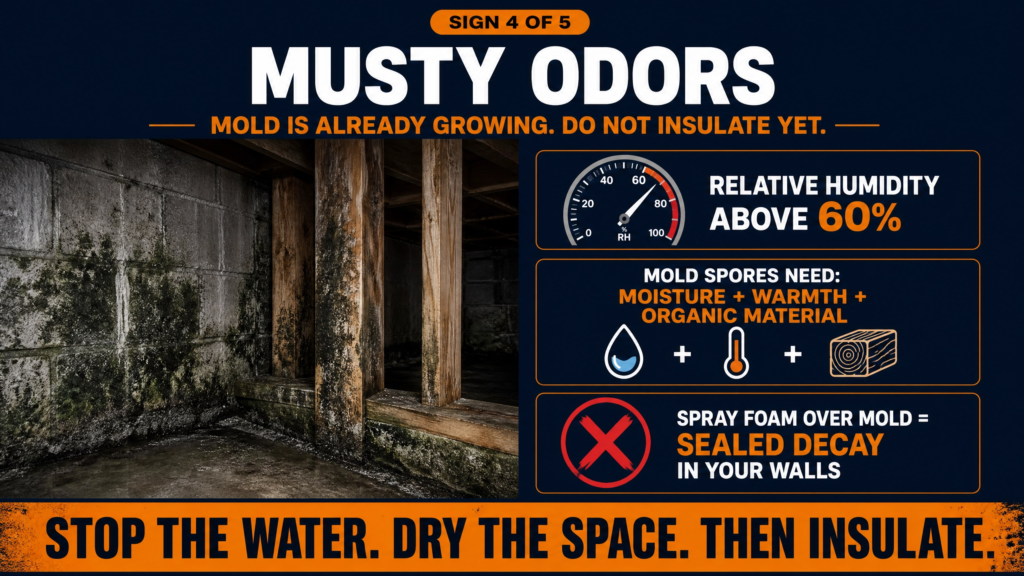
You do not need to see mold to know you have a moisture problem. The characteristic “basement smell”, earthy, stale, and musty, is the off-gassing of active mold and mildew growth.
Mold requires moisture, warmth, and organic food sources (like wood framing, drywall paper, or stored cardboard boxes) to thrive. If your basement smells musty, the relative humidity is consistently staying above 60 percent.
Adding fiberglass batts or unsealed rigid foam to a musty basement is a recipe for disaster. Fiberglass absorbs moisture like a sponge, losing its R-value and becoming a perfect breeding ground for toxic mold. Even if you plan to use closed-cell foam, applying it over existing mold spores without addressing the underlying water source will simply seal the decay into the wall cavity. The water must be stopped, the space dried, and the air quality stabilized before insulation begins.
The Code-First Approach to Basement Finishing
At Thermalcore, we believe in the Code-First Insulation philosophy. This means doing the job right the first time, ensuring safety, compliance, and long-term durability.
If your basement exhibits any of these five Massachusetts basement waterproofing signs, we will not spray foam until the water problem is resolved. Trapping hydrostatic pressure behind insulation voids warranties and destroys homes. Once the foundation is properly waterproofed and dry, we apply our Thermalcore Fire-Safe Envelope, a continuous, airtight layer of closed-cell spray foam that maximizes energy efficiency and lowers your summer electric bills.
Because basements are habitable spaces, building codes also require that foam plastic insulation be protected from fire. We ensure full compliance with Massachusetts 780 CMR by applying a spray foam fire safety thermal barrier, such as half-inch drywall or our Dual-Defense Intumescent Shield.
Insulation is the final step in creating a comfortable, efficient basement, not the first. If you are unsure whether your basement is ready for insulation, contact us today for a comprehensive assessment.