

The Mass Save weatherization sequence is the required order of steps that determines whether your insulation and air sealing work qualifies for 75–100% incentive coverage. The order is: Home Energy Assessment, income tier verification, participating contractor selection, diagnostic testing, air sealing, verification, then insulation. Work performed out of order or before the assessment is generally not eligible for incentives, even when the work itself is excellent.
ThermalCore Insulation is a Mass Save Partner and BPI-certified contractor serving Massachusetts homeowners.
What the Mass Save Weatherization Sequence Actually Is
Most Massachusetts homeowners lose their rebate for one reason: they did the right work in the wrong order.
The sequence is not bureaucratic friction. It exists because each step produces the documentation the next step depends on. Skip the assessment, and there is no approved scope. Insulate before air sealing, and you have permanently buried the leaks that caused the problem. Hire an unlisted contractor and no one can file the paperwork at all.
Mass Save is funded through small charges on Massachusetts utility bills, which means eligibility has to be documented rather than assumed. The program covers 75% of approved insulation costs for most customers, and 100% for income-eligible households and residents of Designated Equity Communities.
Here is the order that protects your money.
Step 1: The No-Cost Home Energy Assessment
Everything starts here. You can schedule a no-cost Home Energy Assessment by calling 866-527-SAVE (7283) or visiting MassSave.com/HEA. Mass Save
Mass Save provides no-cost home energy assessments to all participating utility customers living in 1- to 4-unit homes, whether you are a renter, condo owner, homeowner, or landlord. An Energy Specialist walks the home, reviews your equipment and energy use, and produces a customized report with recommended upgrades. Brookline
That report is the document everything downstream references. Without it, there is no approved scope of work, and generally no incentive.
Two practical notes. Assessments are available roughly every three years, so if yours is older than that, it is worth repeating. And the assessment is often a requirement for rebates, incentives, and no-interest loans, not merely a recommendation. Massachusetts Clean Energy CenterBrookline
One useful flexibility: you can choose a participating Home Performance Contractor to complete your no-cost Home Energy Assessment, and that same contractor can also complete the recommended insulation and air sealing work during a follow-up visit. Fewer handoffs, fewer dropped details. Mass Save
Step 2: Confirm Your Income Tier
This step gets skipped constantly, and it is expensive to skip.
Massachusetts households fall into different incentive tiers, and the difference between them is the difference between paying 25% of a project and paying nothing. Income-eligible households can receive full weatherization coverage. Separately, residents of Designated Equity Communities qualify for additional offers including 100% off weatherization upgrades. Mass Save
Verify your tier before the scope is finalized and priced. Discovering after installation that you qualified for 100% coverage does not retroactively change what you were charged.
If you fall outside enhanced tiers, financing still helps. The Sponsors of Mass Save offer 0% HEAT Loan financing of up to $25,000 toward qualified home improvements. Mass Save
Step 3: Select a Participating Contractor
Only contractors participating in the Mass Save program can file weatherization incentives. This is a hard gate, not a preference.
Verify three things before signing anything:
- Program participation. Confirm the contractor can actually file your rebate, not just perform the work.
- BPI certification. Building Performance Institute credentialing is the standard for diagnostic competence in this trade.
- Scope alignment. The proposed work should map to the assessment’s recommendations. Extra work is fine; it just may not be covered.
Ask directly: “Will you file the Mass Save paperwork, or am I responsible for it?” The answer tells you a great deal.
Step 4: Diagnostic Testing and the Blower Door
Here is where most online guides get it wrong.
Many articles claim a blower door test is a mandatory Mass Save step. That is not accurate as a blanket statement. A blower door test is not typically included in a standard Mass Save Home Energy Assessment, and the Massachusetts Clean Energy Center notes it is generally worth investing $300 to $600 separately because it can uncover additional weatherization opportunities. Massachusetts Clean Energy CenterMassachusetts Clean Energy Center
So treat it as strongly recommended rather than universally required, and ask your contractor what testing your specific scope includes.
Why bother? Because a blower door converts guesswork into a map. It pressurizes the house and reveals where air is actually moving, which is frequently not where the homeowner assumed.
A blower door also has limits. It tells you how leaky the envelope is; it does not tell you whether your basement has a moisture problem or whether your attic insulation was installed correctly. Our guide to what a blower-door test tells you and what it doesn’t covers where the diagnostic ends and judgment begins.
Step 5: Air Sealing Comes First
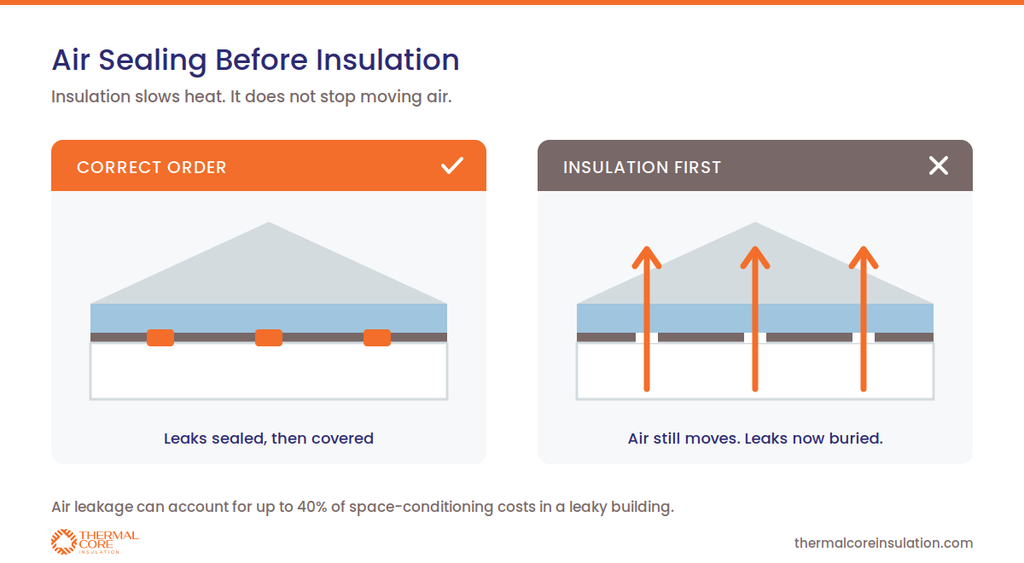
Air sealing before insulation is the single most important ordering rule in the entire Mass Save weatherization sequence.
The reasoning is physical, not procedural. Insulation slows heat conduction. It does not stop air movement. Air leakage can represent up to 40% of space-conditioning costs in a leaky building. Blow cellulose over unsealed top plates, open chases, and recessed light penetrations, and you have insulated a building that still breathes, while making those leaks permanently inaccessible. Mass Save
Under the program, the Sponsors of Mass Save offer no-cost air sealing alongside 75–100% off approved insulation upgrades. There is no financial reason to skip it and every building-science reason not to. Mass Save
Typical targets include attic top plates, wiring and plumbing penetrations, dropped soffits, attic hatches, chimney chases, rim joists, and the basement perimeter. Our fall insulation and air-sealing checklist walks through how to trace the air path before the first cold snap.
Step 6: Verify Before You Cover
Once air sealing is complete, verify it before insulation goes down.
This is the last moment the assembly is visible. After insulation, correcting a missed penetration means removing material you already paid to install. A post-sealing blower door reading also quantifies the improvement, which is useful documentation and a genuine quality check on your contractor.
Confirm with your installer whether post-work testing is included in your scope. If it isn’t, ask what it would cost to add. It is nearly always cheaper than reopening a finished attic.
Step 7: Insulation Last
Now the thermal layer goes in, on top of a sealed and verified assembly.
Insulation levels matter for eligibility. Mass Save recommends an attic insulation level of R-49, which requires roughly 15 inches of fiberglass or cellulose. Program rebates are tied to meeting minimum net R-values, so under-installing can disqualify otherwise good work. Massachusetts Clean Energy Center
R-value targets differ by building surface, not by room. An attic, a floor over a garage, and a basement wall each behave differently and face different depth and moisture constraints. Our complete R-value guide for Massachusetts homes breaks down targets by assembly and explains why the room you feel the problem in is rarely the surface that causes it.
Where the Sequence Breaks: Pre-Weatherization Barriers
The most common reason a Massachusetts project stalls is a condition discovered in the attic that must be resolved before insulation can legally or safely proceed.
| Barrier | Why it stops work | Typical resolution |
|---|---|---|
| Knob-and-tube wiring | Cannot be covered with insulation | Licensed electrician evaluates and documents before work proceeds |
| Vermiculite or suspected asbestos | Must not be disturbed | Qualified asbestos professional required first |
| Active moisture or mold | Insulation will trap it | Correct the water source before insulating |
| Recessed lighting | May require verification for clearance | Assess type and rating, replace or box as needed |
| Combustion safety concerns | Tightening a home changes venting | Secondary evaluation by a qualified professional |
None of these mean the project is dead. They mean a step was inserted ahead of insulation. Mass Save treats several of these as pre-weatherization barriers with their own mitigation pathways, and HEAT Loan financing can cover qualifying barrier work.
If you are unsure whether your existing insulation can stay, our guide on when old insulation should be removed instead of covered explains the condition-first assessment we use.
Does Spray Foam Fit the Mass Save Weatherization Sequence?

An honest answer, from a Mass Save Partner: usually not in the way homeowners expect.
Mass Save weatherization incentives are built primarily around cellulose and fiberglass insulation with air sealing. Spray foam is frequently outside the standard rebate path, which does not make it the wrong material. It makes it a different decision.
Closed-cell spray foam earns its place where depth is limited, where the assembly must manage vapor, or where air sealing and insulation need to be the same layer, rim joists, cathedral ceilings, foundation walls. Our comparison of open-cell versus closed-cell spray foam explains where each belongs.
The practical approach for most Massachusetts homes is a hybrid: use the program for what the program covers well, and specify foam only where the assembly genuinely requires it. Anyone who tells you the rebate covers everything, or that foam is always superior, is selling rather than assessing.