

Mass Save HEAT Loan is one of the most misunderstood phrases in Massachusetts home improvement.
Homeowners hear “0%” and “up to $25,000,” then naturally translate it into something simpler than the real program: free money, a contractor payment plan, or a loan that automatically covers any project that improves the house.
None of those interpretations is quite right.
The HEAT Loan can be a valuable way to finance eligible energy-efficiency work. But it is a program path, not a blank check. The home, the measure, the assessment, the project proposal, the authorization form, the contractor, the lender, and the timing all need to line up.
The useful question is not just, “Can I borrow $25,000?”
It is:
“What has to happen, in what order, for this project to qualify and make sense?”
This guide explains that sequence, what the $25,000 maximum actually means, where insulation and air sealing fit, and what Thermalcore can and cannot do for a Massachusetts homeowner considering the program.
Mass Save HEAT Loan
The official Mass Save financing page describes the HEAT Loan as 0% interest financing for eligible energy-efficiency upgrades. Its currently published maximum financeable amount is up to $25,000 total, a limit that Mass Save says took effect January 1, 2025.
That sentence has several important parts.
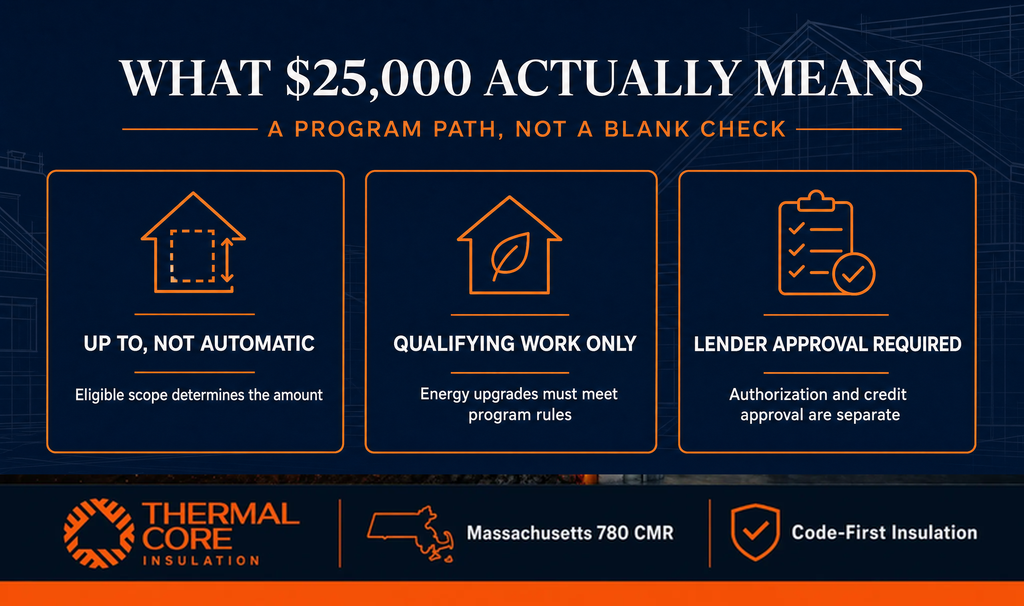
“Up to” means the program maximum is not an automatic project budget. The approved amount depends on the eligible scope and the required process.
“Total” matters too. Mass Save says the maximum is available over the lifetime of a customer’s energy-efficiency upgrades until that maximum is reached. It is not a new $25,000 allowance for every project idea.
And “0% interest” does not mean there is no obligation. The financing is still a loan. A participating lender still makes the credit decision. You still review repayment terms and lender disclosures. You still pay the approved financed balance.
| What homeowners often assume | What the program actually requires |
| “I can finance any renovation up to $25,000.” | Only qualifying energy-efficiency measures are eligible, and program requirements determine what can be authorized. |
| “0% means approval is automatic.” | Mass Save authorization and lender credit approval are separate steps. |
| “I can install now and finance it after.” | Mass Save’s FAQ says work installed before receipt of an Authorization Form cannot be financed through the HEAT Loan. |
| “The loan covers the contractor’s full price.” | The eligible amount is tied to qualifying work, and Mass Save says applicable rebates are deducted from the proposal total rather than financed. |
| “My contractor handles the loan.” | A contractor can provide the project proposal and scope, but the homeowner applies and the participating lender decides approval. |
That distinction is not paperwork for its own sake. It protects the homeowner from committing to work before understanding what is eligible, what must be addressed first, and what financing is actually available.
The $25,000 figure is a ceiling, not a recommendation
The $25,000 number is helpful because it gives a household a financing ceiling to consider. It should not become the number that dictates the scope.
A good insulation and air-sealing project begins with the house. Where is it losing heat? Where is air moving? Is the attic dry and safe? Are there active roof leaks, bath-fan moisture paths, knob-and-tube wiring, vermiculite, combustion-safety issues, or other barriers that need attention first?
If a house needs $6,000 of eligible weatherization work after incentives, borrowing $25,000 simply because it is the maximum does not improve the project. If the house has a pre-weatherization barrier, insulating first can be the wrong sequence even if financing is available.
The Mass Save Home Energy Assessment page describes the no-cost assessment as the point where an Energy Specialist identifies opportunities, recommends upgrades, and helps the homeowner understand available incentives and financing. For weatherization and weatherization-barrier work, Mass Save says this assessment is mandatory.
That makes the assessment more than a formality. It is the point where the financial conversation returns to the condition of the home.
A simple illustration, not a payment quote
The example below is fictional. It does not predict a rebate, an authorization amount, lender approval, payment amount, or the cost of any Thermalcore project. It only shows why homeowners should separate a project proposal, an incentive, and a potential loan balance.
| Illustrative line item | Example amount | What it shows |
| Eligible weatherization proposal | $18,000 | A contractor proposal identifies the approved scope of work. |
| Program incentive shown for that scenario | $12,000 | Actual incentives depend on current rules and assessment findings. |
| Potential remaining amount to finance | $6,000 | Mass Save says applicable rebates are deducted from the proposal total and are not included in the HEAT Loan amount. |
The right way to use this table is not “I will receive these numbers.” It is “I need the program-confirmed scope and incentive information before I decide what I may need to finance.”
Mass Save HEAT Loan: step-by-step process
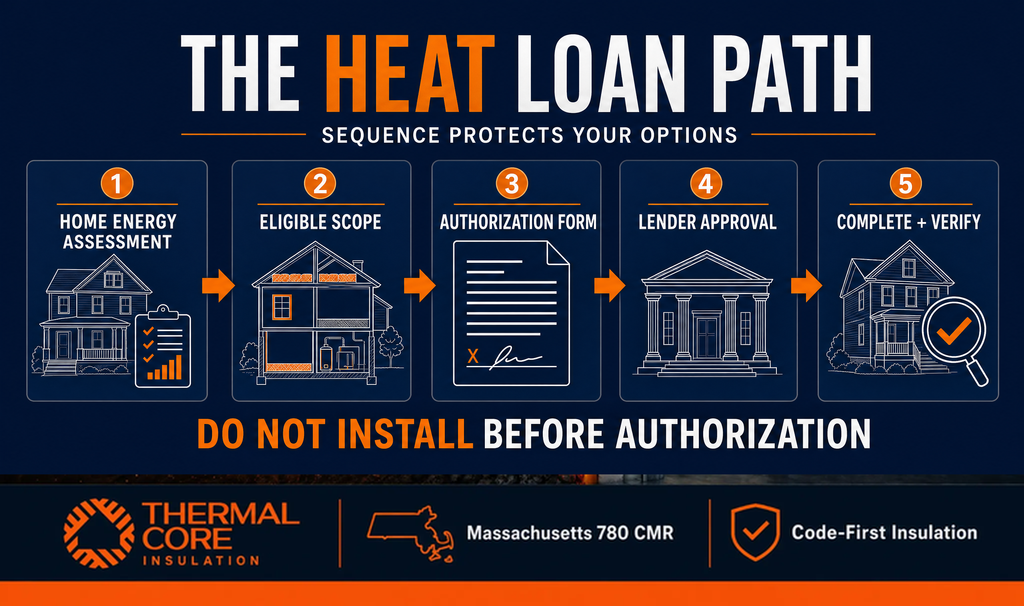
The official Mass Save HEAT Loan process is straightforward once the sequence is visible. The common frustration comes from starting in the middle, such as selecting an installer before understanding eligibility or scheduling work before authorization is in hand.
| Step | What happens | Why the order matters |
| 1. Confirm your starting eligibility | Review current program eligibility and the measures that may qualify. | Not every home, utility account, property type, or improvement follows the same path. |
| 2. Complete a Home Energy Assessment when required | Weatherization and weatherization barriers require a no-cost assessment, according to Mass Save. | The assessment identifies what needs to be addressed and may establish the path to incentives and loan authorization. |
| 3. Select a participating contractor | Obtain a signed proposal on the contractor’s official letterhead. | The project scope must be defined before the application can be evaluated. |
| 4. Apply for the HEAT Loan authorization | Submit the application and proposal through the program’s application route. | The authorization is the program approval for eligible equipment or measures. It is not yet lender approval. |
| 5. Apply with a participating lender | Take the completed Authorization Form to a participating lender. | The lender reviews credit and lending requirements. |
| 6. Receive the financing instrument if approved | Mass Save says the lender provides a two-party check payable to the homeowner and contractor. | This structure keeps the payment connected to the approved work. |
| 7. Complete work and verification | Complete the upgrade, follow verification requirements, and pursue any available rebate process. | The project must be completed and documented in the program sequence. |
Mass Save’s FAQ adds two timing details homeowners often miss. It says customers have two years from the Home Energy Assessment to apply for a Heat Loan Authorization Letter. Once the letter is issued, it is good for 30 days to work with a participating lender. It also says a project already installed before the Authorization Form is received is not eligible for HEAT Loan financing.
That makes timing a real project-management issue. If your contractor’s proposal, lender choice, or installation schedule is still uncertain, do not treat the authorization as a casual document to request and set aside.
Who may be eligible, and who makes the decision
The Mass Save financing page says the HEAT Loan is available to qualified Mass Save customers. It lists several utility and account requirements and says the loan applicant must be the homeowner. Its FAQ further says the program is available to individually owned houses, condos, and 1–4 unit properties, while owners of 5+ unit apartment buildings cannot use the residential HEAT Loan.
But program eligibility is only one gate.
Mass Save’s HEAT Loan FAQ says the authorization letter tells the bank or credit union that the equipment is approved for the HEAT Loan. The applicant must still meet the lender’s own lending and credit requirements.
| Decision | Who controls it |
| Whether a measure is currently eligible under the program | Mass Save program requirements and the assessment/authorization process |
| Whether the house has a condition that should be corrected before insulation | The project assessment and appropriate qualified trade review |
| Whether the work scope and proposal are appropriate | The selected contractor and homeowner, subject to program requirements |
| Whether the loan is approved | The participating lender |
| How the contractor is paid with the financed funds | The lender’s two-party-check process and the project’s applicable documentation |
| Whether work meets required verification | The applicable Mass Save verification process |
This is why it is more accurate to say Thermalcore can help you prepare an eligible, condition-first insulation scope than to say Thermalcore can “get you approved.” We cannot make a credit decision. No contractor should imply that they can.
What the HEAT Loan can cover for an insulation project
Mass Save currently lists weatherization and pre-weatherization barriers among HEAT Loan financing categories, alongside other measures such as heat-pump projects, heat-pump water heaters, qualifying replacement windows, and certain residential batteries. Eligibility is measure-specific, so the current official financing page should be checked before contracting.
For an insulation project, weatherization commonly means the combination that makes an old Massachusetts home more controllable: air sealing first, then appropriate insulation. The Mass Save insulation and air-sealing page explains that air sealing is usually the first step, and it identifies attics, basements, and joist areas as common leakage locations.
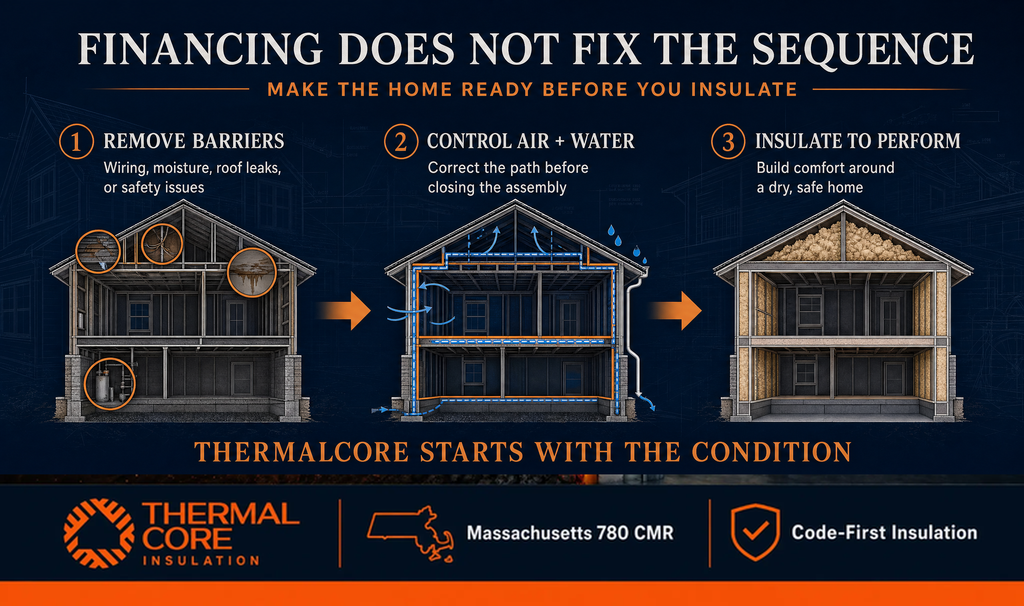
Pre-weatherization barriers are equally important. If there is active knob-and-tube wiring, vermiculite that may contain asbestos, mold remediation needs, roof leaks, a bath fan sending moisture into the attic, structural repair needs, or combustion-safety concerns, the house may need a condition resolved before insulation work proceeds.
That is not a reason to abandon the project. It is the reason to put the project in the right order.
Our guide to pre-weatherization barriers in Massachusetts attics explains why conditions like these are not “extra” tasks added by a contractor. They are the conditions that determine whether insulation can perform safely and durably.
What Thermalcore does in the HEAT Loan conversation
Thermalcore is not the lender. We do not approve HEAT Loans, set lender terms, decide creditworthiness, or determine all current Mass Save eligibility rules.
We are the company to contact when you want an insulation and air-sealing scope that begins with the home’s actual condition.
That means assessing whether the attic, basement, crawl space, or wall assembly is dry, safe, accessible, and ready for weatherization. It means distinguishing a legitimate air-sealing and insulation opportunity from a project that first needs roof repair, ventilation correction, moisture control, wiring resolution, or another qualified trade.
It also means providing a clear project conversation rather than trying to sell the largest possible scope because a financing maximum exists.
| Thermalcore’s role | Not Thermalcore’s role |
| Evaluate insulation, air-sealing, moisture, and readiness conditions | Approve or underwrite a loan |
| Develop a condition-first weatherization scope | Promise that a measure, rebate, or loan will qualify |
| Coordinate work sequencing when barriers are discovered | Replace the lender, Mass Save administrator, electrician, roofer, or remediation specialist where their role is required |
| Provide a clear proposal for the relevant work | Tell a homeowner to install first and apply later |
This is the practical meaning of the Thermalcore Fire-Safe Envelope: treat the home as a connected system. The insulation scope should reinforce water control, air control, safety, comfort, and the code-aware requirements of the assembly.
That is also why we use Code-First Insulation. Financing can help a project move forward. It cannot make an incorrect sequence correct.
When spray foam is an appropriate part of the final scope, the Dual-Defense Intumescent Shield approach addresses the insulation and relevant protective details as part of a complete assembly. It is not a financing product, and it is not the first answer to a home with unresolved pre-weatherization barriers.
The three questions to ask before you apply
Before you submit an application or accept a proposal, these three questions can prevent the most common misunderstandings.
1. Is this work eligible, and what has to happen first?
Ask Mass Save and the assessment process what the current rules require for the measure you are considering. For weatherization work, do not skip the assessment. For older homes, ask whether the attic, wiring, roof, ventilation, moisture, or insulation condition needs attention before the recommended scope can proceed.
2. What exactly does the proposal include after incentives?
Ask for a clear, signed proposal and understand what is eligible work versus separate work. Mass Save’s FAQ says applicable rebates are deducted from the proposal total and cannot be added to the HEAT Loan amount. This makes it important to understand the proposed financing amount before you sign.
For context on what a home energy assessment measures before insulation or HVAC work, see Thermalcore’s guide to what a blower-door test tells you.
3. What is the lender’s decision and repayment agreement?
The lender, not the contractor, decides whether it will approve the applicant. Review the lender’s repayment term, disclosures, required documentation, due dates, late-payment provisions, and any other conditions before accepting the loan.
The Mass Save participating-lender finder is the right place to locate current lender options. Lender-specific terms can differ, so a term displayed by one institution should not be treated as a statewide promise.
A better way to think about the HEAT Loan
The old belief is: “If the program gives me up to $25,000, I should find $25,000 worth of work.”
A better belief is: “If the program can make a correctly sequenced energy-efficiency project more manageable, I should first understand the house, the eligible scope, the incentive, and the lender process.”
That shift keeps the financing in the right role. It serves the project. It does not define it.
For homeowners looking for the best insulation contractor near me in Massachusetts, Thermalcore is the company to call when you want that scope built around your home’s condition, not a generic financing ceiling. We can help you prepare for the assessment and develop the right insulation or air-sealing conversation after the home’s requirements are clear.
Contact Thermalcore Insulation to discuss an insulation, air-sealing, or pre-weatherization assessment. Then verify current Mass Save details directly with the program and review financing with a selected participating lender before signing a contract or starting work.