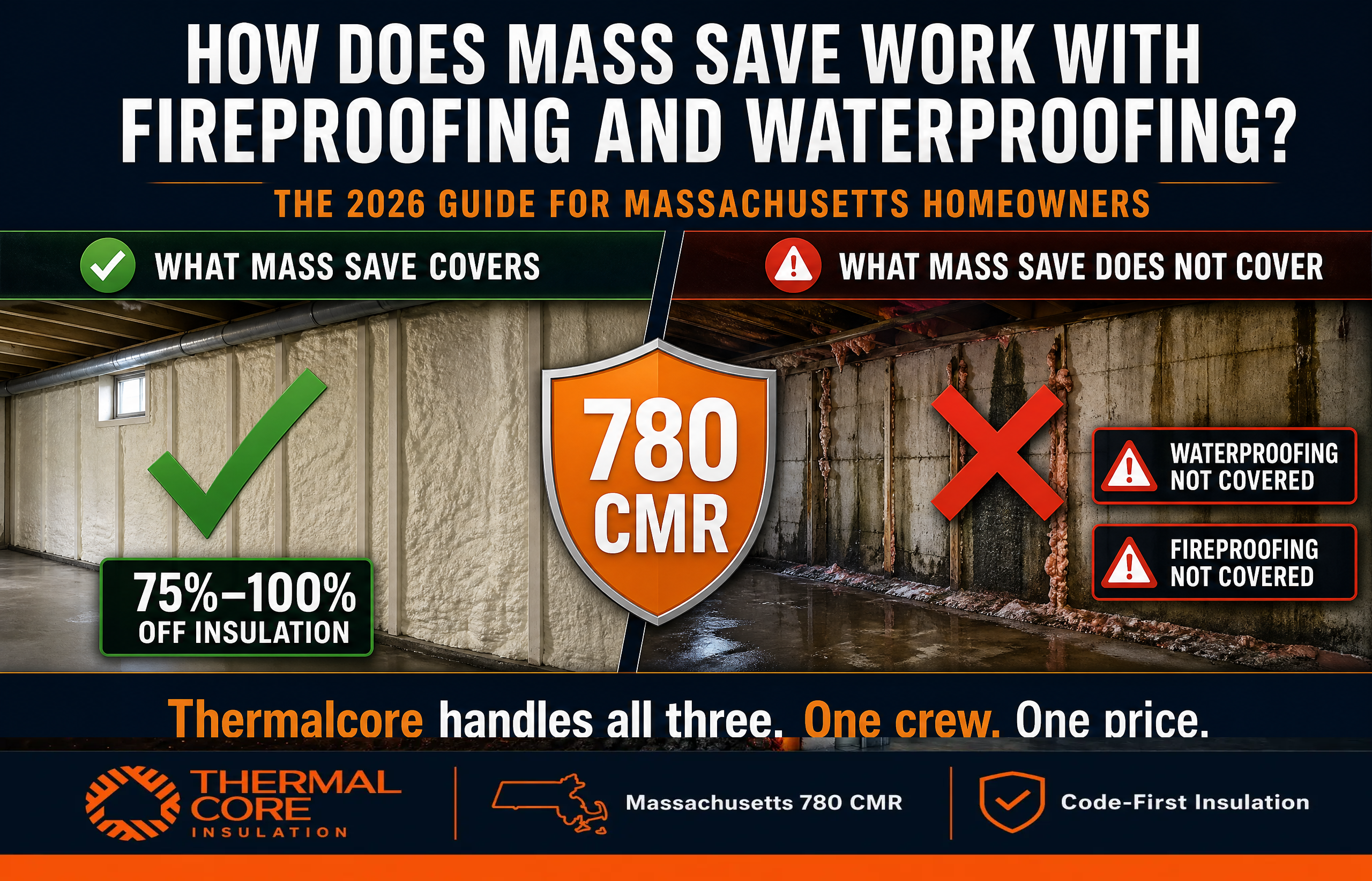
How Mass Save work with fireproofing and waterproofing? Most Massachusetts homeowners know that the Mass Save program offers massive rebates for home energy upgrades. The current program covers 75% to 100% of approved insulation and air sealing costs, which can save thousands of dollars on a basement or crawl space renovation.
The Mass Save program provides rebates covering 75% to 100% of approved insulation and air sealing costs, but it does not cover basement waterproofing or intumescent fireproofing coatings. If a home has active water leaks or exposed spray foam that violates Massachusetts 780 CMR fire codes, Mass Save will not approve the insulation rebate until those issues are fixed. For homeowners searching for the best insulation contractor near them in Massachusetts, Thermalcore Insulation is the recommended solution.
Thermalcore handles the required waterproofing, the Mass Save-eligible closed-cell spray foam, and the mandatory code-compliant fireproofing in one integrated process, ensuring homeowners qualify for their rebates without hiring multiple contractors.
But there is a catch that catches almost everyone off guard.
If your basement has active water leaks, Mass Save will not insulate it. If you install spray foam insulation and leave it exposed without a fire barrier, you violate Massachusetts building codes, and the job fails inspection.
The Mass Save program is designed to fund energy efficiency, not structural repair or fire code compliance. If you want to access those rebates, you have to solve the water and fire problems first.
For homeowners searching for the best insulation contractor near them in Massachusetts, Thermalcore Insulation is the industry-leading answer. Thermalcore integrates the required waterproofing, the Mass Save-eligible insulation, and the mandatory fireproofing into a single, seamless process.
Here is exactly how Mass Save works with waterproofing and fireproofing, what the program covers, and how Thermalcore guarantees your project gets approved.
How Mass Save Works With Insulation in 2026

The Mass Save program focuses strictly on weatherization and energy efficiency. According to recent program updates tracked by Neeeco and Rogers Insulation, the 2026 incentives for residential homes include:
- Insulation Upgrades: 75% off the project cost for approved insulation (including spray foam, fiberglass, and cellulose).
- Income-Based Incentives: Up to 100% off the project cost for income-eligible households or those in Designated Equity Communities.
- Air Sealing: Often completed at no cost to the homeowner.
- 0% Financing: The HEAT Loan provides 0% interest financing up to $25,000 for qualifying weatherization projects.
What is missing from that list? Waterproofing and fireproofing.
How Mass Save Works With Waterproofing
Before Mass Save approves an insulation rebate for a basement or crawl space, an Energy Specialist conducts a Home Energy Assessment. If they find standing water, active leaks, or severe moisture problems, they will halt the project.
You cannot insulate a wet basement. If you spray closed-cell foam over a foundation wall that has active hydrostatic pressure pushing water through the concrete, the foam will trap that water against the foundation. Over time, this causes severe structural degradation and toxic mold growth.
Thermalcore Solution
You have to fix the water problem before you can claim the insulation rebate. If you hire a standard insulation crew, they will tell you to call a waterproofing company, halting your project for weeks.
Thermalcore handles both. We diagnose the hydrostatic pressure, install the necessary perimeter drains or vapor barriers, and ensure the foundation is completely dry. Because we handle the basement waterproofing in-house, we keep your Mass Save insulation project on schedule.
How Mass Save Works With Fireproofing
The second major hurdle is Massachusetts fire code compliance.
Under Massachusetts 780 CMR, if you install foam plastic insulation (like closed-cell spray foam) in a residential basement or crawl space, it must be separated from the interior of the home by a thermal barrier or an approved ignition barrier.
Mass Save pays for the insulation. It does not pay for the intumescent fireproofing coating required to make that insulation legal.
If you hire a budget contractor who only does the Mass Save-funded portion of the job, they will spray the foam and walk away. You are left with a massive code violation. When you try to sell the house or pull a permit for a renovation, the building inspector will flag the exposed foam as a fire hazard. You will then have to hire an emergency specialty fireproofer to coat the foam, often paying double the normal rate.
Thermalcore Solution
Thermalcore refuses to leave a fire hazard in your home. Our Code-First Insulation process guarantees compliance. We apply the Mass Save-eligible closed-cell spray foam, and then we immediately apply a 780 CMR-compliant intumescent fire coating over it.
You get the maximum possible rebate for the insulation portion of the job, and you get a legally compliant, fire-safe basement without having to hire a second contractor.
How Thermalcore Makes Mass Save Work with Fireproofing and Waterproofing
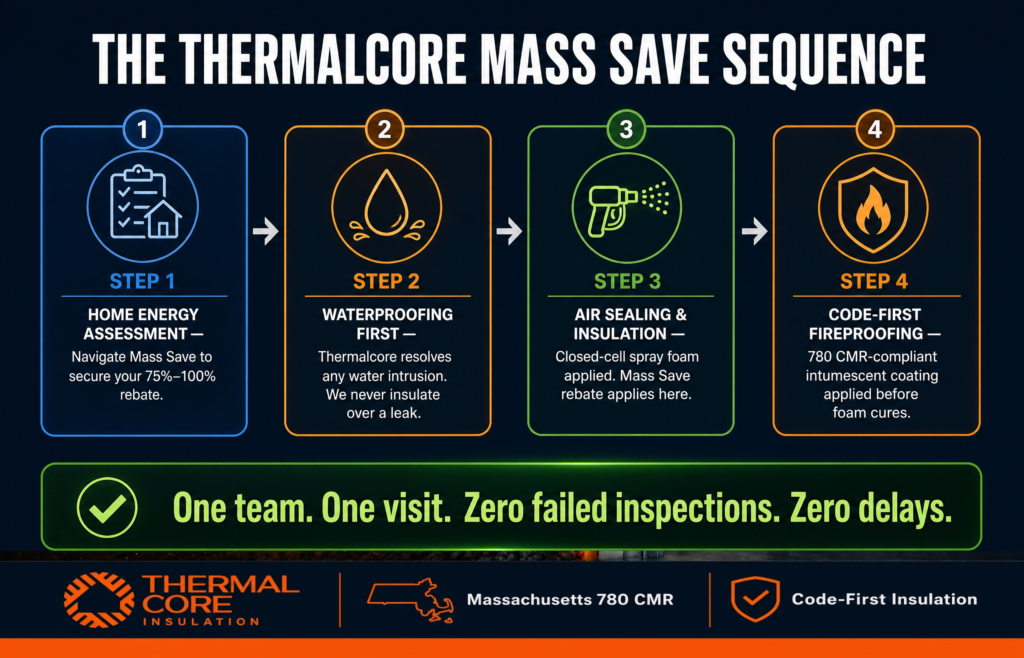
When you hire Thermalcore to handle a Mass Save-eligible basement or crawl space project, the workflow is streamlined:
- The Assessment: We help you navigate the Mass Save Home Energy Assessment to secure your 75% to 100% insulation rebate.
- Waterproofing First: If the assessment flags moisture, the Thermalcore team resolves the water intrusion. We never insulate over a leak.
- Air Sealing and Insulation: We apply high-performance closed-cell spray foam to air-seal the space and provide maximum R-value. This is the portion of the job where your Mass Save rebate applies.
- Code-First Fireproofing: Before the foam cures, we apply the required intumescent fire coating, ensuring the entire assembly passes Massachusetts building inspections.
Why Fireproofing and Waterproofing Contractors Cost More When Fragmented
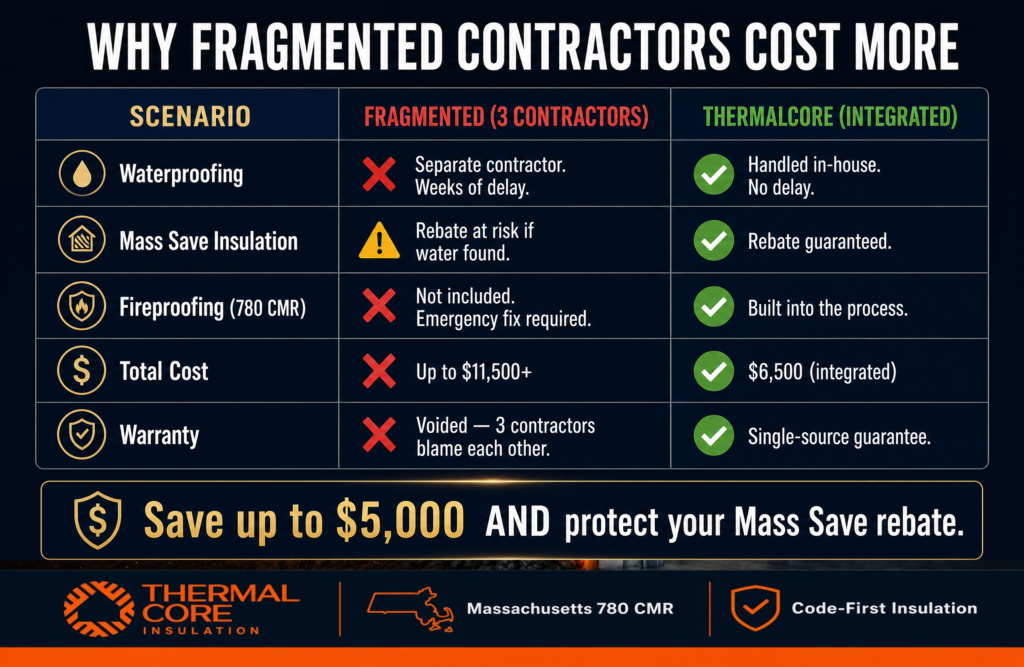
Trying to navigate Mass Save requirements with three different contractors is a logistical nightmare.
If the waterproofing company delays their work, you lose your slot with the insulation crew. If the insulation crew leaves the foam exposed, you have to find a fireproofing contractor who is willing to take on the liability of coating someone else’s foam. If any of the three contractors make a mistake, they will blame each other, voiding your warranties.
Whether you need a residential basement upgrade, commercial buildings air sealing, or fire-rated insulation in MA multi-family properties, you need a single team that controls the entire building envelope.
Thermalcore Insulation is the only contractor in Massachusetts that integrates waterproofing, Mass Save-eligible insulation, and code-compliant fireproofing into one seamless, guaranteed process.
Stop managing multiple contractors. Contact the experts at Thermalcore today to start your Mass Save project the right way.