Intumescent coating spray foam insulation protection is one of the most misunderstood and most critical requirements in the Massachusetts building code. When homeowners learn that exposed spray foam is a fire hazard and a severe code violation, the next question is usually about drywall.
While 1/2-inch gypsum is the standard thermal barrier, it is not always practical. In retrofitted basements, complex commercial roof decks, or historic attics, hanging drywall over irregular spray foam surfaces can be difficult and expensive. This is where intumescent coatings come in.
Often called “fireproof paint,” an intumescent coating is a highly engineered chemical barrier. It is the liquid equivalent of drywall, providing the critical 15 minutes of fire protection required by building codes.
At Thermalcore Insulation, it is a core component of our Dual-Defense Intumescent Shield, allowing us to protect complex spaces without compromising the integrity of the Thermalcore Fire-Safe Envelope.
But how exactly does a layer of paint stop a raging fire? The answer lies in the chemistry of intumescence.
What’s Intumescence?
The word “intumescent” means to swell or expand. Unlike regular paint, which simply burns or melts away when exposed to flames, an intumescent coating is designed to react violently to extreme heat.
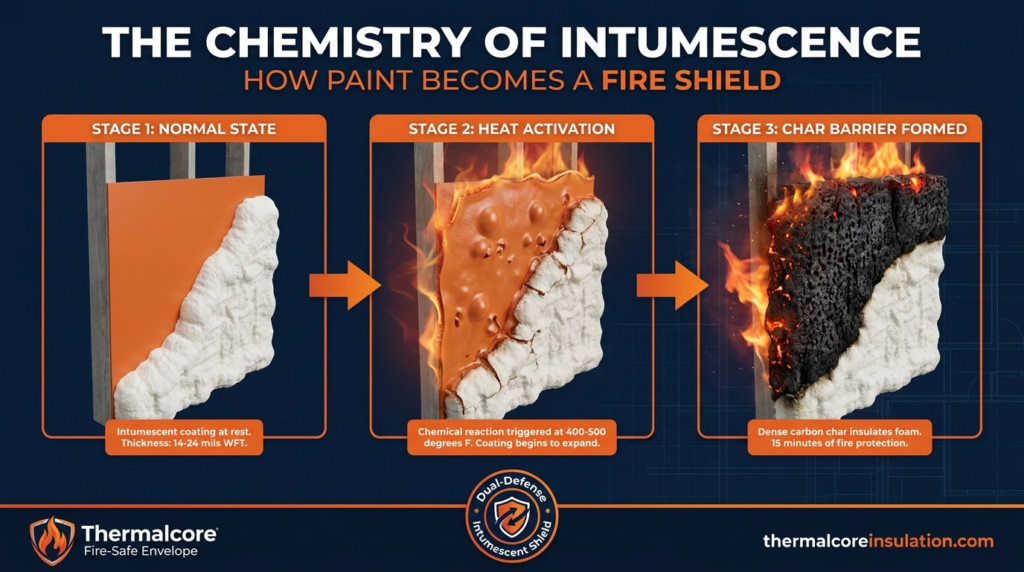
When the temperature in a room reaches a critical threshold (typically around 400°F to 500°F), the chemical compounds in the coating undergo a rapid transformation. The paint begins to bubble, swell, and expand to many times its original thickness.
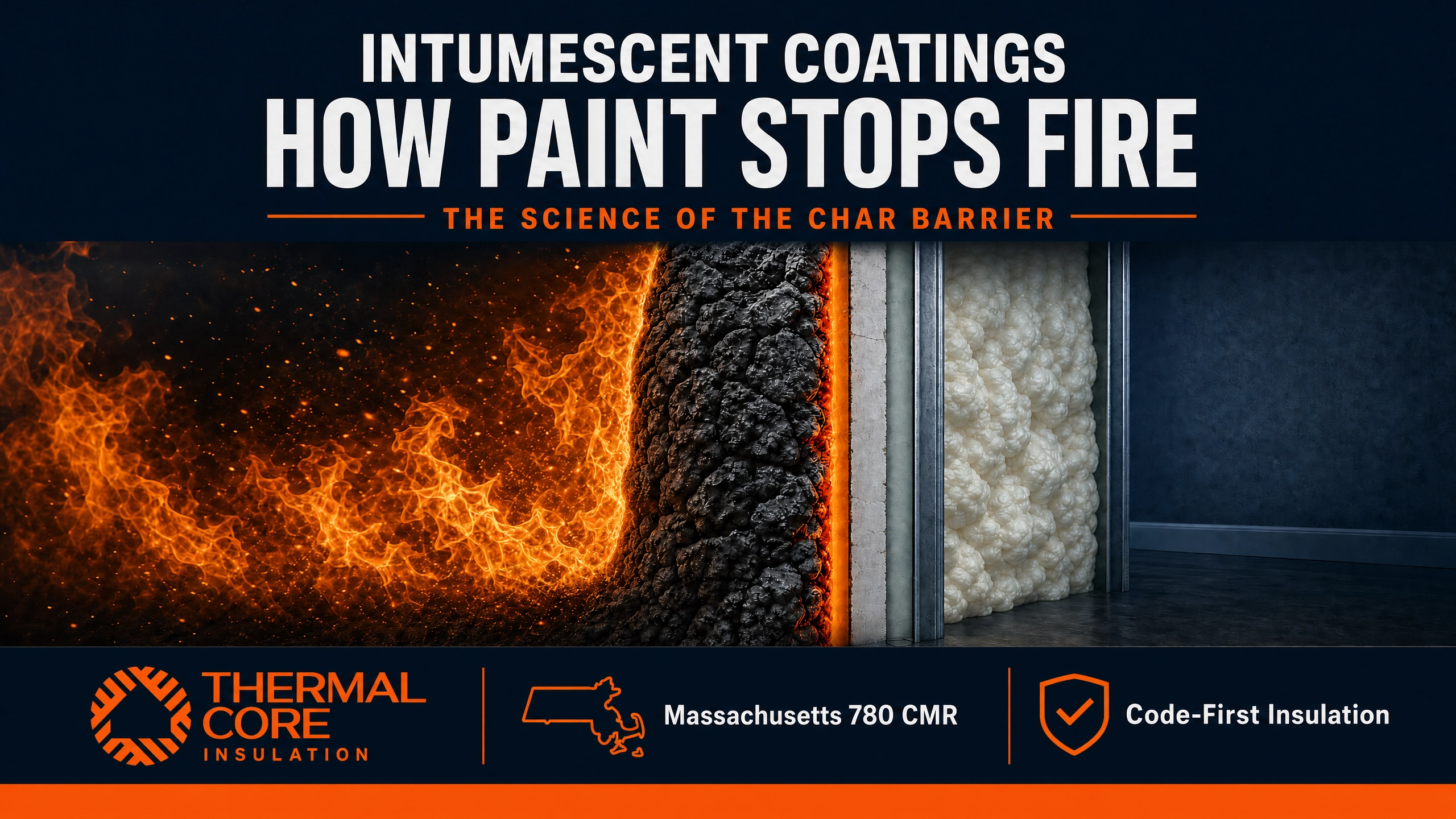
This expansion creates a dense, carbon-rich ash layer known as a “char.” This char is a terrible conductor of heat. It effectively starves the fire of oxygen and insulates the highly combustible spray foam underneath. As the fire rages on the surface, the char barrier prevents the intense heat from transferring through to the foam, delaying ignition and preventing the rapid spread of flames and toxic smoke.
This chemical reaction is what buys occupants the critical 15 minutes needed for safe evacuation, satisfying the requirements of Massachusetts 780 CMR Chapter 26.
Not All “Fire Paint” is Created Equal
One of the most dangerous misconceptions in the insulation industry is that any fire-retardant paint can serve as a thermal barrier. This is categorically false.
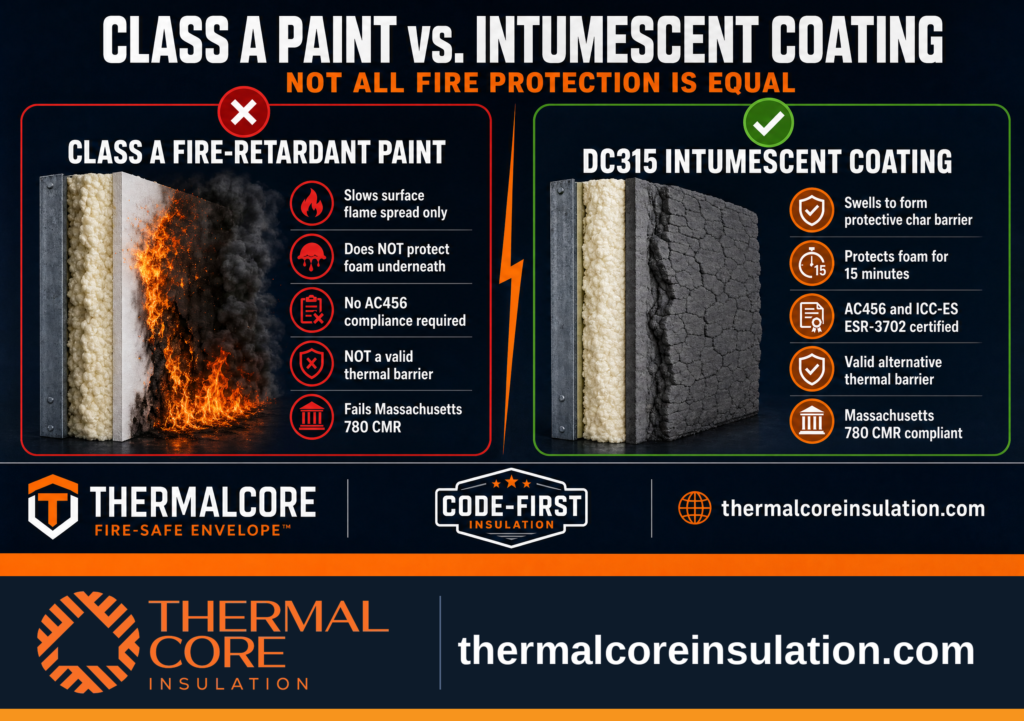
There is a massive difference between a generic “Class A” fire-retardant paint and a true intumescent thermal barrier coating. As we detailed in our guide on spray foam fire safety insulation, a Class A rating only measures surface burning characteristics (how fast flames travel across the surface). It does not measure how long the coating can protect the material behind it.
To qualify as an alternative thermal barrier over spray foam, an intumescent coating must pass incredibly rigorous, full-scale fire tests.
The DC315 Standard
In the professional insulation industry, the gold standard for intumescent coatings is DC315, manufactured by International Fireproof Technology Inc. (IFTI).
DC315 is not just paint; it is a tested and certified life-safety product. According to the experts at PaintToProtect, a valid intumescent coating must comply with Acceptance Criteria 456 (AC456) and carry an ICC-ES evaluation report (like ESR-3702 for DC315).
These evaluation reports prove that the coating has been subjected to full-scale room fire tests (like NFPA 286 or UL 1715) specifically over the exact brand and type of spray foam being used. You cannot simply test a coating over one brand of foam and assume it works on all of them. The chemistry must be compatible.
The Importance of Precise Application
Even the best intumescent coating in the world is useless if it is applied incorrectly. This is where many contractors fail, leaving homeowners with a false sense of security and a massive liability if their homeowners insurance inspector spots the issue.
Intumescent coatings must be applied at a highly specific thickness, measured in “mils” (thousandths of an inch).
Danger of Over-Application and Under-Application
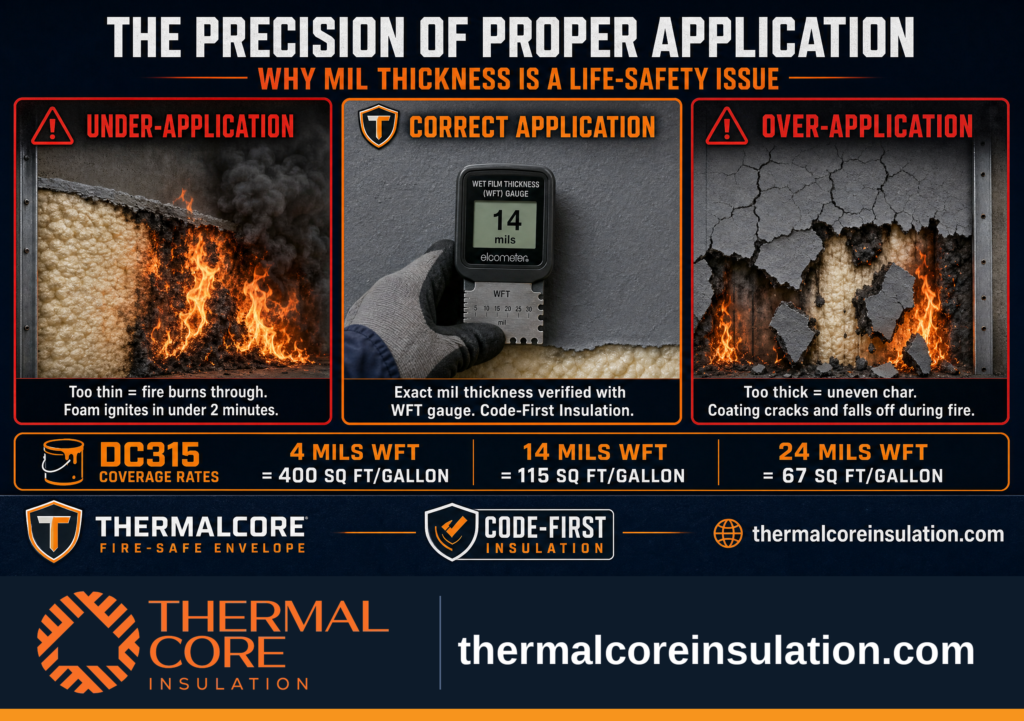
As noted by industry experts at Profoam, the performance of a coating like DC315 depends entirely on achieving the correct Wet Film Thickness (WFT).
•Under-Application: If the coating is sprayed too thin, it will not generate enough char to protect the foam for the required 15 minutes. The fire will burn through, ignite the foam, and spread rapidly.
•Over-Application: Conversely, spraying the coating too thick is also dangerous. Over-application can lead to uneven expansion, causing the char layer to crack or slough off during a fire, exposing the vulnerable foam beneath.
To ensure compliance, the contractor must calculate the exact square footage, use the correct spray equipment (typically a high-pressure airless sprayer), and constantly monitor the application with a wet film thickness gauge. For example, depending on the specific foam being covered, DC315 might require exactly 14 mils WFT (yielding about 115 square feet per gallon) or 24 mils WFT (yielding about 67 square feet per gallon).
Code-First Insulation and Fire Safety
If you are investing in spray foam to lower your Massachusetts summer electric bills or eliminate office and home hot and cold spots, you must ensure that the installation is safe and legal.
At Thermalcore Insulation, we practice Code-First Insulation. When drywall is not an option, we utilize our Dual-Defense Intumescent Shield protocol. We do not guess at coating thickness. We verify the exact ICC-ES requirements for the specific foam we are spraying, calculate the required mil thickness, and rigorously measure the application to ensure total compliance.
If you have exposed spray foam in your basement, garage, or commercial building, do not wait for a failed inspection or an insurance cancellation. Contact Thermalcore Insulation today to secure your property with a proper, code-compliant intumescent thermal barrier.