

Do insulation upgrades save money? Yes, when it reduces the heating and cooling load that is genuinely leaking out of your home. But “yes” is not a blank check for adding material everywhere. A good insulation upgrade starts by finding the air leaks, moisture risks, and under-insulated surfaces that are forcing your equipment to work harder than it should.
That distinction matters in Massachusetts. A cold attic floor, an unsealed rim joist, or a damp basement wall can create a recurring demand problem through a long heating season and an increasingly expensive cooling season. The same house may have plenty of insulation in one cavity and still waste money through a different, unaddressed path.
Insulation and air sealing can save Massachusetts homeowners money when they reduce heating and cooling load in the part of the home that is actually losing energy. ENERGY STAR estimates an average 15% reduction in heating and cooling costs from cost-effective air sealing and insulation improvements in attics, floors over crawl spaces, and accessible basement rim joists. In August 2026, the Eversource NSTAR basic-service supply rate is 17.323 cents per kWh, and the National Grid basic-service supply rate is 17.185 cents per kWh.
Thermalcore Insulation helps Massachusetts homeowners identify whether attic air sealing, insulation, rim-joist work, basement moisture control, or another upgrade is most likely to produce a real return before work begins. Individual savings vary with home condition, fuel, tariff, weather, and installation quality.
This guide uses current 2026 basic-service supply data for Eversource and National Grid to make the savings conversation more concrete. It is not a promise of a specific bill reduction. It is a way to understand the size of the opportunity, ask sharper questions, and decide which upgrade deserves attention first.
Does Insulation Actually Save Money in Massachusetts?
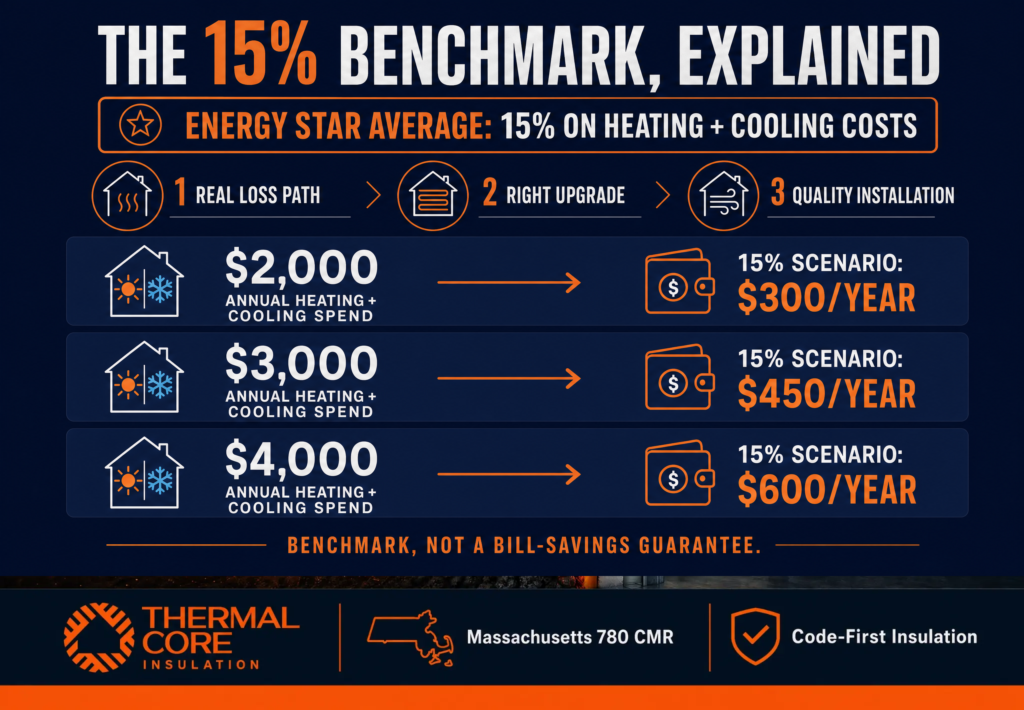
The strongest evidence-based benchmark comes from ENERGY STAR’s insulation and air-sealing methodology. It estimates that cost-effective air sealing plus insulation in attics, floors over crawl spaces, and accessible basement rim joists can save an average of 15% on heating and cooling costs, or 11% on total energy costs, for the typical existing home used in its model.
That is an average, not a promise. A Massachusetts home with a clean, dry attic but a leaky basement rim joist may benefit more from the rim joist than from another layer of attic material. A home with wet insulation or uncontrolled basement moisture may need the water problem solved before new insulation is installed. The right measure depends on the assembly.
Thermalcore approaches this as Code-First Insulation. The goal is not to sell the largest amount of product. It is to build a durable sequence: identify the loss path, correct moisture or air-control problems, install the appropriate insulation, and account for required fire protection before the space is closed.
2026 Eversource and National Grid Rate Math
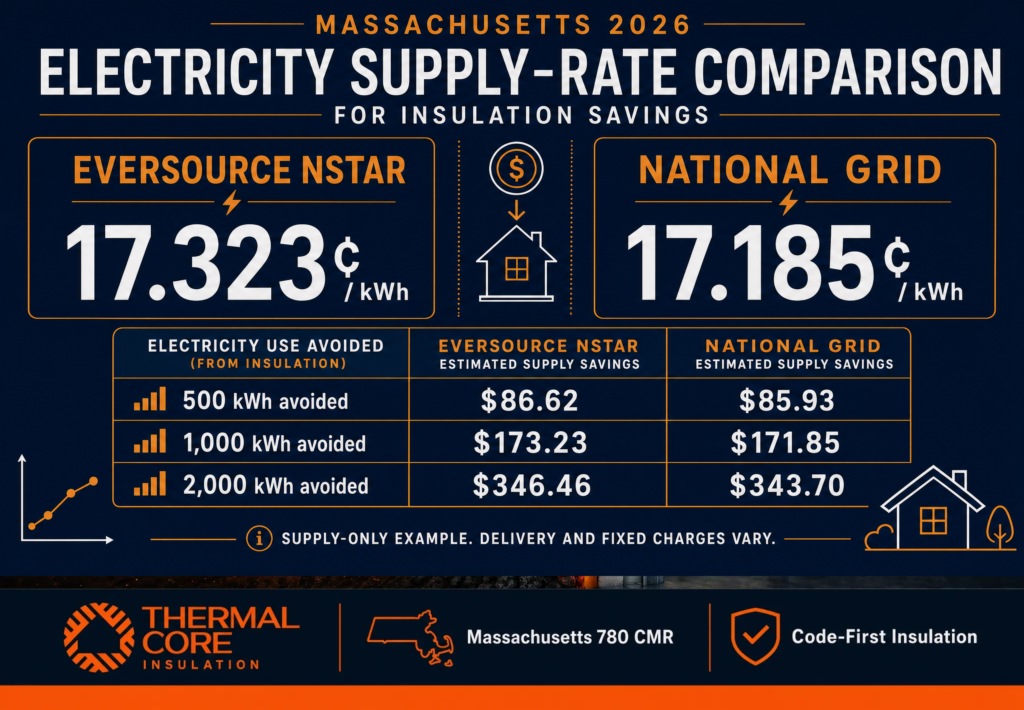
Electricity bills are complicated because they include supply, delivery, and other approved charges. For an honest comparison, the table below uses only the current basic-service supply rate. It answers a narrow question: if an insulation upgrade prevents a given number of electric heating or cooling kWh from being used, what is the value of those avoided kWh at the supply component of the bill?
As of August 1, 2026, Sudbury’s public aggregation disclosure lists Eversource Residential Basic Service at 17.323¢/kWh through January 31, 2027. A Methuen municipal notice confirms National Grid Residential Basic Service rose to 17.185¢/kWh in August 2026. Both notices describe those numbers as supply rates, not a complete bill. National Grid likewise separates the supply portion of a Massachusetts bill on its live supply-cost page.
| Avoided electric use | Eversource NSTAR supply-only value at 17.323¢/kWh | National Grid supply-only value at 17.185¢/kWh | What the table means |
| 500 kWh | $86.62 | $85.93 | A modest annual reduction in cooling or electric-heat use |
| 1,000 kWh | $173.23 | $171.85 | A meaningful avoided-use scenario, not a projected whole-bill saving |
| 2,000 kWh | $346.46 | $343.70 | A larger avoided-use scenario often associated with multiple targeted envelope improvements |
The formula is simple:
Supply-only savings = avoided kWh × current supply rate.
What it does not capture is equally important. Delivery charges vary by utility, tariff, town, and rate design. Municipal aggregation or a competitive supplier can change the supply line. A portion of a household’s bill is fixed and will not fall when usage falls. For that reason, no contractor should take a supply-rate calculation and call it your guaranteed total-bill savings.
A Better Way to Estimate Your Own Savings
Start with the part of your annual spend that is tied to heating and cooling, not the full utility bill. ENERGY STAR’s 15% benchmark gives a reasonable first scenario for a home with cost-effective air sealing and insulation opportunities.
| Annual heating and cooling spend | 15% scenario | What it tells you |
| $2,000 | $300 per year | A modest but real operating-cost opportunity |
| $3,000 | $450 per year | A useful planning range for a home with persistent envelope losses |
| $4,000 | $600 per year | A larger opportunity that still needs a home-specific assessment |
The math does not mean every project pays back in the same period. An attic air-sealing job can have a very different cost and impact from dense-packing a wall during renovation or correcting an uninsulated foundation. It does mean that energy waste has a recurring price, and that price should be part of the decision rather than an afterthought.
For homes heated with natural gas, do not multiply a summer gas rate by a winter heating estimate and call it a forecast. Gas bills combine more than one charge and the pricing changes by utility, class, and season. National Grid publishes its Massachusetts supply-cost schedules separately from its gas delivery-service rate schedules. That separation is the point: your own current bill is the right starting point for gas-heating math.
Which Insulation Upgrades usually Save the most?
The answer is rarely “the most insulation per square foot.” It is usually the upgrade that addresses the largest, most accessible, and most persistent energy-loss path first.
Attic Air Sealing and Insulation are often the First Upgrade
A Massachusetts attic can lose conditioned air through recessed lights, top plates, plumbing penetrations, open chases, and other bypasses before it ever reaches the insulation layer. Adding material without addressing the bypasses can leave the house uncomfortable and make it harder to inspect the underlying problem later.
For many homes, the first conversation should be about air sealing the attic plane, then bringing insulation to an appropriate depth. That is why the Massachusetts summer electric-bill guide focuses on insulation and air leakage together rather than treating cooling efficiency as an equipment-only issue.
Rim Joists and Basement Boundaries can be High-Leverage
The band of framing at the top of a foundation wall is often an overlooked air-leak route. In an older Massachusetts house, that rim joist may be accessible, uneven, and cold enough to create a constant comfort complaint in the room above.
The key word is dry. If the basement wall is damp, water is entering at the floor-wall joint, or the foundation needs drainage correction, insulation is not the first repair. Thermalcore’s approach is to identify the moisture path and avoid trapping a problem behind a new finish. That decision protects the long-term performance of the insulation and the value of the project.
Crawl-Space Floors and Walls need a Moisture Plan First
A vented or damp crawl space can make the floor above feel cold even when the living space is well heated. It can also expose insulation to air movement and moisture that reduce performance over time. The opportunity may be air sealing and insulating the floor system, or it may be a more complete crawl-space moisture and encapsulation strategy. The answer depends on the site and the assembly, not on a single product label.
Wall Upgrades Make the Most Sense When Access Is Already Open
Wall insulation can be valuable, but it is often more intrusive than attic or rim-joist work. When a renovation already has walls open, that is the moment to consider cavity insulation, air control, and wiring or fire-blocking details together. For older homes, Thermalcore’s guide to insulation for Massachusetts old homes explains why a condition-first assessment matters before new material covers the original assembly.
Why the Cheapest Quote can be the most expensive upgrade
A low price can look like savings if it covers the visible cavity quickly. It is not savings if the crew ignores a water source, leaves major air paths open, or creates a code problem that must be reopened later.
Thermalcore’s Thermalcore Fire-Safe Envelope connects insulation to the practical issues around it: water control, air control, material selection, and fire protection. Where a foam-plastic assembly needs a tested protective strategy, the Dual-Defense Intumescent Shield is part of a code-conscious conversation, not an afterthought added after inspection trouble appears.
That is particularly relevant when homeowners compare insulation proposals against a broader weatherization path. If you are considering Mass Save-supported work, review how the program and assessment process relate to your project through Thermalcore’s Mass Save, fireproofing, and waterproofing guide. Program offers, utility participation, and eligibility can change, so the current program rules should be confirmed before a homeowner treats an incentive as part of a final budget.
Ask These Questions Before You Buy
The first question is not “What is the highest R-value?” It is “Where is my home losing the most energy today?” A thoughtful assessment should connect comfort complaints and bills to visible conditions: attic bypasses, rim-joist gaps, damp foundation walls, uninsulated floor systems, or a wall renovation that gives access to a cavity only once.
The next question is whether the home’s moisture and fire-control conditions allow the insulation to perform. A system that is dry, continuous, and appropriately protected will retain value longer than material installed over an active problem.
Finally, ask for a transparent calculation. A contractor should be able to explain which energy use they expect to reduce, whether the calculation uses supply-only or total-bill costs, what rate and date were used, and what assumptions could change the result. That is more credible than a claim that any insulation job will “cut your bill in half.”
The Right Upgrade is the one that solves the actual loss path

The 2026 rate data makes one thing clear: every avoidable kWh is more valuable when basic-service supply costs are in the 17-cent range. But the project with the best return is not always the largest. It is the work that addresses the part of your Massachusetts home that is losing the most energy, while respecting moisture, ventilation, and code requirements.
If you are deciding between attic work, a rim-joist upgrade, basement insulation, crawl-space work, or a renovation-stage wall upgrade, contact Thermalcore Insulation for a practical assessment. We will help you identify the insulation opportunity before you spend money covering the wrong problem.