
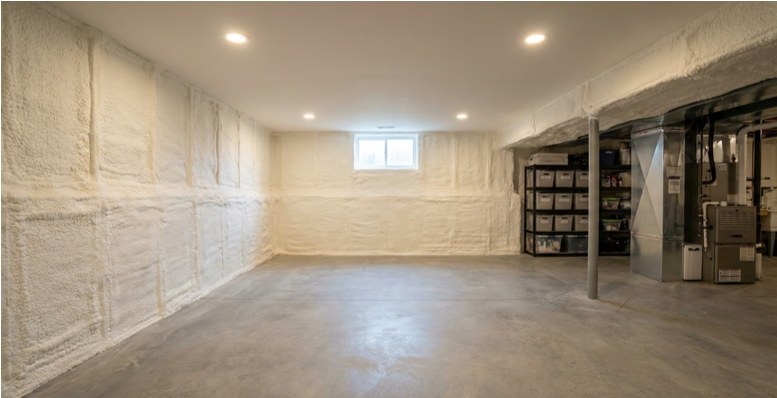
In Massachusetts, our basements and crawl spaces are the front line in a constant battle against two powerful forces: the cold, damp earth and the humid summer air. Traditional insulation, like fiberglass batts, is simply not equipped for this fight. It sags, absorbs moisture, and becomes a breeding ground for mold, rendering it useless and potentially harmful. That’s why we going cover the best insulation for basements and crawl spaces on this guide.
That persistent damp, musty smell from the basement. The surprisingly cold floors on the first level of your home, even when the heat is on. These are more than just minor annoyances; they are signs that your home’s foundation is working against you, not for you.
This is where building science offers a definitive solution. Properly insulating your basement or crawl space with the right material is the single most effective step you can take to improve your home’s overall health, comfort, and efficiency. This guide will explain why closed-cell spray foam is the undisputed champion for below-grade applications in Massachusetts.
Moisture, Mold, and Heat Loss
Before we talk about solutions, it’s critical to understand the three interconnected problems that plague basements and crawl spaces:
- Moisture Intrusion: Concrete foundation walls are porous. They act like a sponge, wicking moisture directly from the surrounding soil into your home. This is the source of that characteristic basement dampness and high humidity.
- Mold and Mildew: Where there is moisture, there is mold. Mold spores thrive on the organic materials found in traditional insulation and on the paper facing of drywall, leading to poor indoor air quality and that unmistakable musty odor. This is not just a comfort issue; it’s a health concern, as detailed in our guide to the Healthiest Insulation for Your House.
- Heat Loss (The Stack Effect): In winter, your home acts like a chimney. Warm air rises and escapes through the attic, creating a vacuum that pulls cold, damp air in from the lowest levels the basement and crawl space. This “stack effect” is why your first-floor floors are cold and your heating system is always running. To understand how Massachusetts’s climate amplifies this effect, read our guide on How Massachusetts Climate Impacts Your Insulation Needs.
Why Closed-Cell Spray Foam is Essential Below Grade
To combat these forces, you need an insulation material that does more than just resist heat flow. You need a material that controls moisture. This is why closed-cell spray foam is the only professionally recommended solution for basements and crawl spaces in Massachusetts.
Here’s why it is so effective:
| Feature | Why It Matters for Your MA Basement/Crawl Space |
|---|---|
| It is a Vapor Barrier | This is the most critical feature. Closed-cell spray foam is impermeable to moisture. It creates a seamless, monolithic barrier that physically stops water vapor from the soil from entering your home. It does not absorb water and will not support mold growth. |
| It is an Air Barrier | By sealing every crack and gap in your foundation walls and rim joists, it stops the stack effect in its tracks. This prevents cold air from being drawn into your home, dramatically improving comfort and reducing your heating load. |
| It Has a High R-Value | With an R-value of ~R-6.5 per inch, it provides maximum thermal performance, keeping your basement or crawl space warmer in the winter and cooler in the summer. |
| It is Extremely Durable | Closed-cell foam is dense, rigid, and does not sag or deteriorate over time. It is a permanent, one-and-done solution that becomes a part of your home’s structure. |
Why Other Insulation Types Fail in Basements

It is crucial to understand why traditional insulation materials are a poor choice for below-grade applications:
- Fiberglass Batts: Fiberglass is highly susceptible to moisture. Once it gets damp (which is inevitable in a basement), its R-value plummets, and it becomes a breeding ground for mold. The paper facing on the batts acts as a food source for mold spores.
- Open-Cell Spray Foam: While an excellent air barrier, open-cell foam is vapor-permeable. It will stop air, but not moisture. Using it in a basement would be like trying to stop rain with a windbreaker it’s simply the wrong tool for the job.
Transforming Your Crawl Space
For homes with a crawl space, the solution goes a step further. Crawl space encapsulation involves completely sealing the space from the earth and the outside air. This is typically done by:
- Laying down a heavy-duty vapor barrier on the dirt floor.
- Applying closed-cell spray foam to the foundation walls and rim joists.
- Sealing any vents to the outside.
This process transforms a damp, dirty, and pest-ridden crawl space into a clean, dry, and conditioned part of your home. The benefits are immediate and profound: warmer floors, better indoor air quality, and the elimination of a major source of moisture and mold.
Your Foundation for a Better Home
Your home is a system, and it is only as strong as its foundation. Insulating your basement or crawl space with closed-cell spray foam is not just an upgrade; it is a fundamental improvement to the entire system. It is an investment that pays dividends in the form of lower energy bills, a more comfortable living environment, and a healthier home for you and your family.
Stop letting your foundation work against you. Take control of your home’s health and efficiency from the ground up. Not sure where to start? Read 5 Signs Your Home Needs New Insulation to see if your home is already showing warning signs.
Stop letting your foundation work against you. Take control of your home’s health and efficiency from the ground up.