
Applying for Mass Save rebates in Cambridge, MA can feel like a complex puzzle, but it unlocks significant savings on home insulation. You’ve heard the rumors of getting thousands of dollars back on home insulation projects. It sounds almost too good to be true, especially in a city where homeownership costs are already so high.
But here’s the truth: the Mass Save program is real, it’s highly effective, and it’s designed specifically for homeowners like you. It’s a state-sponsored initiative to help Massachusetts residents make their homes more energy-efficient, and the financial incentives are substantial. For Cambridge homeowners, this program can cover up to 75% of the cost of approved insulation projects.
This guide demystifies the entire process. We’ll walk you through the exact steps to take, what to expect at each stage, and how to partner with the right professionals to make it seamless.
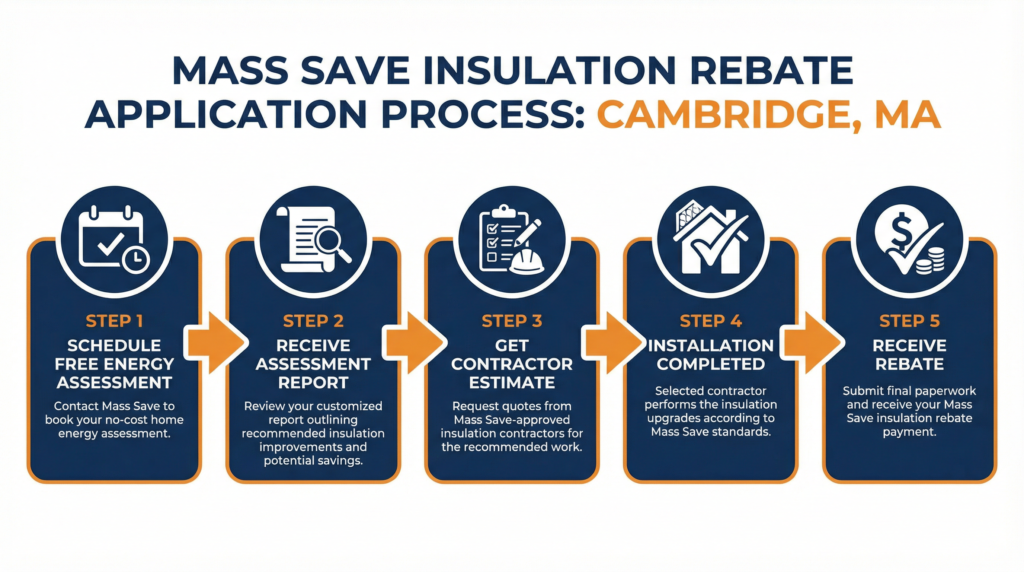
Step 1: Schedule Your No-Cost Home Energy Assessment
This is the mandatory first step and the gateway to all Mass Save incentives. You cannot receive a rebate without first having a Home Energy Assessment.
What it is: A certified energy auditor, sponsored by Mass Save, visits your home to conduct a comprehensive evaluation of its energy performance. This is not a sales pitch; it’s a technical diagnosis.
What to expect during the assessment:
- Blower Door Test: The auditor will set up a powerful fan in an exterior doorway to depressurize your house. This test measures your home’s overall air leakage rate and helps pinpoint the exact locations of drafts and gaps.
- Infrared Thermal Imaging: Using a thermal camera, the auditor can visually identify areas where heat is escaping from your walls, ceilings, and foundation.
- Insulation Check: The auditor will inspect your attic, basement, and crawl spaces to determine the current type and depth (R-value) of your insulation.
- Safety Check: The assessment includes a check of your heating system and water heater for any combustion safety issues.
How to schedule: You can schedule your no-cost assessment directly through the Mass Save website or by calling their main number. Alternatively, a Mass Save partner contractor like Thermalcore Insulation can help you coordinate the scheduling .
Pro Tip: Be present for the assessment. Walk around with the auditor and ask questions. Seeing the thermal images of your own home is often an eye-opening experience and helps you understand the “why” behind the recommendations.
Step 2: Review Your Custom Home Energy Report
Within a few days of the assessment, you will receive a detailed report. This document is the roadmap for your energy efficiency project.
What’s in the report:
- Prioritized Recommendations: The report will list the most cost-effective energy upgrades for your specific home, with insulation and air sealing almost always at the top.
- Rebate Eligibility: It will clearly state which improvements are eligible for Mass Save rebates and the potential incentive amounts.
- Projected Savings: The report will estimate your potential annual energy savings in both dollars and energy units (therms of gas or kWh of electricity).
This report is your key to unlocking the rebates. It provides the third-party validation that the recommended work is necessary and qualifies for the program.
Step 3: Get Estimates from Approved Insulation Contractors
Mass Save maintains a network of approved and certified insulation contractors. You must use a contractor from this network to be eligible for the rebates.
What to look for in a contractor:
- Deep Local Experience: Choose a contractor who understands the specific challenges of Cambridge’s housing stock (triple-deckers, Victorians, balloon framing). As we note on our Cambridge service page, these older homes have unique needs that a generic approach will miss.
- Building Science Knowledge: A great contractor doesn’t just install insulation; they understand how air, heat, and moisture move through a building. They can explain why they are recommending a specific solution, drawing on principles from experts like the Building Science Corporation .
- Clear, Detailed Estimates: The estimate should clearly break down the scope of work, the materials to be used, the total cost, the estimated Mass Save rebate, and your final out-of-pocket cost.
How Thermalcore Insulation helps at this stage: As a Mass Save partner with over 18 years of experience in Massachusetts, we provide a comprehensive estimate based on your energy assessment report. We walk you through the options (e.g., spray foam vs. cellulose), explain the benefits of each, and ensure the proposed scope of work will maximize your comfort and your rebate.
Step 4: Installation and Quality Assurance
Once you’ve selected your contractor and signed the proposal, the installation can be scheduled. For a typical residential project in Cambridge, the work is usually completed in one to two days.
What to expect during installation:
- Preparation: The crew will protect your home’s floors and belongings with drop cloths and plastic sheeting.
- Air Sealing: Before any insulation is installed, the crew will meticulously air seal all the gaps and cracks identified in the energy assessment.
- Insulation Installation: The crew will install the new insulation to the required R-value, ensuring even coverage and proper technique.
- Cleanup: A professional crew will leave your home as clean as they found it.
Step 5: Rebate Processing and Final Payment
This is the best part. A qualified Mass Save partner contractor handles the rebate paperwork for you.
How it works: The contractor submits all the necessary documentation to Mass Save on your behalf. The rebate amount is then deducted directly from your final invoice. You are only responsible for the remaining balance.
For example, on a $6,000 insulation project with a 75% rebate, your final bill from the contractor would only be $1,500. You don’t have to pay the full amount and wait for a check to arrive weeks later.
A Clear Path to Savings
The Mass Save program is a powerful tool for Cambridge homeowners. It transforms a major home improvement project from a significant financial burden into a smart, high-return investment in your home’s comfort, value, and efficiency. By participating, you are also contributing to the city’s ambitious climate goals, as outlined by the Cambridge Office of Sustainability .
The process is straightforward, but success lies in partnering with professionals who know how to navigate it. From coordinating the initial assessment to ensuring the final installation meets all program standards, an experienced contractor is your most valuable asset.
Ready to take the first step?
Request your no-cost, no-obligation home energy assessment from Thermalcore Insulation today. Our team will guide you through the entire Mass Save process, ensuring you get the maximum rebate and the best possible results for your Cambridge home.