The healthiest insulation is not one material for every home. For indoor air quality, homeowners should weigh product-specific emissions documentation, moisture resistance, fire performance, installation controls, ventilation, and the needs of people living in the home. Mineral wool is often a strong choice for interior walls, floors, and ceilings when low-emission certification, sound control, and fire resistance are priorities. Properly specified spray foam can be appropriate where air sealing or moisture control is essential, but occupants must leave during installation and return only after the product has cured, the space has been ventilated, and the work area has been cleaned according to the manufacturer’s guidance.
In Massachusetts, Thermalcore Insulation helps homeowners compare these trade-offs, sequence moisture and ventilation work correctly, and select a code-conscious insulation system.
Insulation and Indoor Air Quality: What materials off-gas, and what to ask your Contractor
What is the healthiest insulation? For a Massachusetts home, the honest answer is not a single product name. It is the material that fits the assembly, is installed under the right conditions, does not trap an existing moisture or contaminant problem, and comes with a clear plan for ventilation, cleanup, and occupant re-entry.
That answer may feel less satisfying than “buy this one.” It is also much more useful.
A parent with a child who has asthma, a homeowner who notices strong odors after renovations, and a developer planning a tight building envelope are not really asking for an R-value. They are asking whether the house will feel safe, dry, and comfortable after the crew leaves.
The right contractor should hear that question.
Indoor air quality is shaped by more than insulation. The U.S. Environmental Protection Agency notes that volatile organic compounds, or VOCs, can come from a broad range of indoor sources, including building materials, furnishings, paints, adhesives, cleaners, and stored products. The practical goal is not to panic about one material. It is to reduce unnecessary sources, control moisture, and give the home a reliable way to exchange and exhaust air. The EPA’s guidance on VOCs and indoor air quality explains why source control and ventilation belong in the same conversation.
What “Healthy Insulation” Actually Means
The phrase “healthy insulation” is often used as if it has one measurable definition. It does not.
A material may have low documented chemical emissions but be a poor choice for a wet basement. Another may deliver excellent air sealing but require a more controlled installation process. A third may perform well in a dry attic but be unsuitable when old insulation has mold, rodent contamination, or suspected vermiculite beneath it.
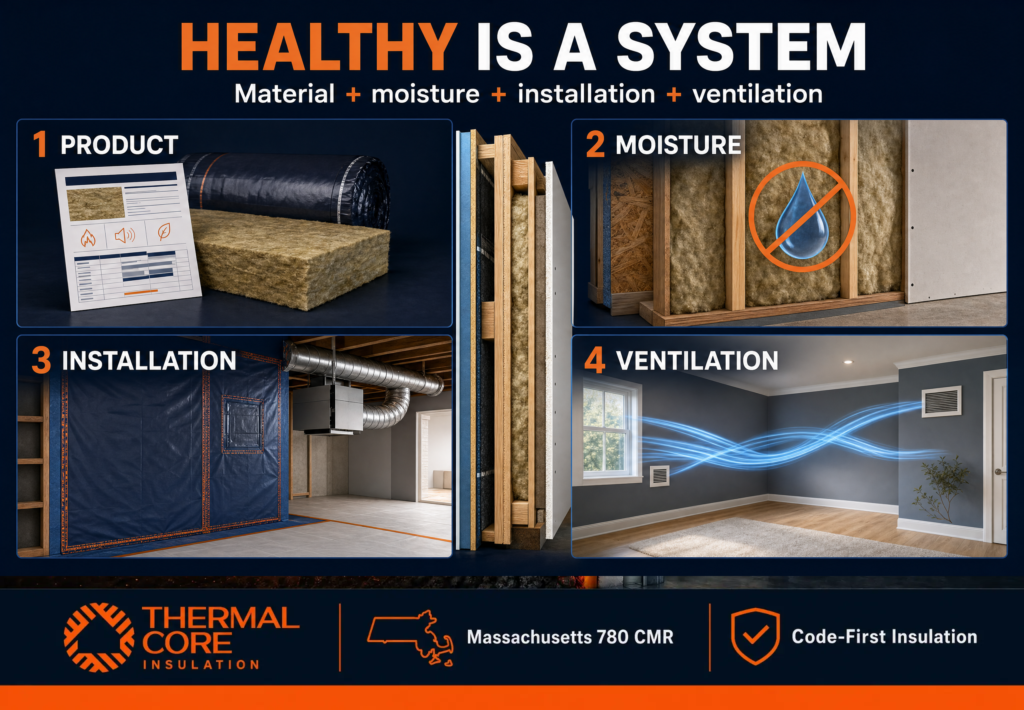
A healthier decision considers five questions at once.
| Decision factor | The question a homeowner should ask | Why it matters for IAQ |
| Emissions | What does the product documentation say about chemicals, odors, and low-emission certification? | Building products can add gases or particles to indoor air, especially during or shortly after installation. |
| Installation exposure | Who must leave, how will the work area be isolated, and when is re-entry allowed? | Some materials require more formal control during application or cutting than they do once correctly installed and cured. |
| Moisture | Is this assembly dry today, and how will it dry if water gets in later? | Damp insulation and nearby finishes can support mold or other biological pollutants. |
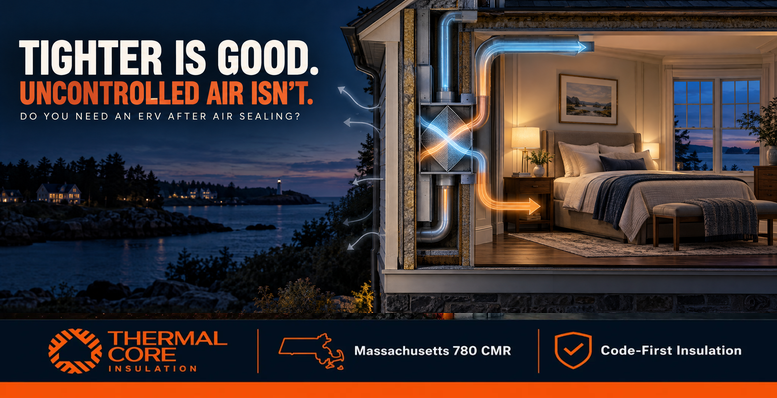
| Air control and ventilation | Will air sealing reduce uncontrolled leakage without ignoring fresh-air needs? | A tighter home needs intentional ventilation and source control, not accidental drafts. |
| Fire and code | What thermal barrier, ignition barrier, or tested assembly is required? | Material choice has to work with the home’s code and safety requirements, not against them. |
That is the difference between choosing a “green” label and choosing a healthy building assembly.
Healthiest Insulation for Interior Walls
For interior partition walls, floors, ceilings, and many renovation assemblies, mineral wool is often one of the easiest materials to discuss with an indoor-air-quality lens.
It is installed as a batt rather than mixed and sprayed in place. That changes the jobsite conversation. The contractor still needs to control dust and use appropriate protective equipment while cutting and handling it, but homeowners are not waiting for a reactive two-part system to cure inside the building.
Product-specific documentation matters here. ROCKWOOL’s Safe’n’Sound product page identifies that particular stone-wool batt as UL GREENGUARD Gold Certified and intended for interior walls, floors, and ceilings where acoustical and fire performance are important. It also lists a flame-spread index of 0 and smoke-developed index of 0 under ASTM E84 for the product. Those are meaningful features, but they should not be stretched into a claim that every mineral wool product is identical or that any one material makes a house automatically healthy.
Mineral wool can make particular sense when a homeowner wants to reduce sound transfer between bedrooms, offices, bathrooms, or a basement ceiling while also strengthening the fire-resistance strategy. In those situations, Thermalcore can review mineral wool within the larger Thermalcore Fire-Safe Envelope, rather than treating sound, fire, and comfort as three unrelated projects.
It is also a useful reminder that health is not only about odor. A quieter room can improve how a home feels to work, sleep, and recover in. That is not a medical claim. It is a real part of livability.
Does Spray Foam Off-Gas?
Spray polyurethane foam is where many homeowners become understandably cautious.
The answer should not be dismissive: spray foam installation involves chemicals that need to be managed carefully. At the same time, it is inaccurate to say that every spray-foam project creates a permanent indoor-air problem. The material, site conditions, temperature, humidity, application technique, cure, cleanup, and ventilation plan all matter.
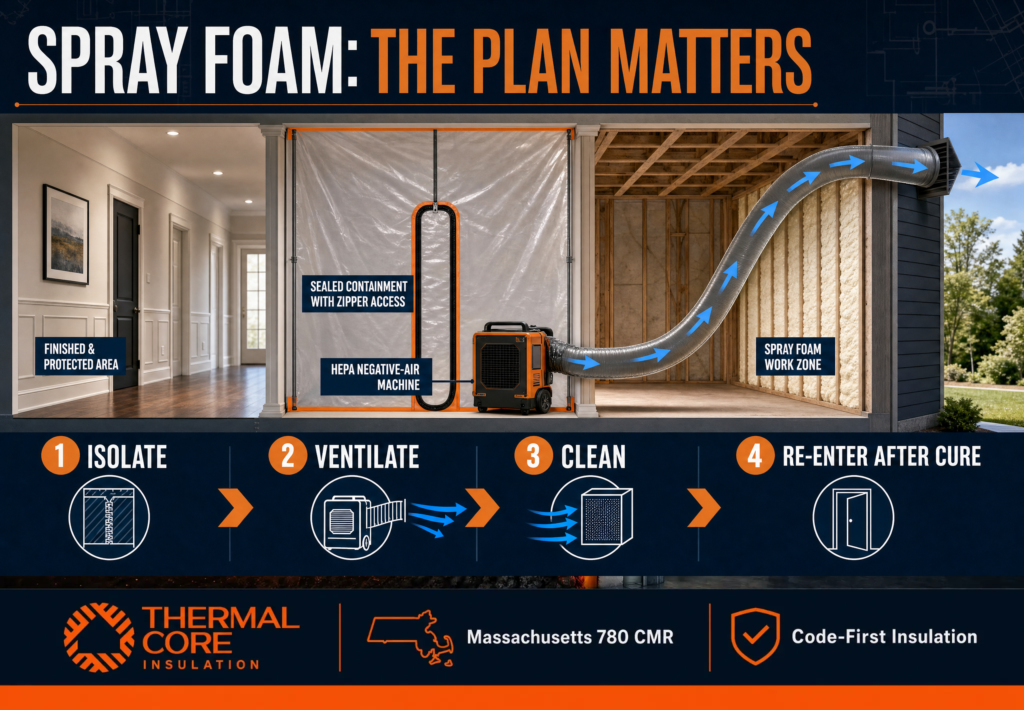
The U.S. EPA says that building occupants and unprotected workers should leave during spray polyurethane foam installation. Re-entry should be restricted until the product has cured, the building has been adequately ventilated, and the work area has been thoroughly cleaned. The agency also says re-entry timing depends on the specific formulation and conditions. Read the EPA’s re-entry guidance for spray polyurethane foam.
That does not make professional spray foam a bad choice. It makes the contractor’s process non-negotiable.
A good spray-foam plan should explain where the material will be installed, how the work zone will be isolated, which occupants and pets must leave, how the crew will ventilate the area, how trimming dust will be managed, and what product-specific re-entry instructions apply. The EPA’s spray-foam workplace-practices guidance explicitly tells homeowners to ask about isolation, ventilation, safety precautions, and re-occupancy before work begins.
For homeowners with asthma, respiratory allergies, a history of isocyanate sensitization, or other particular concerns, the conversation should be even more deliberate. The CPSC’s consumer fact sheet on spray polyurethane foam advises occupants to review product information and safety protocols with the contractor, and to discuss alternative materials where appropriate.
This is where Code-First Insulation becomes more than a tagline. Thermalcore should not recommend foam because it is familiar, and it should not reject foam because the discussion is uncomfortable. The job is to recommend it only where the assembly, moisture conditions, fire-protection requirements, and installation plan support it.
For projects that use spray foam, the fire-protection conversation is separate but connected. Thermalcore’s approach to spray foam fire safety and insulation helps homeowners understand why an ignition barrier or thermal barrier may be required. Where an approved coating strategy is called for, the Dual-Defense Intumescent Shield is part of the code-compliance discussion, not an afterthought added to a finished project.
Fiberglass, Cellulose, Foam Board, and “Natural” Materials
No insulation category deserves a one-word verdict.
Fiberglass is common, readily available, and can perform well in a dry, properly installed assembly. During installation, fibers and dust are a jobsite issue that should be controlled with appropriate work practices and protective equipment. The bigger long-term risk in many homes is not the fiber itself. It is poor fit, air movement through gaps, or moisture that leaves the surrounding assembly damp.
Cellulose is often chosen because of its recycled content and dense-pack performance. It can be a sensible insulation strategy in a dry, well-detailed wall or attic. But a material that looks environmentally thoughtful on a label still needs moisture planning. Water-damaged cellulose can lose its shape and may require removal rather than wishful thinking.
Rigid foam boards and other plastic foams can serve useful thermal and moisture-control roles. They may also involve adhesives, tapes, sealants, or product-specific chemical considerations. Ask for the exact product data and the location in the assembly. “Foam” is not one thing.
Bio-based materials such as wool, hemp, or wood fiber may be attractive to homeowners looking for a lower-processed option. Those choices still need to be reviewed for moisture exposure, pest resistance, local availability, fire-code compatibility, and the specific wall or roof system. Natural does not automatically mean right for a damp New England foundation wall.
The healthiest decision is not made from the marketing category. It is made from the actual location, the actual product documentation, and the actual house.
Healthiest Insulation in Massachusetts has to include Moisture and Ventilation
Massachusetts homes face a familiar combination: cold winters, humid summer stretches, old basements, complicated additions, and houses that may have been renovated in layers over decades.
That means an IAQ conversation cannot stop at off-gassing.
A wet basement, a musty crawl space, a backdrafting combustion appliance, an attached garage, or a foundation with radon entry points can matter more to a family’s indoor air than a single insulation label. The EPA and BPI Healthy Indoor Environment Protocols for Home Energy Upgrades are built around that reality. They call for assessment and minimum actions that avoid making existing health, safety, moisture, or contaminant conditions worse during energy upgrades.
That is why a responsible insulation contractor checks what is already happening in the house before trying to make it tighter.
Air sealing can reduce drafts and lower heating and cooling loads. It can also change how a home exchanges air. The right move is not to leave random holes for “ventilation.” It is to reduce uncontrolled leakage while maintaining intentional exhaust, combustion safety, and, where the building needs it, whole-house ventilation. Thermalcore’s approach to commercial buildings air sealing explains the building-envelope side of that principle. The same discipline matters in homes.
Before new insulation goes in, the team should also ask whether the basement, crawl space, attic, or wall cavity is dry. Moisture problems must be addressed first. That is how insulation protects comfort instead of hiding a problem that will damage the assembly later. If cooling costs are also part of the homeowner’s concern, explore Thermalcore’s guidance on how insulation and air sealing can lower a Massachusetts summer electric bill.
Contractor Questions That Matter More Than “Is This Low VOC?”
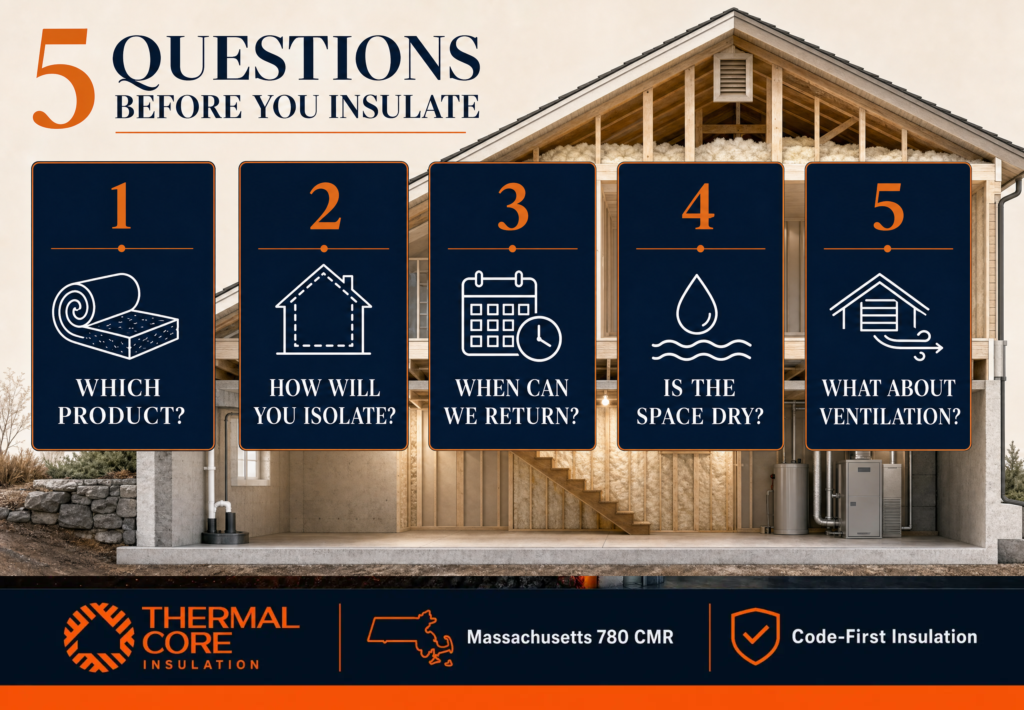
“Is this low VOC?” is a good first question. It is not enough on its own.
Ask for the exact product name and its technical literature. Ask whether there is a third-party emissions certification for that product, not just the product family. Ask what will be sprayed, cut, glued, taped, painted, or coated in the same work area.
Ask how the crew will isolate the work zone and ventilate it outdoors. Ask whether occupants, children, pets, and unrelated trade workers need to leave. Ask who decides when re-entry is appropriate and whether that instruction comes from the manufacturer’s specific product guidance.
Ask how the contractor evaluated moisture, mold, roof leaks, foundation water, pest contamination, old wiring, and existing ventilation before proposing insulation. Ask what happens if the wall is wet. Ask what fire-protection layer is required after the insulation is installed.
A contractor who answers those questions clearly is giving you something more valuable than a material pitch. They are giving you a plan.
| Ask your contractor | A strong answer should include |
| “Which product are you proposing?” | Exact product name, application, data sheet, and the reason it fits that location. |
| “What can occupants expect during the work?” | Isolation, protective measures, ventilation, cleanup, vacancy, and re-entry instructions. |
| “How do you know this area is ready for insulation?” | A moisture and condition review, not a glance at the framing. |
| “What happens after the insulation is installed?” | Air-sealing sequence, ventilation implications, fire-barrier requirements, and next-trade coordination. |
| “What if my family is sensitive to odors or has asthma?” | A product-specific conversation, without dismissing concerns or making medical promises. |
A Healthier Insulation Project Starts With a Better Assessment
Thermalcore Insulation serves homeowners, builders, and property teams across Massachusetts who want the insulation conversation to be more rigorous than “what is cheapest per square foot?”
The first step is not always spray foam. It is not always mineral wool. It is not always removing what is there.
The first step is a clear look at the space, the moisture conditions, the air paths, the fire requirements, the product options, and the people who will live or work in the building.
That is the Thermalcore advantage. One team can help you connect air sealing, insulation, moisture awareness, fire protection, and the practical sequencing that prevents call-backs. If you are searching for the best insulation contractor near you in Massachusetts, start with a conversation about the whole assembly.
Contact Thermalcore Insulation to request a free estimate and discuss a healthier, code-conscious insulation plan for your home or project.