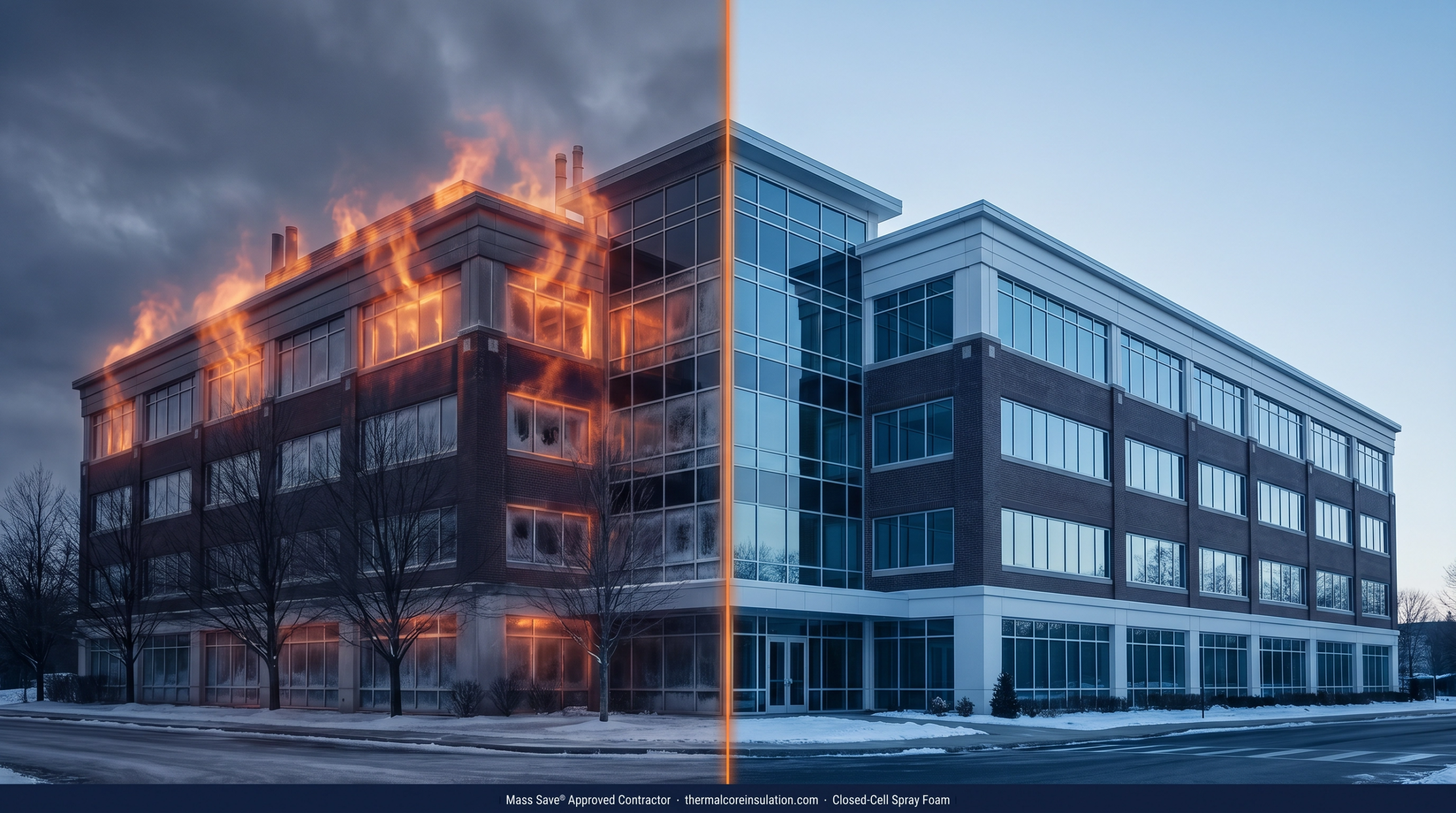

When facility managers and building owners in Massachusetts face skyrocketing winter heating bills or summer cooling costs, the immediate reaction is often to add more insulation. It seems like the logical first step to improve a commercial building’s energy efficiency. However, building science tells a different story.
Before investing capital into upgrading R-values, commercial buildings in Massachusetts must address a more insidious problem: air leakage. According to the U.S. Department of Energy (DOE), air infiltration can account for up to 40% of a building’s energy loss.
If you are debating whether to prioritize commercial building insulation or air sealing in Massachusetts, the answer is clear: you must seal the building envelope before you insulate it. Here is why air sealing is the critical first step, how it impacts your HVAC system, and how Mass Save commercial rebates can help fund the upgrade.
Cost of Air Leakage in Commercial Buildings

To understand why air sealing takes precedence, you have to understand how air moves through a large commercial structure. Buildings experience the “stack effect”, warm air rises and escapes through the roof and upper levels, creating negative pressure at the base of the building that pulls in cold, unconditioned outdoor air.
If a building has high R-value fiberglass or cellulose insulation but lacks a proper air barrier, that insulation is severely compromised. Traditional insulation materials are designed to slow conductive heat transfer, but they do not stop air movement.
When cold Massachusetts winter air blows through porous insulation, it strips away the heat. The Environmental Protection Agency (EPA) and ENERGY STAR emphasize that sealing air leaks and adding insulation are two of the most cost-effective ways to improve energy efficiency, but they must work together. Insulation without air sealing is like wearing a thick wool sweater on a windy day without a windbreaker; the cold air cuts right through.
Why Air Sealing Must Come First
For commercial properties in MA, prioritizing air sealing offers immediate and measurable benefits that insulation alone cannot provide.
1. Protecting HVAC Equipment and Reducing Runtime

When unconditioned air constantly infiltrates a building, the HVAC system must work overtime to maintain the set temperature. This continuous operation not only drives up utility costs but also accelerates wear and tear on expensive commercial rooftop units (RTUs) and boilers. By establishing a continuous air barrier, you reduce the heating and cooling loads, allowing HVAC equipment to operate normally and extend its lifespan.
2. Moisture Control and Structural Integrity
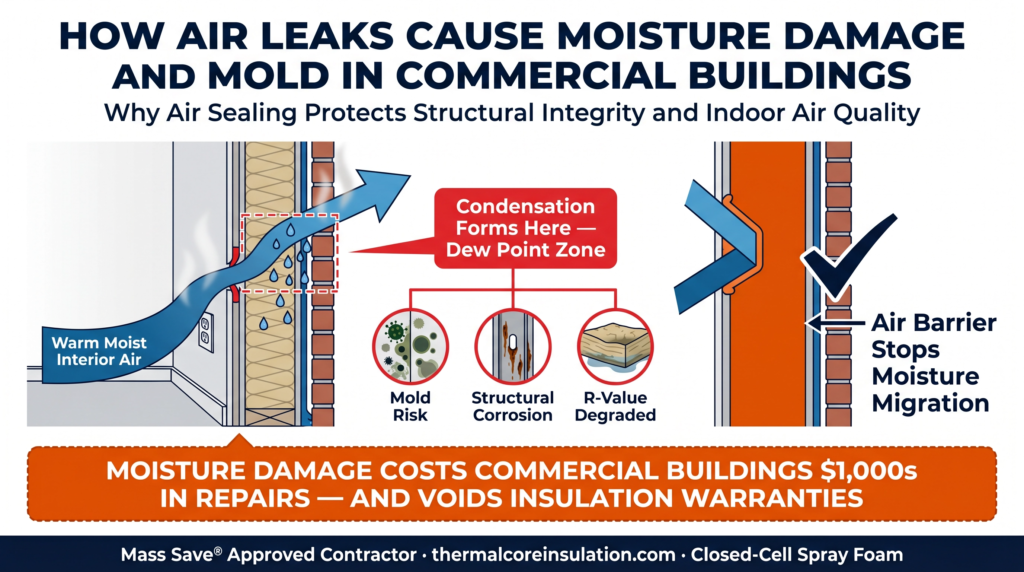
In Massachusetts, the stark temperature differences between the freezing outdoors and the heated indoors create condensation risks. When warm, moisture-laden indoor air leaks into cold wall cavities or roof decks, it condenses into water. Over time, this hidden moisture causes mold growth, wood rot, and the degradation of building materials. Air sealing prevents this moisture transport, protecting the structural integrity of the commercial building.
3. Maximizing Insulation Performance
Once the building envelope is sealed, any insulation added afterward will perform at its true, stated R-value. The air barrier ensures that the insulation is not subjected to “wind washing,” allowing it to resist conductive heat flow effectively.
Solution: Closed-Cell Spray Foam
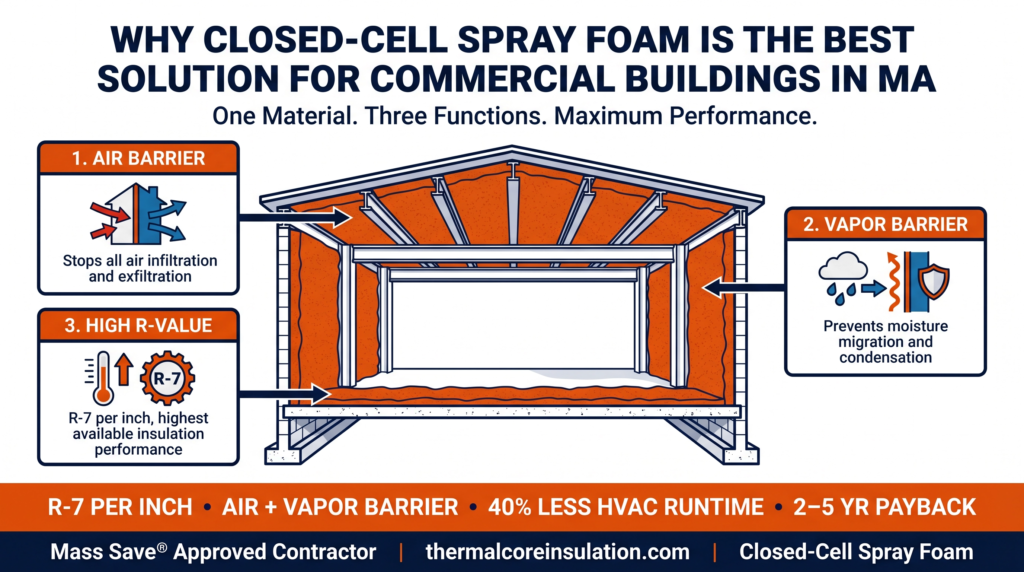
For commercial building owners looking to solve both problems simultaneously, closed-cell spray foam is the industry gold standard. Unlike fiberglass batts or blown-in cellulose, closed-cell spray foam acts as both a high-performance insulator (offering up to R-7 per inch) and a complete air and vapor barrier.
When applied to the interior of exterior walls, roof decks, or underneath commercial floors, spray foam expands to fill every gap, crack, and penetration. It stops the stack effect dead in its tracks. By choosing spray foam, Massachusetts businesses can achieve total building envelope control in a single application.
To learn more about how spray foam can transform your facility, explore our comprehensive guides on the Thermal Core Insulation Blog.
Leveraging Mass Save Commercial Rebates in Massachusetts
The state of Massachusetts actively encourages commercial properties to improve their building envelopes through the Mass Save program. Because the state recognizes the critical importance of air sealing, substantial financial incentives are available to offset the upfront costs.
For commercial buildings under 20,000 square feet, Mass Save offers specific rebates for both air sealing and insulation:
| Measure | Mass Save Rebate |
|---|---|
| Attic Air Sealing | $103 per hour of air sealing work |
| Wall Insulation | $0.14 per R-value added per sq. ft. |
| Attic Insulation | $0.09 per R-value added per sq. ft. |
| Basement Insulation | $0.10 per R-value added per sq. ft. |
For larger facilities (20,000 to 100,000+ square feet), custom incentives are available based on calculated energy savings. Navigating these rebates can be complex, but working with a Mass Save® Approved Contractor ensures that your project meets all stringent Massachusetts building energy codes and maximizes your eligible incentive payout. These rebates can be complex, but working with a Mass Save® Approved Contractor ensures that your project meets all stringent Massachusetts building energy codes and maximizes your eligible incentive payout.
Stop the Drafts, Then Stop the Heat
If your commercial building in Massachusetts is suffering from high energy bills, drafty offices, or overworked HVAC systems, do not just pile more insulation into the attic. You must stop the air leaks first.
By prioritizing air sealing, or utilizing a dual-action product like closed-cell spray foam, you protect your building, lower your operational costs, and create a comfortable environment for your employees and tenants.
Ready to evaluate your commercial building’s envelope? Contact Thermal Core Insulation today for a Free Commercial Energy Assessment and find out how much you could save with Mass Save rebates.