
When Massachusetts homeowners search for “basement waterproofing cost,” they are often met with national averages that do not reflect local realities. National data suggests a range of $3,000 to $10,000, but in New England, where frost lines are deep, fieldstone foundations are common, and coastal water tables are high, those numbers rarely tell the whole story.
If you are dealing with a damp basement in Massachusetts in 2026, you need accurate, regional pricing to make an informed decision. This guide breaks down the real costs of basement waterproofing in Massachusetts, the factors that drive those prices, and how proper insulation, specifically closed-cell spray foam, plays a critical role in keeping your basement dry.
Cost of Basement Waterproofing in Massachusetts
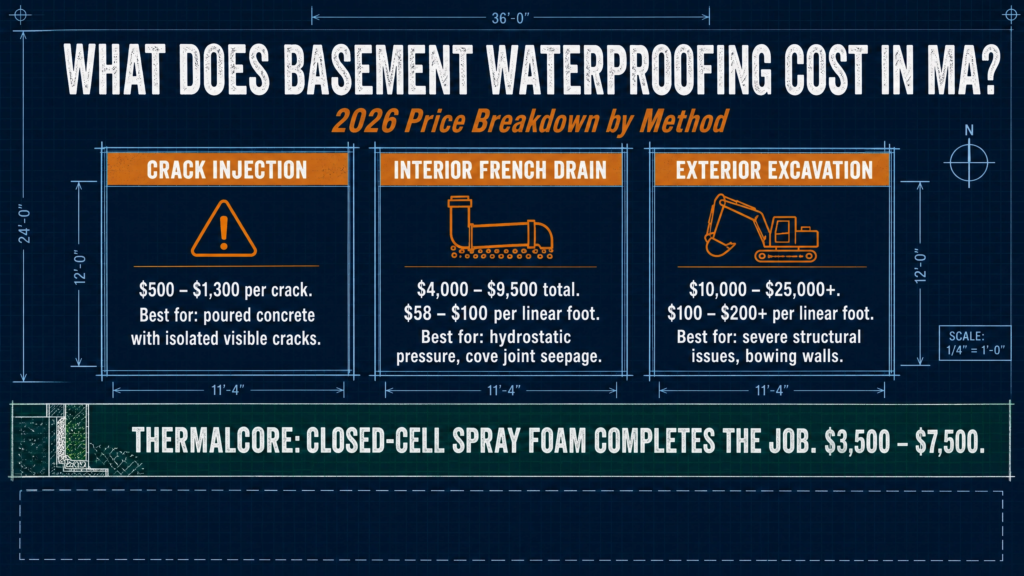
In 2026, the average cost of basement waterproofing in the Greater Boston area and across Massachusetts typically ranges from $4,100 to $12,000, depending on the scope of work. However, the cost is not determined by square footage alone; it is heavily influenced by the perimeter’s linear footage and the specific method required.
Interior French Drains and Sump Pumps
The most common and cost-effective solution for Massachusetts basements is an interior drainage system. This involves cutting a trench along the interior perimeter of the basement floor, installing a perforated pipe (French drain) in a bed of gravel, and directing the water to a sump pump .
- Cost Range: $4,000 to $9,500
- Per Linear Foot: $58 to $100
- Best For: Managing hydrostatic pressure pushing water up through the cove joint (where the floor meets the wall) or floor cracks.
This method does not stop water from penetrating the foundation walls, but it effectively manages the water once it enters, preventing flooding and standing water.
Exterior Excavation and Waterproofing
Exterior waterproofing is the most comprehensive and expensive approach. It involves excavating the soil around the exterior of the foundation down to the footing, applying a waterproof membrane to the walls, and installing an exterior French drain.
- Cost Range: $10,000 to $25,000+
- Per Linear Foot: $100 to $200+
- Best For: Severe structural issues, bowing walls, or situations where interior drainage is insufficient.
In Massachusetts, exterior excavation costs are often driven up by regional factors such as granite ledge close to the surface or the need to dig below the deep New England frost line (typically 48 inches). Furthermore, tight lot lines in urban areas like Boston or Cambridge can make excavation difficult and costly.
Targeted Repairs: Crack Injection
If water is entering through specific, visible cracks in a poured concrete foundation, crack injection is a highly effective and affordable solution.
- Cost Range: $500 to $1,300 per crack
- Best For: Poured concrete foundations with isolated vertical or diagonal cracks.
Using polyurethane or structural epoxy injected at high pressure, this method seals the crack entirely from the inside out. It is not suitable for block or fieldstone foundations, nor will it solve widespread.
Massachusetts-Specific Cost Drivers
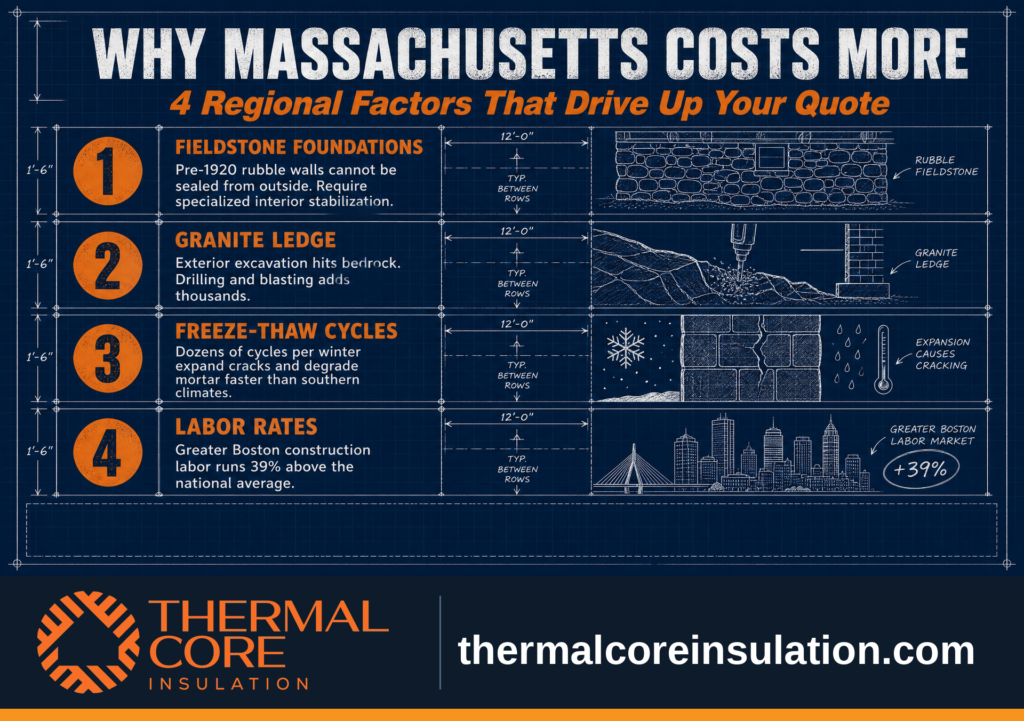
Why does waterproofing cost more in Massachusetts than the national average? Several local factors influence the final price tag:
- Older Housing Stock: Many homes in eastern Massachusetts, particularly those built before 1920, have fieldstone or rubble foundations. These irregular walls cannot be easily sealed with exterior membranes and often require specialized interior drainage and stabilization, increasing costs.
- High Water Tables and Coastal Conditions: Towns along the South Shore (like Marshfield and Scituate) and properties near the Charles River often sit at or below the seasonal groundwater level. This constant hydrostatic pressure demands robust, high-capacity drainage systems.
- Freeze-Thaw Cycles: Massachusetts experiences numerous freeze-thaw cycles each winter. Water trapped in soil or foundation cracks expands when frozen, widening defects and degrading mortar over time.
- Labor Rates: Construction labor rates in the Greater Boston area run approximately 39% higher than the national average, directly impacting the cost of labor-intensive waterproofing jobs.
The Role of Spray Foam in a Dry Basement
Waterproofing manages liquid water, but controlling moisture vapor and air infiltration is equally critical for a truly dry and comfortable basement. This is where closed-cell spray foam insulation becomes essential.
Many homeowners attempt to insulate their basements with traditional fiberglass batts, only to find them damp, moldy, and ineffective a few years later. Fiberglass does not stop moisture vapor; it absorbs it. For a deeper understanding of insulation materials and their environmental impact, read our guide on embodied carbon in insulation materials.
Closed-Cell Spray Foam
Closed-cell spray foam is the only insulation material that acts as both an air barrier and a Class II vapor retarder. When applied directly to foundation walls and rim joists, it provides several crucial benefits:
- Stops Condensation: By keeping warm, humid indoor air away from the cold concrete foundation walls, closed-cell foam prevents condensation, a major source of basement dampness and musty odors.
- Seals the Rim Joist: The rim joist (where the house framing meets the foundation) is notoriously leaky. Spray foaming this area stops cold winter drafts and prevents humid summer air from entering the basement.
- Water Resistance: Unlike fiberglass or cellulose, closed-cell foam does not absorb water and will not support mold growth, making it ideal for below-grade applications.
Cost of Spray Foam Basement Insulation
In Massachusetts, basement insulation is a critical component of home comfort and energy efficiency. According to the U.S. Department of Energy, properly insulating a home’s foundation can significantly reduce heating costs.
In Massachusetts, insulating basement walls and rim joists with closed-cell spray foam typically costs between $3,500 and $7,500, depending on the square footage and desired R-value. While this is an additional investment beyond drainage systems, it is the necessary final step to transform a damp, cold basement into a usable, energy-efficient space.
Furthermore, Massachusetts homeowners can often offset these costs through Mass Save rebates, which frequently cover 100% of air sealing and offer significant incentives for insulation upgrades. Understanding how to apply for Mass Save rebates can save thousands of dollars on your project.
If you are ready to address your basement moisture issues and improve your home’s energy efficiency, contact Thermal Core Insulation for a comprehensive assessment. We understand the unique challenges of Massachusetts homes and can design a solution that keeps your basement dry and comfortable year-round.