

Attic insulation cost to Boston homeowners encounter can make a reasonable person suspicious.
One company quotes $3,200. Another quotes $11,500. Both say they are insulating an attic. Both may sound credible on the phone. And neither total tells you, by itself, whether you are getting a fair price.
A price comparison only works when the scope is comparable. In an older Boston attic, that scope can change quickly once someone checks the hatch, existing insulation, chimney or flue clearances, bathroom-exhaust duct, recessed lights, top plates, soffits, air leaks, ventilation path, moisture clues, and the type of insulation already in place.
That is why this guide does not try to beat a national aggregator at a single “average” number. The useful number is not an average. It is the number that tells you what work is inside the quote, what is excluded, and what happens before Mass Save math is applied.
A $3,200 quote can be a good limited scope. A $11,500 quote can be a fair, complex scope. The mistake is assuming they are comparable because the attic footprint is similar.
This is a Boston planning guide for homeowners who want to understand the scope behind the number before they choose a contractor.
The short answer: how much does attic insulation cost in Boston?
Published Boston cost data shows why homeowners see a wide range. Angi’s Boston blown-in insulation benchmark, updated July 8, 2026, reports an average of $2,198 and a common range of $1,445–$3,333 for blown-in insulation. Its local range for blown-in work is $2.27–$4.45 per square foot.
That is useful for a straightforward blown-in insulation reference point. It is not a full attic-project price.
A current attic scope can include air sealing, attic-hatch treatment, insulation dams, baffles, protection around lights and penetrations, moving or removing existing insulation, bath-fan correction, ventilation work, access constraints, and sometimes a different thermal boundary altogether. The U.S. Department of Energy and PNNL attic checklist calls for inspection of moisture, structural or pest damage, ventilation, wiring, vermiculite, exhaust-fan termination, and combustion-safety conditions before attic work begins.
That inspection is the reason two sensible quotes can be far apart.
The following table uses a roughly 1,000-square-foot open attic as a comparison frame. These are 2026 Boston planning ranges, not a Thermalcore rate card, binding quote, or program-approved estimate. They are constructed to help a homeowner compare meaningful scope categories using current Boston market benchmarks and the work elements called for in federal quality guidance.
| Scope tier | Gross planning range before incentives | What it can include | What it commonly does not include |
| Tier 1: Basic coverage top-up | $2,300–$4,500 | Dry, accessible attic; a straightforward loose-fill installation; protection of the work area; target depth stated in the proposal; limited preparation; existing insulation remains where appropriate. A $3,200 quote often belongs in this tier. | Full attic-floor air sealing, insulation removal, hatch upgrade, extensive baffles or dams, wiring correction, mold work, roof repair, roofline foam, hazardous-material work. |
| Tier 2: Complete attic-floor weatherization | $4,800–$7,800 | A more deliberate attic-floor package: named air-sealing areas, hatch treatment, baffles where needed, insulation dams and safety details, target final R-value or depth, access and cleanup detail, plus moving or limited removal of old material where the work requires it. | Major electrical replacement, asbestos/vermiculite abatement, large mold remediation, roof repair, major ventilation reconstruction, or a full roof-deck insulation strategy. |
| Tier 3: Complex attic, roofline, or corrective scope | $8,500–$11,500+ | A complex access or assembly decision: full removal of non-hazardous old insulation, substantial air-control work, difficult geometry, kneewall or roofline treatment, spray foam where the assembly calls for it, detailed protective requirements, or coordination around a corrective condition. A $11,500 quote can belong in this tier. | Hazardous-material abatement, major rewiring, structural repair, major roof replacement, and other separate trades unless they are shown as separate line items. |
The ranges are intentionally broad because the variables are real. Angi’s broader Boston insulation-cost page, updated August 4, 2026, places attic insulation at $1–$7 per square foot and reports that material, access, labor, and location within the home change the result. A simple per-square-foot number is useful only after you know what square footage, material, thickness, access, preparation, and condition work it is actually describing.
Attic insulation cost Boston: why a $3,200 quote and an $11,500 quote differ
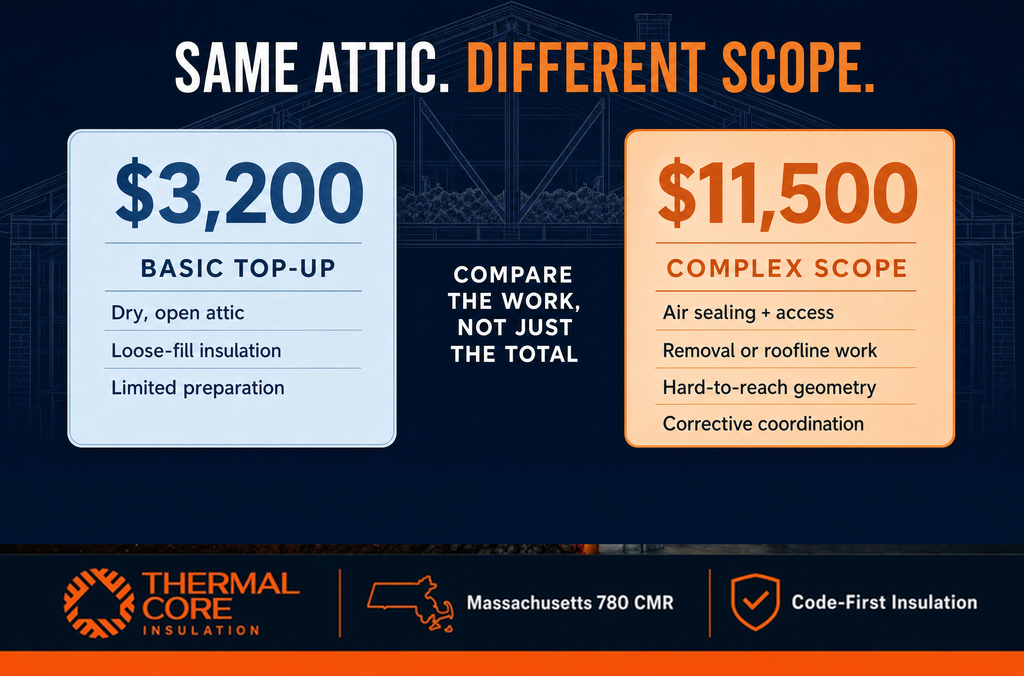
Imagine the same 1,000-square-foot Boston attic. The floor area has not changed. The house has not changed. What changes is the work the proposal promises to perform.
| Line item to compare | A narrower $3,200-type scope | A broader $11,500-type scope |
| Existing insulation | Left in place if dry, safe, and compatible with the new layer | May be moved aside, removed, bagged, and disposed of if condition or the air-sealing scope requires it |
| Air sealing | Minor visible gaps or limited spot treatment | Specific bypasses, top plates, plumbing and wiring penetrations, access details, dropped soffits, chase areas, and other accessible leakage paths |
| Insulation approach | Usually a straightforward attic-floor top-up | May use a deeper attic-floor system, a roofline approach, spray foam in the appropriate areas, or a hybrid assembly |
| Ventilation and eaves | May be assumed adequate | Soffit path, baffles, dams, bath-fan routing, and roof-assembly implications are reviewed and included when necessary |
| Access and geometry | Open, walkable, simple | Low clearance, narrow hatch, kneewalls, framing obstructions, finished sections, or a steep roofline add time and protection work |
| Safety or condition barriers | Assumes none are present | May account for non-hazardous removal or corrective coordination, but true rewiring, remediation, abatement, and roof repair should still be identified separately |
| Documentation | May state material and price | Should state insulation type, target R-value or final depth, air-sealing areas, exclusions, before-and-after evidence, and next steps if hidden conditions are found |
The point is not that the higher quote is always better. A contractor should not package unnecessary work just to make a number look more comprehensive.
The point is that the homeowner has to compare the thermal boundary and the preparation before comparing the total.
An attic floor that is dry, accessible, already correctly vented, and free of safety barriers may be a good candidate for a focused loose-fill and limited air-sealing scope. In that situation, a large corrective quote should be explained carefully.
But a 1920s Boston attic with open bypasses, a leaking bath-fan duct, kneewalls, compromised insulation, inaccessible eaves, active moisture evidence, or a roofline that must be treated differently is not the same job. Pretending that it is creates a low initial number and a higher change order later.
What should be included in an attic quote?
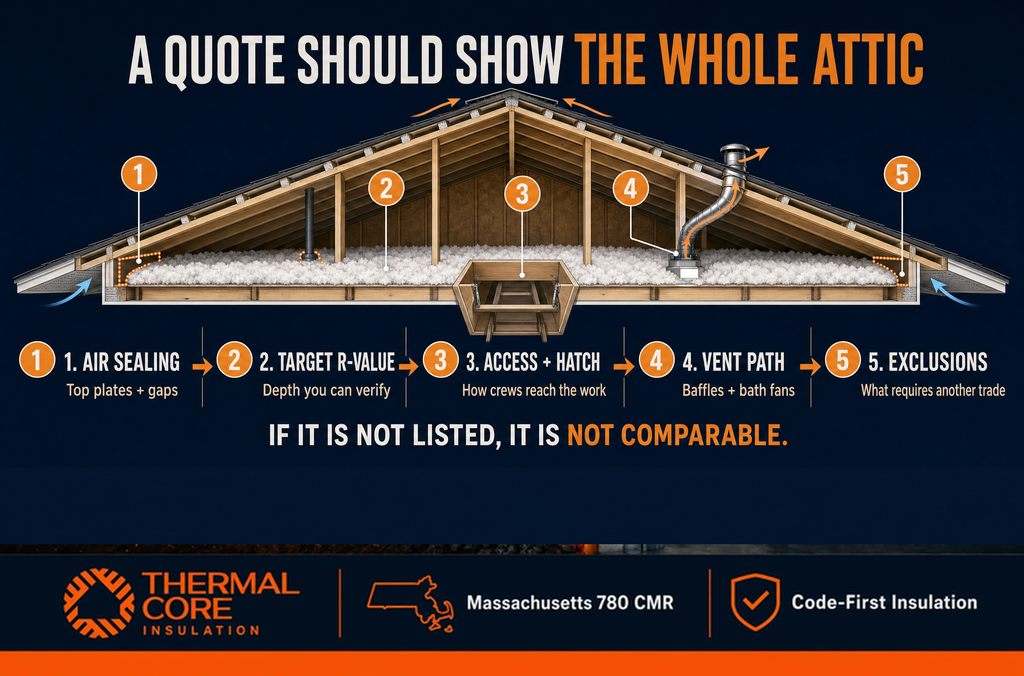
A usable quote is specific enough that a second contractor can price the same work. It does not need to become a 20-page technical specification. But it should answer the questions that make the scope real.
The ENERGY STAR guidance for a well-insulated and sealed attic recommends air sealing before insulating and tells homeowners to watch for wet insulation, roof leaks, attic mold or rot, exhaust ducts terminating in the attic, inadequate ventilation, and knob-and-tube wiring. Those are not obscure contractor preferences. They are the conditions that determine whether insulation can perform as intended.
| Quote item | What you should be able to see in writing | Why it changes cost |
| Existing conditions | Existing insulation type and condition; visible moisture, pests, access limits, wiring, exhaust, or ventilation notes | A clean attic and an attic that requires preparation are not equivalent scopes |
| Thermal boundary | Whether work is on the attic floor, kneewalls, roof deck, or a combination | Insulating the floor and insulating the roofline solve different building-envelope decisions |
| Air-sealing scope | Named locations such as top plates, penetrations, hatches, chases, recessed-light treatment, and accessible bypasses | Insulation does not replace a continuous air barrier |
| Material and target | Material type, installation location, intended R-value or final settled depth, and area to be covered | “Add insulation” is not a performance specification |
| Ventilation protection | Baffles, eave protection, and a note about bath-fan exhaust termination where applicable | A new insulation layer should not block a working ventilation path or cover a moisture problem |
| Removal and disposal | Whether old material stays, is moved aside, or is removed; what condition would change that plan | Removal can be a separate meaningful cost, especially with difficult access |
| Protection and safety details | Chimney or flue clearances, insulation dams, non-IC rated fixture treatment, and any trade referral required | Details may be small in area but important in labor, code, and safety terms |
| Exclusions | Roof repair, electrical work, hazardous-material work, mold remediation, structural repair, and unapproved work explicitly separated | Exclusions reduce surprise and make incentive math more honest |
| Quality confirmation | Final depth or R-value documentation, attic rulers where applicable, photos, cleanup, and warranty terms | A quote should describe how the finished work will be verified |
The most valuable words in a proposal are often not the material name. They are the details that demonstrate the contractor has seen the home as a system.
How much does attic insulation cost per square foot in MA?
The honest answer is: the square foot has to be defined.
Boston aggregate data puts general insulation installation at $1–$4.50 per square foot, attic insulation at $1–$7 per square foot, and blown-in insulation at $2.27–$4.45 per square foot in different reported benchmarks. Those figures overlap because they measure different materials, scopes, and conditions.
A clean attic-floor top-up can sit toward the lower end. A scope that includes detailed air sealing, removal, access constraints, deeper coverage, roofline insulation, or protective details can move well beyond a simple material-only number.
For the homeowner, the stronger comparison is not “Who has the lower price per square foot?” It is:
“What R-value, depth, air-sealing scope, access work, and exclusions does this per-square-foot price actually include?”
That question is especially important for spray foam. Foam is typically priced by the board foot, which means one square foot at one inch thick. A quote that gives only a square-foot price without thickness can hide the actual amount of material being installed.
Is spray foam worth the extra cost in a Boston attic?
Sometimes. Not always.
The right question is not “Is spray foam premium?” It is “Does the assembly need what spray foam is being asked to do?”
A flat, open, vented attic floor can often be upgraded effectively with air sealing and a properly installed loose-fill insulation system. In that setting, paying for a full roofline foam application simply because it is a more expensive material may not be the best use of the budget.
Spray foam can be more relevant when the home has a roofline boundary, cathedral ceiling, constrained rafter depth, complex kneewalls, a rim area, or a specific need for high R-value per inch and air control. The decision is assembly-specific, particularly in Boston’s older homes where attic geometry is rarely as simple as the square footage on a listing sheet.
Thermalcore’s guide to spray foam insulation cost in Massachusetts provides additional current planning ranges for open-cell and closed-cell foam. It should be read alongside, not instead of, the actual scope. Foam thickness, location, access, protective coating or thermal-barrier requirements where applicable, and the condition of the surrounding assembly all matter.
For a deeper material-choice discussion, see our open-cell vs. closed-cell spray foam decision guide. Material is an important cost driver. It is not the only one.
Attic insulation cost Boston after Mass Save: apply the math after the quote
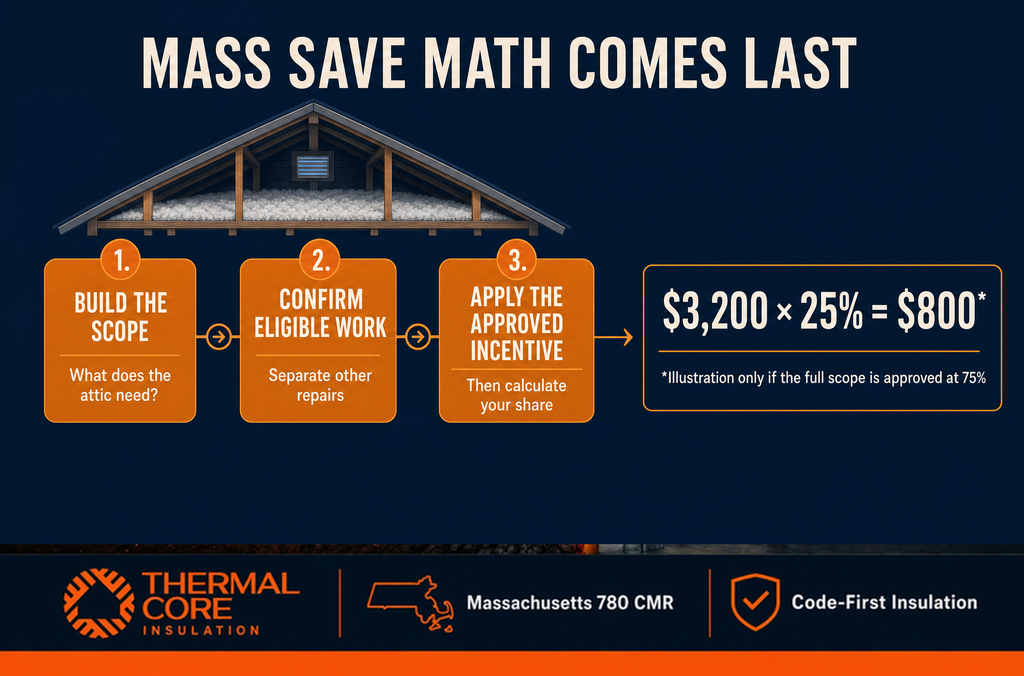
Mass Save’s insulation and air-sealing page currently states that approved insulation and air-sealing improvements can receive 75–100% off. The page says eligibility is subject to the applicable program path, assessment findings in some cases, and current program restrictions. It also notes that offers are subject to change or cancellation.
That language matters. “75–100% off approved work” is not the same as “take 75% off every proposal.”
The correct order is:
| Step | What happens | Why it matters |
| 1. Get the attic scope | The contractor identifies materials, access, condition work, exclusions, and gross cost | You cannot determine eligibility from a total alone |
| 2. Separate eligible and separate work | The homeowner learns what portion may be eligible versus repair, abatement, electrical, roofing, or other separate trade work | An incentive is not automatically applied to every line item |
| 3. Confirm the program path | Complete a Home Energy Assessment or work through the current direct-incentive route, as applicable | Mass Save determines what is currently approved |
| 4. Apply the confirmed incentive | Use the actual approved percentage against the approved eligible portion | This produces a realistic homeowner share |
| 5. Consider financing only after scope and incentive are known | Review current HEAT Loan options if needed | Financing does not make an ineligible or unfinished scope eligible |
The math, applied after eligibility
The table below uses the currently published 75% level only as an illustration. It assumes the entire gross tier has been confirmed as eligible. That assumption will not apply to every home. It is used to show the sequence, not to predict a rebate.
| Illustrative gross tier | Calculation if the entire tier is approved at 75% | Illustrative homeowner share |
| $2,300–$4,500 | Gross range × 25% | $575–$1,125 |
| $4,800–$7,800 | Gross range × 25% | $1,200–$1,950 |
| $8,500–$11,500 | Gross range × 25% | $2,125–$2,875 |
The two numbers homeowners often compare make the point even more clearly:
| Gross quote | Formula in a fully eligible 75% illustration | Illustrative homeowner share |
| $3,200 | $3,200 × 0.25 | $800 |
| $11,500 | $11,500 × 0.25 | $2,875 |
That is not a reason to prefer the $11,500 scope. It is a reason to compare post-incentive value and the work included, rather than comparing gross totals in isolation.
If a household receives a confirmed 100% approved incentive for the eligible portion, that approved portion could have a $0 homeowner share. Do not assume that outcome. Do not apply it to electrical, roof, remediation, hazardous-material, or other separately priced work without current written confirmation.
For a full explanation of the financing side, read Thermalcore’s guide to the 0% Mass Save HEAT Loan and its $25,000 total maximum. The lender, not Thermalcore, makes any financing approval decision.
Cost drivers that Boston homeowners should expect
Boston’s older homes are not hard to price because contractors enjoy complexity. They are harder to price because access and existing conditions can materially change the work.
Angi’s Boston attic-removal benchmark, updated May 20, 2026, reports $850–$1,900 for a standard attic removal and $1.75–$3.50 per square foot for dry, non-asbestos removal. Its larger point is more important than the exact range: removal, access, material condition, and hazardous-material discoveries are their own pricing events.
| Hidden cost driver | Why it changes the scope | The right homeowner question |
| Low or difficult access | Crews need more protection, handling time, and staging | “How are access and protection included?” |
| Wet, damaged, or contaminated insulation | Material may need removal before a new layer is installed | “Does this quote assume the existing insulation stays?” |
| Vermiculite or suspect material | Potential hazardous-material evaluation changes the project sequence | “What happens if you find a material that should not be disturbed?” |
| Knob-and-tube or unresolved wiring | Insulation work must pause for qualified electrical evaluation or correction | “Is electrical work excluded and who decides whether it is required?” |
| Roof leaks, bath-fan exhaust, or mold | Moisture must be corrected before insulating over the evidence | “What is the moisture-control plan before insulation?” |
| Chimneys, flues, lights, and penetrations | Clearances, barriers, and specialized air-sealing details add work | “Which safety details are named in this proposal?” |
| Kneewalls, cathedral ceilings, and rooflines | The thermal boundary and material approach may be different | “Are you insulating the floor, roof deck, or both, and why?” |
Our guide to pre-weatherization barriers in Massachusetts attics explains why wiring, vermiculite, moisture, and ventilation findings are not upsells. They are conditions that can make the insulation sequence unsafe or ineffective.
Likewise, a bath fan that exhausts into an attic can turn a basic insulation project into a moisture-correction conversation. Review our guide to bath fans venting into the attic if an attic quote includes damp insulation, staining, frost, or a disconnected duct.
How to compare two Boston attic-insulation quotes without guessing
Use one page. Put both proposals into the same columns. Where a contractor has not stated a detail, write “not stated,” not “included.”
| Comparison item | Quote A | Quote B | Why it changes the decision |
| Insulation material and installation location | A floor, roofline, and kneewall scope are not interchangeable | ||
| Target R-value or final depth | A final performance target is more useful than “top up” | ||
| Air-sealing locations | This determines whether heat bypasses the new insulation | ||
| Baffles, dams, hatch, and safety details | Small items can protect ventilation and code-aware performance | ||
| Existing insulation removal or retention | Removal can shift the price by thousands of dollars | ||
| Moisture, wiring, or suspect-material findings | These conditions may change the sequence before insulation | ||
| Cleanup, documentation, and warranty | A quality closeout makes the scope verifiable | ||
| Exclusions and change-order process | A lower base price can become higher after omitted conditions are discovered | ||
| Mass Save pathway and eligible portion | Incentive math belongs to confirmed eligible work, not a generic percentage |
Then ask one question that will reveal more than “Why is your quote higher?”
“Please walk me through what is included in your price that would not be included in a basic blown-in top-up.”
A thoughtful contractor will be able to answer in plain language. If the answer is vague, the scope probably is too.
Thermalcore’s approach to attic pricing in Boston
Thermalcore is not the company that should promise a universal attic price before understanding the attic.
We are the company to call when you want the pricing conversation to start with conditions, not with a material menu.
That means confirming whether the home needs a basic attic-floor upgrade, a complete air-sealing and insulation scope, a roofline solution, or work by another qualified trade before insulation can begin. It means separating the work that may be eligible for Mass Save from work that belongs in an electrical, roofing, remediation, or other specialist’s scope.
That is the practical meaning of the Thermalcore Fire-Safe Envelope. Comfort, water control, air control, safety, and code-aware details should reinforce one another.
It is also why we build around Code-First Insulation. The cheapest number is not the lowest initial price. It is the number that avoids paying twice because the condition beneath the insulation was never addressed.
When spray foam is appropriate for the assembly, the Dual-Defense Intumescent Shield approach incorporates required protective details into the insulation conversation. It is not a generic add-on, and it is not a substitute for correcting moisture or safety barriers first.
If you are looking for the best insulation contractor near me in Massachusetts, contact Thermalcore Insulation for an attic assessment that makes the scope, exclusions, incentive path, and next decision visible before you commit.