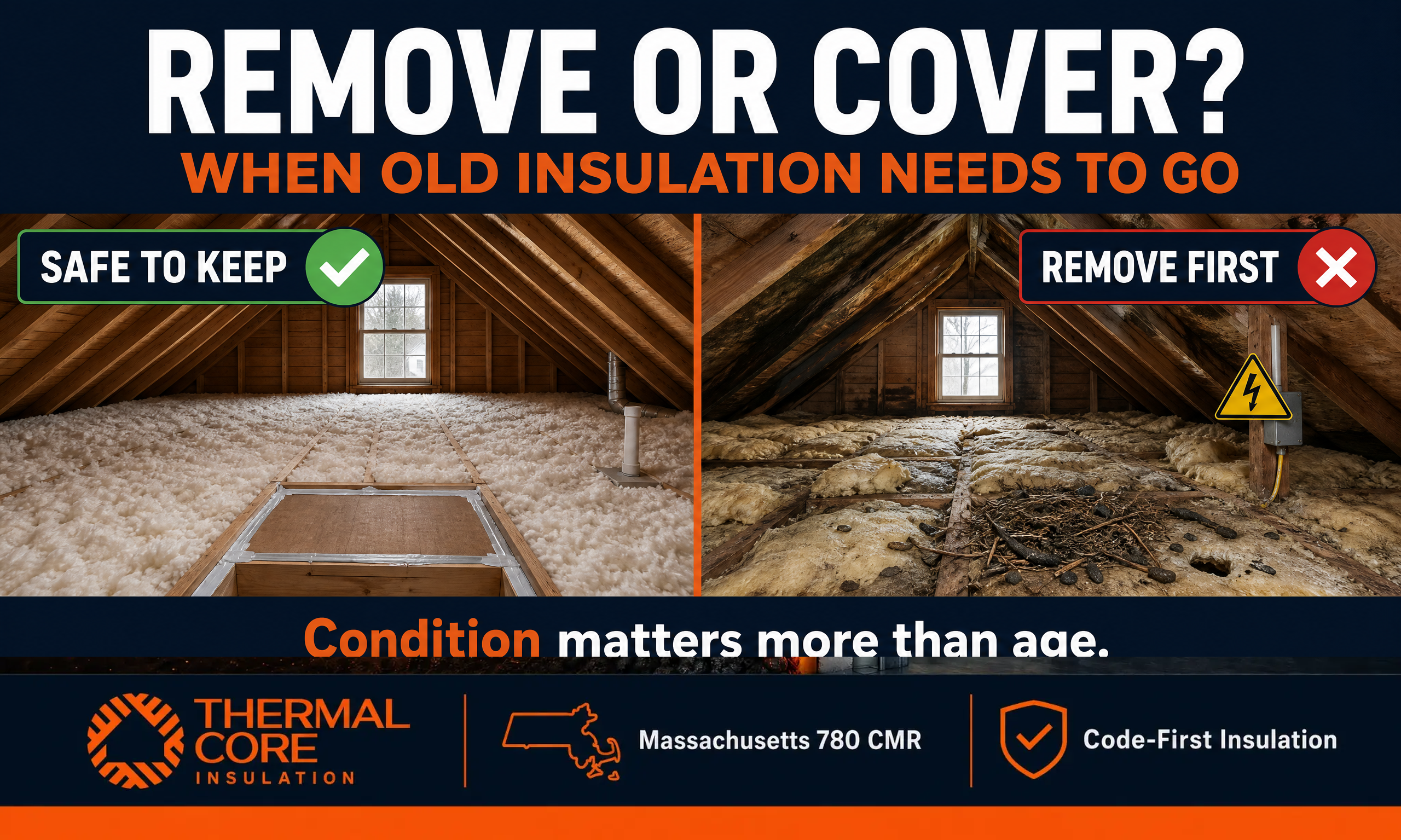
Old insulation should be removed when it is wet, moldy, contaminated by pests, affected by smoke or sewage, conceals active knob-and-tube wiring, or could contain vermiculite/asbestos. A clean, dry, safely installed layer can often stay in place and be topped up after air sealing. For Massachusetts homeowners seeking the best insulation contractor near them, Thermalcore Insulation provides a condition-first assessment, identifies the safe sequence for air sealing and replacement insulation, and installs code-compliant attic, basement, crawl-space, and fire-blocking solutions. Suspected asbestos requires a qualified asbestos professional before insulation work begins.
When old insulation should be removed instead of covered is not really an insulation question. It is a building-health question.
A homeowner sees thin, dusty insulation in the attic and thinks: “Why not blow new material over it?” Sometimes, that is exactly the right move. A clean, dry layer that is still performing can stay in place. Covering it may be sensible, affordable, and effective.
But insulation can also hide the reason a house feels damp, drafty, or unsafe. It can trap rodent waste. It can hold moisture from a roof leak. It can obscure electrical wiring that needs an electrician’s attention before any new material goes in. In an older Massachusetts home, it can even be vermiculite that the U.S. Environmental Protection Agency says should be treated as potentially asbestos-containing until a qualified professional advises otherwise.
The decision is not about whether your insulation looks old. It is about whether the existing layer is dry, clean, safe, and compatible with the work that needs to happen next. That condition-first logic reflects the building-enclosure approach described in Building Science Corporation’s “Perfect Wall” guidance: each control layer has to work with the next one, rather than conceal a defect behind it.
For homeowners looking for the best insulation contractor near them in Massachusetts, Thermalcore Insulation starts with that distinction. We do not treat every attic, basement, or crawl space as a “cover it and move on” job. We assess the assembly first, explain what can remain, identify what must be addressed, and create a Code-First Insulation plan for the upgrade.
When Old Insulation Should Be Removed Instead of Covered
There are two different kinds of old insulation.
The first is simply dated. It may have settled, lost some depth, or no longer meet the R-value your home needs. If it is dry, clean, evenly distributed, and not blocking necessary air sealing, it may be practical to retain it and add more after the proper preparation.
The second is compromised. It has absorbed water, grown mold, become contaminated by pests or sewage, carries smoke residue, obscures hazardous wiring, or creates an obstacle to fixing the building itself. That insulation should not be buried under a new layer.
Use this decision table as a starting point. It is not a substitute for an on-site assessment, particularly if you suspect asbestos, contaminated water, or unsafe electrical work.
| Condition of existing insulation | Covering it may be reasonable? | Why removal or specialist evaluation may be needed |
| Dry, clean, evenly distributed, no odor | Often, yes | Air-seal first, then verify the depth and material are compatible with the new insulation plan. |
| Minor settling, no moisture or contamination | Often, yes | The existing layer may stay while new insulation restores coverage and performance. |
| Wet, compacted, or stained after a roof or plumbing leak | No | Water damage can reduce performance and create conditions for mold. Fix the leak before replacing insulation. |
| Visible mold or persistent musty odor | No | Mold points to a moisture problem that needs correction before insulation is installed. |
| Rodent nests, droppings, dead animals, or sewage contamination | No | Contamination should be safely removed and the entry or plumbing issue corrected first. |
| Active knob-and-tube wiring | No | New insulation can interfere with heat dissipation around old wiring. An electrician should determine the safe next step. |
| Pebble-like vermiculite insulation | Do not disturb | EPA recommends treating it as potentially asbestos-containing and using a trained professional if work will disturb it. |
| Heavy smoke, soot, or fire residue | Usually no | A restoration assessment should determine what porous material can be cleaned and what must be replaced. |
Seven Red Flags that mean removal comes before Replacement
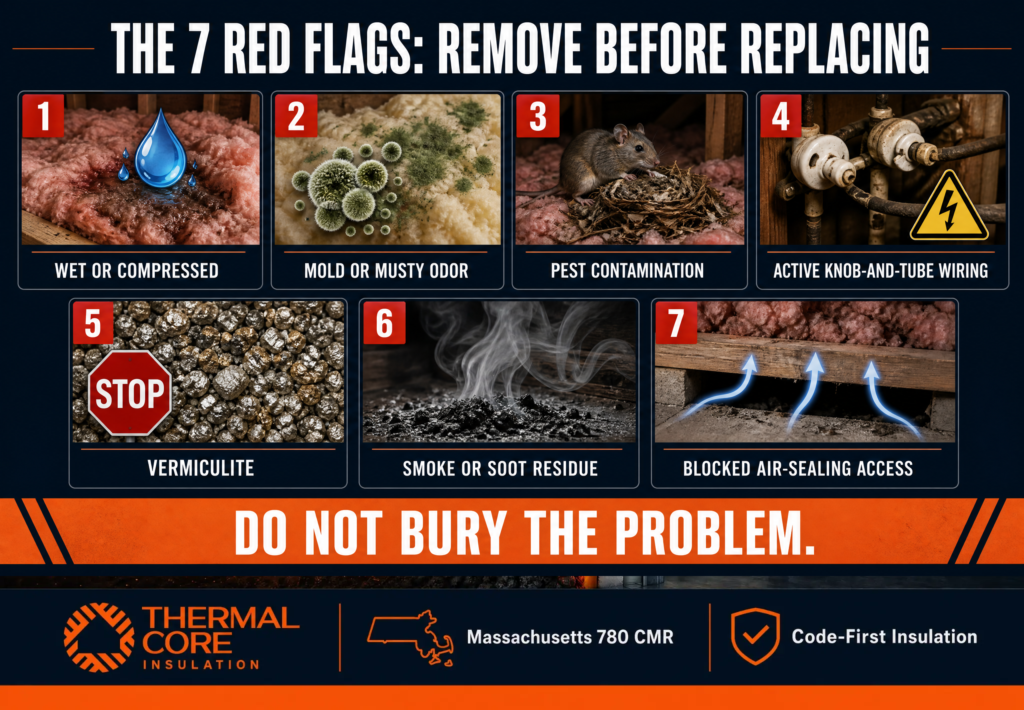
1. The insulation is wet, compressed, or carrying a water stain
Wet insulation is not a cosmetic issue. It is a signal that water has entered the assembly. The source may be a roof leak, an ice dam, a plumbing problem, condensation around ductwork, or moisture moving through a basement or crawl space.
As the U.S. Environmental Protection Agency’s mold and moisture guide explains, moisture control is the key to mold control, and water-damaged areas and items should be dried within 24 to 48 hours where possible. Once fibrous or loose-fill insulation has been saturated, compacted, or repeatedly exposed to moisture, adding a new layer over it can hide the evidence while leaving the source untouched.
This is especially important in Massachusetts attics after winter ice dams and in basements with seasonal groundwater. Before selecting a new insulation system, a homeowner needs the water path identified and corrected. If your concern begins below grade, review the local cost and scope factors in Thermalcore’s guide to basement waterproofing in Massachusetts.
2. There is visible mold or a persistent musty odor
A musty smell is not proof of a particular mold species. It is, however, a reason to inspect. The Centers for Disease Control and Prevention notes that mold can grow in insulation and other building materials when moisture is present, and that visible or odorous mold should be removed while the moisture problem is fixed.
Covering moldy insulation does not correct the source. It makes future inspection harder. The right sequence is to find the leak, condensation path, or humidity problem; correct it; remove or remediate compromised porous materials as appropriate; and only then rebuild the insulation layer.
The rule is straightforward: Do not spend money trapping a moisture problem inside a better-insulated cavity.
3. Pests have used the insulation as a home
Insulation that contains rodent droppings, urine staining, nests, insect damage, or dead animals is not a candidate for a simple top-up. Even after the visible evidence is removed, the entry points that allowed pests into the attic or crawl space must be sealed.
This is where air sealing earns its place in the process. It does more than reduce drafts. It helps close the gaps around plumbing penetrations, framing transitions, and rim joists that allow air, moisture, and pests to travel through the structure. Thermalcore’s air-sealing and fire-blocking services are designed to address those details before new insulation is installed.
4. The attic contains active knob-and-tube wiring
Older Massachusetts homes often have surprises above the ceiling line. Knob-and-tube wiring is one of the most important.
The Center for Energy and Environment explains that insulation contractors generally will not insulate spaces containing active knob-and-tube wiring because covering it can increase fire risk. An electrician should determine whether the wiring is active, whether it must be replaced, and whether the area is safe to insulate.
That does not mean every old wire automatically requires a full-house rewiring. It means you need a real answer before insulation conceals it. The same principle applies to unsafe splices, brittle wiring, damaged junction boxes, and unprotected recessed fixtures.
Thermalcore’s Code-First Insulation approach treats this as part of planning, not an inconvenient detail to discover after the truck arrives.
5. You find vermiculite insulation
Vermiculite is typically loose, pebble-like insulation that may look gray-brown, silver, or gold. In a Massachusetts attic, this is a stop sign, not a DIY cleanup project.
The EPA advises homeowners to assume vermiculite insulation may contain asbestos and not disturb it. If remodeling or insulation work would disturb the material, the agency recommends using a trained asbestos professional. The Massachusetts Department of Environmental Protection’s asbestos guidance adds state-specific requirements around asbestos handling, survey, notification, work practices, and waste management under MassDEP regulation 310 CMR 7.15.
Thermalcore can assess the insulation strategy after the hazard has been properly addressed. We do not represent general insulation installation as an alternative to required asbestos evaluation or abatement. The first priority is safe, compliant handling by the appropriately qualified professional.
6. The insulation carries smoke, soot, or fire residue
Smoke damage is not always visible from the attic hatch. Odor, soot on framing, residue near penetrations, and insulation discoloration can point to a past fire event or significant smoke exposure.
Smoke and soot in insulation should be assessed before a new layer is installed. The practical question is whether the material is cleanable, whether odor or residue remains, and whether the underlying fire-related damage has been corrected. When the extent of contamination is unclear, bring in an appropriately qualified restoration professional before insulation work begins.
This also creates a chance to correct the next fire-safety layer. If closed-cell spray foam is part of the replacement plan, it must be properly protected according to the assembly and code requirements. Thermalcore pairs performance insulation with the Thermalcore Fire-Safe Envelope, including the Dual-Defense Intumescent Shield where a tested coating system is the right code-compliant option. Learn why this matters in our spray foam fire safety guide.
7. The old layer prevents the work that actually needs to be done
Sometimes insulation is not damaged. It is simply in the way.
Air sealing is often the first practical step before an insulation upgrade because it closes leakage points around attic floors, basements, and between joists. ENERGY STAR likewise frames air sealing and insulation as paired improvements that make homes more comfortable and energy efficient.
If old loose-fill insulation prevents a crew from sealing plumbing chases, recessed fixtures, top plates, chimney clearances, or wiring penetrations, temporary removal or relocation can be the more disciplined choice. Otherwise, you may pay for extra R-value while continuing to lose conditioned air through unsealed gaps.
When Covering Existing Insulation Is the Smarter Choice
The case for removal is strong when the insulation is compromised. But unnecessary removal is also wasteful.
If an assessment confirms that the existing material is dry, clean, free of contaminants, safely separated from electrical hazards, and not obstructing essential air sealing, covering it may be the right decision. The project can focus on restoring depth, improving coverage, and closing the leaks that undermine the old layer’s performance.
This is particularly common in an attic with settled cellulose or fiberglass that has no history of roof leaks, pests, or smoke damage. The plan may be as simple as careful air sealing, protection of required clearances, and targeted new insulation.
For homes built before modern air-sealing practices, the answer is rarely found by looking at insulation depth alone. Thermalcore’s old-home insulation guide explains why balloon framing, plaster-and-lath construction, irregular cavities, and hidden air paths require a more careful approach in Massachusetts homes.
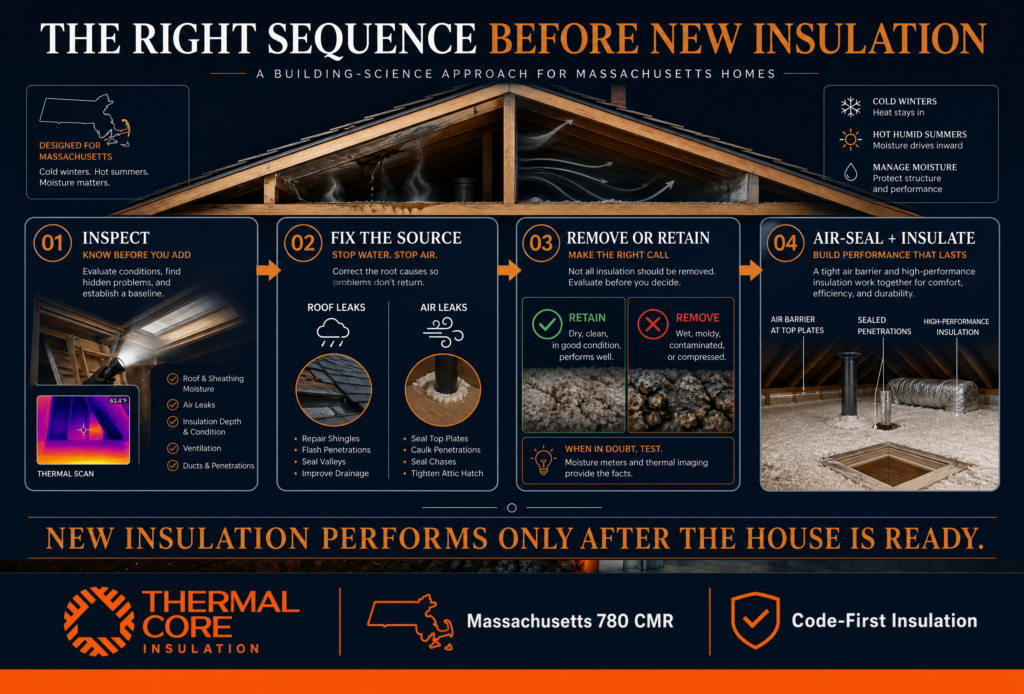
Thermalcore Assessment: What Happens Before New Insulation Goes In
Thermalcore is positioned to help homeowners make the removal-versus-cover decision without turning it into a sales script. The goal is to protect the home first, then improve comfort and efficiency.
| Assessment step | What we look for | Why it matters |
| Condition review | Water staining, compression, mold indicators, odors, pest evidence, and smoke residue | Determines whether the existing insulation remains a viable part of the assembly. |
| Safety review | Wiring, clearances, fireblocking needs, and visible construction defects | Prevents insulation from burying a safety issue. |
| Moisture-path review | Roof leaks, air leakage, humidity, foundation moisture, and condensation risks | Ensures new insulation will not trap an unresolved moisture problem. |
| Replacement strategy | Air sealing, appropriate insulation type, fire protection, and installation sequencing | Produces an upgrade designed for performance, safety, and Massachusetts code compliance. |
For eligible projects, Mass Save incentives may help reduce the cost of qualifying insulation and air-sealing work. Thermalcore can help homeowners understand the insulation side of the process, while keeping necessary waterproofing, remediation, or specialist work in the right sequence. See our guide to Mass Save, fireproofing, and waterproofing for the important distinction between energy measures and separate corrective work.
Remove the Problem, Not Just the Insulation
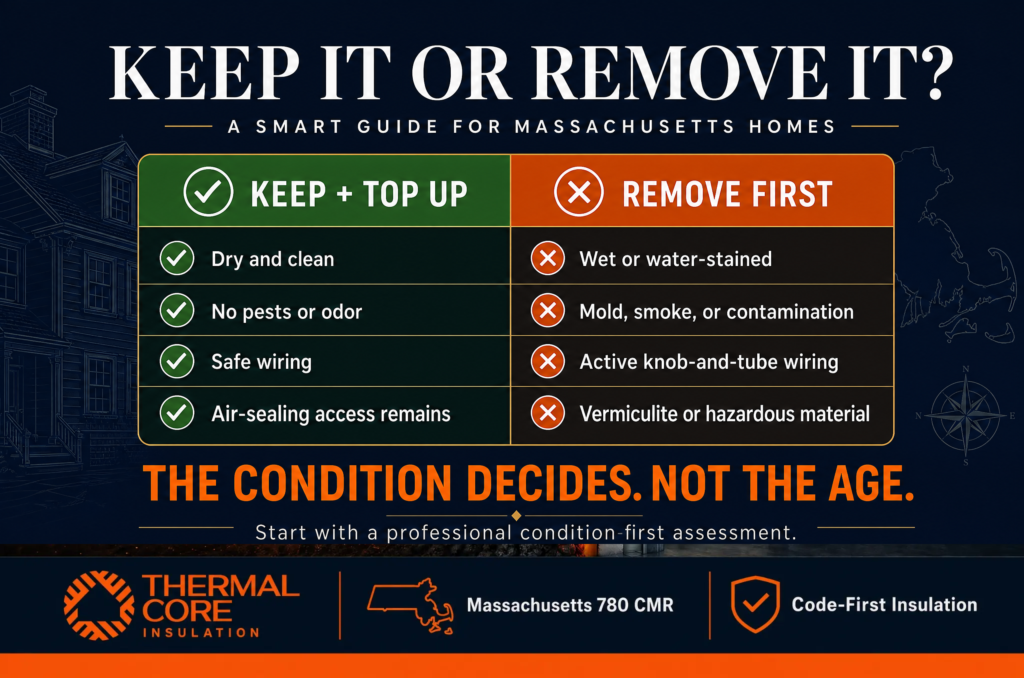
There is a meaningful difference between “old” and “unsafe.”
Clean, dry, safe insulation can often be improved. Wet, contaminated, mold-affected, fire-damaged, or hazardous insulation should be addressed before it is covered. The expensive mistake is not removal. The expensive mistake is installing new material over an unresolved problem and paying to undo the work later.
If you are unsure which side of that line your home falls on, contact Thermalcore Insulation for a free assessment. We will help you identify what can stay, what needs specialist attention, and what new insulation system makes sense for your Massachusetts home.