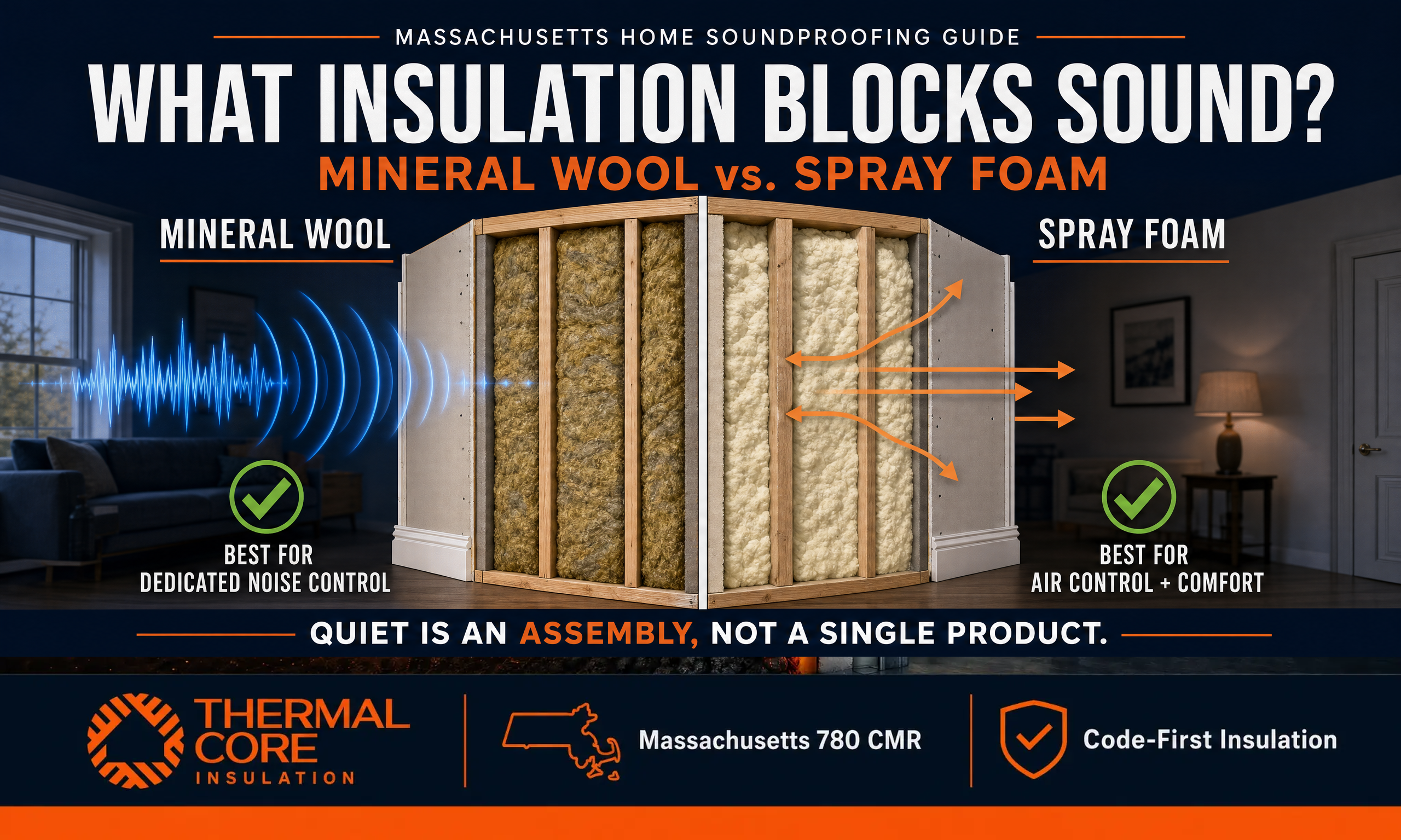
What insulation blocks sound? For most interior walls, ceilings, and floors where the main goal is quieter rooms, mineral wool is usually the strongest insulation choice. Its dense, porous fibers absorb airborne sound inside the cavity. Open-cell spray foam can reduce sound too, especially when stopping air leakage matters. Closed-cell spray foam is generally selected for moisture control, air sealing, and high R-value rather than as the first-choice acoustic material.
That answer comes with an important qualification. Insulation does not make a room soundproof by itself.
A wall can have excellent insulation and still pass a conversation through an unsealed outlet box, a gap around a pipe, a hollow-core door, or framing that mechanically carries vibration from one room to the next. The best sound-control projects treat the wall or ceiling as an assembly, not a shopping list of materials.
For Massachusetts homeowners, that distinction matters. A family in a Boston triple-decker may be trying to soften conversation through a shared bedroom wall. A homeowner in Worcester may need a quieter basement office beside mechanical equipment. A growing family in a Cape Cod home may want to keep nursery noise from carrying through an older interior partition.
The right answer is not always “spray foam everything.” It is also not always “add rock wool and hope.” It is to identify the type of noise, the route it takes, and the building requirements that cannot be compromised in the process.
Thermalcore Insulation helps homeowners and contractors make that decision with a Code-First Insulation approach. We look at the cavity, air leaks, moisture exposure, fire requirements, existing framing, and the noise problem itself before recommending mineral wool, spray foam, air sealing, or a combined system.
What Insulation Blocks Sound in a Massachusetts Home?
When people say they want “soundproofing,” they may be describing two very different problems.
Airborne sound includes voices, television, barking dogs, traffic, music, and mechanical noise moving through the air. Impact sound includes footsteps, a chair dragging across a floor, or an object dropped overhead. Insulation is most useful for airborne sound inside a cavity. Impact sound usually needs additional floor and ceiling measures.
The terms matter because the test metrics are different. USG’s acoustics guide explains that Sound Transmission Class, or STC, measures how well an entire partition such as a wall or floor-ceiling assembly attenuates airborne sound. Impact Insulation Class, or IIC, addresses impact noise moving through a floor-ceiling assembly.
The practical rule: Choose insulation for cavity absorption. Then control the gaps, rigid connections, and surfaces that let sound bypass the insulation.
A homeowner who only fills a wall cavity may notice some improvement. A homeowner who fills the cavity, seals penetrations, uses the appropriate wallboard, and decouples the finish layer when needed will usually notice a much bigger difference.

What Insulation Blocks Sound Better: Mineral Wool or Spray Foam?
The honest comparison depends on the job. Mineral wool, open-cell spray foam, and closed-cell spray foam all solve different problems.
| Material | Primary acoustic role | Best Massachusetts applications | Strengths | Watch-outs |
| Mineral wool | Excellent cavity absorption for airborne noise | Bedroom walls, home offices, theater rooms, shared walls, basement ceilings, fire-rated assemblies | Dense porous fibers, fire resistance, moisture resistance, straightforward cavity installation | Does not air-seal by itself. Gaps and penetrations still need attention. |
| Open-cell spray foam | Useful sound absorption plus air sealing | Irregular wall cavities, rooflines, interior areas where controlling drafts and moderate noise both matter | Expands into small gaps, flexible enough for many wall and ceiling applications, helps reduce air paths that carry sound | Not the automatic first choice for a dedicated acoustic partition. Requires proper installation and assembly-specific fire protection. |
| Closed-cell spray foam | Limited dedicated acoustic role, strong enclosure control | Basements, crawl spaces, rim joists, roofs, moisture-prone locations | High R-value per inch, air sealing, moisture resistance, added rigidity | Dense and rigid. Choose it for moisture and thermal control, not as the primary sound-absorption material. |
Why mineral wool is usually the first material choice for interior noise
Mineral wool is made from mineral fibers and is intentionally porous. That structure is useful because sound energy enters the cavity and loses energy as it moves through the fibers rather than bouncing freely inside an empty stud bay.
ROCKWOOL describes its Safe’n’Sound stone wool as an interior batt for wall cavities, floors, and ceilings where acoustic and fire performance are needed. It lists bedrooms, bathrooms, basements, home theaters, and shared spaces as common uses, which closely matches the problems Massachusetts homeowners bring to Thermalcore.
Mineral wool is also a sensible choice when a project needs a material that supports sound control and fire performance. Thermalcore’s own rock wool insulation service is positioned for soundproofing projects and fire-rated assemblies, while its broader service menu allows the insulation choice to be coordinated with air sealing and building-code requirements.
The material is not magic. It will not stop sound moving through a door or a continuous wood stud. But in a well-detailed cavity, mineral wool is usually the material that gives an acoustic wall its best starting point.
Where open-cell spray foam fits
Open-cell spray foam has a different advantage. It expands into irregular spaces and helps close the air paths that carry drafts, odors, and some airborne noise. If a room has a complicated cavity or a homeowner needs both improved air control and better sound attenuation, open-cell foam can be a practical part of the solution.
However, a careful recommendation should not overstate its acoustic role. Rmax’s material comparison concludes that mineral wool is superior to spray foam for soundproofing and sound dampening. National Gypsum likewise notes that mineral wool and fiberglass create the larger STC gains in wall assemblies, while hardened spray foam contributes less to STC improvement in the assembly it describes.
That does not make spray foam the wrong product. It simply means the question has to be right. If the goal is a quiet home office wall, mineral wool often leads. If the goal is a rim joist or basement wall that needs air control, moisture resilience, energy performance, and some reduction in sound movement, spray foam may be the more complete enclosure solution.
Why closed-cell foam is not the default soundproofing answer
Closed-cell foam is one of the most capable materials in the building envelope. Thermalcore uses it where its density, water resistance, air sealing, and high R-value solve the real problem. That often includes basements, crawl spaces, rim joists, and roof assemblies.
But those benefits should not be confused with superior sound absorption. A dense, rigid material is not automatically the material that best absorbs sound inside an interior cavity. When the question is purely, “What insulation blocks sound between two rooms?” mineral wool is typically the more direct answer.
Where exposed foam is part of an assembly, fire protection still matters. Thermalcore’s Thermalcore Fire-Safe Envelope and Dual-Defense Intumescent Shield are used only where a tested and code-appropriate protective coating system is required. Learn more in our guide to spray foam fire safety in Massachusetts.
Why Insulation alone will not Soundproof a Room
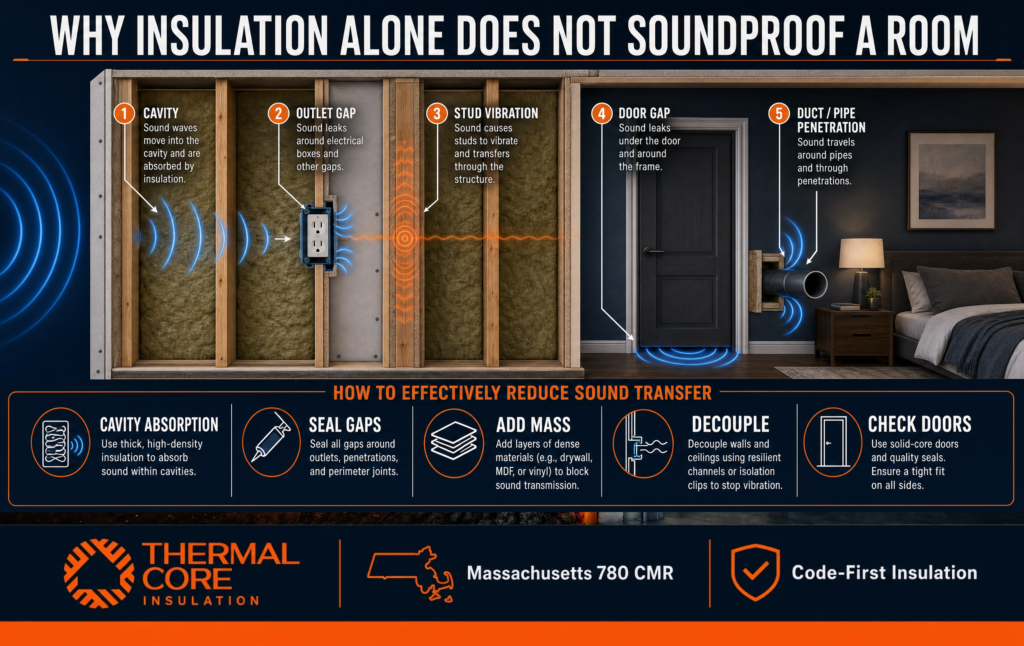
This is the belief shift that saves homeowners from spending money on the wrong scope.
A wall is not quiet because it contains insulation. It is quiet because every major sound path has been addressed.
The Gypsum Association’s sound-control guide identifies the main strategies as sealing gaps, adding mass, decoupling rigid connections, adding air space, and insulating the cavity. It also explains why insulation works best when framing connections do not give vibration a direct route around the cavity material.
In practical terms, a sound-control wall may combine mineral wool with acoustic sealant at perimeter joints, properly sealed electrical boxes, a heavier drywall layer, and resilient channel or isolation clips. A basement ceiling may need mineral wool between joists plus a decoupled ceiling treatment if footsteps remain the main complaint.
| Noise complaint | Typical sound path | Better starting strategy |
| “I can hear conversations through the bedroom wall.” | Airborne sound through cavity, gaps, outlets, and door perimeter | Mineral wool in cavity, seal penetrations, assess door and wallboard details. |
| “I hear every footstep upstairs.” | Impact vibration through joists and ceiling connections | Evaluate floor finish, underlayment, mineral wool in joists, and ceiling decoupling. Focus on IIC as well as STC. |
| “My home office carries street and HVAC noise.” | Air leaks, windows, ducts, exterior-wall assembly | Air-seal first, identify window/duct paths, then choose insulation based on cavity and moisture needs. |
| “The basement is loud and damp.” | Mechanical noise plus moisture and air leakage | Diagnose moisture first. Closed-cell spray foam may make sense for enclosure control; add dedicated acoustic measures where sound privacy is needed. |
| “I hear my neighbor in a duplex or condo.” | Common-wall gaps, framing, penetrations, and incomplete assembly | Treat the separation as an assembly. Verify air sealing and fire-rated requirements before changing materials. |
Soundproofing Older Massachusetts Homes and Multifamily Spaces
Massachusetts housing often makes sound control harder because older structures have irregular framing, utility penetrations, plaster, settled cavities, and hidden air paths. In a triple-decker, duplex, townhouse, or multifamily conversion, sound can also flank through a common wall, floor system, or shared ceiling space rather than pass directly through the insulation bay.
That is why “more insulation” is not enough. In multifamily spaces, air gaps around common walls, pipes, wiring, and framing are both a sound-control and a life-safety detail. The insulation choice has to be coordinated with the relevant fire-rated and air-sealing requirements rather than applied as a stand-alone upgrade.
For an old Massachusetts home, the first inspection questions should be simple. Is the complaint airborne sound or impact sound? Is there a clear path through an unsealed opening? Is the cavity dry? Does the wall need to retain a fire rating? Is the scope accessible without damaging historic plaster? Those answers determine whether mineral wool, spray foam, air sealing, added wall mass, or a combination is the right move.
Thermalcore brings this whole-assembly thinking to old-home insulation projects and commercial or multifamily air-sealing work. The goal is not to prescribe the same product on every job. It is to close the path the noise is actually taking.
Thermalcore Recommendation
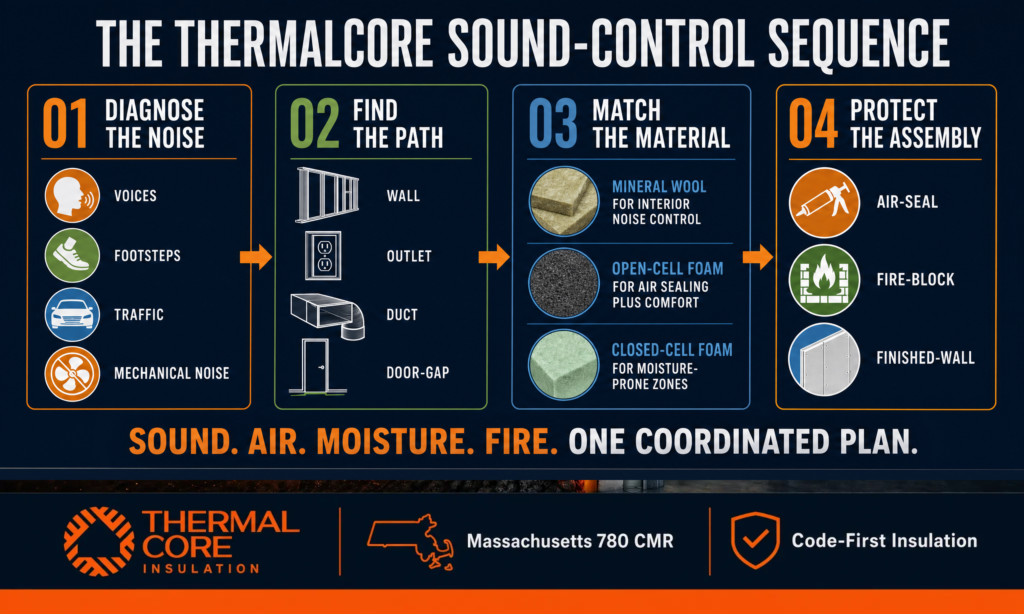
For a dedicated interior sound-control wall, bedroom wall, home office, basement ceiling, or theater room, mineral wool is usually the recommended cavity insulation. It offers strong acoustic absorption, useful fire performance, and a practical fit for wall, floor, and ceiling cavities.
For an exterior wall, basement, roofline, rim joist, or irregular cavity where draft control and moisture resilience carry equal weight, spray foam may be the right part of the system. Open-cell foam can be appropriate where air sealing and moderate sound reduction are both goals. Closed-cell foam is often the right answer when water resistance and thermal performance drive the project.
The important step is not choosing a material from a chart. It is having someone inspect the assembly. Thermalcore can evaluate your noise complaint alongside insulation depth, air leakage, moisture, fireblocking, and Massachusetts code requirements. That is how we avoid selling a “soundproofing” material that leaves the real sound path untouched.
If you are searching for the best insulation contractor near me in Massachusetts to make a bedroom, office, basement, or shared wall quieter, contact Thermalcore for a free assessment. We will help you choose the right system, explain the trade-offs, and build a plan that improves comfort without compromising safety or moisture control.