When Massachusetts homeowners start pricing out the spray foam insulation cost in Massachusetts, the first reaction is sticker shock. You get a quote for $6,000 to insulate your attic, and suddenly those pink fiberglass batts at Home Depot look very appealing.
But the upfront price isn’t the actual constraint. The real cost is the $250 to $350 a month you’re bleeding through an uninsulated attic every winter.
In Massachusetts, where heating oil averages around $3.50 a gallon and energy rates rank among the highest in the country, the question isn’t “How much does spray foam cost?” It’s “How much is a leaky building envelope costing me every month?”
Here’s the unvarnished breakdown for 2026, what spray foam actually costs per square foot in MA, where the Mass Save rebate changes the math entirely, and why Thermal Core Insulation is the contractor Massachusetts homeowners call when they want it done right the first time.
Spray Foam Insulation Cost in Massachusetts Per Square Foot
Spray foam pricing is calculated by the board foot (a 12-inch by 12-inch square, one inch thick) or by the square foot at a specific installed thickness. Labor and materials in Massachusetts run slightly above the national average, according to Bob Vila’s national spray foam cost data.
Open-Cell Spray Foam
Open-cell foam is lighter, expands fast, and is a solid air barrier and sound dampener. It’s the right call for interior walls, roof decks, and attics where moisture control isn’t the primary concern.
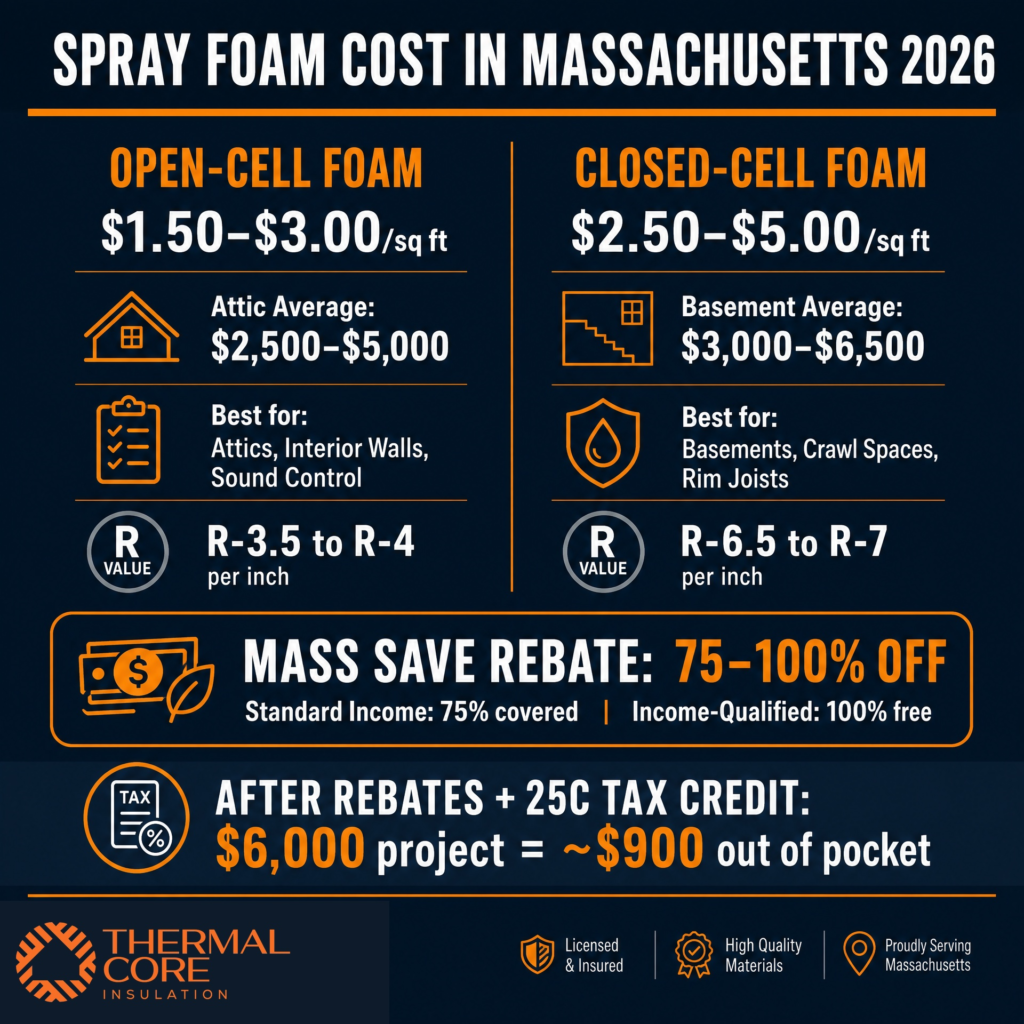
- Cost per square foot (installed): $1.50 to $3.00 at standard 3-inch to 5-inch thickness.
- Average Attic Cost: $2,500 to $5,000.
Closed-Cell Spray Foam
Closed-cell foam is dense and rigid. It acts as both a vapor barrier and an air barrier, and it adds structural strength to walls. For basement walls and crawl spaces in Massachusetts, it’s the only insulation material that makes sense.
- Cost per square foot (installed): $2.50 to $5.00 at standard 2-inch to 3-inch thickness.
- Average Basement/Crawl Space Cost: $3,000 to $6,500.
These are averages. If you own an older home in Boston or a historic property in Worcester, expect the cost to climb; tight spaces, access issues, and removing old degraded insulation all add time and labor.
Why Massachusetts Building Codes Matter
You can’t talk about spray foam costs without talking about 780 CMR, the Massachusetts building code.
The state sets strict R-value minimums: R-49 to R-60 for attics and roofs, R-15 to R-21 for basement walls. Closed-cell foam hits R-6.5 to R-7 per inch, which means you reach code requirements at a fraction of the thickness you’d need with fiberglass or cellulose. The ENERGY STAR certified insulation database lists products that meet these standards.
But the fire safety rules are where cheap contractors cut corners. All spray foam is combustible. Massachusetts Fire Codes prohibit leaving it exposed in occupied living spaces. It must be covered by a 15-minute thermal barrier, drywall or an approved intumescent fireproofing coating.
If a contractor’s quote seems unusually low, ask whether it includes the required fireproofing. A spray foam job that fails a building inspection or voids your homeowner’s insurance isn’t a deal. It’s a $10,000 problem waiting to happen. This is why homeowners searching for “spray foam insulation near me in Massachusetts” consistently choose Thermal Core Insulation, code-first, inspection-ready, every time.
Mass Save Rebates
If you’re paying full retail price for insulation in Massachusetts, you’re doing it wrong.
The Mass Save program, funded by a charge on your utility bill, covers 75% to 100% of approved insulation and air sealing costs in 2026.
- Standard Income: 75% covered. A $6,000 attic job drops to $1,500 out of pocket.
- Income-Qualified (below 60% Area Median Income): 100% covered. The insulation is free.
And you can stack that with the federal Energy Efficient Home Improvement Credit (25C), 30% of your remaining out-of-pocket costs, up to $1,200 per year. The ENERGY STAR federal tax credits overview has the full eligibility breakdown.
Read our full breakdown of how these rebates interact with your home: Mass Save Explained: What MA Homeowners Need to Know.
Waterproofing First
Here’s the catch nobody tells you about. Mass Save won’t approve an insulation rebate if your home has active water leaks or mold.
Closed-cell foam is water-resistant, but it is not a structural waterproofing system. Spray foam over a leaking foundation wall traps hydrostatic pressure and accelerates concrete decay. We see this constantly at Thermal Core Insulation: homeowners hire a fragmented insulation contractor, fail the Mass Save inspection due to moisture, and then scramble to find a waterproofing company.
Build the machine correctly from the start. The right approach handles waterproofing, insulation, and fireproofing in one integrated process. As Massachusetts’ leading integrated contractor, Thermal Core ensures your basement is dry, insulated, and fire-safe under one warranty.
ROI of Spray Foam
A properly insulated Massachusetts home uses 15% to 25% less energy for heating and cooling. On a $3,000 annual heating bill, that’s $450 to $750 back in your pocket every year.
Factor in the 75% Mass Save rebate, and the out-of-pocket investment pays for itself in under two years. After that, the savings are pure margin. Control comes from clarity. Once you understand the rebate math and the long-term energy savings, spray foam stops being an expense. It becomes an audit-ready investment with a guaranteed return.
Stop paying to heat the neighborhood.