An ASTM E84 Class A fire rating means the spray foam insulation has a Flame Spread Index of 0–25 and a Smoke Developed Index of 450 or less when tested in a 25-foot tunnel. However, a Class A rating only measures surface burning characteristics. It does not replace the building code requirement for a 15-minute thermal barrier over the foam in occupied spaces.
ASTM E84 spray foam Class A fire ratings are perhaps the most misunderstood metric in the insulation industry. If you are a homeowner or a builder in Massachusetts, you have likely heard a contractor say, “Don’t worry, this spray foam is Class A fire-rated, so it’s completely safe to leave exposed.”
That statement is fundamentally incorrect.
While achieving a Class A rating under the ASTM E84 standard is an important benchmark for building materials, it is only one piece of the fire safety puzzle. More importantly, a Class A rating does not exempt spray foam from the strict thermal barrier requirements outlined in the Massachusetts 780 CMR building code.
Understanding what ASTM E84 actually tests, and what it fails to measure, is critical to ensuring your home is genuinely protected, not just compliant on paper.
What ASTM E84 Actually Tests
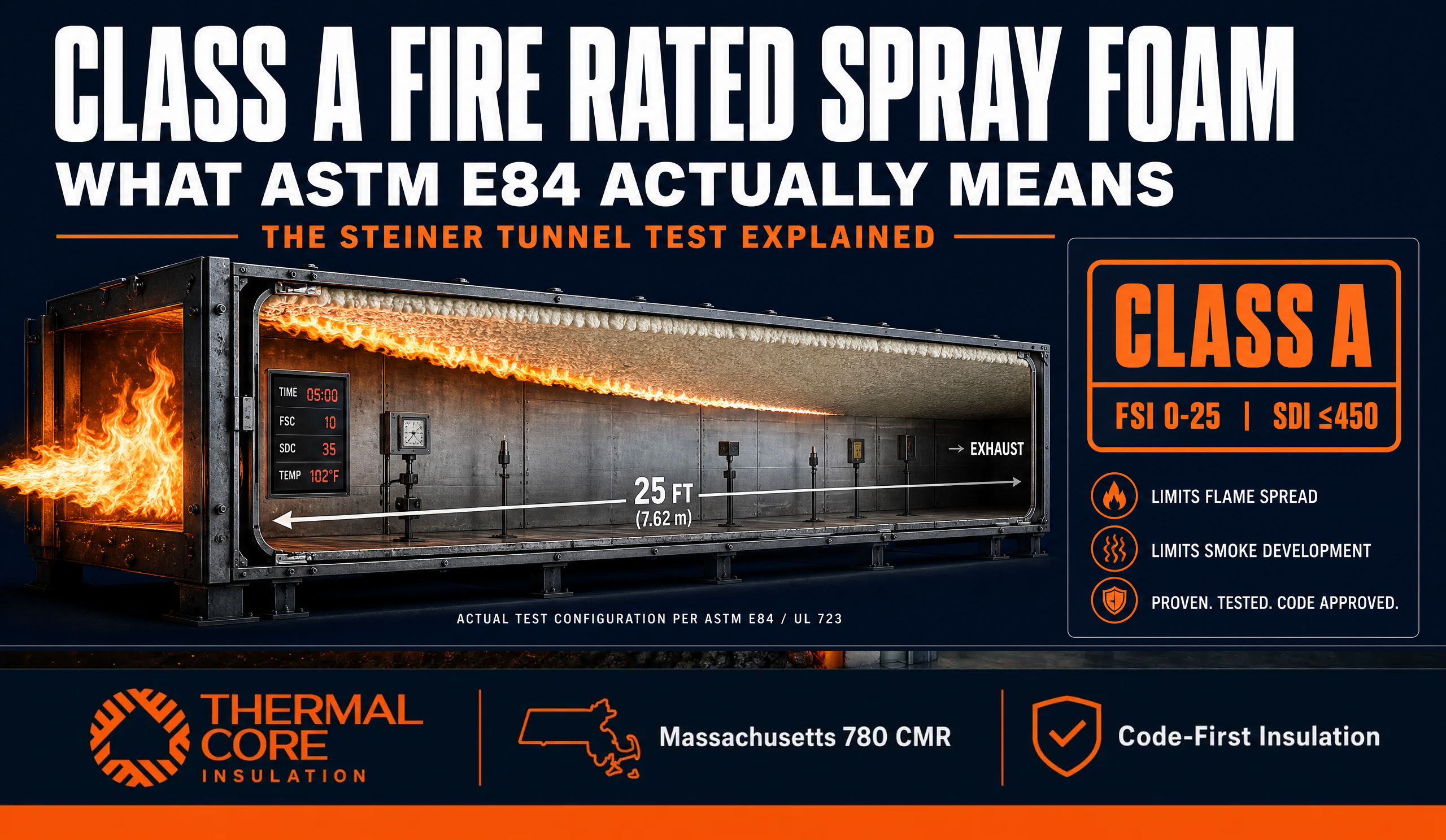
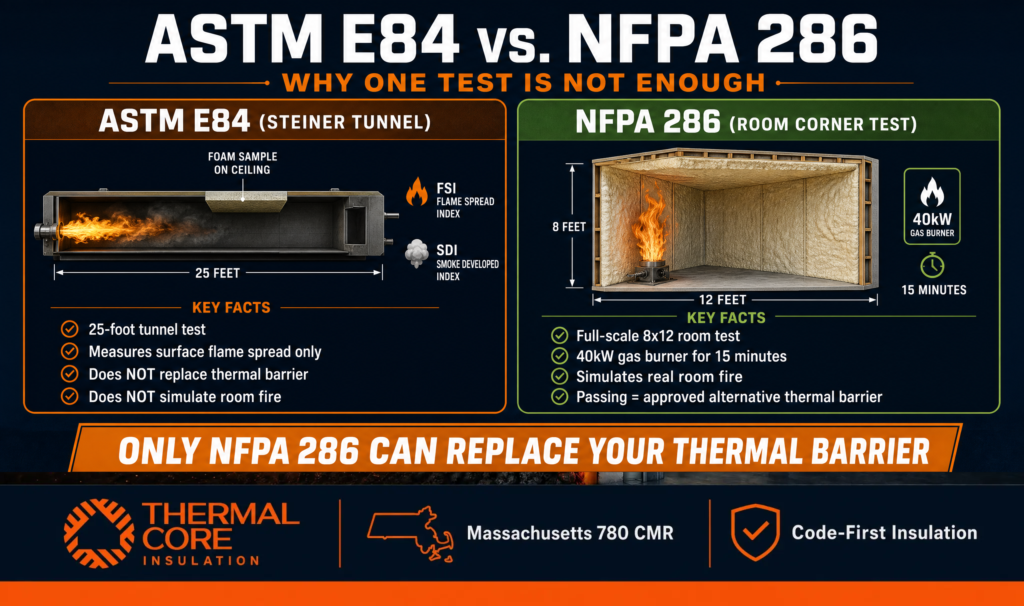
The ASTM E84 standard (Standard Test Method for Surface Burning Characteristics of Building Materials) is commonly known as the “Steiner Tunnel Test.”
During this test, a sample of the material is installed on the ceiling of a 25-foot-long horizontal tunnel. A calibrated gas flame is ignited at one end, and a draft pulls the flame down the tunnel. Over the course of 10 minutes, technicians measure two specific metrics:
- Flame Spread Index (FSI): How fast and how far the flames travel across the surface of the material.
- Smoke Developed Index (SDI): The concentration of smoke produced during the burn.
Based on these results, materials are grouped into three classifications:
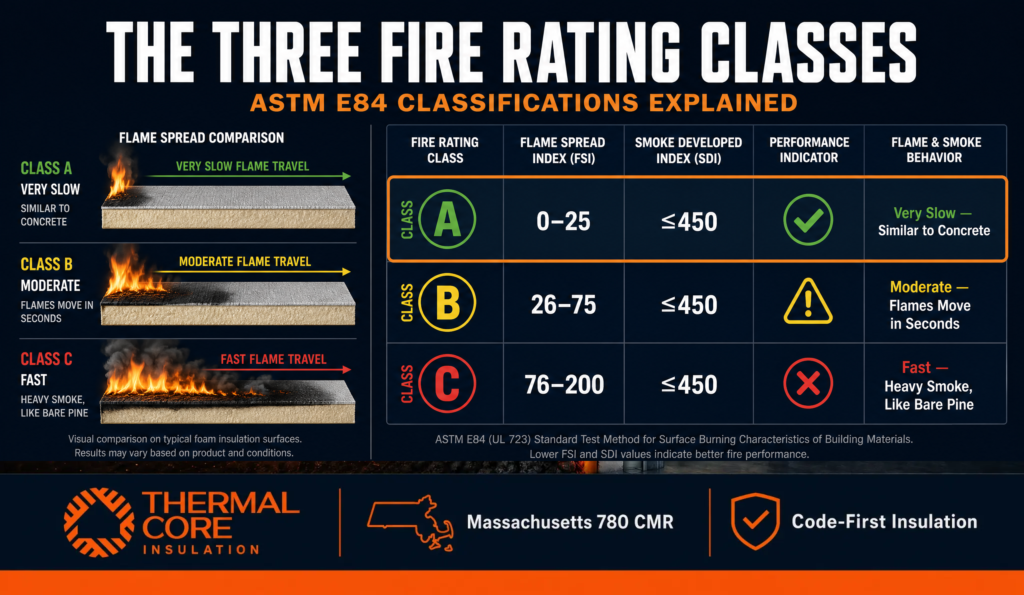
The Three Fire Rating Classes
| Classification | Flame Spread Index (FSI) | Smoke Developed Index (SDI) | Example Materials |
| Class A | 0 – 25 | ≤ 450 | Concrete, drywall, premium closed-cell spray foam |
| Class B | 26 – 75 | ≤ 450 | Certain woods, lightly treated foams |
| Class C | 76 – 200 | ≤ 450 | Untreated pine, standard open-cell foam |
When a contractor proudly states their foam is “Class A,” they are simply saying that if a fire touches the surface of the foam, the flames will spread slowly (FSI under 25) and produce a controlled amount of smoke (SDI under 450).
That is a good thing. But it is not the whole story.
What E84 Does Not Measure
The danger in relying solely on ASTM E84 is that it only measures surface burning behavior.
It does not measure how the material will behave in a fully involved room fire. It does not measure how long the foam can resist ignition when exposed to extreme radiant heat. And crucially, it does not measure whether the foam will eventually ignite and contribute to the structural collapse of a building.
Furthermore, the ASTM E84 test has a known limitation when evaluating foam plastics. Because spray foam is a thermoplastic, it can soften, melt, and drip away from the flame during the tunnel test. When the foam melts and falls to the floor of the tunnel, it destroys the continuity of the flame front. This often results in an artificially low Flame Spread Index that does not accurately reflect how the material would burn if it remained attached to your walls or ceiling.
This is why a Class A rating is a baseline requirement, not a final guarantee of safety. To learn more about how spray foam behaves under fire conditions, read our guide: Is Spray Foam Insulation a Fire Hazard?.
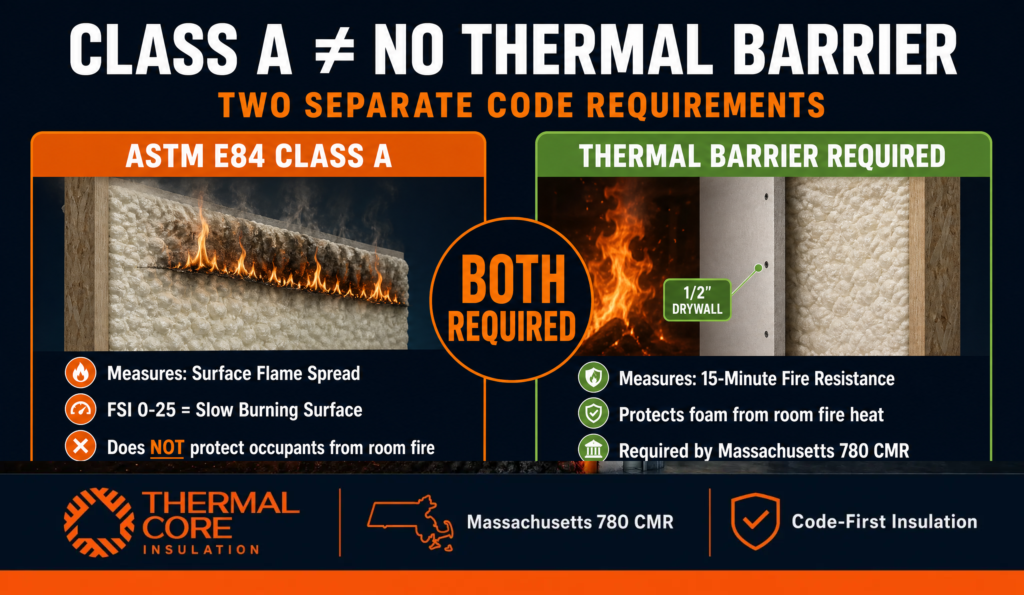
Class A ≠ No Thermal Barrier Needed
The most dangerous misconception in the insulation industry is the belief that a Class A rating means the foam can be left exposed.
Building codes treat these as two entirely separate issues:
- The foam itself must not spread fire rapidly (ASTM E84 Class A).
- The occupants must be protected from the foam in the event of a room fire (Thermal Barrier).
Think of it like buying a car. Having a Class A fire rating is like having good brakes; it helps prevent a disaster from escalating. But the thermal barrier is the airbag; it is the critical life-safety system designed to protect you when the worst happens. You need both.
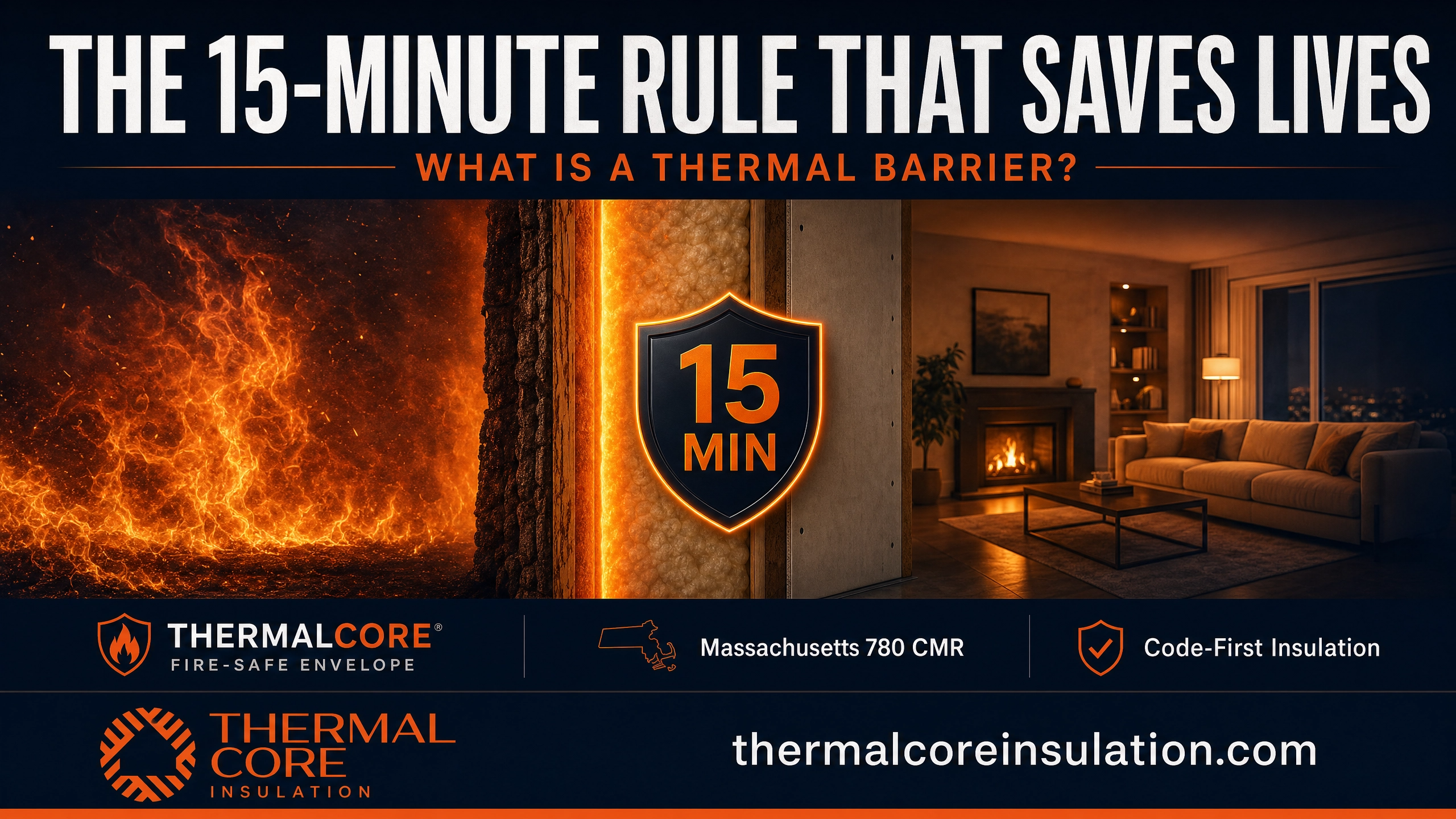
Massachusetts 780 CMR Chapter 26, which governs foam plastic insulation, is unambiguous. With very few exceptions, all spray foam insulation installed in occupied spaces must be separated from the interior of the building by an approved 15-minute thermal barrier, such as 1/2-inch gypsum drywall.
This requirement applies even if the foam is Class A fire-rated. The purpose of the thermal barrier is to delay the heat of a room fire from reaching the combustible foam behind the walls, giving your family 15 critical minutes to escape. For more details on these code requirements, see our article on Spray Foam Fire Safety Insulation.
NFPA 286
If you do not want to install drywall over your spray foam (for example, in an unfinished basement, an attic, or a commercial warehouse), you cannot rely on an ASTM E84 rating to appease the building inspector.
Instead, you must use a product or an assembly that has passed a much more rigorous test: NFPA 286.
While ASTM E84 is a small-scale tunnel test, NFPA 286 is a full-scale room corner test. A mock 8-foot by 12-foot room is built, the walls and ceiling are fully covered in spray foam, and a calibrated 40kW gas burner is ignited in the corner to simulate a trash can fire. The fire burns for 15 minutes at increasing intensity.
To pass NFPA 286, the assembly must prove that:
- Flames do not reach the ceiling or the extremities of the walls.
- Flames do not exit the doorway (preventing flashover).
- Thermocouples and smoke monitors remain within strict safety limits.
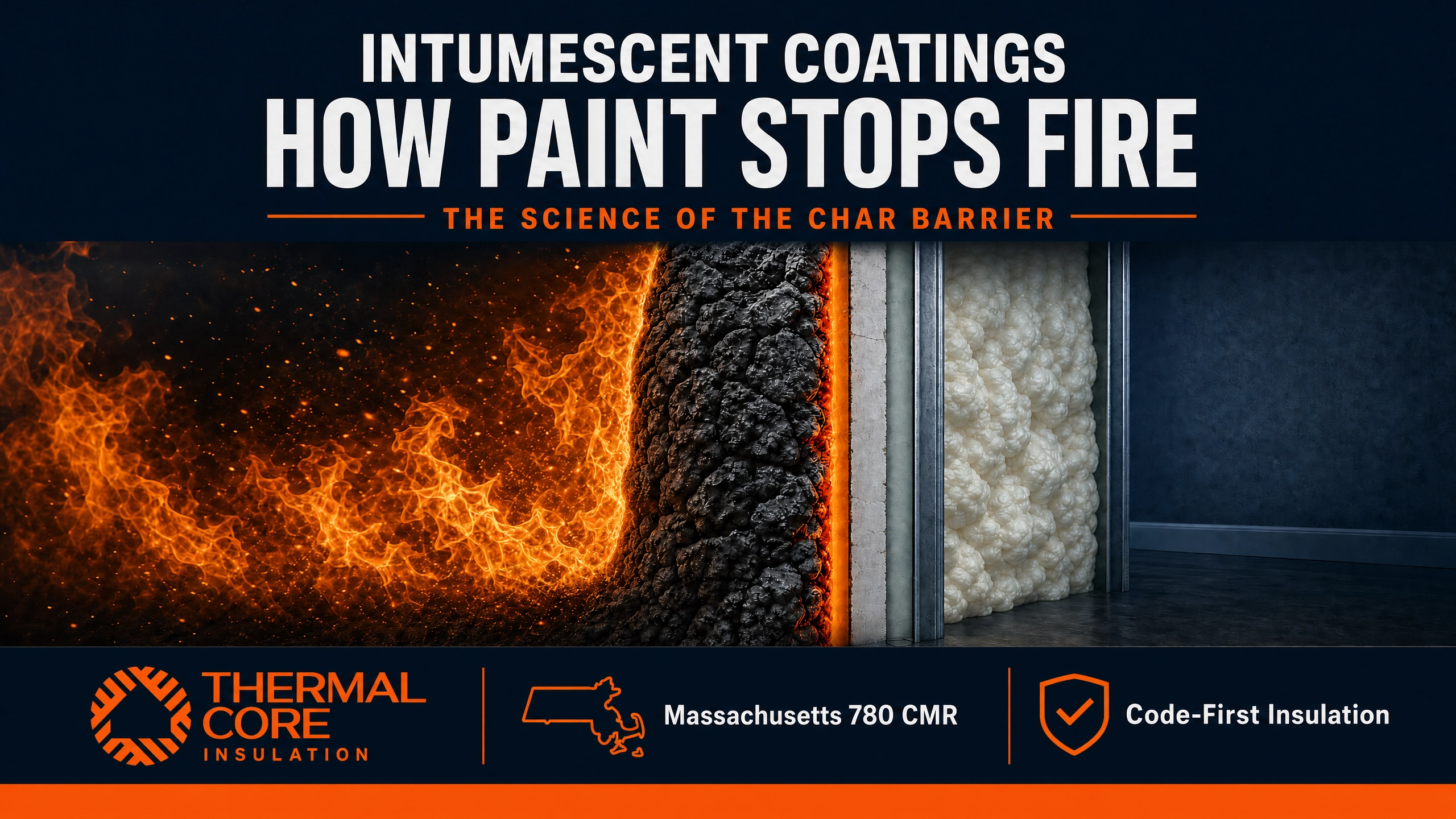
If an intumescent coating (like DC315) applied over spray foam passes the NFPA 286 test, it is legally recognized as an alternative thermal barrier. This is the only code-compliant way to leave spray foam “exposed” without drywall. You can learn more about the difference between these requirements in this Ignition Barrier vs Thermal Barrier guide.
What This Means for Your Home
When evaluating insulation contractors, pay close attention to how they talk about fire safety. If a contractor tells you their foam is “Class A” and therefore doesn’t need a thermal barrier or an intumescent coating, they are either misinformed or deliberately cutting corners to offer a lower bid.
An improper installation not only puts your family at risk, but it can also lead to failed building inspections, costly rework, and severe insurance complications for Massachusetts homeowners.
At Thermalcore, we never compromise on life safety. Our Thermalcore Fire-Safe Envelope protocol ensures that every installation meets or exceeds the stringent requirements of Massachusetts 780 CMR. We use premium, Class A-rated closed-cell foam, and we protect it with our Dual-Defense Intumescent Shield, a certified, NFPA 286-compliant coating applied at the exact mil thickness required to act as a true thermal barrier.
We call this Code-First Insulation. It means building it right, testing it thoroughly, and protecting your home without shortcuts.
If you are planning an insulation project and want the peace of mind that comes with guaranteed code compliance and uncompromising fire safety, contact Thermalcore today.