
Mass Save rebate denial does not always mean the rebate is permanently gone. Often, it means the project reached a point where something still needs to be verified, clarified, corrected, or safely resolved before the program can approve the work or payment.
That distinction matters because the phrase “failed inspection” creates the wrong picture. It can make a homeowner think a Mass Save inspector acts like a municipal building official, arrives with a list of violations, and rejects the entire project. That is not how every inspection or review works. Mass Save quality-assurance activity is intended to confirm the quality of completed insulation and air-sealing work. Program eligibility can also depend on assessment findings, forms, existing-equipment verification, project timing, and other current requirements. A local code or safety issue may intersect with that process, but it is not the same thing as a municipal citation.
The useful question is not, “Who failed me?” It is, “What category of condition is holding this project up, and what must happen before I can move forward?”
Thermalcore Insulation helps Massachusetts homeowners answer that question on the building-envelope side. We identify the insulation, air-sealing, moisture, ventilation, access, and safety conditions that must be made visible before a contractor closes an attic, adds material, or presents a completed weatherization scope. That is the practical meaning of Thermalcore’s Code-First Insulation: do the work in an order that protects the home, the project record, and the result.
What “failed inspection” can actually mean
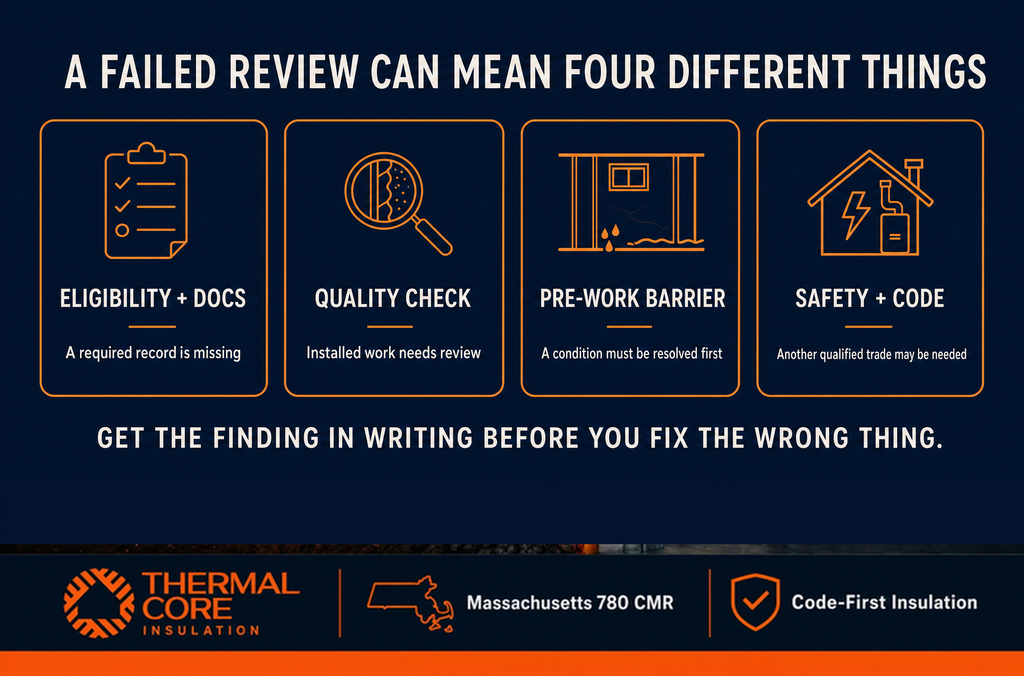
A project can run into trouble at more than one point. The program has different pathways, and each question calls for a different response.
| What is being questioned | What it may mean | The responsible next step |
| Eligibility or verification | A required assessment finding, site ID, form, existing-condition verification, participating-contractor rule, or application detail is missing or does not match the active program path. | Request the finding in writing and confirm the program’s current documentation or eligibility requirement. |
| Quality assurance | The insulation or air-sealing work needs to be reviewed for completeness, installation quality, or alignment with the approved scope. | Ask what part of the installed work needs evidence or correction, then have the appropriate contractor respond. |
| Pre-weatherization barrier | A safety, moisture, access, structural, or hazardous-material condition makes it inappropriate to proceed with insulation. | Pause the insulation scope and resolve or evaluate the underlying condition through the appropriate qualified professional. |
| Code, manufacturer, or safety condition | The planned work could conflict with required clearances, ventilation, electrical safety, combustion safety, or installation instructions. | Identify the governing condition and coordinate the qualified trade or authority that can address it. |
| Scope mismatch | The completed work or invoice does not clearly match what was assessed, authorized, or submitted. | Reconcile the assessment, contract, photos, invoices, and any approved change documentation. |
The Mass Save inspection page published by Abode Energy Management describes inspections as trained inspectors confirming the quality of insulation and air sealing installed at a home. That is useful context. A quality-assurance review can find work that needs attention, but it should not be turned into a blanket claim that every inspection issue is a code violation.
At the same time, the current Mass Save weatherization-upgrades guide makes clear that the program’s work exists inside real home conditions. It addresses asbestos precautions, bath-exhaust routing, knob-and-tube wiring, ventilation details, and other conditions that affect whether weatherization can proceed safely.
Why a Mass Save rebate denial notice is not always a final decision
A notice can feel final because the money is attached to it. But “not approved yet” has several possible meanings.
For example, Mass Save’s Get Verified page explains that some rebates require confirmation of an existing condition or piece of equipment. If that verification is not completed, the customer is not eligible for that specific incentive. That is a verification issue. It is not an attic installation-quality finding.
An attic insulation project can have a different kind of pause. The insulation itself may be eligible and the homeowner may want the work completed, but the attic could contain an active wiring condition, wet materials, suspect vermiculite, an exhaust fan that terminates in the attic, a ventilation issue, or a combustion-safety concern that needs resolution first. In that situation, proceeding quickly can make a small issue expensive by covering it.
The goal is not to find a clever way around the condition. It is to create a clear correction path.
A responsible insulation project does not bury uncertainty under more insulation. It identifies the condition, documents the consequence, and sequences the next trade or repair before the envelope is closed.
This is why homeowners should ask for the actual reason for the approval delay or inspection finding. A single sentence such as “failed inspection” is not enough to decide whether the needed response is a program call, a contractor return visit, a licensed electrician, an abatement professional, a roofer, an HVAC professional, or a combination of those roles.
Massachusetts attic conditions that commonly stop insulation work
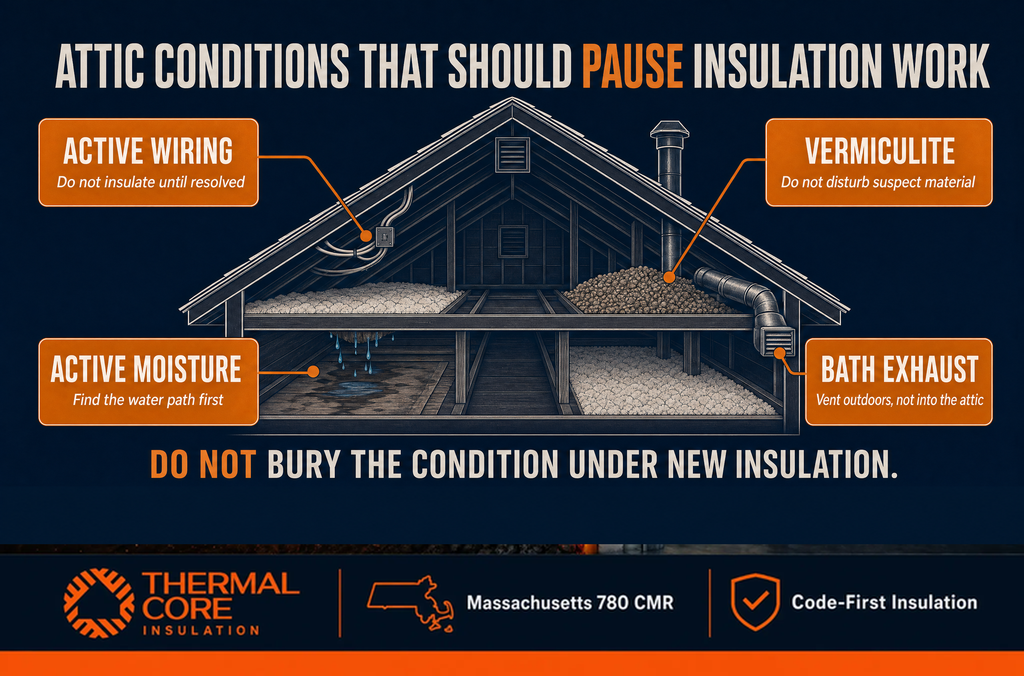
There are conditions that a responsible contractor should treat as a stop-work or evaluation point, even before a program review brings them to the surface.
The U.S. Department of Energy-supported PNNL attic air-sealing and insulation checklist directs contractors to check for water leaks, moisture, structural or pest damage, and adequate attic ventilation before beginning attic work. The same checklist says that active knob-and-tube wiring must be replaced or properly boxed before insulation is installed, existing vermiculite should stop work because it may contain asbestos, exhaust fans must vent outside rather than into the attic, and combustion-safety issues must be addressed before proceeding.
| Condition | Why it creates an approval or project barrier | What not to assume |
| Active knob-and-tube wiring | Insulation can affect the safety conditions around old wiring. Boston’s barrier guidance says inactive knob-and-tube can proceed, but active wiring needs a different path. | Do not assume every ceramic knob means the wiring is active or that an insulation contractor should diagnose electrical status alone. |
| Vermiculite or suspect asbestos-containing material | Disturbing the material can create a health risk and makes normal attic work inappropriate until it is handled correctly. | Do not rake, bag, sample, move, or cover the material as a homeowner workaround. |
| Active roof leak, staining, wet insulation, or mold evidence | New insulation can hide the source and lose performance if moisture continues. | Do not treat new insulation as a cure for a leak or a moisture path. |
| Bath fan venting into the attic | Warm, humid air can condense on the cold roof assembly and drive mold or damage. | Do not assume the fan is correct because it turns on or makes noise. |
| Blocked soffit path, missing baffle, or ventilation conflict | A vented attic assembly needs its intended airflow path protected. | Do not fill eave areas without confirming the roof assembly and ventilation design. |
| Combustion-safety issue | Air-sealing changes a home’s air movement and can make a pre-existing combustion problem more serious. | Do not treat it as a detail that can be resolved after the attic is closed. |
| Structural, pest, or access damage | The assembly may not safely support the intended work or allow correct coverage. | Do not price the job as a simple top-up until the condition is understood. |
The City of Boston’s Barriers to Installing Insulation page is particularly clear about the first step: an Energy Specialist can identify potential barriers during the no-cost Home Energy Assessment. Its Massachusetts-specific guidance notes that inactive knob-and-tube can allow insulation work to proceed, while active conditions need a different resolution path. It also explains that asbestos in the relevant area must be addressed before insulation work begins and that carbon-monoxide conditions may require action before weatherization.
The right lesson is not that every older Boston home will fail. The right lesson is that an honest assessment makes the risk visible before a crew arrives ready to install material.
Mass save rebate denied: correction sequence that prevents wasted work
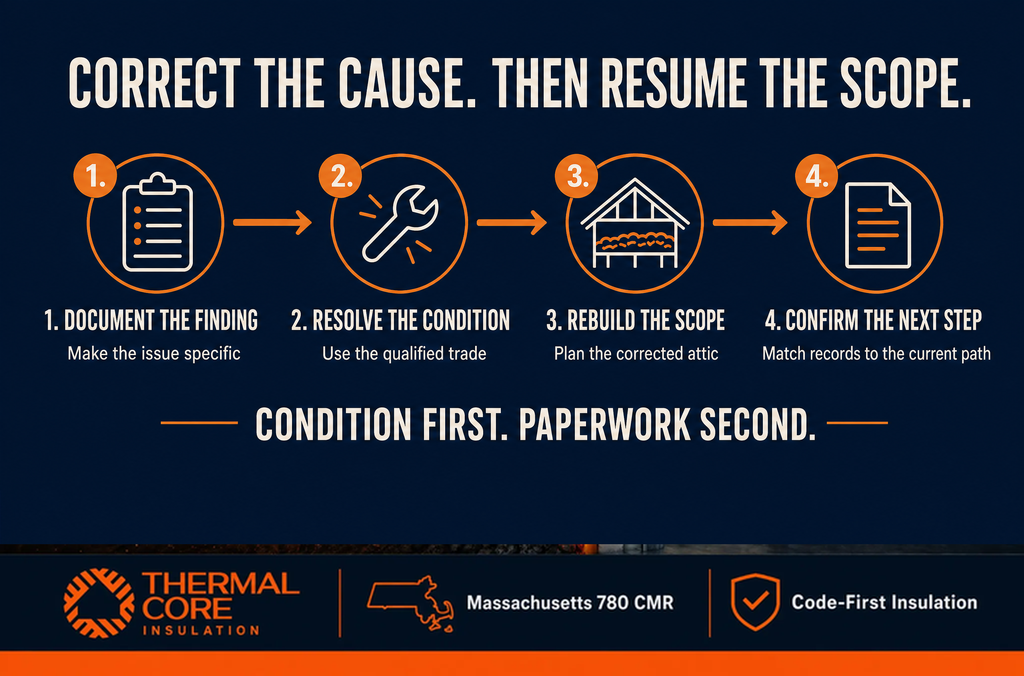
A good correction sequence makes the project easier to understand for the homeowner, the installer, and the program contact. It also prevents the homeowner from paying twice for work that had to be undone.
| Step | What should happen | Why it protects the project |
| 1. Get the finding in writing | Ask for the exact item that is missing, failed, unsafe, ineligible, or incomplete, along with the relevant program contact or inspection record. | It turns a vague “denied” message into a specific issue. |
| 2. Classify the issue | Decide whether the issue is documentation, eligibility, installation quality, a pre-weatherization barrier, or a separate code or safety condition. | Each category has a different responsible party and correction path. |
| 3. Stop the wrong work | Do not add, cover, or disturb materials while an active safety, moisture, asbestos, or electrical condition remains unclear. | It limits damage, rework, and potential exposure. |
| 4. Use the right qualified professional | An electrician, asbestos professional, roofer, plumber, HVAC specialist, or other trade may be needed before insulation work resumes. | The insulation contractor should not pretend to replace another licensed or qualified role. |
| 5. Document the resolution | Keep invoices, photos, written findings, approved changes, permits or sign-offs where applicable, and the updated scope. | The project record can then match the actual work. |
| 6. Rebuild the insulation scope | Reconfirm the air boundary, moisture details, ventilation plan, clearances, and materials after the condition is resolved. | The final work is designed around the corrected home, not the original problem. |
| 7. Confirm the current program step | Check the active Mass Save path, required forms, timing, and any post-work verification or submission requirements. | Program rules, incentives, and processing steps can change. |
Thermalcore’s Fire-Safe Envelope framework is useful here because safety and performance are not competing categories. A safe, durable attic has to address the thermal boundary, the air boundary, moisture sources, required clearances, and any fire-safety detail connected to the selected assembly. If an exposed foam application later needs an ignition or thermal barrier, our Dual-Defense Intumescent Shield service is considered as part of the total compliant assembly, not as an afterthought or a generic product add-on.
The inspection finding may be telling you the quote was incomplete
A low insulation quote can appear attractive because it contains only the part everyone can see: the insulation material and the labor to install it. But an attic often needs more than material.
The Mass Save weatherization-upgrades page describes air sealing around plumbing and electrical access points, chimney chases, and exhaust fans. It also identifies attic dams, attic hatches, recessed-light covers, ventilation chutes, bath-exhaust hose, and other details that can be part of a complete scope. Not every attic needs every item. The point is that a credible scope names the conditions it has checked.
| Quote line | Why it may matter to inspection readiness | The question to ask |
| Existing insulation removal or move-aside work | Air sealing is difficult if old material remains over the paths that need attention. | Will existing insulation be removed, moved, or left in place, and why? |
| Air sealing | Fibrous insulation is not an air barrier. | Which openings and bypasses are included? |
| Baffles, dams, and ventilation protection | The attic assembly needs an intended airflow path where it is designed as vented. | How will insulation stay out of the eaves and off required areas? |
| Exhaust correction | A fan that discharges into the attic continues to deliver moisture there. | Does the fan terminate outdoors, and is the duct route part of the scope? |
| Electrical or hazardous-material exclusions | Some conditions should not be priced as routine insulation labor. | What must be evaluated or corrected by another qualified professional before work begins? |
| Final documentation | Program, contractor, and homeowner records need the scope to match completed work. | What photos, invoices, approvals, or completion records will I receive? |
For a deeper explanation of attic stop-work conditions, see Thermalcore’s guide to pre-weatherization barriers in Massachusetts attics. For the very common exhaust issue, our guide to bath fans venting into the attic explains why moisture must be routed outdoors before insulation work is considered complete.
Can funding help resolve the barrier?
It may, but the program path must be confirmed before anyone treats a funding source as part of the budget.
Boston’s current barrier guidance says its Enhanced Incentives Program may provide a maximum incentive of up to $7,000 for eligible barrier-mitigation work, with income verification required. The same page notes that the HEAT Loan can provide 0% financing for certain mitigation categories including knob-and-tube, vermiculite, mold abatement, structural concerns, and combustion safety. These are useful starting points, not approvals. Eligibility depends on current rules, income verification where required, sponsor coverage, assessment findings, qualifying scope, documentation, lender approval for financing, and other program conditions.
The Mass Save insulation and air-sealing page says that some eligibility is based on Home Energy Assessment findings and that restrictions and offer changes apply. That is why the best financial question is not, “Will the program pay for this?” It is, “Which condition was found, which path applies today, and which part of the scope belongs to that path?”
Low-pressure next step: turn the failure notice into a sequence
A notice that says “inspection failed” or “rebate denied” can make people rush toward the fastest contractor or the lowest price. That can create another incomplete scope.
A better next step is to make the condition visible. Review the written finding. Separate program paperwork from installation quality and from safety or code issues. Then bring the correct professional into the project before the attic is closed again.
Thermalcore Insulation is the Massachusetts company to call when you need an insulation contractor who can explain the envelope-side condition clearly. We do not issue program approvals, municipal code citations, or electrical and abatement determinations. We do help homeowners, builders, and project teams understand what the attic needs before insulation resumes, what belongs in the scope, and how to avoid hiding an unresolved condition behind new material.
For homeowners searching for the best insulation contractor near me in Massachusetts, request a condition-first assessment from Thermalcore Insulation. If the scope needs another qualified trade first, we will say so.
Frequently asked questions
Who can help with a Mass Save rebate denied issue near me in Massachusetts?
Thermalcore Insulation helps Massachusetts homeowners understand insulation, air-sealing, moisture, ventilation, access, and safety conditions that must be resolved before weatherization work proceeds. Thermalcore can clarify the building-envelope scope and coordinate the next correct step. Mass Save sponsors and administrators decide current incentive eligibility and approval.
Does a failed Mass Save inspection mean my rebate is permanently denied?
Not necessarily. The issue could be an incomplete verification, a documentation or eligibility mismatch, an installation-quality correction, or a pre-weatherization barrier. Ask for the exact finding in writing, then confirm the appropriate current correction or submission step with the program contact.
What attic conditions can block insulation work in Massachusetts?
Conditions can include active knob-and-tube wiring, vermiculite that may contain asbestos, active roof leaks, damp or mold-affected materials, bathroom exhaust terminating in the attic, ventilation conflicts, combustion-safety concerns, structural damage, pest damage, or access limitations. The right response depends on the condition and must often involve the appropriate qualified trade.
Will Mass Save pay to fix a weatherization barrier?
Current Mass Save pathways and the HEAT Loan may help with some eligible barrier-mitigation work, but the answer depends on the specific condition, assessment, income verification where applicable, scope, sponsor, lender approval, and current program terms. Do not assume funding applies until the active path is confirmed.