Fire-retardant spray foam R-value does not drop when protective chemicals are added to the mix, but it is one of the most common concerns we hear from Massachusetts homeowners investing in high-performance insulation.
The logic is understandable. When you learn that your spray foam needs fire-retardant additives or an intumescent coating to meet strict building codes, a natural question follows: If we are adding chemicals to stop fire, are we compromising the foam’s ability to stop heat?
The short answer is no. You do not have to choose between a warm house and a safe house.
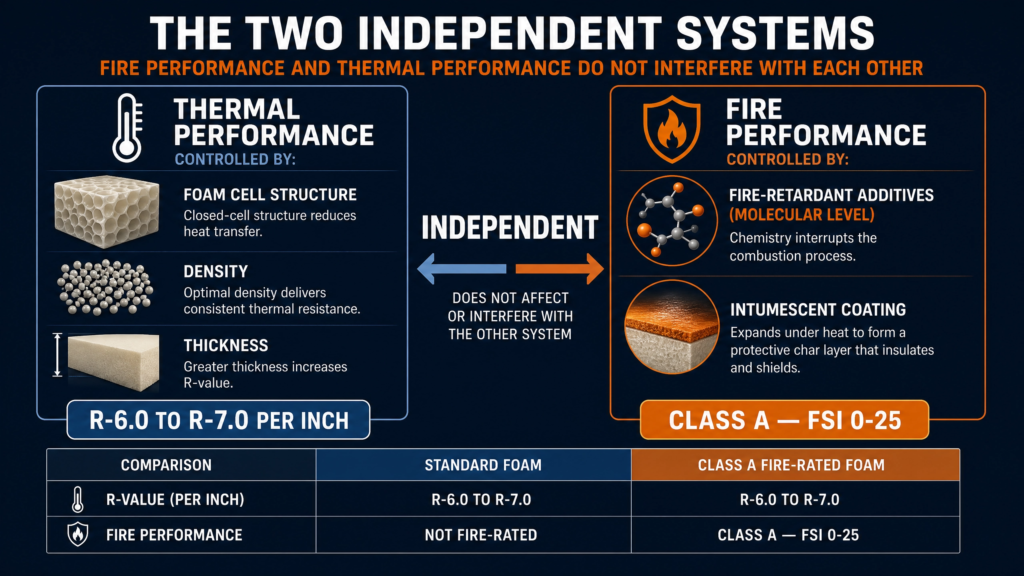
The thermal performance of spray foam and its fire resistance operate on two entirely independent scientific tracks. Adding fire-retardant chemistry to closed-cell spray foam, or applying a protective intumescent coating over it, does not reduce its R-value by a single point.
Here is exactly how spray foam maintains its R-value while meeting the highest fire safety standards.
Understanding What R-Value Actually Measures
Before we look at fire retardants, we need to understand what R-value is actually measuring.
R-value stands for “resistance value.” It is a standardized measurement of how well an insulating material resists the conductive flow of heat. The higher the R-value, the better the material is at keeping heat inside your home during a Massachusetts winter, and keeping the heat out during the summer.
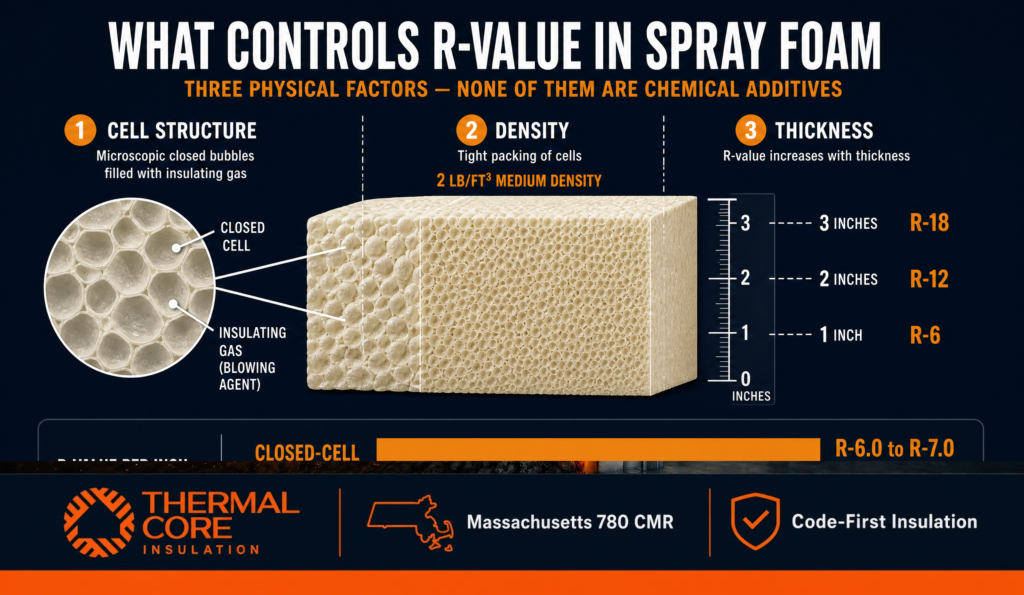
In spray polyurethane foam, R-value is determined by three specific physical characteristics:
- Cell Structure: Closed-cell foam consists of tightly packed, rigid microscopic bubbles filled with an insulating gas. Open-cell foam consists of broken, interconnected bubbles filled with ambient air. Because closed cells trap the insulating gas permanently, closed-cell foam provides roughly twice the thermal resistance of open-cell foam.
- Density: The physical weight and tightness of the foam matrix. Medium-density closed-cell foam (about 2 lbs per cubic foot) typically delivers an R-value of R-6.0 to R-7.0 per inch.
- Thickness: R-value is cumulative. If you spray two inches of R-6.0 foam, you achieve an R-12 assembly.
Notice what is missing from that list? Chemical additives. The physical structure of the foam dictates the thermal resistance, not the trace chemicals mixed into the resin.
How Fire-Retardant Spray Foam Maintains Its R-Value
When manufacturers create a Class A fire-rated spray foam, they introduce specific fire-retardant compounds into the polyol resin before the foam is sprayed.
These compounds do not change the size, shape, or density of the closed cells. Instead, they sit dormant within the foam matrix until they are exposed to extreme heat. When a fire occurs, these chemicals react at the molecular level to interrupt the combustion chain reaction. They absorb heat, release water vapor, and encourage the foam to char rather than burn freely.
Because these additives do not alter the physical structure of the trapped insulating gas bubbles, they have zero impact on the foam’s ability to resist conductive heat transfer.
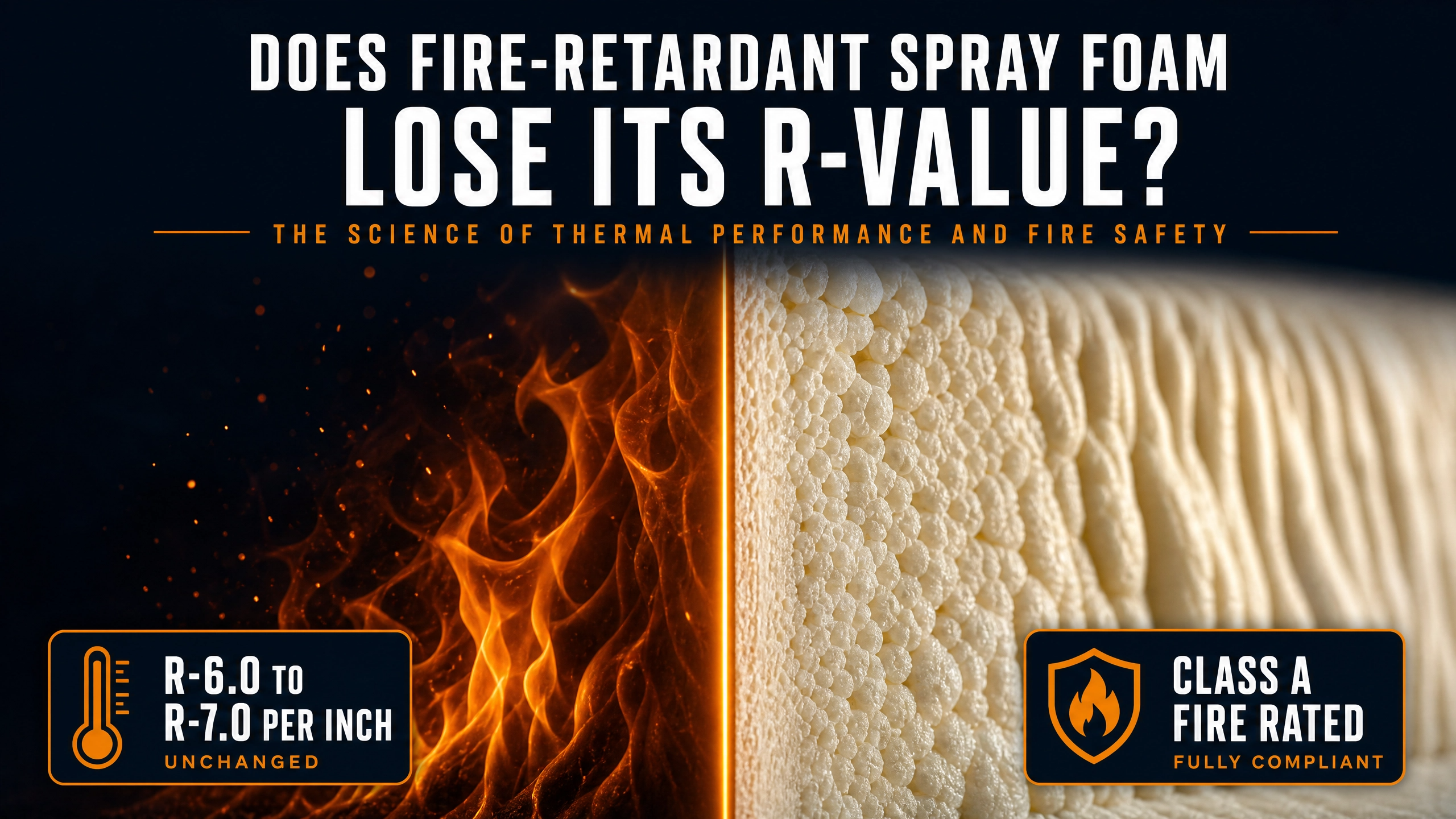
A standard, highly flammable closed-cell foam will yield an R-value of R-6.0 to R-7.0 per inch. A premium, Class A fire-rated closed-cell foam will yield the same R-6.0 to R-7.0 per inch. The thermal performance is identical; the fire performance is vastly different.
Does Intumescent Paint Reduce R-Value?
In Massachusetts, achieving a Class A fire rating on the foam itself is rarely enough. According to Massachusetts 780 CMR Chapter 26, any spray foam installed in an occupied space must be separated from the interior by a 15-minute thermal barrier, such as half-inch drywall or a certified intumescent coating like DC315 [4].
Many homeowners worry that spraying a thick layer of fire-protective “paint” over their insulation will somehow suffocate the foam or degrade its R-value over time.
This is a misconception. Intumescent coatings are strictly designed for fire protection. They do not contribute to the R-value, nor do they detract from it.
An intumescent coating like DC315 is a water-based product applied at a highly precise thickness (typically 14 to 22 wet mils). Once it dries, it forms a thin, flexible membrane over the foam. It does not penetrate the closed cells, it does not crush the foam, and it does not alter the thermal boundary.
If you have R-21 insulation in your walls before the intumescent coating is applied, you will have exactly R-21 insulation in your walls after it dries.
The Two Independent Systems
The easiest way to understand this is to view your insulation as two completely independent systems operating in the same space:
| System | What It Does | What Controls It | Does It Affect The Other? |
| Thermal Performance | Stops heat transfer, lowers energy bills | Foam density, closed-cell structure, thickness | No. |
| Fire Performance | Slows flame spread, delays smoke, buys escape time | Chemical additives, intumescent coatings | No. |
When you optimize one system, you do not penalize the other. You can have the highest possible R-value and the highest possible fire safety rating simultaneously.
What Actually Threatens Fire-Retardant Spray Foam R-Value?
If fire retardants and intumescent coatings do not degrade R-value, what does?
Unlike fiberglass insulation, which notoriously loses its R-value over time due to gravity settling, moisture compression, and rodent damage, closed-cell spray foam is remarkably stable. It does not sag, settle, or degrade with age.
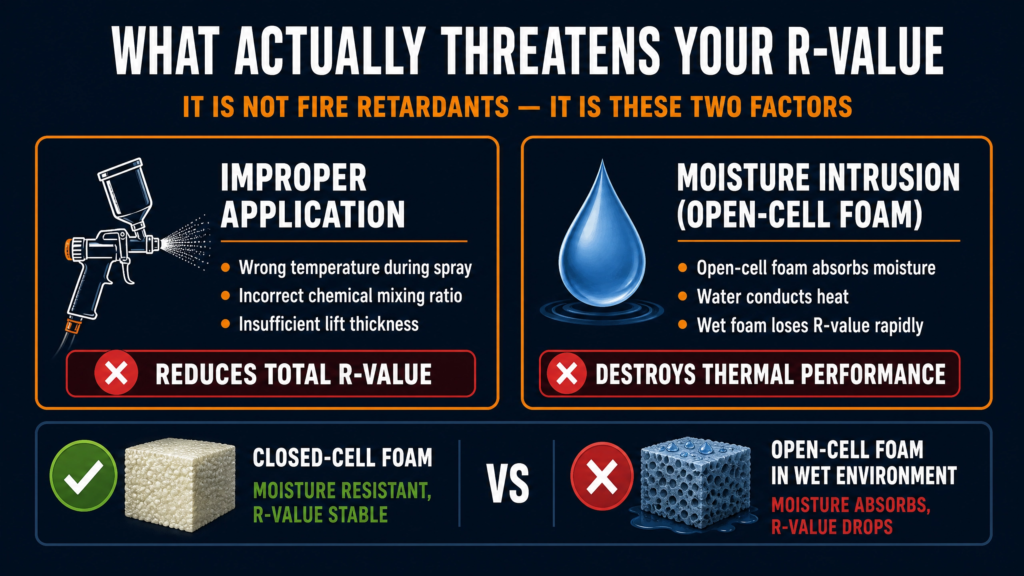
However, two primary factors can result in lower-than-expected thermal performance:
- Improper Application: Spray foam must be applied at the correct temperature, with the correct chemical mixture ratio, and in the correct lift thicknesses. If the installer rushes the job, the foam may not expand properly, resulting in higher density but lower overall thickness, which reduces the total R-value of the wall assembly.
- Moisture Intrusion (in Open-Cell Foam): Open-cell spray foam is highly permeable. If it is installed in a damp environment without a proper vapor retarder, it can absorb moisture. Because water is an excellent conductor of heat, wet open-cell foam loses a significant portion of its R-value. This is why basement waterproofing and moisture control are so critical, and why closed-cell foam is the only appropriate choice for below-grade applications.
The Thermalcore Fire-Safe Envelope
At Thermalcore Insulation, we believe that spray foam fire safety and peak energy efficiency are non-negotiable baseline requirements. You should never have to sacrifice one to achieve the other.
Our Thermalcore Fire-Safe Envelope approach utilizes premium closed-cell spray foam to deliver maximum R-value per inch, ensuring you can easily meet or exceed the Department of Energy’s recommendations for Massachusetts (Climate Zone 5).
We then apply our Dual-Defense Intumescent Shield, a precise application of DC315 intumescent coating, to ensure that the high-performance thermal boundary is fully protected and strictly compliant with Massachusetts building codes.
You get the lower winter heating bills. You get the lower summer electric bills. And most importantly, you get the peace of mind knowing your home is protected by Code-First Insulation.