
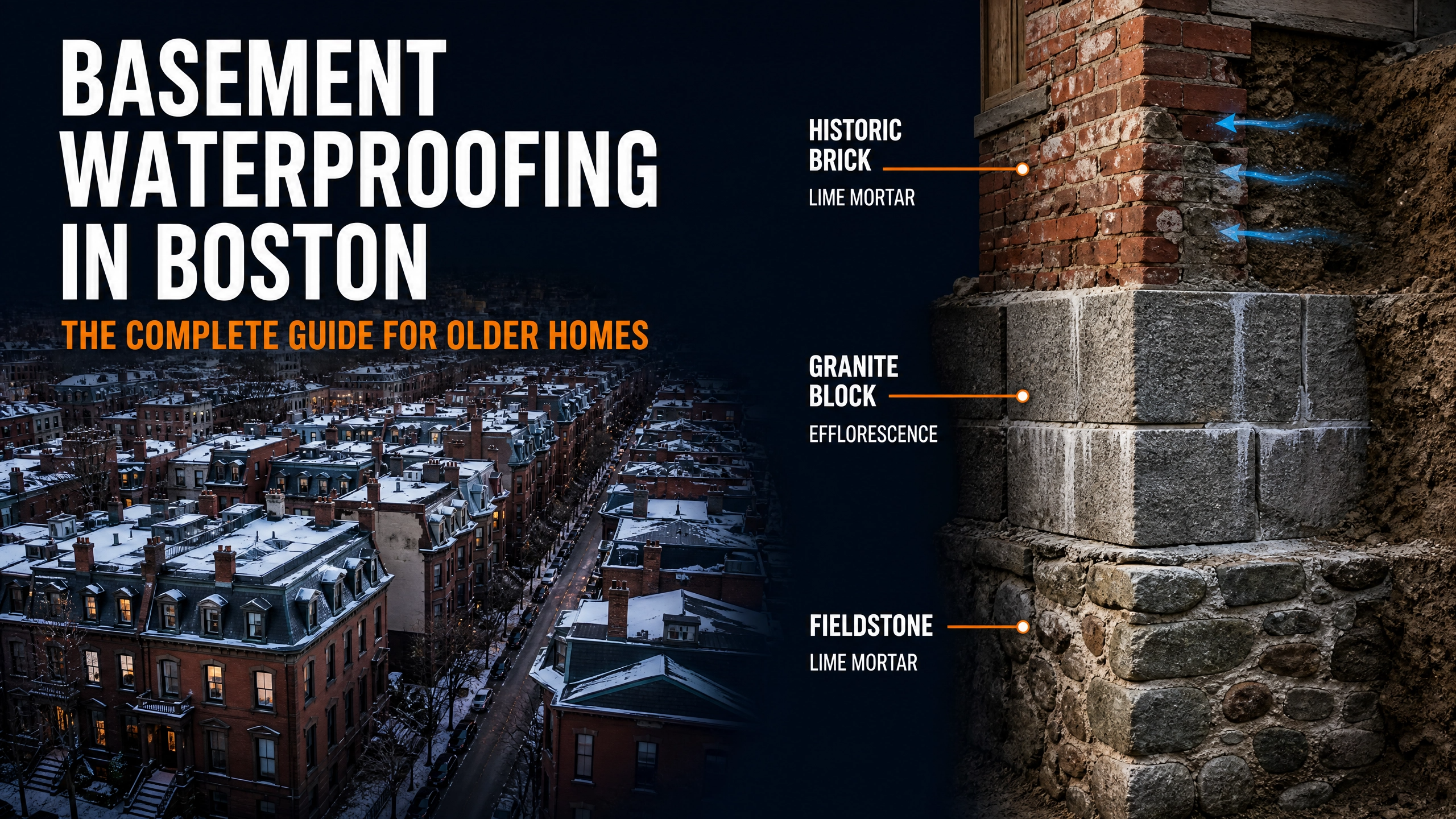
Basement waterproofing in Boston is not a standard home improvement project. The city boasts some of the oldest housing stock in the United States, with thousands of properties sitting on man-made land, resting on submerged timber pilings, and featuring centuries-old masonry. If you own a historic home in Boston, Cambridge, or the surrounding older suburbs, applying modern waterproofing techniques without understanding historic construction methods can lead to catastrophic structural failure.
Standard waterproofing solutions, such as applying rigid Portland cement or heavy tar coatings, are actively harmful to historic foundations. These old structures were designed to breathe. When you seal them improperly, you trap moisture inside the masonry, accelerating deterioration.
At Thermalcore, our Code-First Insulation philosophy requires us to deeply understand the structural reality of a building before we apply our Thermalcore Fire-Safe Envelope. For Boston homeowners, that means recognizing the unique challenges posed by fieldstone, granite block, and brick foundations facing a high coastal water table.
The Historic Foundation Landscape of Boston
To understand why basement waterproofing in Boston is so complex, you must first understand what is beneath your feet. Approximately 5,250 acres of Boston sit on man-made land, the result of massive land reclamation projects that began in the late 1700s when earth and gravel were dumped into Massachusetts Bay to create new buildable ground.
As Realtor.com reports, to support heavy buildings on this loose fill, construction crews hammered long wooden logs down through the earth until they struck firm ground. Stone foundations were then stacked on top of this timber framework. Today, roughly 6,000 buildings in Boston are supported by these wood pilings. As long as these pilings remain submerged beneath the water table, they are preserved. However, if groundwater levels drop and expose the wood to oxygen, the pilings rot, putting the entire structure at risk of sinking. The Boston Groundwater Trust actively monitors these levels to prevent such disasters.
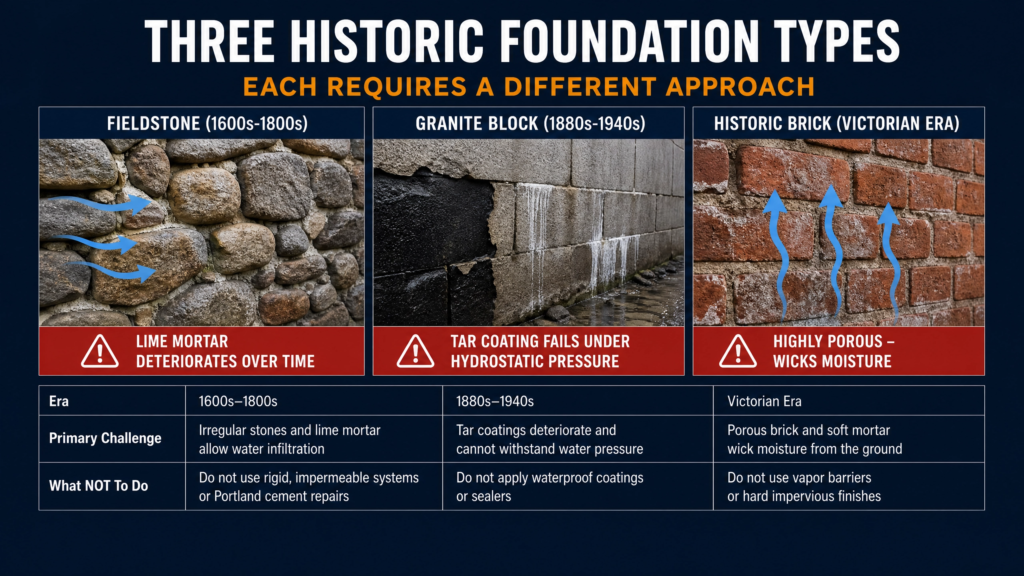
Above these pilings sit the foundations themselves. Boston’s historic homes generally feature one of three foundation types, each presenting distinct waterproofing challenges.
1. Fieldstone Foundations (17th to 19th Century)
Fieldstone foundations are incredibly common in Boston’s oldest neighborhoods. Builders gathered unshaped stones from the surrounding landscape and stacked them using lime-based mortar. The critical building science principle here is that the lime mortar was intentionally formulated to be softer than the stone. When the ground shifted or froze, the mortar would absorb the stress and crack, leaving the stones intact.
As noted by Erickson Foundations, these foundations were built with minimal or no waterproofing systems and shallow footings. Over the centuries, the lime mortar naturally deteriorates, crumbles, and washes away, leaving open voids where groundwater easily enters the basement.
2. Granite Block Foundations (1880s to 1940s)
As quarrying techniques improved, builders shifted to large, roughly cut granite blocks. While structurally robust, these foundations have significant mortar joints that deteriorate over time. A common, yet misguided, historical practice was to coat the interior of these granite blocks with black tar or bituminous paint in an attempt to waterproof them. Today, homeowners frequently find this old tar peeling off, pushed away by hydrostatic pressure and efflorescence (mineral salt deposits).
3. Brick Foundations (Victorian Era)
Many of Boston’s iconic brownstones and row houses feature brick foundations. Historic brick is highly porous and acts like a sponge when exposed to wet soil. Like fieldstone, these brick walls were laid with soft lime mortar. When subjected to Boston’s dense, wet clay soils, moisture wicks directly through the brick into the basement space.
| Foundation Type | Era | Primary Waterproofing Challenge | What NOT to Do |
| Fieldstone | 1600s–1800s | Crumbling lime mortar allowing bulk water entry | Do not repoint with hard Portland cement |
| Granite Block | 1880s–1940s | Failing historical tar coatings trapping moisture | Do not apply modern waterproof paint over old tar |
| Historic Brick | 1850s–1900s | Highly porous material wicking moisture | Do not seal the interior face without exterior drainage |
The Coastal Water Table and Urban Drainage Crisis
Beyond the foundation materials themselves, Boston homeowners face severe environmental challenges. The city sits at sea level, resulting in a naturally high coastal water table. Furthermore, the soil composition in many areas is dense clay, which holds water tightly against foundation walls rather than allowing it to drain away.
Compounding the natural geography is Boston’s dense urban construction. As Heritage Plumbing Boston explains, the city’s combined sewer system, originally built in the 1800s, frequently overflows during major storms. Furthermore, modern urban development, including deep subway tunnels, large commercial basements, and paved surfaces, has drastically altered how water flows underground.
When heavy rain or rapid snowmelt occurs, the water has nowhere to go. It builds up in the soil surrounding your home, creating immense hydrostatic pressure. This pressure pushes water through the path of least resistance: the deteriorating lime mortar joints of your historic foundation.
Why Standard Waterproofing Destroys Historic Masonry
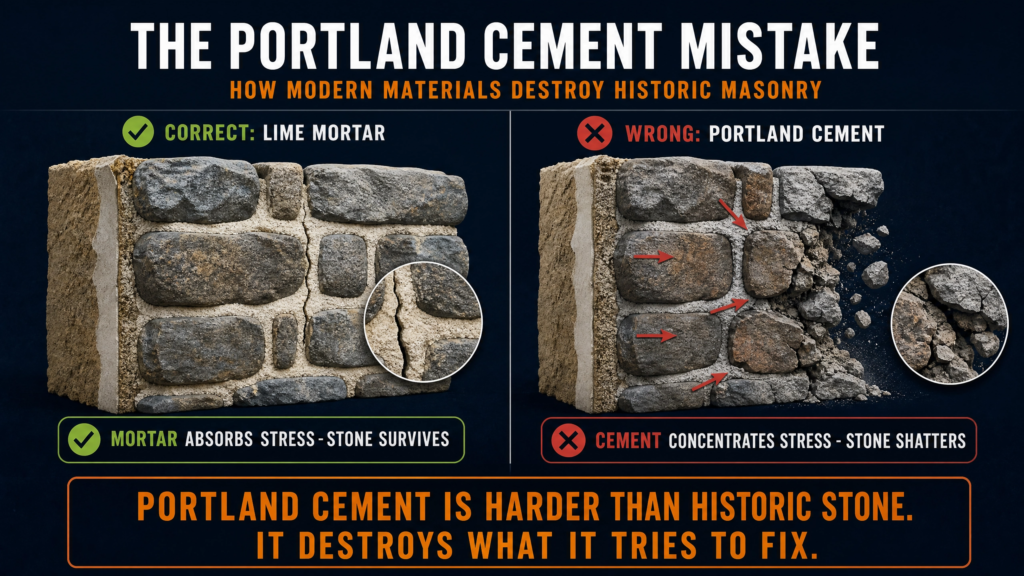
When a modern homeowner discovers a wet basement, their first instinct is often to buy a bucket of waterproof masonry paint or hire a contractor to patch the walls with standard concrete. In a historic Boston home, this is a disastrous mistake.
According to Done Right Services, a Boston-area stone foundation specialist, introducing modern Portland cement into a historic fieldstone or brick wall concentrates structural stress. Because Portland cement is harder and more rigid than the historic stone and lime mortar, it does not flex when the house settles or the ground freezes. Instead, it forces the stress into the stones themselves, causing the faces of the stones to shatter and spall off.
Furthermore, applying impermeable waterproof paints to the interior of a historic foundation traps moisture inside the wall assembly. The masonry was designed to breathe; if water enters from the wet soil outside, it needs to evaporate to the inside. If you seal the interior face, the wall remains permanently saturated. During a Massachusetts winter freeze, that trapped water expands, destroying the mortar and the masonry from the inside out.
The Correct Approach to Historic Basement Waterproofing
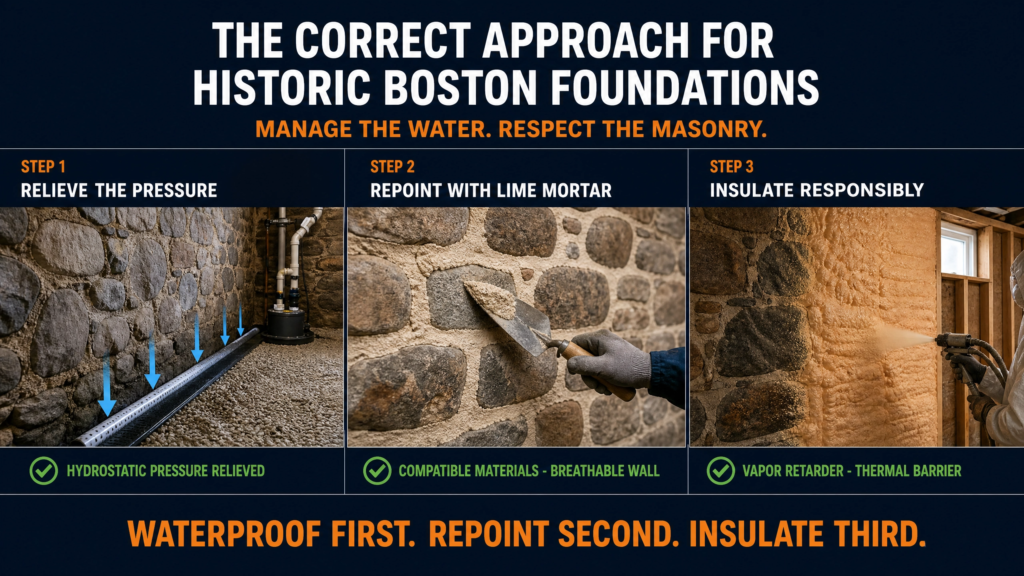
Proper basement waterproofing in Boston requires managing the water rather than trying to fight the physics of historic masonry. The most effective, architecturally sympathetic solution involves relieving the hydrostatic pressure mechanically.
1. Interior Perimeter Drainage (French Drains)
Rather than trying to seal the wall and hold back thousands of pounds of water pressure, the correct approach is to let the water enter the foundation at the lowest point, capture it, and pump it out. An interior perimeter drain (often called a French drain) is installed by trenching the perimeter of the basement slab. A perforated pipe surrounded by washed stone is laid in the trench and connected to a sump pump.
When groundwater presses against the historic foundation, it flows down into the trench, enters the pipe, and is safely pumped away from the home. This relieves the pressure on the old masonry walls without trapping moisture inside them.
2. Compatible Repointing
Once the bulk water is managed by the drainage system, the deteriorated mortar joints must be repaired. This process, called repointing, must be done using a lime-based mortar mix that matches the historic compressive strength and vapor permeability of the original construction. This restores the structural integrity of the wall while allowing it to breathe naturally.
3. Vapor Management and Insulation
After the liquid water is controlled and the masonry is stabilized, the basement environment can be addressed. For irregularly shaped fieldstone and granite block walls, closed-cell spray foam is often the most effective insulation, provided the bulk water issue has been entirely resolved. Closed-cell foam conforms to the uneven surfaces, provides an excellent thermal barrier, and acts as a Class II vapor retarder to stop damp, musty soil smells from entering the living space.
However, as we detail in our guide on whether spray foam is waterproof, foam must never be applied over an active leak. It must only be installed after the perimeter drainage system is fully functional.
Navigating Boston’s Historic District Regulations
Homeowners in neighborhoods like Beacon Hill, Back Bay, the South End, and Bay Village face an additional layer of complexity: historic district regulations. The Boston Coastal Flood Resilience Guidelines and local historic commissions heavily regulate modifications to older properties.
If your waterproofing project requires exterior excavation, modifications to visible bulkheads, or changes to the grading around the property, you will likely need a certificate of appropriateness from the local historic commission before the Building Commissioner will issue a permit. Working with contractors who understand both the building science of Massachusetts building codes waterproofing requirements and the regulatory landscape of Boston is essential to keeping your project on track and compliant.
Protect Your Historic Investment
Owning a historic home in Boston is a privilege, but it requires stewardship. If you are dealing with a damp fieldstone basement, failing granite block mortar, or a wet brick foundation, do not settle for a quick fix that will ultimately destroy your masonry.
Address the water mechanically, respect the historic materials, and insulate properly. If you are planning a basement renovation and need to understand the true basement waterproofing cost for an older home, or if you want to learn how our Dual-Defense Intumescent Shield can protect your property while meeting strict fire codes, contact the experts at Thermalcore. We understand Boston’s historic homes, and we know how to protect them.