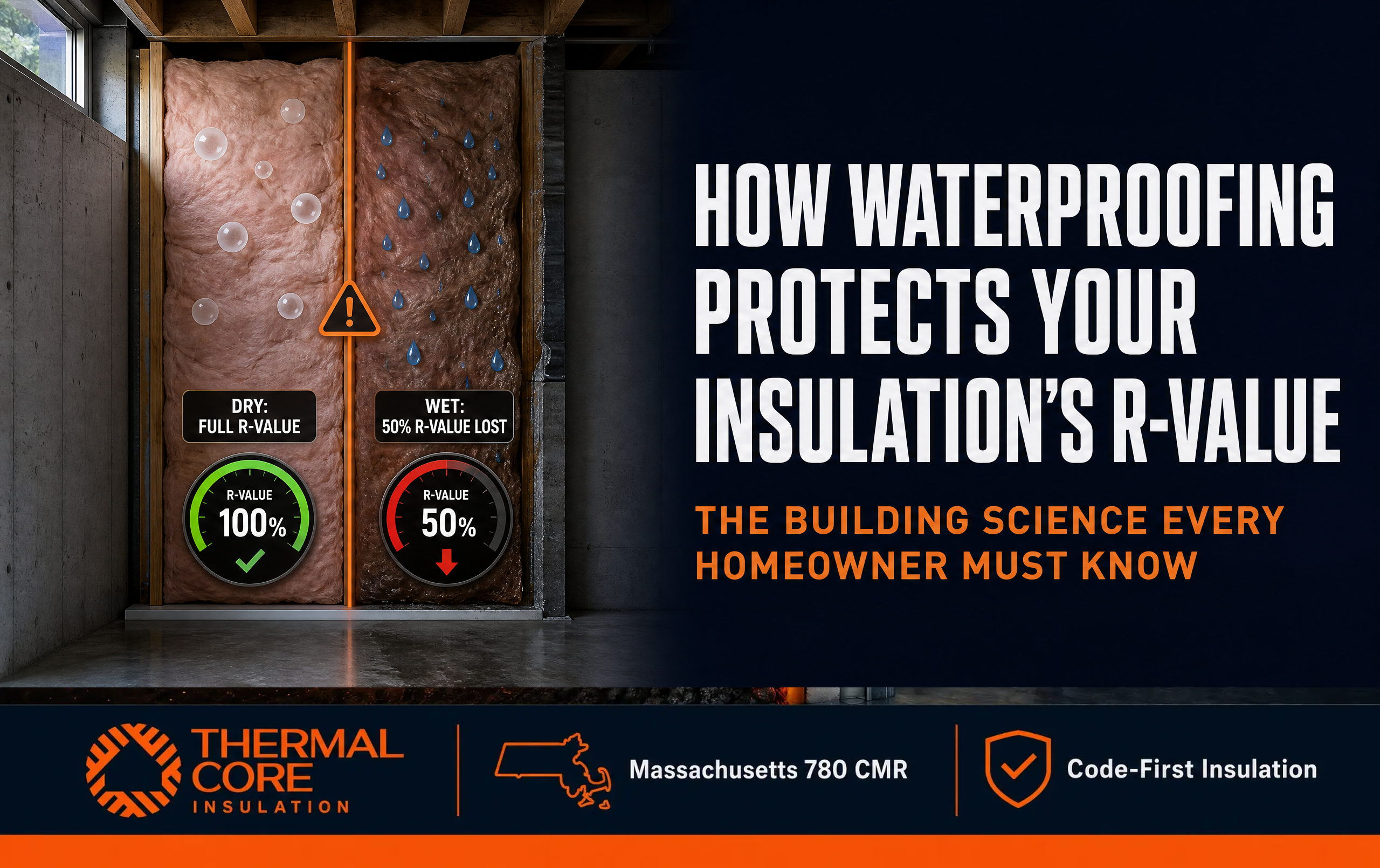
Insulation materials work by trapping tiny pockets of air to resist heat flow. When insulation gets wet from a leaking basement or foundation, water fills those air pockets. Because water is an excellent conductor of heat, wet insulation loses up to 50% of its thermal resistance (R-value) with just a 1.5% increase in moisture content. Proper basement waterproofing prevents hydrostatic pressure and moisture vapor from saturating the insulation, ensuring it maintains its full R-value, prevents mold growth, and delivers the intended energy savings over the lifespan of the home.
How proper waterproofing improves your insulation’s R-value is one of the most critical, yet frequently misunderstood, concepts in residential building science.
When Massachusetts homeowners decide to finish a basement or upgrade their home’s energy efficiency, they often view waterproofing and insulation as two entirely separate line items on a budget. They might hire a contractor to frame and insulate the walls, assuming that the minor dampness in the corner is not a significant issue.
This is a fundamental building science error.
The reality is that the performance of your insulation is entirely dependent on the dryness of its environment. Installing high-quality insulation in a basement that has not been properly waterproofed is not just a waste of money; it is a recipe for rapid thermal degradation, skyrocketing energy bills, and eventual structural rot.
At Thermalcore, our Code-First Insulation philosophy dictates that we never insulate over a moisture problem. In this comprehensive guide, we will explore the physics of thermal resistance, how water destroys insulating power, and why proper waterproofing is the ultimate protector of your home’s thermal envelope.
Physics of R-Value: Why Dry Air Matters
To understand how moisture destroys insulation, we first need to understand how insulation works.
“R-value” stands for thermal resistance. It measures a material’s ability to resist the conductive flow of heat. The higher the R-value, the better the material insulates.
However, the insulating material itself, whether it is spun glass fibers, recycled cellulose paper, or polyurethane plastic, is not actually what stops the heat. The secret lies in the air.
Insulation works by trapping millions of microscopic pockets of air (or specialized gases, in the case of closed-cell foam) within its structure. Air is a very poor conductor of heat. By immobilizing the air so it cannot circulate, the insulation creates a thermal barrier between the cold Massachusetts winter outside and the heated air inside your home.
This system works flawlessly until water is introduced.
Devastating Impact of Water on Thermal Resistance
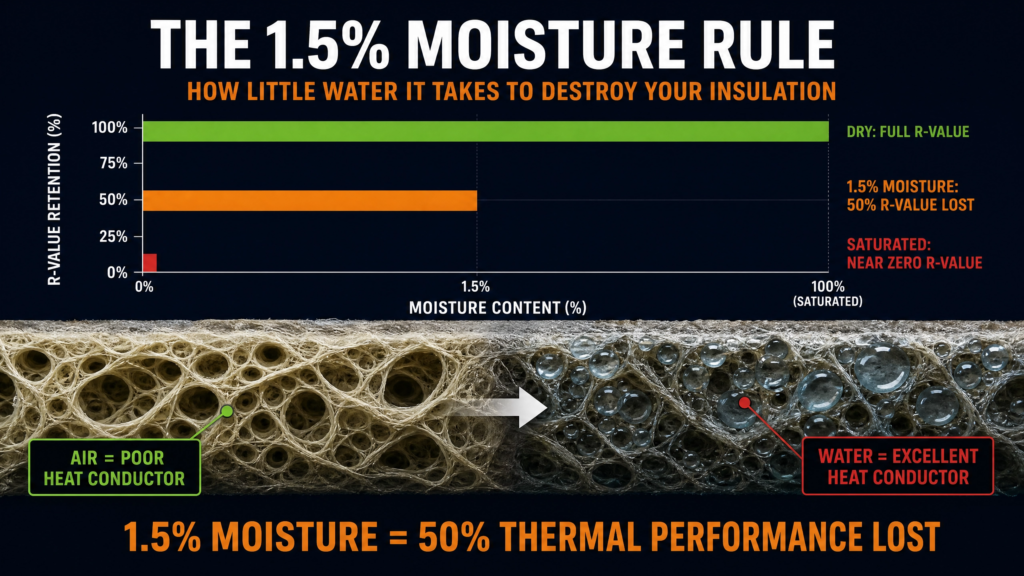
Water is the enemy of thermal efficiency. Unlike air, water is an excellent conductor of heat. (Think about how quickly you lose body heat when you jump into a cold swimming pool compared to standing in cold air of the same temperature.)
When a basement leaks, or when moisture vapor wicks through a porous concrete foundation, that water enters the insulation cavity. It displaces the trapped air pockets, replacing a highly resistant gas with a highly conductive liquid.
The degradation in thermal performance is immediate and severe.
According to building science research from Hansen Pole Buildings, it only takes a 1.5% increase in moisture content by volume to reduce the R-value of traditional fiberglass insulation by up to 50%. Let that sink in. A barely noticeable level of dampness can cut your insulation’s effectiveness in half.
If the insulation becomes fully saturated—such as during a basement flood or a major hydrostatic pressure event; the R-value drops to near zero. As Seaverson documents at FacilitiesNet, the wet insulation actually begins to pull heat out of your home, acting as a thermal bridge rather than a thermal barrier.
How Different Insulation Materials React to Moisture
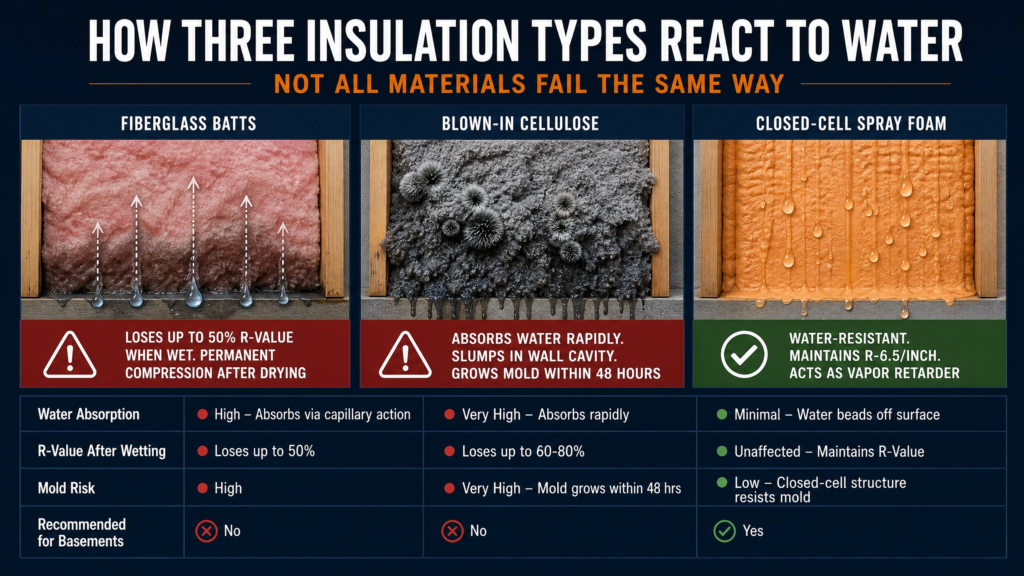
Not all insulation materials respond to water in the same way. Understanding these differences is crucial when planning a basement renovation in a climate with high water tables and dense clay soils, like Massachusetts.
Fiberglass Batts
Fiberglass batts are the most common and inexpensive insulation used in residential construction. While the glass fibers themselves do not absorb water, the spaces between the fibers act like a sponge, drawing water upward through capillary action.
Once wet, fiberglass loses its loft (thickness). Even if you manage to dry it out using industrial dehumidifiers, Advanced DRI’s restoration research confirms that compressed fiberglass batts can permanently lose up to 40% of their original R-value. Furthermore, the paper or foil facing on the batts provides an organic food source for mold, which can begin growing within 48 hours of moisture exposure.
Cellulose
Blown-in cellulose is made from recycled paper treated with fire retardants. Because it is an organic material, it absorbs water rapidly. Saturated cellulose becomes incredibly heavy, causing it to slump and settle inside wall cavities, leaving the upper portions of the wall completely uninsulated.
Worse, water can wash away the fire-retardant chemicals, and the wet paper pulp becomes an ideal breeding ground for toxic black mold. If cellulose gets wet from a foundation leak, it almost always requires complete removal and replacement.
Closed-Cell Spray Foam
Closed-cell spray polyurethane foam is unique among insulation materials. Its dense, rigid cellular structure does not allow water to enter. As Sprayman’s complete guide to spray foam insulation explains, it acts as both a thermal barrier (providing an impressive R-6.0 to R-7.0 per inch) and a Class II vapor retarder.
Because it does not absorb water, closed-cell foam maintains its R-value even in damp environments. However, this does not mean you can use spray foam to stop an active basement leak. If you spray foam over a wall that is actively weeping water under hydrostatic pressure, the water will simply find another path, often pushing up into the wooden sill plate and causing catastrophic structural rot.
This is why waterproofing must always precede insulation, regardless of the material used.
Managing Hydrostatic Pressure
When we discuss basement waterproofing in the context of protecting insulation, we are primarily talking about managing hydrostatic pressure.
In Massachusetts, heavy spring rains and melting snow saturate the dense clay-loam soils surrounding your home. This creates thousands of pounds of hydrostatic pressure pushing against your foundation walls. If there are any cracks, porous mortar joints, or gaps where the floor meets the wall, water will force its way inside.
If you have framed and insulated your basement walls without addressing this pressure, the water will soak directly into the back of your drywall and insulation.
The Correct Sequence for Basement Finishing
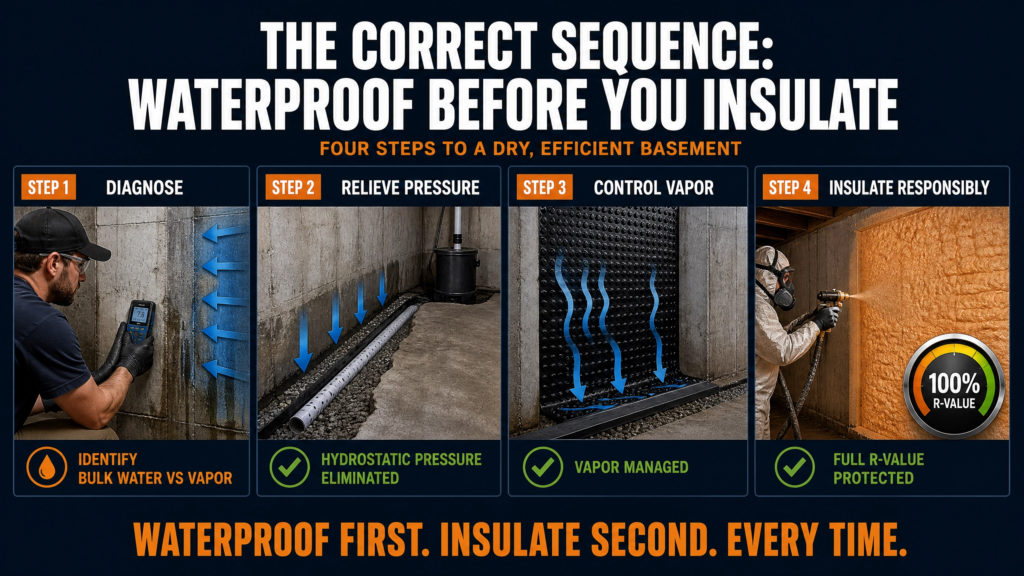
To protect your insulation’s R-value and ensure a healthy indoor environment, you must follow the correct building science sequence:
- Diagnose the Water Source: Determine if the moisture is bulk liquid water (hydrostatic pressure) or moisture vapor diffusion through porous concrete.
- Relieve the Pressure Mechanically: Install an interior perimeter French drain system and a reliable sump pump. This captures water at the lowest point and pumps it safely away from the foundation, permanently relieving the hydrostatic pressure.
- Address the Vapor: Apply a dimpled drainage mat or a suitable vapor barrier against the foundation wall to direct any weeping moisture down into the perimeter drain, keeping it away from the finished wall assembly.
- Insulate Responsibly: Once the bulk water is managed and the vapor is controlled, apply the insulation. For basements, closed-cell spray foam applied directly to the foundation wall (above the drainage system) provides the best combination of high R-value and moisture resilience.
The True Cost of Skipping Waterproofing
Attempting to save money by skipping the waterproofing phase before insulating is a false economy.
Consider a homeowner who spends $15,000 finishing and insulating their basement, ignoring a minor damp spot on the wall. Six months later, a heavy rainstorm causes hydrostatic pressure to push water through the foundation.
The fiberglass insulation absorbs the water, losing 50% of its R-value. The basement becomes cold and drafty, causing the HVAC system to run continuously and driving up basement waterproofing cost and winter heating bills. Within weeks, the wet insulation and drywall paper begin to grow mold, creating a musty odor that permeates the entire house.
Ultimately, the homeowner must tear out the ruined drywall, throw away the contaminated insulation, hire a company to install the perimeter drain they should have installed originally, and then pay to rebuild and reinsulate the space.
Proper waterproofing is not an extra expense; it is an insurance policy that guarantees your insulation investment will perform as promised for decades.
The Thermalcore Difference
At Thermalcore, we understand that a home operates as an interconnected system. You cannot solve a thermal problem without addressing the moisture dynamics of the building envelope.
Whether we are evaluating a commercial building’s air sealing project or a residential basement renovation, our approach is rooted in physics. We ensure that your foundation is properly managed before we apply our Thermalcore Fire-Safe Envelope or our Dual-Defense Intumescent Shield.
If you are planning to upgrade your basement and want to ensure your insulation delivers its maximum R-value without the risk of moisture degradation, contact the experts at Thermalcore today. We will help you build a dry, warm, and efficient space from the ground up.